Archive

economy


My cousin  once asked me what I thought about deciding on who to vote for for President might be best done when evaluating how well your 401K or investments did.  Kind of an amusing thought.  In that vein the decisions might be very different than they were.  Clearly your 401k did with with Clinton.  The economy was flat for George W. Bush, and the end of his term was the Great Recession.  Reagan’s first term was flat.  We all know about George H.W. Bush.  Interesting thoughts.  Not so good.  So what about the last 8 years?   But is raises a more interesting issue.  So don’t get me wrong, this blog is not intended to lobby for any candidate (and Obama can’t run), but it is interesting to look at the last 8 years.  They have been difficult.   The economy responded slowly.  Wages did not rebound quickly.  But in comparison to 2008 are we better off?

The question has relevance for utilities because if our customers are better off, that gives us more latitude to do the things we need – build reserves (so we have funds for the next recession), repair/replace infrastructure (because unlike fine wine, it is not improving with age), improve technology (the 1990s are long gone), etc., all things that politicians have suppressed to comport with the challenges faced by constituents who have been un- or under-employed since 2008.

Economist Paul Krugman makes an interesting case in a recent op-ed in the New York times:  (http://krugman.blogs.nytimes.com/2016/01/13/yes-he-did/?module=BlogPost-Title&version=Blog%20Main&contentCollection=Opinion&action=Click&pgtype=Blogs&region=Body).  Basically he summarizes the figure below which shows that unemployment is back to pre-2008 levels, and income is back to that point.  Some income increase would have been good, but this basically tracks with the Bush and Reagan years for income growth – flat.  So the question now is in comparison to 2008 are we worse off that we were?  And if not, can we convince leaders to move forward to meet our needs?  Can we start funding some of the infrastructure backlog?  Can we modernize?  Can we create “smarter networks?”  Can we adjust incomes to prevent more losses of good employees?  Can we improve/update equipment?  All issues we should contemplate in the coming budget.
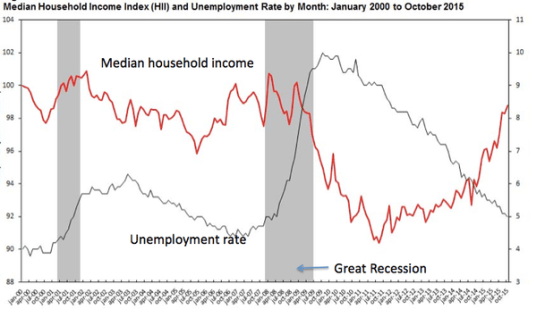
Krugman Income percent


So everyone is doing their Top 10 questions for 2016 (although with David Letterman off the air, perhaps less so), I figured why not?  So it the vein of looking forward to 2016, let’s ponder these issues that could affect utilities and local governments:

  1. How wild, or weird will the Presidential election get? And part b, what will that do to America’s status in the world?  Thinking it won’t help us.  Probably won’t help local governments either.
  2. Will the economic recovery keep chugging along? Last time we had an election the economy tanked.  Thinking a major change in direction might create economic uncertainty.  Uncertainty (or panic) would trickle down.  Status quo, probably keeps things moving along.  .
  3. What will the “big” issue be in the election cycle and who will it trickle down to local governments and utilities? In 2008 it was the lack of health care for millions of Americans and the need for a solution. Right after the election we got the Great Recession so most people forgot about the health care crisis until the Affordable are Act was signed into law.  And then ISIS arose from a broken Iraq and Arab summer.  None helped local governments.
  4. What are we going to hear about the 20 richest Americans having more assets than the bottom 150 million residents? 20 vs 150,000,000.  And while we are at it, the top 0.1% have more assets than the bottom 90%, the biggest disparity since the 1920s.  While we will decide that that while hard work should be rewarded, the disparity is in part helped by tax laws, tax shelters, lobbying of politicians, etc. as Warren Buffett points out, indicate a discussion about tax laws will be heard.  Part b – if we do adjust the tax laws, how will we measure how much this helps the bottom 99.9%?
  5. What will be the new technology that changes the way we live? Computers will get faster and smaller.  Phones are getting larger.  Great, but what is the next “Facebook”?  By the way the insurance folks are wondering how the self driving car will affect the insurance industry.  So reportedly is Warren Buffett.  Watch Mr. Buffett’s moves.
  6. Along a similar vein, will the insurance industry start rethinking their current risk policies to look at longer term as opposed to annual risk? If so what does that mean for areas where sea levels are rising?  The North Carolina coast, where sea level rise acceleration is not permitted as a discussion item could get tricky.
  7. Will unemployment (now 5%) continue to fall with associated increases in wages? Will that help our constituents/customers?  Will people use more water as a result?
  8. Where is the next drought? Or flood?  And will the extremes keep on coming?  Already we have record flooding in the Mississippi River in December – not March/April?  Expect February to be a cold, snowy month. IT is upper 80s here.  Snowing in the Colorado Rockies.
  9. Will we continue to break down the silos between water “types” for a more holistic view of water resources? We have heard a bunch on potable reuse systems.  More to come there, especially with sensors and regulations.  But in the same vein, will we develop a better understanding of the link between ecosystems and good water supplies, and encourage lawmakers to protect the wild areas that will keep drinking water cleaner?
  10. Will we get water, sewer, storm water, etc. customers to better understand the true value of water, and therefore get their elected official on board with funding infrastructure neglect? And will that come as a result of better education, a better economy, breaking down those silos, drought (or floods), more extreme event, more breaks or something else?

Happy New Year everyone.  Best to all my friends and followers in 2016!


My apologies for being offline for a month. It has been very busy.  I got back from Utah, and it was tests, reports, etc.  Then Thanksgiving – we went to Disney for my stepdaughter.  Then the Florida Section AWWA conference, then student final design presentations with President Kelly present for some of it, then finals, then a trip to the west coast, then posting grades, then it’s now.  Crazy.  And my kitchen is being worked on -see the photos of what is left of it.   Not much, and Christmas is how far away.  Yikes.  At least the wrapping and chopping are 99% done!

In the meantime a lot has happened.  Congress cut SRF funding, but passed the transportation bill.  They passed WITAF, but provided minimal funding.  The debates roll on.  A recent South Park episode is all about illegal immigrants from Canada escaping, then there is a wall built, by the Canadian so t hose who left don’t come back, and then we find out who the new president in Canada looks like… well you just have to watch and be scared.  Very scared.  If you do not follow South Park, well you are just missing it.

Russia had a plane brought down by an apparent ISIS bomb.  The Egyptians deny it.  Too much arguing about was it or wasn’t it to garner much of an outcry.  Best wishes to the friends and families of the victims.  Then France had their 911 event sponsored by ISIS, and most of the world is sending their best wishes to the victims, the victims families and the French population.  In such events, most of the world comes together.  Everybody was French for a day.  Best wishes to the friends and families of the victims. Then the couple in California.  Best wishes to the friends and families of the victims. But it raises a very disconcerting question, and one fraught with far too many xenophobic concerns as ISIS and their allies like the Taliban, Boko Hiram and others continue to reign terror and violence on the rest of the world.  The xenophobic response will be – whom do we trust in the Muslim world?  If you don’t believe in blowback, listen to the debates.  One commentator points out the xenophobia may actually help ISIS (Donald are you listening?).  LOL – of course not.  But utilities should expect another round of security costs and analyses in the future.

The Florida Section conference was great.  The venue was great (Renaissance at Sea World).  The program garnered a lot of buzz and comments.  Who knew at a water conference that potable reuse would be the big topic?  I also won two awards at the Florida Section conference – a best paper award and the Alan B. Roberts award for Outstanding Service by a member.  Wow!!  I am humbled.  A lot of great utility folks were present at the FSAWW conference.  It is a great event for the water industry (that includes wastewater, storm water etc.).  The technical program is designed to be good, timely and useful to those that attend.  While all utilities struggle with costs, please make time to send your folks if possible.  The training cost is reasonable for what you get and who you meet.

My students did well on tests and presentations.  President Kelly was impressed with their presentations and projects at the Dean’s Design Showcase.  We have never had the Dean at student presentations, let alone the President of the University.  My sincere appreciation to him, his staff and those that made it happen.  The students were pleased and impressed.  And they are getting jobs easily.  You can tell people are building and working on infrastructure as most of the graduates get jobs right away, if they don’t have them already.

Grading and the west coast went well.  The Fort Myers News Press-Sunday Headline was “Where has all the water gone” – a discussion on how groundwater is depleting across the country including south Florida which gets 60 inches of rain.  But the article points out what that climate, rainfall, recharge and other factors have been altered in south Florida as a result of development.  We really do make an impact and it is affecting utilities today. This follows another article last week on depleted groundwater around the world.  I have lots of photos in my travels from the air – groundwater use is highest where surface waters are limited – i.e. dry areas.  Except in dry areas, the groundwater does not recharge.  I had a student do a project for his master’s degree that estimated that groundwater depletion is a measureable percentage of sea level rise.  More to come on that.

Next the kitchen.  I will post photos in another blog.

As I said, a busy month.


I love South Park.  Parody on the ridiculous stuff that goes on every day.  Most of the time the writers hit the target.  And I laugh.  There is an episode of South Park where the residents cry out about immigrants that “took ‘r jobs!!”  And then they go on to “rabble rabble rabble” because they don’t know what else to do.  And of course in the Republican debates, the illegal immigrant issue has arisen.  But how big a problem is this really?  And are these jobs Americans really want to do, or is the illegal immigrant market basically taken the bottom rung because today’s workers don’t want those jobs.

So first, what are those jobs? Steven A. Camarota and Karen Zeigler at the Center for Immigration Studies analyzed the census data from 2010 and found there to be 472 “professions” that could be categorized. Of the 472 civilian occupations, only six would be categorized as being “majority immigrant (legal and illegal).” The six are:

  • Plasterers,
  • Personal appearance workers
  • Sewing machine operators
  • Garment manufacturing, and
  • Agricultural occupations (2)

They note that these six occupations account for 1 percent of the total U.S. workforce and that even in those fields, native-born Americans still comprise 46 percent of workers even in these occupations.  In high-immigrant occupations, 59 percent of the natives have no education beyond high school, compared to 31 percent of the rest of the labor force.

Many jobs often thought to be overwhelmingly immigrant (legal and illegal) are in fact majority native-born:

  • Maids and housekeepers: 51 percent native-born
  • Taxi drivers and chauffeurs: 58 percent native-born
  • Butchers and meat processors: 63 percent native-born
  • Grounds maintenance workers: 64 percent native-born
  • Construction laborers: 66 percent native-born
  • Porters, bellhops, and concierges: 72 percent native-born
  • Janitors: 73 percent native-born

There are 67 occupations in which 25 percent or more of workers are immigrants (legal and illegal). In these high-immigrant occupations, there are still 16.5 million natives — accounting for one out of eight natives in the labor force.

Illegal immigrants work mostly in construction, cleaning, maintenance, food service, garment manufacturing, and agricultural occupations. They found no occupations in the United States in which a majority of workers are illegal immigrants. Even in the overwhelming majority of workers even in these areas are native-born or legal immigrants.

So then the question really is this – are they taking jobs that Americans want to do?  Historically the answer is no.  Both the agricultural and garment industries have struggled to get native workers.  The work is long, hard, and conditions difficult.  If you have education, you can find a better, higher paying job.  No American kids grows up wanting to pick beans or sew for a living.  Immigrants have always been the source of labor.  Plasterers are difficult to find when construction jobs are plentiful so that is the one exception to low paying jobs that no one wants to do.  Construction has always looked for labor help and certain specialties. And there are not that many of these jobs in comparison to the others on the list.  So for those 5 jobs the answer is no.  Same goes for most of the next seven (Maids, housekeepers, janitors, bellmen, etc.).  I should note that my great grandmother (an immigrant) cleaned houses, but made sure none of her kids would by making them get an education.  Ditto for my uncle who was a janitor.  Neither was well educated, but their kids were.  And there kids were far better  off economically.

So political rhetoric aside, the answer seems to be that immigrants do in fat take those jobs that we do not want to do that require less education.  These jobs mostly pay minimum wage. The study notes that 59 percent of the natives have no education beyond high school, compared to 31 percent of the rest of the labor force.   Get educated – get a job that pays better than minimum wage.  Seems like I have heard that rhetoric as well.


Bernie Sanders wants a $15 minimum wage law.  Voters in Seattle have agreed.  Starbucks and a variety of others companies have acted.  The change is great for the many low wage earners who struggle to get by working multiple part-time, minimum wage jobs.  Low wages are a drain on the talents of society who struggle with juggling food, medicine, education, shelter and other costs while supporting families. Since 1980, the actual wage rates, when adjusted for inflation, have fallen form many people, shrinking the middle class and expanding the number of economically challenged.  Economic challenges lead directly to social, and health vulnerability.  If you want to cut medical costs, increase the standard of living for people at the lower income levels. You want to sell more stuff, create more disposable income for people to spend across all income levels, not just at the top.   Ditto if you want to have less debt, and more savings.  That is what the intent was in the 1960s under the reforms of the “Great Society.”   Progress started, then 1980 showed up and many reforms were reversed before the trends could really show.  Not that those 1960s ideas were perfect, but clearly the last 30 years has shown the reversal is not unless you are among the 0.1%.

As an example, back in the day, fast food restaurants were the purview of students, not twenty and thirty something adults and grandma.  These were low income jobs, and have remained so.  The intent was not to make these jobs “permanent.”  But they have become jobs for adults.  Back in the day there were more workers, more customer service and more food prep.  Over the years, though, ingredients started to arrive packaged and pre-mixed, so that the only labor was to heat it up, bag it and hand it out the window.  Fast food is now packaged at factories in mass production which requires less labor. Less jobs, same low pay. Gas station attendants were also commonly kids, who washed your windows, checked your oil and pumped your gas (no, really they did!).  They got paid minimum wage as well. Not anymore – that was too costly and got cut.  The list goes on.  Customer service is apparently only important if you are trying  to attract customers.

So now more adults are in these industries, and many must work multiple jobs to make ends meet.  So a higher wage is welcome news.  Or is it?  Let’s see what happens when the wage doubles up without increased growth.  Well, the gas station attendants that used to pump gas were replaced with computers.  You even have gas stations that are completely automated – no people!.  You have computers putting in orders now at restaurants.  About 30 percent of the restaurant industry’s costs come from salaries, so could burger-flipping robots and computer ordering system like some restaurants already employ, become more cost-competitive and may displace more workers if the current federal minimum wage of $7.25 an hour is doubled.  At risk are 2.4 million wait staffers, 3 million cooks and food preparers and 3.3 million cashiers.

So where will we see this?  Electronic menus can be constantly updated so that items that are out of stock can be removed. Connecting the point of the sale to the oven’s operating system allows precise amounts of food to be cooked, which helps cut down on costs. Other inventions save energy, reduce maintenance and better dispose of grease. On the digital side, restaurants are working on apps that include reward systems and location tracking that prompt customers to eat with them more frequently. Olive Garden said earlier this year that it would roll out the Ziosk system at all its restaurants, which means that all a server has to do is bring out the food.  The employees would be reduced to fixing things when they break.  That could be a lot less employment.

Corporations have a priority to make money, which can mean cutting costs and becoming more efficient.  Bottom line profits are king, not people. See GM, VW and others who ignored defects in their products, preferring to pay the costs of the lawsuits as opposed to fixing the defect.   So the $15 minimum wage will be cheered by those making less, but jeered by low margin corporations that will be forced to raise prices and become more efficient.  Too often those changes do not include paying people – at least in this country.  The winner will be……. to soon to tell, but I won’t bet against the corporations.


Your grandma always told you to save money for a rainy day.  She wasn’t really talking about rainy days, but days when you had less or no income.  The press talks about the huge percentage of Americans that have little or no savings, and how compared to other countries, we are at a disadvantage during economic times.  A huge problem is that the same argument can be translated to governments, which must provide services, and often more services during economic downturns.  But if they have no savings, how are they to accomplish this?  They do not want to raise taxes and fees in down situations, so won’t the loss of services just make things worse?

A recent PEW reports suggests that states “had about half the reserves necessary to address budget gaps during the first year of the Great Recession.  The 50 states had about $60 billion set aside in the summer of 2008, but in fiscal 2009, budget gaps across the country totaled $117 billion, about twice what states had in reserve. The budget gaps continued to grow in 2010 and many states struggled with shortfalls for years afterward.  Bad news, but the news really does not improve.  They report that 37 states have legal caps that prevent them from saving enough to weather recessions or even enough to substantially offset revenue losses, and most of those are based on some percentage of the prior year’s revenues.  Why?  Short-term views?  Most governments figure on keeping enough cash on hand to pay bills during tax seasons. That accounts for 60-90 days of funds.  Far too little for dealing with economic impacts.  Far too few state governments recognize the importance of saving, figuring that cutting taxes during time of plenty and giving back to taxpayers is a better use of funds.  Then it is someone else’s issue when the next economic hiccup occurs – and it will.  Unless you raise your cap now as Minnesota and Virginia have recently done.

But the issue is not just a state issue.  It is a local and a utility issue as well.  Local governments are closer to the ground, have less leeway in their budgets and often have far too little funding as a result of resistance to raising property taxes, user fees and over-dependence on state shared sales tax, which often drops precipitously during a recession.  Same goes for sin and gas tax dependence.  When people slow smoking, or as oil prices drop, so do revenues.  Ask Alaska, Louisiana, Kansas, Texas, North Dakota and others that are oil rich states about their budget this past year.  The legislatures were begging Grover Norquist to let them out of their no tax increase pledges.  He said no of course, because he doesn’t want government to function properly.  So those legislators were stuck in the either “do the right thing” or “get whacked by Grover in the next election” conundrum.  You know what they did because they want to get re-elected  That doesn’t help the citizens of those states.  Standard & Poor’s revised its outlook on Alaska’s general obligation and appropriation-backed debt from stable to negative. That will cost them in the future. St. Louis, Moody’s downgraded the city’s credit rating one step to A1, citing “the city’s weak socioeconomic profile; reliance on earnings taxes which are due for voter reauthorization in 2016.”  Diversity in industry and taxes is beneficial.  Too often this gets lost in the desire to do more with less, but doing more means you need more funding!  And you need to collect those savings as grandma counselled!


I have a friend in south Florida who is a lawyer who is starting the conversation about farmland for sale.  Ok, in south Florida is might be about 40 years too late, but he has a great argument to make, even here, now.  Developers have paid handsomely for agricultural land near urban areas, especially in areas with nice weather (see Florida).  The problem is that many of those lands have been productive and because they are close to urban areas, convenient for the movement or produce to feed those communities or export the food to other areas.  It would seem obvious that buying food locally would be preferred to buying food from far away, unless you are an Agribusiness or developer that is.  And most family farms have been handed down to generations that, well, just don’t want to work farms, given the amount of money that the land can be sold for.  So it is an easy economic argument to make – sell your farm to developers and live happily ever after.  Except that means farmland that is no longer producing.  And as my friend notes, there is a finite amount of farmland out there and we are decreasing that acreage in the US every year.

Now true, some will argue than development is less water intensive than farms, but much of that argument is due to the traditional practices used for farm watering, as opposed to newer, less wasteful means.  So they argue, development is preferable to farming, but that argument may be limited to areas that are a) water poor  b) bring water in from elsewhere, c) extensively use groundwater which may not recharge, or d) should probably have neither farming or development.  But is Florida, we see fewer oranges, fewer row crops and less ranching than 20 or 40 years ago.  All that land is condos and houses, and our food gets trucked or shipped in from many places, a lot of them not Florida and few local.  He suggests that might not be a good thing for the long term.

Of course Florida is going to be faced with another of these land dilemmas.  When Crist was governor, he negotiated a deal to buy land from US Sugar to help restore water from Lake Okeechobee to the Everglades.  Now the powers say they can’t afford to maintain the land, so US Sugar can keep it.  Of course US Sugar has plans for 100,000 houses in the Everglades Agricultural Area, or more, once farming stops.  I see my friend cringing.  That land, while not beneficial as farmland, surely would be less beneficial and farm more vulnerable as development.  Maybe we should rethink that land purchase?  Worth thinking about anyway.


Over the past couple weeks I have been at two conferences and had two interesting conversations.  The first one was in Anaheim at the AWWA Annual Conference and Exposition.  The subject was the organization Engineers Without Borders (EWB).  The organization has the mission to help get drinkable water to people in undeveloped parts of the world.  Nearly two billion people do not have clean drinking water which drastically impacts their health and ability to be productive and earn a living.  Many of these people live in Africa and Asia; some in central and South America as well.  The mission is a noble one – to help people.  But the guy I was talking to raised an interesting question – if we help all these people get water, they will demand more resources and if the resources are already limited, won’t creating more demands for those resources compromise our access and cost to those services?  Hence helping them actually creates competition with us for the same resources and that can compromise our goals.  Clearly not a fan of EWB, but, an interesting take on the issue..…

The second conversation was a few days later when a group of people were talking politics.  The conversation inevitably ended up on political parties and people and service organizations like Engineers Without Borders that are often viewed as being ”liberal” or “progressive” as opposed to “conservative.”  The discussion got around to this question – would conservative groups give money to progressive groups like EWB?  The answer was a resounding yes, because that would improve conditions which would make people more productive, which means more jobs, and more income to give more people access to buy more things, which creates a demand for more things, which expands the economy.  In other words, increase profits for those folks building the “things.”  Interesting twist, and you thought is was all about water….


There is an interesting ethical issues that arises in this discussion also. Engineers are entrusted to protect the public health, safety and welfare. When there were few people, projects did not impact many so little thought was given to the “what could possible happen” question. We are still paying for that. When bad things happen, the precedent has unfortunately been set that somehow “the government” will resolve this. An old 1950s BOR director said he thought he was “a hero because he helped create more room for people” in the west with dams and water projects. He did accomplish that, except that while there were more people coming, the resources were never analyzed for sustainability, nor the impact it might have on the existing or potential future economic resources. But once the well runs dry, I think we just assumed that another solution would resolve any issue. But what is if doesn’t?

There are many water supply examples, where we have engineered solutions that have brought water or treated water to allow development. South Florida is a great example – we drained half a state. But no one asked if that development was good or appropriate – we drained off a lot of our water supply in the process and messed up the ecological system that provided a lot of the recharge. No one asked in the 1930 if this was a good idea.

Designing/building cities in the desert, designing systems that pump groundwater that does not recharge, or design systems that cannot be paid for by the community – we know what will happen at some point. Now that there are more people, conflicts become more likely and more frequent. Most times engineers are not asked to evaluate the unintended consequences of the projects they build. Only to build them to protect the public health safety and welfare while doing so, but from a specific vantage point.

So if you know a project will create a long-term consequence, what action should you take? So the question is whether there is a conflict between engineers meeting their obligations to the public and economic interests in such cases?  Or should we just build, build, build, with no consideration of the consequences?


We are all aware of the major drought issues in California this year – it has been building for a couple years.  The situation is difficult and of course the hope is rain, but California was a desert before the big water projects on the 1920s and 30s. Los Angeles gets 12 inches of rain, seasonally, so could never support 20 million people without those projects.  The central valley floor has fallen over 8 feet in places due to groundwater withdrawals. Those will never come back to levels of 100 years ago because the change in land surface has collapsed the aquifer. But the warm weather and groundwater has permitted us to develop the Central Valley to feed the nation and world with produce grown in the desert.  The development in the desert reminds me of a comment I saw in an interview with Floyd Dominy (I think), BOR Commissioner who said his vision was to open the west for more people and farming, and oversaw lots of projects to bring water to where there was none (Arizona, Utah). The problem is that the west never head much agriculture or population because it was hot, dry and unpredictable – hence periodic droughts should be no surprise – the reason they are a surprise is that we have developed the deserts far beyond their capacity through imported water and groundwater.  Neither may be reliable in the long run and disruptions are, well, disruptive.  Archaeologist Bryan Fagan traced the fall of Native American tribes in Arizona to water deficits 1000 years ago.

Yet policymakers have realized that civil engineers have the ability to change the course of nature, at least temporarily, as we have in the west, south, Florida. I often say that the 8th and 9th wonders of the world are getting water to LA over the mountains and draining the southern half the state of Florida. I have lived in S. Florida for 25+ years and am very familiar with our system. The difference though is that we have the surficial Biscayne aquifer and a rainy season that dumps 40 inches of rain on us and LA doesn’t (as a note of caution, for the moment we are 14 inches below normal in South Florida – expect the next drought discussion to ensue down here in the fall). The biggest problems with the Everglades re-plumbing are that 1) no one asked about unintended consequences – the assumption was all swamps are bad, neglecting impacts of the ecosystem, water storage, water purification in the swamp, control of feedwater to Florida Bay fisheries, ….. 2) one of those unintended consequences is that the recharge area for the Biscayne aquifer is the Everglades. So less water out there = less water supply along the coast for 6 million people 3) we lowered the aquifer 4-6 ft along the coastal ridge, meaning we let saltwater migrate inland and contaminate coastal wellfields 4) we still have not figured out how to store any of that clean water – billions o gallons go offshore every day because managing Lake Okeechobee and the upper Everglades was made much more difficult when the Everglades Agricultural Area was established on the south side of Lake Okeechobee, which means lots of nutrients in the upper Everglades, and a lack of place for the lake to overflow, which meant dikes, more canals, etc. to deal with lake levels.

The good news is that people only use 11% of the water in California and Florida, and that Orange County, CA and others have shown a path to some degree of sustainability (minus desal), but the real problem is water for crops and the belief that communities need to grow. When we do water intensive activities like agriculture or housing, in places where it should not be, it should be obvious that we are at risk. Ultimately the big issue it this – no policy makers are willing to say there is “no more water. You cannot grow anymore and we are not going to send all that water to Ag.”  Otherwise, the temporary part of changing nature will come back to haunt us.