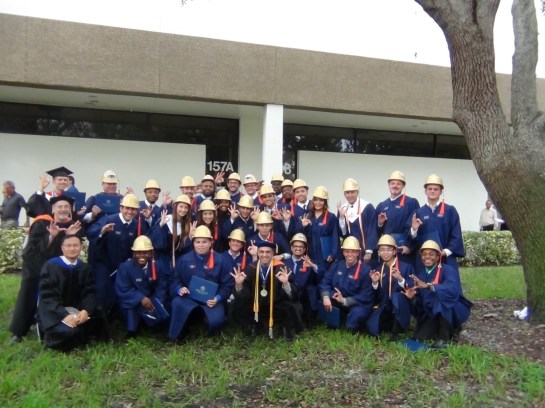
I am a little late, but I had the privilege of leading our students into graduation. We had 4 masters grads and over 30 BS grads They all did well and should been very proud of their efforts. Congratulations gang!! Thanks to Dr. Meeroff for the photo!!
engineering
It’s Been a Month!!
My apologies for being offline for a month. It has been very busy. I got back from Utah, and it was tests, reports, etc. Then Thanksgiving – we went to Disney for my stepdaughter. Then the Florida Section AWWA conference, then student final design presentations with President Kelly present for some of it, then finals, then a trip to the west coast, then posting grades, then it’s now. Crazy. And my kitchen is being worked on -see the photos of what is left of it. Not much, and Christmas is how far away. Yikes. At least the wrapping and chopping are 99% done!
In the meantime a lot has happened. Congress cut SRF funding, but passed the transportation bill. They passed WITAF, but provided minimal funding. The debates roll on. A recent South Park episode is all about illegal immigrants from Canada escaping, then there is a wall built, by the Canadian so t hose who left don’t come back, and then we find out who the new president in Canada looks like… well you just have to watch and be scared. Very scared. If you do not follow South Park, well you are just missing it.
Russia had a plane brought down by an apparent ISIS bomb. The Egyptians deny it. Too much arguing about was it or wasn’t it to garner much of an outcry. Best wishes to the friends and families of the victims. Then France had their 911 event sponsored by ISIS, and most of the world is sending their best wishes to the victims, the victims families and the French population. In such events, most of the world comes together. Everybody was French for a day. Best wishes to the friends and families of the victims. Then the couple in California. Best wishes to the friends and families of the victims. But it raises a very disconcerting question, and one fraught with far too many xenophobic concerns as ISIS and their allies like the Taliban, Boko Hiram and others continue to reign terror and violence on the rest of the world. The xenophobic response will be – whom do we trust in the Muslim world? If you don’t believe in blowback, listen to the debates. One commentator points out the xenophobia may actually help ISIS (Donald are you listening?). LOL – of course not. But utilities should expect another round of security costs and analyses in the future.
The Florida Section conference was great. The venue was great (Renaissance at Sea World). The program garnered a lot of buzz and comments. Who knew at a water conference that potable reuse would be the big topic? I also won two awards at the Florida Section conference – a best paper award and the Alan B. Roberts award for Outstanding Service by a member. Wow!! I am humbled. A lot of great utility folks were present at the FSAWW conference. It is a great event for the water industry (that includes wastewater, storm water etc.). The technical program is designed to be good, timely and useful to those that attend. While all utilities struggle with costs, please make time to send your folks if possible. The training cost is reasonable for what you get and who you meet.
My students did well on tests and presentations. President Kelly was impressed with their presentations and projects at the Dean’s Design Showcase. We have never had the Dean at student presentations, let alone the President of the University. My sincere appreciation to him, his staff and those that made it happen. The students were pleased and impressed. And they are getting jobs easily. You can tell people are building and working on infrastructure as most of the graduates get jobs right away, if they don’t have them already.
Grading and the west coast went well. The Fort Myers News Press-Sunday Headline was “Where has all the water gone” – a discussion on how groundwater is depleting across the country including south Florida which gets 60 inches of rain. But the article points out what that climate, rainfall, recharge and other factors have been altered in south Florida as a result of development. We really do make an impact and it is affecting utilities today. This follows another article last week on depleted groundwater around the world. I have lots of photos in my travels from the air – groundwater use is highest where surface waters are limited – i.e. dry areas. Except in dry areas, the groundwater does not recharge. I had a student do a project for his master’s degree that estimated that groundwater depletion is a measureable percentage of sea level rise. More to come on that.
Next the kitchen. I will post photos in another blog.
As I said, a busy month.
On Taxes and Fees – Is starving Government the Answer?
Most states were doing pretty well before the 2008 recession hit, but that ended in 2009. Most states had to make extremely difficult cuts or raise taxes, which was politically unacceptable. Of course invested pension systems received a lot of attention as their value dropped and long term sufficiency deteriorated, which was fodder for many changes in pensions, albeit not how they were invested. The good news is a lot of them came back in the ensuing 5 years, but 2015 may be different. A number of states have reported low earnings in 2015 and whether this may be the start of another recession. The U.S. economy has averaged a recession every six years since WWII and it has been almost seven years since the last contraction. With China devaluing their currency, this may upset the economic engine. At present there are analysts on Wall Street who suggest that some stocks may be overvalued, just like in 1999. If so, that does not bode well states like Illinois, Kansas, New Jersey, Louisiana, Alaska and Pennsylvania that are dealing with significant imbalances between their expenses and incomes. Alaska has most of its revenue tied to oil, so when oil prices go down (good for most of us), it is a huge problem for Alaska that gives $2200 to every citizen in the state. An economic downturn portends poorly for the no tax, pro-business experiment in Kansas that has been unsuccessful in attracting the large influx of new businesses, or even expansion of current ones. California and next door Missouri, often chided by Kansas lawmakers as how not to do business, outperform Kansas.
Ultimately the issue that lawmakers must face at the state and as a result the local level is that tax rates may not be high enough to generate the funds needed to operate government and protect the states against economic down turns. There is a “sweet spot” where funds are enough, to deal with short and long term needs, but starving government come back to haunt these same policy makers when the economy dips. It would be a difficult day for a state to declare bankruptcy because lawmakers refuse to raise taxes and fees.
Congratulations to the Summer 2015 graduates
We walked today, and you all made us proud!
More Direct Potable Reuse?
This month’s Journal for AWWA has several articles devoted to direct potable reuse (DPR). Total Water Solutions is the moniker that AWWA has tapped lately as the organization has moved to the message that water sources cannot be separated. California believes that 40% of its urban water use can be recycled to direct potable reuse, which can address a lot of the drought concerns for urban users (11% of California’s water use). The technology is available to make DPR a reality. The concerns involve insuring system reliability (i.e. redundancy in processes), and public perception of DPR. As I noted in a prior blog, there are two cities in Texas already doing DPR. There are several places in California doing indirect potable reuse (IPR) which basically involves injected the water into an aquifer or releasing it in an upstream reservoir. The treatment is basically the same for both but the separation is creates a different public opinion. One that is not so different than discharging wastewater to rivers that serve as water supplies downstream. Both IPR and DPR were unheard of as ideas outside southern California until more recently. But in the past several years, both have seen a significant change in Texas, California and Florida. Water-logged south Florida has looked at 5 IPR projects in the past 7 years, and has a couple reuse ASR systems. Should drought conditions return, these projects may not be so far-out (note we are at 25% normal rainfall in southeast Florida – but water use is 10% below 2005 levels).
Engineers without Borders discussion continued.
The most recent issue of the magazine Population Connection notes several interesting things. First, the world’s population grows by 80 million people per year, predominantly in areas that are not “first World” countries. In many of these places water is limited – 1.2 billion people live in these areas. By 2030, 40% of the people, especially those in these areas will be facing water deficits that will increase their risks. Some of these deficits will be exacerbated by climate changes. Agriculture is responsible for 70% of water use, and that number is not expected to decline as the need for agricultural products increases with time. So clearly water use and population are related, just as carbon dioxide concentrations in the atmosphere and population appear to be related. Worse yet, the number of urban residents that do not have access to wastewater services is expected to increase by 50%. The good news, not so much in the US, where such services are expected and available to the vast majority of people. So the problem – most of these people live in Third World countries that lack both the economic resources and social infrastructure to deal with these problems. This is what Engineers Without Borders is trying to address but it does raise that question – what are the social consequences of trying to help them? Surely engineering ethics say we should help protect the public health, safety and welfare, which this work does. But on the other side, if they develop more and add more people, does that add to the strain on limited resources in these areas which might damage the public health safety and welfare. Which is the more critical issue? And how do we decide? How should engineers evaluate the conflict between public health and sustainability from an ethics perspective? Just asking?
Interesting Conversations
Over the past couple weeks I have been at two conferences and had two interesting conversations. The first one was in Anaheim at the AWWA Annual Conference and Exposition. The subject was the organization Engineers Without Borders (EWB). The organization has the mission to help get drinkable water to people in undeveloped parts of the world. Nearly two billion people do not have clean drinking water which drastically impacts their health and ability to be productive and earn a living. Many of these people live in Africa and Asia; some in central and South America as well. The mission is a noble one – to help people. But the guy I was talking to raised an interesting question – if we help all these people get water, they will demand more resources and if the resources are already limited, won’t creating more demands for those resources compromise our access and cost to those services? Hence helping them actually creates competition with us for the same resources and that can compromise our goals. Clearly not a fan of EWB, but, an interesting take on the issue..…
The second conversation was a few days later when a group of people were talking politics. The conversation inevitably ended up on political parties and people and service organizations like Engineers Without Borders that are often viewed as being ”liberal” or “progressive” as opposed to “conservative.” The discussion got around to this question – would conservative groups give money to progressive groups like EWB? The answer was a resounding yes, because that would improve conditions which would make people more productive, which means more jobs, and more income to give more people access to buy more things, which creates a demand for more things, which expands the economy. In other words, increase profits for those folks building the “things.” Interesting twist, and you thought is was all about water….
Ethics and Sustainability
There is an interesting ethical issues that arises in this discussion also. Engineers are entrusted to protect the public health, safety and welfare. When there were few people, projects did not impact many so little thought was given to the “what could possible happen” question. We are still paying for that. When bad things happen, the precedent has unfortunately been set that somehow “the government” will resolve this. An old 1950s BOR director said he thought he was “a hero because he helped create more room for people” in the west with dams and water projects. He did accomplish that, except that while there were more people coming, the resources were never analyzed for sustainability, nor the impact it might have on the existing or potential future economic resources. But once the well runs dry, I think we just assumed that another solution would resolve any issue. But what is if doesn’t?
There are many water supply examples, where we have engineered solutions that have brought water or treated water to allow development. South Florida is a great example – we drained half a state. But no one asked if that development was good or appropriate – we drained off a lot of our water supply in the process and messed up the ecological system that provided a lot of the recharge. No one asked in the 1930 if this was a good idea.
Designing/building cities in the desert, designing systems that pump groundwater that does not recharge, or design systems that cannot be paid for by the community – we know what will happen at some point. Now that there are more people, conflicts become more likely and more frequent. Most times engineers are not asked to evaluate the unintended consequences of the projects they build. Only to build them to protect the public health safety and welfare while doing so, but from a specific vantage point.
So if you know a project will create a long-term consequence, what action should you take? So the question is whether there is a conflict between engineers meeting their obligations to the public and economic interests in such cases? Or should we just build, build, build, with no consideration of the consequences?
Drought Discussions on Line
We are all aware of the major drought issues in California this year – it has been building for a couple years. The situation is difficult and of course the hope is rain, but California was a desert before the big water projects on the 1920s and 30s. Los Angeles gets 12 inches of rain, seasonally, so could never support 20 million people without those projects. The central valley floor has fallen over 8 feet in places due to groundwater withdrawals. Those will never come back to levels of 100 years ago because the change in land surface has collapsed the aquifer. But the warm weather and groundwater has permitted us to develop the Central Valley to feed the nation and world with produce grown in the desert. The development in the desert reminds me of a comment I saw in an interview with Floyd Dominy (I think), BOR Commissioner who said his vision was to open the west for more people and farming, and oversaw lots of projects to bring water to where there was none (Arizona, Utah). The problem is that the west never head much agriculture or population because it was hot, dry and unpredictable – hence periodic droughts should be no surprise – the reason they are a surprise is that we have developed the deserts far beyond their capacity through imported water and groundwater. Neither may be reliable in the long run and disruptions are, well, disruptive. Archaeologist Bryan Fagan traced the fall of Native American tribes in Arizona to water deficits 1000 years ago.
Yet policymakers have realized that civil engineers have the ability to change the course of nature, at least temporarily, as we have in the west, south, Florida. I often say that the 8th and 9th wonders of the world are getting water to LA over the mountains and draining the southern half the state of Florida. I have lived in S. Florida for 25+ years and am very familiar with our system. The difference though is that we have the surficial Biscayne aquifer and a rainy season that dumps 40 inches of rain on us and LA doesn’t (as a note of caution, for the moment we are 14 inches below normal in South Florida – expect the next drought discussion to ensue down here in the fall). The biggest problems with the Everglades re-plumbing are that 1) no one asked about unintended consequences – the assumption was all swamps are bad, neglecting impacts of the ecosystem, water storage, water purification in the swamp, control of feedwater to Florida Bay fisheries, ….. 2) one of those unintended consequences is that the recharge area for the Biscayne aquifer is the Everglades. So less water out there = less water supply along the coast for 6 million people 3) we lowered the aquifer 4-6 ft along the coastal ridge, meaning we let saltwater migrate inland and contaminate coastal wellfields 4) we still have not figured out how to store any of that clean water – billions o gallons go offshore every day because managing Lake Okeechobee and the upper Everglades was made much more difficult when the Everglades Agricultural Area was established on the south side of Lake Okeechobee, which means lots of nutrients in the upper Everglades, and a lack of place for the lake to overflow, which meant dikes, more canals, etc. to deal with lake levels.
The good news is that people only use 11% of the water in California and Florida, and that Orange County, CA and others have shown a path to some degree of sustainability (minus desal), but the real problem is water for crops and the belief that communities need to grow. When we do water intensive activities like agriculture or housing, in places where it should not be, it should be obvious that we are at risk. Ultimately the big issue it this – no policy makers are willing to say there is “no more water. You cannot grow anymore and we are not going to send all that water to Ag.” Otherwise, the temporary part of changing nature will come back to haunt us.