Archive

management


Regardless of the causes, southeast Florida, with a population of 5.6 million (one-third of the State’s population), is among the most vulnerable areas in the world for climate change due its coastal proximity and low elevation (OECD, 2008; Murley et al. 2008), so assessing sea level rise (SLR) scenarios is needed to accurately project vulnerable infrastructure (Heimlich and Bloetscher, 2011). Sea level has been rising for over 100 years in Florida (Bloetscher, 2010, 2011; IPCC, 2007).  Various studies (Bindoff et al., 2007; Domingues et al., 2008; Edwards, 2007; Gregory, 2008; Vermeer and Rahmstorf, 2009; Jevrejeva, Moore and Grinsted, 2010; Heimlich, et al. 2009) indicate large uncertainty in projections of sea level rise by 2100. Gregory et al. (2012) note the last two decades, the global rate of SLR has been larger than the 20th-century time-mean, and Church et al. (2011) suggested further that the cause was increased rates of thermal expansion, glacier mass loss, and ice discharge from both ice-sheets. Gregory et al. (2012) suggested that there may also be increasing contributions to global SLR from the effects of groundwater depletion, reservoir impoundment and loss of storage capacity in surface waters due to siltation.

Why is this relevant?  The City of Fort Lauderdale reported last week that $1 billion will need to be spent to deal with the effect of sea level rise in Fort Lauderdale alone.  Fort Lauderdale is a coastal city with canals and ocean property, but it is not so different from much of Miami-Dade County, Hollywood, Hallandale Beach, Dania Beach and host of other coastal cities in southeast Florida.  Their costs may be a harbinger of costs to these other communities. Doing a “back of the napkin”  projection of Fort Lauderdale’s cost for 200,000 people to the additional million people in similar proximity to Fort Lauderdale means that $5 billion could easily be spent over the next 100 years for costal impoundments like flap gates, pumping stations, recharge wells, storm water preserves, exfiltration trenches and as discussed in this blog before, infiltration galleries. Keep in mind that would be the coastal number and we often ignore ancillary issues.  At the same time, an addition $5 to 10 billion may be needed for inland flooding problems due to the rise of groundwater as a result of SLR.

The question raised in conjunction with the announcement was “is it worth it?”  I suggest the answer is yes, and not just because local politicians may be willing to spend money to protect their constituents.  The reality is that $178 billion of the $750 billion economy of Florida, and a quarter of its population, is in the southeast. With nearly $4 trillion property values, raising a few billion for coastal improvements over 100 years is not an insurmountable task.  It is billions in local engineering and construction jobs, while only impacting taxpayers to the tune of less than 1/10 of a mill per year on property taxes. This is still not an insurmountable problem.

I think with good leadership, we can see our way.  However, that leadership will need to overcome a host of potential local community conflicts as some communities will “get more” than others, yet everyone benefits across the region.  New approaches to working together will need to be tried.  But the problem is not insurmountable, for now…

A number of years ago I had the pleasure of speaking with archeaologist Bryan Fagan for an hour or so before a presentation he gave at a conference.   Dr. Fagan is a modern-day Indiana Jones, who has been all over the world studying ancient ruins.  Dr. Fagan expressed his career as “50 years of studying drainage ditches,” but with studying drainage ditches he could provide you with the rise and fall of civilizations through history.  His book Elixir outlines a number of these civilizations:  Egyptian, Babylonia, Southeast Asia, and even the American West.  His findings were that the civilization expended as far as infrastructure could be constructed to allow water to flow to where it was needed, whether that was Alexandria or Ur.  Later civilizations expanded and developed as technology allowed water to flow further.  Rome demonstrated that water could be moved with more than ditches, which would have been a severe limitation for Rome and other civilizations based in dry areas with topography.  The Romans constructed extensive tunnels and aqueducts to supply Rome with water from mountains to the east and north. A recent article noted that we probably know about 20% of the Roman tunnel system as we keep discovering more of it each year – tunnels lost in the Dark Ages after the fall of Rome.  Dr. Fagan notes that it was access to water that allowed human civilizations to develop and evolve.  It is why a number of engineering organizations like Water for People and Engineers Without Borders focus their efforts on providing access to clean water to people in Third World countries.  It is their only way to get to the modern world.  All other infrastructure:  roads, major buildings, etc., result from the access to clean water that allows people to be healthy and productive.

So if civilization rises and falls with access to water, why is it so hard to get public officials to fund water supply and rehabilitation projects?  We talk of an infrastructure crisis in the United States because our average water and sewer infrastructure systems are working on 50 years old and deterioration is evident.  We have many mid-western communities with water, but no customers to pay for deteriorating infrastructure (Detroit), and southeastern utilities that have lost factories that supported the bulk of their utility, and insufficient growth in the customer base to deal with operations and maintenance.  As a result, outages and breaks occur more frequently, costing more money to repair, but under the auspices of maintaining rates, the revenues do not increase to support the needed repairs. 

At least the southeast has surface supplies, albeit perhaps limited, which constrains growth (Atlanta), but our fastest growth often occurs in areas we know have limited precipitation, like a lot of the American West.  Yet somehow we expect groundwater sources that do not recharge locally, to sustain the community indefinitely without disruption – ignoring the fact that history tells us communities cease to function when water supplies are exhausted.  USGS identified many areas that have long-term permanent declines in aquifers as a result of pumpage for agricultural and community uses.  No one raises the question about the aquifer levels – permits get issued, but little data is gathered and very limited plans are available in most places to deal with the declines.  And no one raises a question about aquifer levels because stopping growth to deal with water supplies is not in conformance with the desire to grow, which is required to support additional services demanded by the community. 

No one questions how to secure the water either, much of which has been “created” by federal tax dollars spend over 50 years ago during the era of great dam building (1920-1960).  However, as these systems and populations age, the concern about costs will continue to engender discussion.  And hand wringing.  Water costs money.  Water creates civilization and sustains it.  When we take it for granted, it becomes all too easy to fall behind the proverbial “eight-ball,” and the system crashes.  It is a testament to the utility personnel – the managers, engineers and operators – that these systems continue to operate as they do.  But bailing wire and duct tape only go so far.  We need to develop a frank discussion about the need to infuse funds – local, federal, state and private – into addressing our infrastructure needs.  The dialog needs to commence sooner, as opposed to after failure. 


Back during the dark days of the late-1970s, when America was being held hostage by Middle East oil interests, the Department of Energy was created, ostensibly to free our economy from the dependence on foreign oil and all that trappings that go with it.  It was a noble goal – the American economy could grow without the risks posed by foreign governments.  Thirty five years later, could we finally be reaching that goal? 

Interesting the often criticized billions of energy company subsidies of the Bush era do not appear to be responsible for solving the issue.  Nor are the prior efforts to subsidize or otherwise encourage investments before.  The energy subsides since 2000 do not appear to be the reason, but the arctic wilderness did not need to be disturbed either.  The success had nothing to do with any of it, but instead a series of private risk takers to a gamble on an unproven technology, to make great strides – fracking.

Based on the success of the development of fracking for natural gas, we have made major improvements.  But it is not just fracking, as many power plants are or have been rehabilitated to convert away from oil and coal to cleaner burning natural gas, thereby developing the market for natural gas.  Local governments have been migrating their fleets to natural gas for years – natural gas can use the same engine with an $8000 conversion kit that allows automobiles to run on both.  The conversions have made the demand for natural gas greater, making the investments needed to frack, more profitable.  The US has significant reserves of natural gas, and fracking has made it easier to capture this resource.  The benefit of natural gas is that the demand for oil is down, creating a glut of oil on the market and a decrease in price (at least for now).

But the question that has been left unanswered is what the domino effect of natural gas is.  Certain advertisements will argue there is 200 years of natural gas available for the US so we don’t need to worry about energy.  Others will argue that only 10-15% of that supply is actually recoverable (it should be noted that this assumes current methods), which is a far shorter horizon.  But in either case, natural gas in the ground is not a renewable resource so the question must be asked – does the fracking boom interfere with investment in truly renewable resources? 

Since 2000, Washington has invested heavily in renewable resources – wind, solar and to an extent waves.  Some energy companies like NextEra have been investing heavily in wind and solar power (they are the biggest investors in renewable power in the US), so what of these truly renewable investments?  Will the rush to frack turn resources away from truly renewables?  Or will renewable continue to be a small fraction of energy demands for the near future?  The question remains unanswered for now.

The bigger question for utilities is whether fracking will divert money away from plans for renewable efforts like digester gas capture, solar cells and wind power at reservoirs and the like that utilities are using to help reduce power purchases.  Will it impact utility efforts to become self-sufficient energy consumers like East Bay MUD?  You see the economy has few favorites.  Government can create favorites, by subsidizing products that would otherwise be too expensive like PV panels. The benefit of subsides can be to reduce costs of emerging technologies that may never otherwise see widespread use.  Subsidizing renewables fit this mode.

Utilities should be concerned that the rush to frack pulls money away from their plans for renewable power.  As the feds look to reduce their contributions to water and wastewater infrastructure, public money to energy does not appear to be decreasing.  And unlike publically owned water and sewer systems, private investment in energy is increasingly available as a result of the potential profits that can be made.  The diversion of funds may decrease prospects for funding water and sewer utility options, especially if interest rates begin to rise.  The Federal Reserve Bank’s concern about rising interest rates was manifested earlier this year when interest rate increased, housing sales decreased immediately.

Of course the issue of fracking goes beyond the potential to disrupt monies for renewable energy.  There are questions about the practice of fracking include water quality impacts, causing earthquakes, land subsidence, etc., issue that have yet to be resolved.  Keep an eye out for a risk assessment that AWWA and others will be involved with to look at these risks.  


Several weeks ago we looked at the phenomenon of population, income, education and unemployment.  The impact to from the combination of these factors in certain communities can be difficult.  Let’s explore a little further as there is more, interesting data every day.  The US Department of Agriculture is releasing its report of rural America.  The findings are interesting and counter-intuitive to the understanding of voters in many of those communities.  Their findings include:

  • The rural areas grew 0.5 % vs 1.6% in urban areas from mid-2011-mid 2012
  • Rural incomes are 17% lower than urban incomes.
  • The highest income rural works (95th percentile) earn 27% less than their urban counterparts
  • 17.7% of rural constituents live in poverty vs 14.5% in urban areas
  • 80% of the high poverty rate counties were rural
  • All the high income counties are urban.

Wow!  So the ghetto has move to the country? According to these statistics there is truth in that statement.  Let’s look a little further using some on-line mapping. 

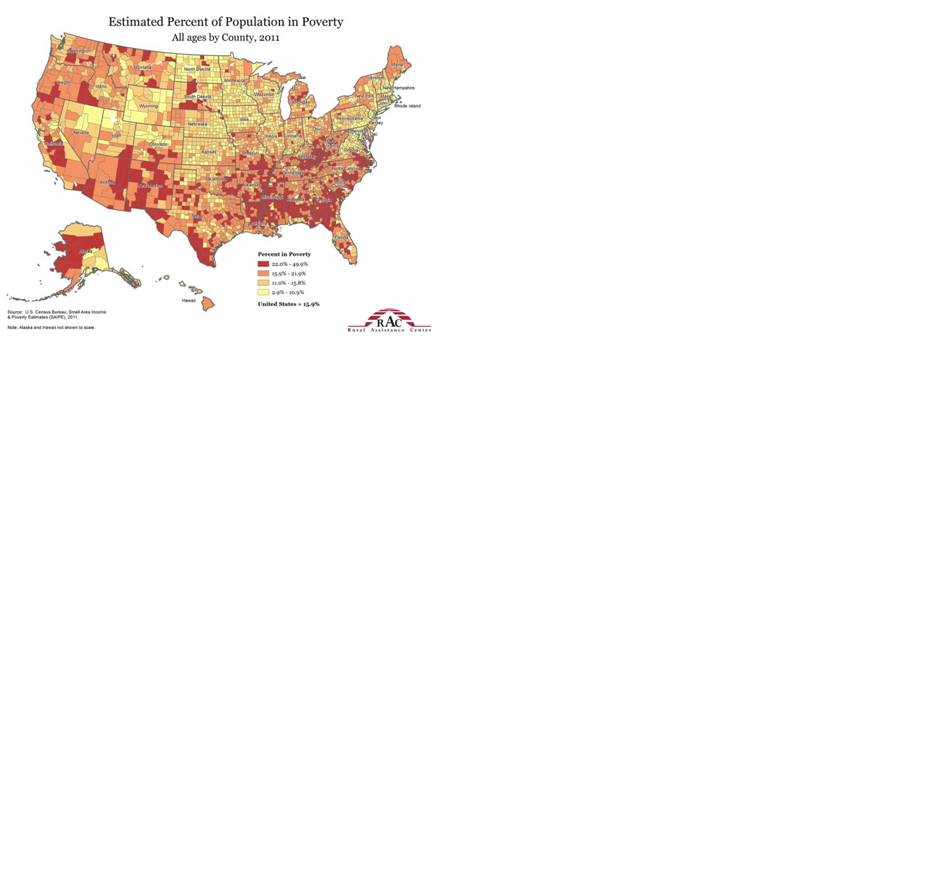
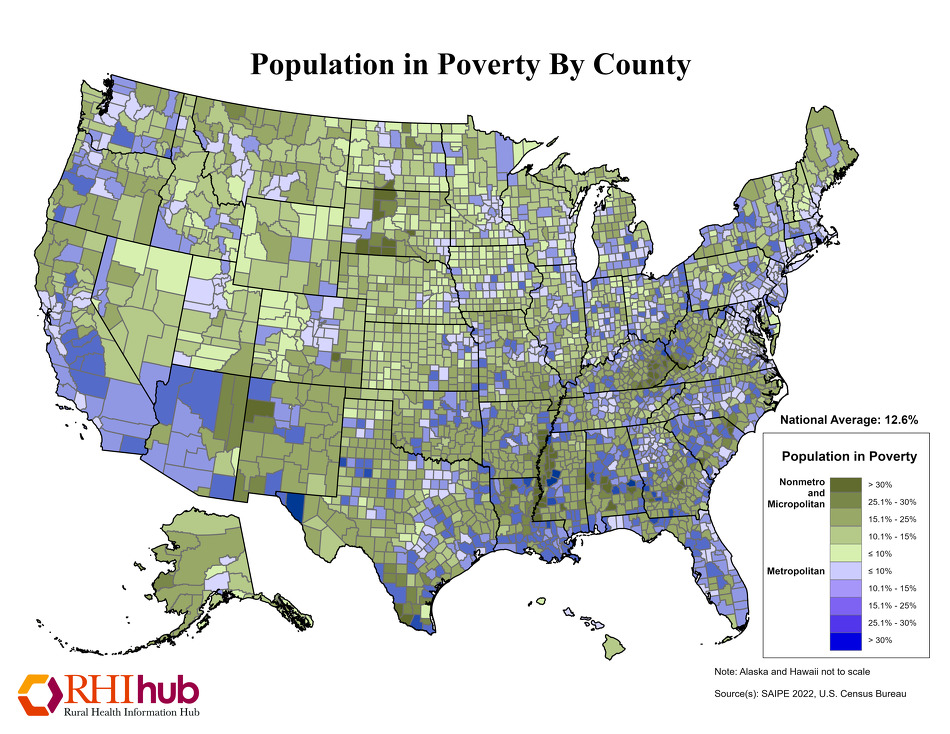
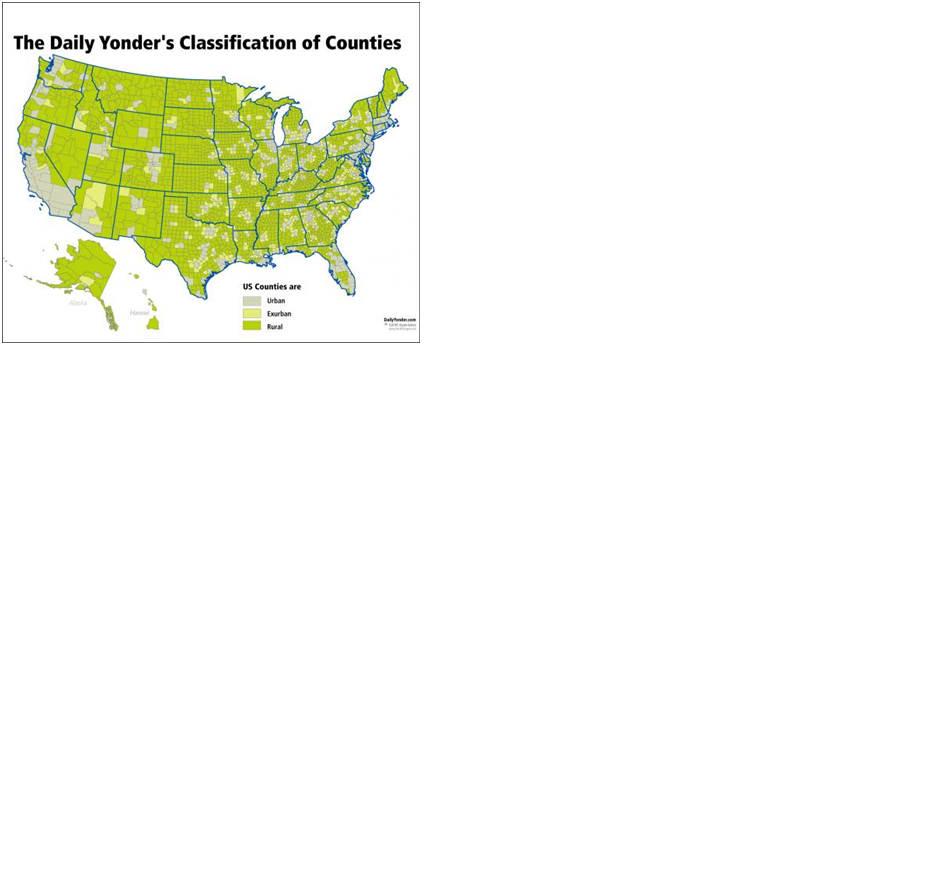
First let’s look at where these rural counties are.  Figure 1 is a map from www.dailyyonder.com  that shows (in green) the rural counties in the US.  Wikipaedia shows the 100 lowest income counties in Figure 2.  For the most part, these counties are rural, with the exceptions being a few areas in south Texas and in the Albuquerque/Santa Fe area of New Mexico. Raceonline.com shows the populations in poverty by county.  The red areas are the highest poverty rates.  The red areas in Figure 3 expand Figure 2 to include much of the rural deep south, Appalachia, more of Texas and New Mexico and part of the central valley in California.

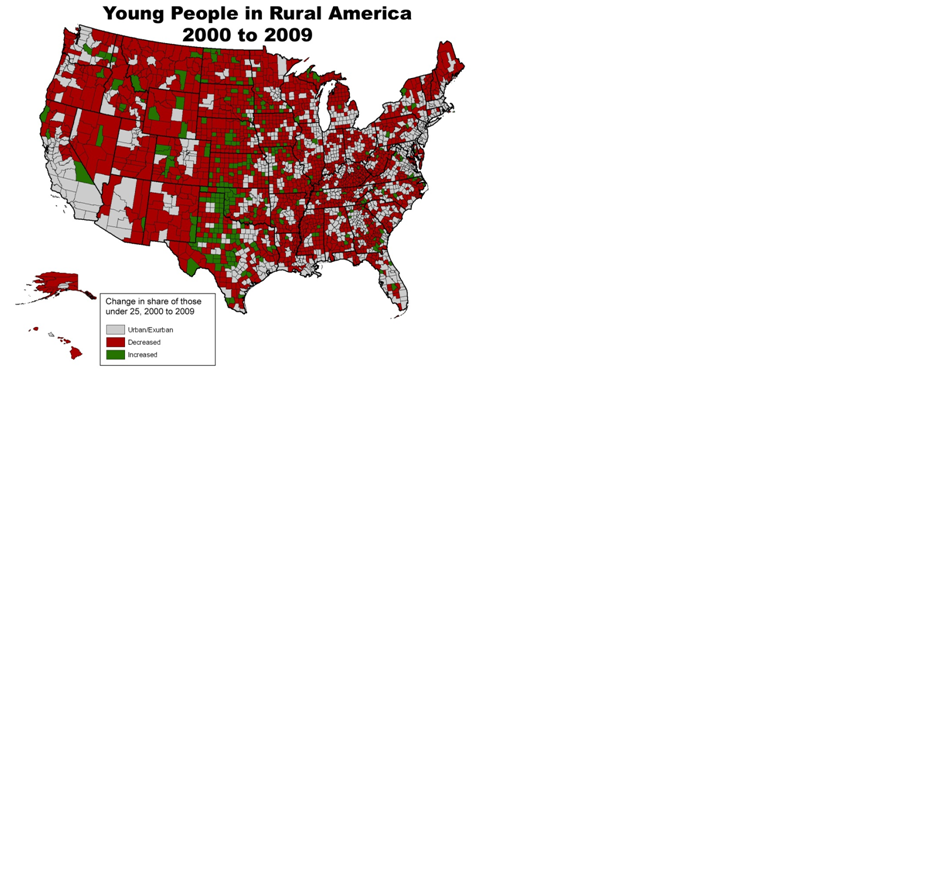
Figure 4 shows how the number of young people has changed between 2000 and 2009 in rural counties (urban counties are white and not included – red means a decrease).  Figure 5 shows population growth (or not) by county. What you see in these two maps is that the young people are moving to the rocky mountain states and vacating the high poverty counties in Figure 3.  Yong people do not see jobs in the rural area – unemployment is 20% higher in rural America and the jobs that are there pay less.  Figures 6 and 7 show unemployment by County in 2008 after the start of the Great Recession and in 2013.  What these figures show is that with exception of the Plains states and Rockies, is that many of the areas with high poverty also had high unemployment, and that the unemployment has remains stubbornly high in many rural areas in the Deep South, Appalachia and New Mexico, plus high unemployment in parts to  the Great Lakes, but the poverty rates are still lower.  Education may by a factor in why the Plains states and Rocky Mountains have less unemployment – despite being rural their students are far more likely to graduate from high school than those in the deep South, Appalachia where unemployment remains high and incomes low. 

So what does this possibly have to do with utilities?  Utilities need to understand this problem as is demands some real, on-the-ground leadership.  Small and rural utilities are more costly to operate per thousand gallons than larger utilities.  A 1997 study by the author showed that economy-of-scale manifested itself to a great extent with water and wastewater operations.  The differences were not close – it is a lot less costly to operate large utilities vs small ones.  Rural utilities complicate the issue further because not only is the number of customers limited, but the pipe per customer is less so the capital investment per customer is far higher than in urban areas.  The impact is that utilities are under pressure to reduce rates to customers, or create a set of lower cost rates for those in poverty, while at the same time their costs are increasing and infrastructure demands are incrementally higher than their larger neighbors.  The scenario cannot be sustained, especially when large portions of rural infrastructure was installed with FHA grants, meaning the customers never paid for the capital cost in the first place.  There was no or lower debt, than what larger utility customers have.  The rural rates since these investments have been set artificially lower than they should as a result. But with Congress talking about reducing SRF and FHA programs, FHA is unlikely to step in to replace their initial investment, meaning that the billions of rural investment dollars that will be needed in the coming years will need to be locally derived, and rate shock will become a major source of controversy in areas that are largely very conservative politically and tend to vote against projects that will increase costs to them.

The good news is that much of the rural infrastructure may be newer when compared to much of the urban infrastructure.  So there is time to build the argument that local investment is needed.  The community needs to be engaged in this discussion sooner as opposed to when problems occur.  Saving for the infrastructure may be the best course since rural utilities will have limited access to the borrowing market because of their size, but that means raising rates now and keeping those saved funds as opposed to using them to deer rate increases.  If ongoing efforts in the House deplete federal funding further, the pinch will be felt sooner by rural customers who will lose the federal dollars from SRF and FHA programs. 


Image

Figures 1 – Rural Counties

The United States: By Rural, Urban and Exurban Counties


Image


Figure 2.  100 lowest income Counties in the US


http://en.wikipedia.org/wiki/List_of_lowest-income_counties_in_the_United_States


Image

Figure 3.  Estimated population in poverty

http://www.raconline.org/racmaps/mapfiles/poverty.jpg


Image

Figure 4.  Where the Young People Are

http://www.raconline.org/maps/topic_details.php?topic=55


Image


Figure 5.  Where people are moving to http://www.raconline.org/maps

Image


Figure 6  Unemployment 2008

http://en.wikipedia.org/wiki/Unemployment

Image

Figure 7  Unemployment 2013 http://www.huduser.org/portal/pdredge/pdr_edge_featd_article_040


Local utilities are among the largest power users in their communities.  This is why power companies make agreements with utilities at reduced cost if the utilities will install backup power supplies.  The peak power generation capacity as well as backup capacity is at the local utilities and other large users.  Power companies can delegate this capital cost to large users without the investment concerns.  It works for both parties.  In addition, power companies spend effort to be more efficient with current power supplies, because recovering the costs for new, large plants is difficult, and in ways, cost prohibitive.  Hence small increment options are attractive, especially when they are within high demand areas (distributed power).  The use of localized wind, solar and on-site energy options like biogas are cost effective investments if sites can be found.  That is where the utilities come in.  Many utilities have sites.  Large water utilities may have large reservoirs and tank sites that might be conducive to wind or solar arrays.  Wind potential exists where there are thermal gradients or topography like mountains.  Plant sites with many buildings and impervious areas could also be candidates for solar arrays and mini-wind turbines.  Wastewater plants are gold mines for digester gas that is usually of high enough quantity to drive turbines directly.  So utilities offer potential to increase distributed power supplies, but many water/wastewater utilities lack the expertise to develop and maintain these new options, and the greatest benefit is really to power companies that may be willing to provide as much money in “rent” to the utilities as they can save.   Power entities obviously have the expertise and embedded experience to run distributed options optimally.  So why don’t we do this?

I would speculate several reasons.  First, the water/wastewater utilities have not really considered the option, and if they do there is the fear of having other folks on secure treatment sites.  That can be overcome.  The power entities have not really looked at this either.  The focus in the power industry is to move from oil-based fuels to natural gas to accumulate carbon credit futures, the potential for lower operating costs and better efficiency of current facilities to reduce the need for capital investments.  Power entities operate in a tight margin just like water/wastewater utilities do so saving where you can is a benefit.  There are limited dollars to invest on both sectors and political and/or public service commission issues to overcome to invest in distributed power options at water/wastewater facilities. 

But a longer-term view is needed.  While fossil fuels have worked for us for the last 100 years, the supply is finite.  We are finding that all that fracking might not give us 200 years, but more like 20-40 years of fuel.  We have not solved the vehicle fuel issue and fossil fuels appear to be the best solution for vehicles for the foreseeable future which means they will compete directly with power demands.  Natural gas can be used for vehicles fairly easily as evidenced by the many transit and local government fleets that have already converted to CNG. 

The long-term future demands a more sustainable green power solution.  We can get to full renewable power in the next 100 years, but the low hanging fruit need to be implemented early on so that the optimization of the equipment and figuring out the variables that impact efficiency can be better understood than they are now.  For example, Leadville, CO has a solar array, but the foot of snow that was on it last September didn’t allow it to work very well.  And solar arrays do use water to clean the panels.  Dirty panels are nowhere near as efficient as clean ones.  We need to understand these variables.

Area that are self sufficient with respect to power will benefit as the 21st century moves forward.  There are opportunities that have largely been ignored with respect to renewable power at water and wastewater facilities, and with wastewater plants there is a renewable fuel that is created constantly.  Wastewater plants are also perfect places to receive sludge, grease, septage, etc which increase the gas productions.  There are examples of this concept at work, but so far the effort is generally led by the wastewater utilities.  An example is East Bay Municipal Utility District (Oakland, CA) which produces 120% of its power needs at its wastewater plant, so sells the excess power back to the power company.  There are many large wastewater plants that use digester gas to create power on-site to heat digesters or operate equipment.  Others burn sludge in on-site incinerators to produce power.  But so far the utilities are only reducing their cost as opposed to increasing total renewable power supplies.  A project is needed to understand the dynamics further.  If you are interested, email me as I have several parties wishing to participate in such a venture. 


As 2014 is only a month away, expect water and sewer infrastructure to become a major issue in Congress.  While Congress has failed to pass budgets on-time for many years, already there are discussions about the fate of federal share of SRF funds.  The President has recommended reduction in SRF funds of $472 million, although there is discussion of an infrastructure fund, while the House has recommended a 70% cut to the SRF program.  Clearly the House sees infrastructure funding as either unimportant (unlikely) or a local issue (more likely).  Past budgets have allocated over $1.4 billion, while the states put up a 20% match to the federal share.  A large cut in federal funds will reverberate through to local utilities, because many small and medium size utilities depend on SRF programs because they lack access to the bond market.  In addition, a delay in the budget passage due to Congressional wrangling affects the timing of SRF funds for states and utilities, potentially delaying infrastructure investments. 

This decrease in funding comes at a time when ASCE rates water and wastewater system condition as a D+ and estimates over $3 trillion in infrastructure investment will be needed by 2020.  USEPA notes that the condition of water and wastewater systems have reached a rehabilitation and replacement stage and that infrastructure funding for water and sewer should be increased by over $500 billion per year versus a decrease of similar amounts or more.  Case Equipment and author Dan McNichol have created a program titled “Dire Straits:  the Drive to Revive America’s Ailing Infrastructure” to educate local officials and the public about the issue with deteriorating infrastructure.  Keep in mind much of what has made the US a major economic force in the middle 20th century is the same infrastructure we are using today. Clearly there is technical momentum to indicate there is greater need to invest in infrastructure while the politicians move the other way.  The public, caught in the middle, hears the two sides and prefers less to pay on their bills, so sides with the politicians as opposed to the data. 

Local utilities need to join the fray as their ability to continue to provide high quality service.  We need to educate our customers on the condition of infrastructure serving them.  For example, the water main in front of my house is a 50 year old asbestos concrete pipe that has broken twice in the past 18 months. The neighborhood has suffered 5 of these breaks in the past 2 months, and the City Commission has delayed replacement of these lines for the last three years fearing reprisals from the public.  Oh and the road in front of my house is caving in next to where the leak was.  But little “marketing” by the City has occurred to show the public the problem.  It is no surprise then that the public does not recognize the concern until service is interrupted.  So far no plans to reinitiate the replacement in front of my house.  The Commission is too worried about rates.

Water and sewer utilities have been run like a business in most local governments for years  They are set up as enterprise funds and people pay for what they use.  Just like the private sector.  Where the process breaks down is when the price is limited while needs and expenses rise.  Utilities are relatively fixed in their operating costs and I have yet to find a utility with a host of excess: workers.  They simply do not operate in this manner.  Utilities need to engage the public in the infrastructure condition discourse, show them the problems, identify the funding needs, and gain public support to operate as any enterprise would – cover your costs and insure you keep the equipment (and pipes) maintained, replacing them when they are worn out.  Public health and our local economies depend on our service. Keep in mind this may become critical quickly given the House commentary.  For years the federal and state governments have suggested future funding may not be forthcoming at some point and that all infrastructure funding should be local.  That will be a major increase in local budgets, so if we are to raise the funds, we need to solicit ratepayer support.  Now!  


Communicating effectively in both written form and public speaking is critical for the success of the utility.  I have been reading several books on leadership and communication remains an ongoing issue throughout.  We see many schools trying to incorporate this into the engineering curriculum, but that leaves far too many outside the training “program.”  The problem is that many people think they communicate well, when in fact they do not.  Nothing is  more of a reality check than college students, too many of which write in “text message form” as opposed to real written words.  Presenting utility concepts and ideas to different audiences is an integral part of the profession and unfortunately the technical nature of many of our issues requires technical people to communicate concepts to non-technical audiences.  This s far more difficult than it appears, which is part of why the message may be lost.  .Knowing this fact, aspiring utility employees must become familiar with using visual aids and computer-based tools to convey the important design details, so that, the client, regulators, politicians, the public and even other engineers can envision what the final product will look like and evaluate their ability to successfully execute the project. 

We tell our students that technical communication for civil engineers is essential to the profession and is a prerequisite for a successful engineering career. It assists in conveying information, serves as a thought process tool, and is arguably just as essential as excellent analytical or computational skills. For some, writing well comes naturally, for others, it can be a struggle. The difference can be experience, confidence, and proper planning. Planning makes writing easier. A good place to start would be to make an outline of topics to adequately cover the necessary content and in the appropriate order that allows the reader to follow along in a logical fashion. Of course too many of them resist outlines and read very little.  

Reading and writing go hand in hand.  If you read a lot, you have a better chance of being a good writer than those o do not.  The saving grace of the vampire books, Hunger Games, Game of thrones and 50 Shades series is that someone is actually reading the books. That is a first step.  Of course the news is another matter.  History, of course no so much.  For utility folks, it is technical materials that must be read, digested and conveyed to the ratepayers.  People are naturally suspicious of those they cannot understand, a huge barrier for the industry to overcome. I remind our students than when the general public is asked what engineers do, more than half answer:  drive trains.  Wow.  the disconnect!

It is important to avoid overly long documents with too much technical detail, jargon or specialized terms, distractions and tangents.The consequences of poor communications clearly justify the amount of time and effort required to write well because, for example, the written word in a document is permanent; therefore, the bad impression left with the reader of sloppy work can be extremely damaging.  We need to engage the public in a positive way.  Communication needs to be a more robust goal for all of us than it currently is to engender that needed support.


I worked for a while in rural North Carolina.  I confronted two issues there that are instructive. The first was that many people did not value education because for the most part they expected to do menial labor activities on farms or in construction.  They figured they did not need much education. That was the adults!!  Kids in such situations have little hope of succeeding academically when their parents do not value education, and in some cases may either ridicule their efforts or at least be un-supportive of same.  The second was the idea that the “guys” who could not work anywhere but needed a job should get a job with the “city.”  Wow, I’d like to hope we are past both of these, but the Census statistics clearly show we are not on the education part at least.  Census data indicates that when you look at educational spending, per capita income, graduation rates and unemployment rates, the bottom 10 states are:

North Carolina

Tennessee

South Carolina

Nevada

Kentucky

Alabama

Mississippi

West Virginia

Louisiana

Arkansas

All but Nevada (#35) are in the bottom 12 in spending per student and the academic achievement of their students appears to indicate the efforts are inadequate.  For the most part these are largely rural southern states, so my experiences 25 years ago may be no different now. Kids see low wages, higher unemployment and figure what does education get them?, so it perpetuates the myth of their parents. Or maybe it is not a myth afterall?  Interesting these are primarily the states with the highest number of students in poverty, lead my Mississippi’s whopping 71%.  All are over 50%. All among the states with highest rates of food stamp recipients.  So the kids are living the low income expectations.

Where I currently am I periodically interact with inner-city kids. No surprise, there is a similar mindset – the kids see their future as minimum wage jobs that require no skills, or the expectation that the violence of their surroundings will catch up to them (crime, welfare, etc).  None of their expectations require education (although it is surprising how sophisticated their understanding of all of these issues are), so many do not pursue learning with vigor after 10 or 12 years old. Skipping school, suspensions, lower scores and grades are common.  Too many parents do not encourage their kids and the mindset creates deterioration of urban schools. Periodically I have students who are actively trying to escape the stereotypes, but they will confirm that school is not a priority for far too many  inner city kids.  No surprise they learn this from their parents who are often underemployed or lack good employment because they never obtained the education needed to escape the neighborhood. 

In both cases the problem is lack of employment expectations. The kids look around them and figure they have no hope of escaping the minimum wage, limited skill jobs. Unfortunately our job resurgence indicates that these are the jobs we are producing the most on far too many areas.  In the past 2 years, the State of Florida suggests that 90% of the jobs created are minimum wages jobs.  The local casinos are advertising for hundreds of jobs – as waiters, kitchen help, maintenance, etc. most starting at or just above minimum wage rate.  The hospitality industry is full or low wage, limited skill jobs. So is agriculture in rural areas. The problem is the message sent to kids?  Education is not rewarded, so why bother.

So what does this have to do with utilities?  Utilities are everywhere and inn every community. Education affects utilities because as technology grows, we need better job skills from workers.  Gone are the days of hiring people to dig ditches that may not need to read, write or do math.  We are computerizing everything.  As a result all of our jobs, regardless how much labor may be involved, need skills.  Utility field people are the face of the utility.  We need qualified, employees to can represent the utility well, not uneducated, ignorant people who can’t answer questions or who cannot communicate with the public about what they are doing.  The question is how to solve this problem especially in rural areas where education may not be valued. 

First, we need to get into the schools.  Not colleges, but middle schools.  That is where many students appear to be lost.  They get to be 16 and drop out.  Hanging out, not working, gangs, crime, drug cultures, etc all appear to be “easier” than going to school and then working to earn a living.  We need to create value in all of our jobs.  Certainly not all jobs need a college education, but  a high school diploma with basic abilities to read, write, do math and communicate to the public are needed to create value for us. We need to impress on rural communities and inner city kids that we provide desirable jobs and encourage them toward us.  That may mean internships, student efforts in schools, tours, and lots of interaction with teachers.  It takes time, but may be worth our while on many levels.  

Happy 91st Pop! It’s been 2.5 years since you were last with us, but it’s funny how many things popped (no pun intended) up today that connect to you. Clearly you are still watching what goes on. We had a family summer cottage located 8 miles east of Grayling Michigan. So today I came across an old book entitled the Old AuSable written in 1963 by Hazen Miller, a U of M doctor (you were a U of M aerospace engineer) who wrote about the area back in the day (1870s to 1920s), just before your father purchased property along the AuSable River. It mentions the great grandfather of my dad’s summer playmates, one of whom just died last summer - his obit came up in my email today. Reminded me of many places I went as a kid. Funny it also reminded me of some of the old “names” that are now being lost to time, but created what exists today. It also helped with some perspective on a proposal I have been working on regarding water supplies and quality. The grayling fish disappeared by 1912 as a result of hanged on water quality (warming and silt), human impacts of logging on the fish and the introduction of other species. My proposal looks at impacts of human activity on SE Florida, especially as it relates to sea level rise and the need to capture additional soil storage capacity through infiltration trenches. The water cannot be discharged to tide due to Human-induced nutrient and roadway pollutants of the potential exists to impact fish populations. So we are looking at moving the infiltrated water to water plants in the future. We can treat the water there, cost effectively while solving another problem – diminishing water supplies for urban populations. This would diminish our need to deal with desalination and the disposal of concentrate, another proposal. Funny how sometimes it all comes together….Good times back then and up there. Making progress today. Thanks and keep on watching out for us!!


I recent Wall Street Journal article outlined where growth is likely to be coming.  Of no surprise, Arizona, Las Vegas, Central Valley, San Antonio, Dallas, Houston, Denver, Albuquerque, Boise, Pensacola, Tallahassee, Raleigh, Atlanta, and the Washington DC area.  Only one of those areas is has water much water availability.  It means that all of these communities are in areas that are water limited.  We already know that Texas, Las Vegas and Arizona have lots of water problems.  Most of these areas have had issues in the past as well, and will have more in the future. 

Low growth areas:  Detroit, Cleveland, Chicago, Buffalo, Cincinnati, Omaha, and a variety of areas with plenty of water, but old infrastructure and limited funding.  So the big questions is how do we redirect development to areas with plenty of water as opposed to allowing development in areas where we know that there will be serious water supply consequences in the future?  It’s a leadership issue, but local officials and states are so in need to the growth we have discussed in prior blogs, that the long-term realities of water supply limits overrides the short term need to show growth in the communities to delay tax increases, water increases and the like.  But is delays the inevitable, with potentially serious future impacts.