Archive

politics


Regardless of the causes, southeast Florida, with a population of 5.6 million (one-third of the State’s population), is among the most vulnerable areas in the world for climate change due its coastal proximity and low elevation (OECD, 2008; Murley et al. 2008), so assessing sea level rise (SLR) scenarios is needed to accurately project vulnerable infrastructure (Heimlich and Bloetscher, 2011). Sea level has been rising for over 100 years in Florida (Bloetscher, 2010, 2011; IPCC, 2007).  Various studies (Bindoff et al., 2007; Domingues et al., 2008; Edwards, 2007; Gregory, 2008; Vermeer and Rahmstorf, 2009; Jevrejeva, Moore and Grinsted, 2010; Heimlich, et al. 2009) indicate large uncertainty in projections of sea level rise by 2100. Gregory et al. (2012) note the last two decades, the global rate of SLR has been larger than the 20th-century time-mean, and Church et al. (2011) suggested further that the cause was increased rates of thermal expansion, glacier mass loss, and ice discharge from both ice-sheets. Gregory et al. (2012) suggested that there may also be increasing contributions to global SLR from the effects of groundwater depletion, reservoir impoundment and loss of storage capacity in surface waters due to siltation.

Why is this relevant?  The City of Fort Lauderdale reported last week that $1 billion will need to be spent to deal with the effect of sea level rise in Fort Lauderdale alone.  Fort Lauderdale is a coastal city with canals and ocean property, but it is not so different from much of Miami-Dade County, Hollywood, Hallandale Beach, Dania Beach and host of other coastal cities in southeast Florida.  Their costs may be a harbinger of costs to these other communities. Doing a “back of the napkin”  projection of Fort Lauderdale’s cost for 200,000 people to the additional million people in similar proximity to Fort Lauderdale means that $5 billion could easily be spent over the next 100 years for costal impoundments like flap gates, pumping stations, recharge wells, storm water preserves, exfiltration trenches and as discussed in this blog before, infiltration galleries. Keep in mind that would be the coastal number and we often ignore ancillary issues.  At the same time, an addition $5 to 10 billion may be needed for inland flooding problems due to the rise of groundwater as a result of SLR.

The question raised in conjunction with the announcement was “is it worth it?”  I suggest the answer is yes, and not just because local politicians may be willing to spend money to protect their constituents.  The reality is that $178 billion of the $750 billion economy of Florida, and a quarter of its population, is in the southeast. With nearly $4 trillion property values, raising a few billion for coastal improvements over 100 years is not an insurmountable task.  It is billions in local engineering and construction jobs, while only impacting taxpayers to the tune of less than 1/10 of a mill per year on property taxes. This is still not an insurmountable problem.

I think with good leadership, we can see our way.  However, that leadership will need to overcome a host of potential local community conflicts as some communities will “get more” than others, yet everyone benefits across the region.  New approaches to working together will need to be tried.  But the problem is not insurmountable, for now…

When we ask what the biggest issues facing water and sewer are in the next 20 years, the number one answer is usually getting a handle on failing infrastructure.  Related to infrastructure is sustainability of supplies and revenue needs.  Resolving the infrastructure problem will require money, which means revenues, and overcoming the resistance to fully fund water and sewer system by local officials, the potential for significant costs or shortfalls for small, rural systems and the increasing concern about economically disadvantaged people. 

The US built fantastic infrastructure systems in the mid-20th century that allowed our economy to grow and for us to be productive.  But like all tools and equipment, it degrades, or wears out with time.  Our economy and our way of life requires access to high quality water and waste water. So this will continue to be critical. 

ASCE and USEPA have both noted the deteriorated condition of the water and wastewater systems.  In the US, we used to spend 4% of the gross GNP on infrastructure.  Currently is it 2%.  Based on the needs and spending, there is a clear need to reconstruct system to maintain our way of life.  This decrease in funding comes at a time when ASCE rates water and wastewater system condition as a D+ and estimates over $3 trillion in infrastructure investment will be needed by 2020.  USEPA believes infrastructure funding for water and sewer should be increased by over $500 billion per year versus the proposed federal decrease of similar amounts or more. 

Keep in mind much of what has made the US a major economic force in the middle 20th century is the same infrastructure we are using today. Clearly there is research to indicate there is greater need to invest in infrastructure while the politicians move the other way.  The public, caught in the middle, hears the two sides and prefers less to pay on their bills, so sides with the politicians as opposed to the data.  Make no mistake, our way of life results from extensive, highly efficient and economic infrastructure systems. 

In many ways we are victims of our own success.  The systems have run so well, the public takes them for granted.  It is hard to make the public understand that our cities are sitting on crumbling systems that have suffered from lack of adequate funding to consistently maintain and upgrade.  Public agencies are almost always reactive, as opposed to pro-active, which is why we continuously end up in defensive positions and at the lower end of the spending priorities. So we keep deferring needed maintenance. The life cycle analysis concepts used in business would help. A 20 year old truck, pump, backhoe, etc. just aren’t cost effective to operate and maintain.

Another part this problem is that people have grown used to the fact that water is abundant, cheap, and safe. Open the tap and here it comes; flush the toilet and there it goes, without a thought as to what is involved to produce, treat and distribute potable water as well as to collect, treat, and discharge wastewater.

Water and Sewer utilities are being funded at less than half the level needed to meet the 30 year demands.  Meanwhile relying on the federal government, which is trying to reduce funding for infrastructure for local utilities is not a good plan either. We need education, research and demonstrations to show those that control funding of the needs. The education many be the toughest part because making the those that control funding agree to increase rates carries a potential risk to them personally.  But there are no statues to those that don’t raise rates – only those with vision.  We need to instill vision in our decision-makers.


Several weeks ago we looked at the phenomenon of population, income, education and unemployment.  The impact to from the combination of these factors in certain communities can be difficult.  Let’s explore a little further as there is more, interesting data every day.  The US Department of Agriculture is releasing its report of rural America.  The findings are interesting and counter-intuitive to the understanding of voters in many of those communities.  Their findings include:

  • The rural areas grew 0.5 % vs 1.6% in urban areas from mid-2011-mid 2012
  • Rural incomes are 17% lower than urban incomes.
  • The highest income rural works (95th percentile) earn 27% less than their urban counterparts
  • 17.7% of rural constituents live in poverty vs 14.5% in urban areas
  • 80% of the high poverty rate counties were rural
  • All the high income counties are urban.

Wow!  So the ghetto has move to the country? According to these statistics there is truth in that statement.  Let’s look a little further using some on-line mapping. 

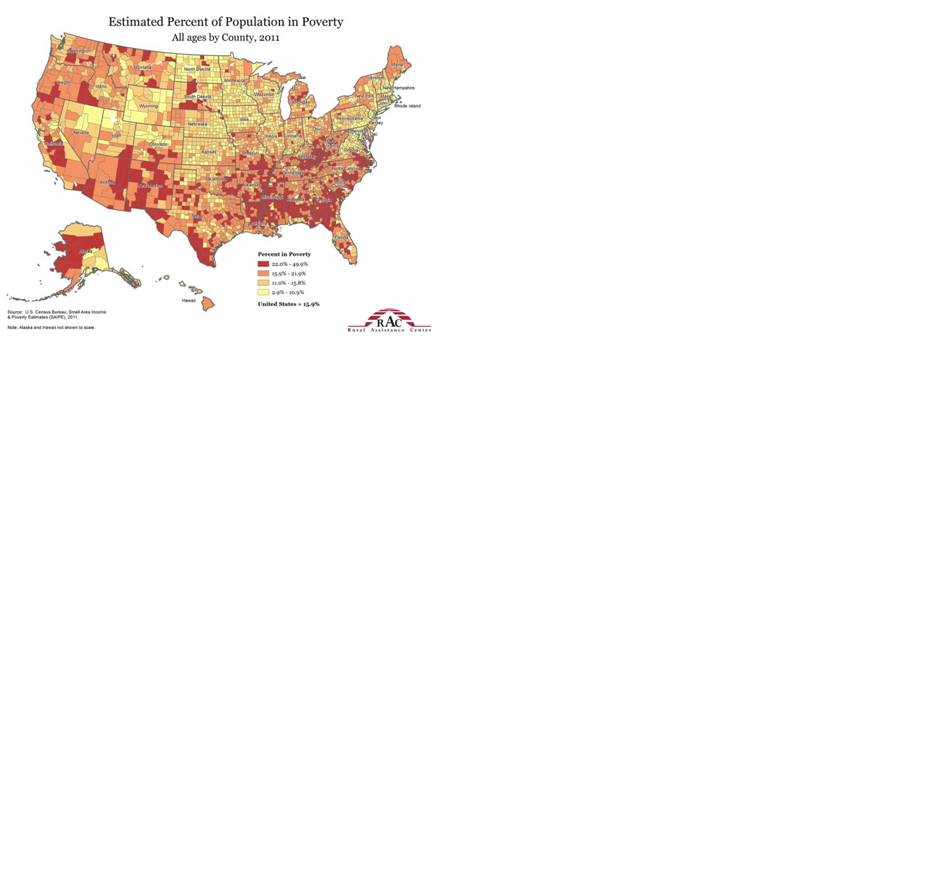
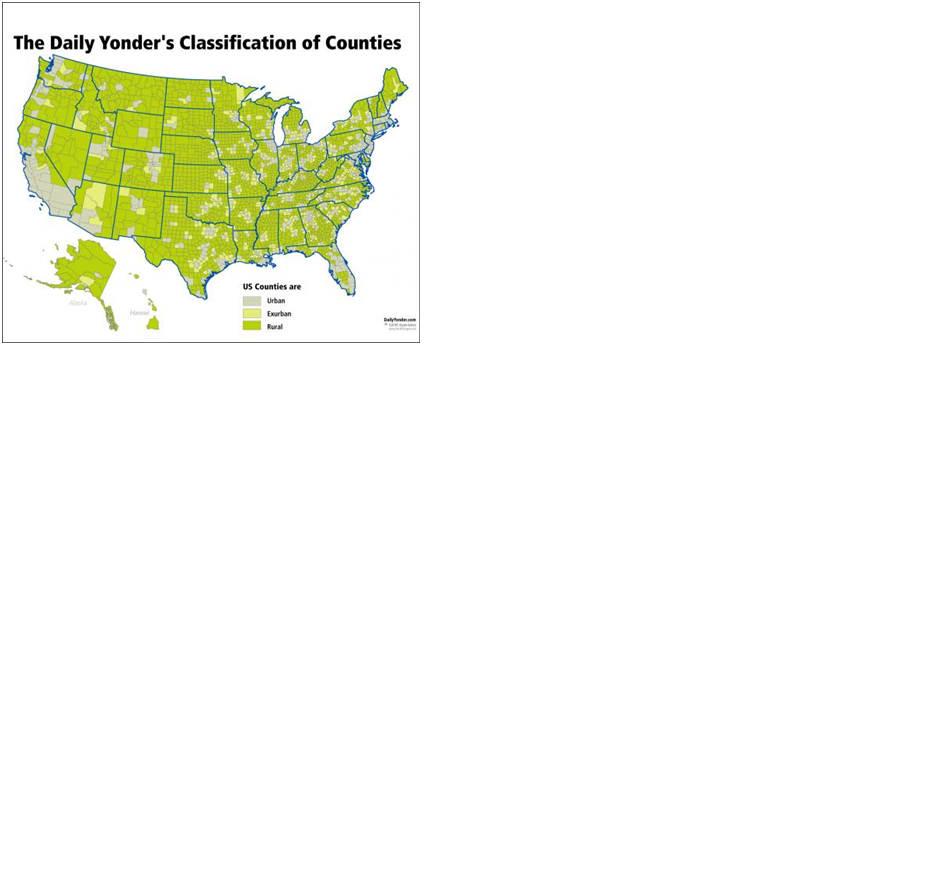
First let’s look at where these rural counties are.  Figure 1 is a map from www.dailyyonder.com  that shows (in green) the rural counties in the US.  Wikipaedia shows the 100 lowest income counties in Figure 2.  For the most part, these counties are rural, with the exceptions being a few areas in south Texas and in the Albuquerque/Santa Fe area of New Mexico. Raceonline.com shows the populations in poverty by county.  The red areas are the highest poverty rates.  The red areas in Figure 3 expand Figure 2 to include much of the rural deep south, Appalachia, more of Texas and New Mexico and part of the central valley in California.

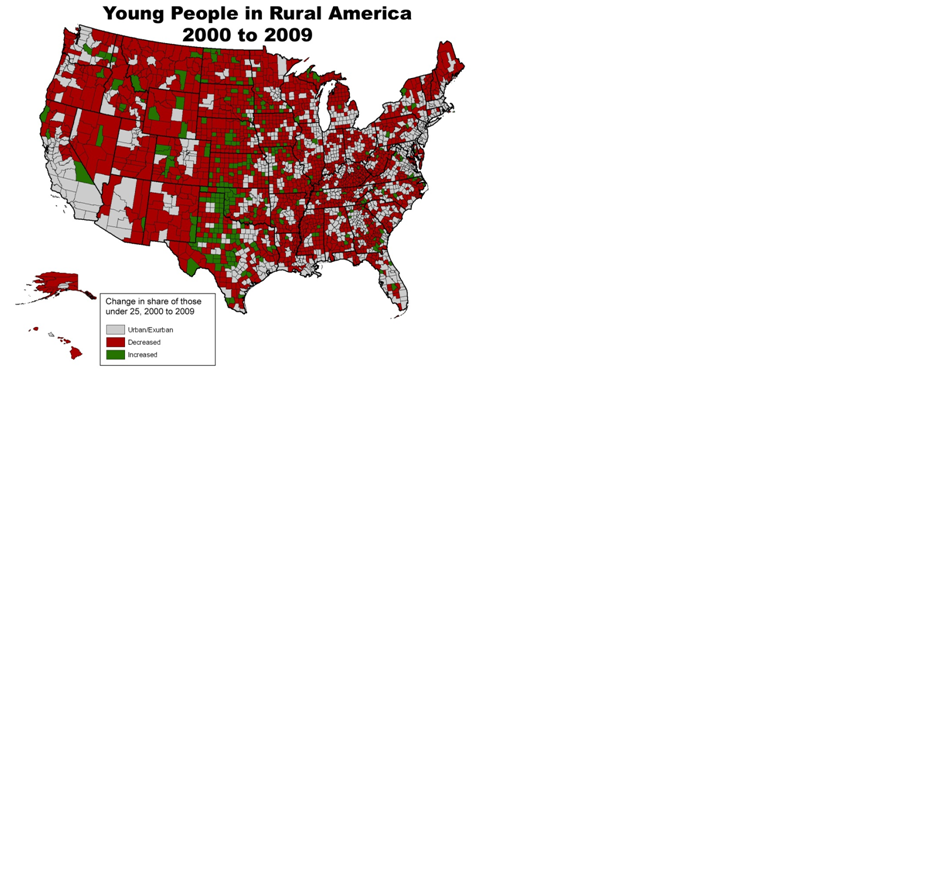
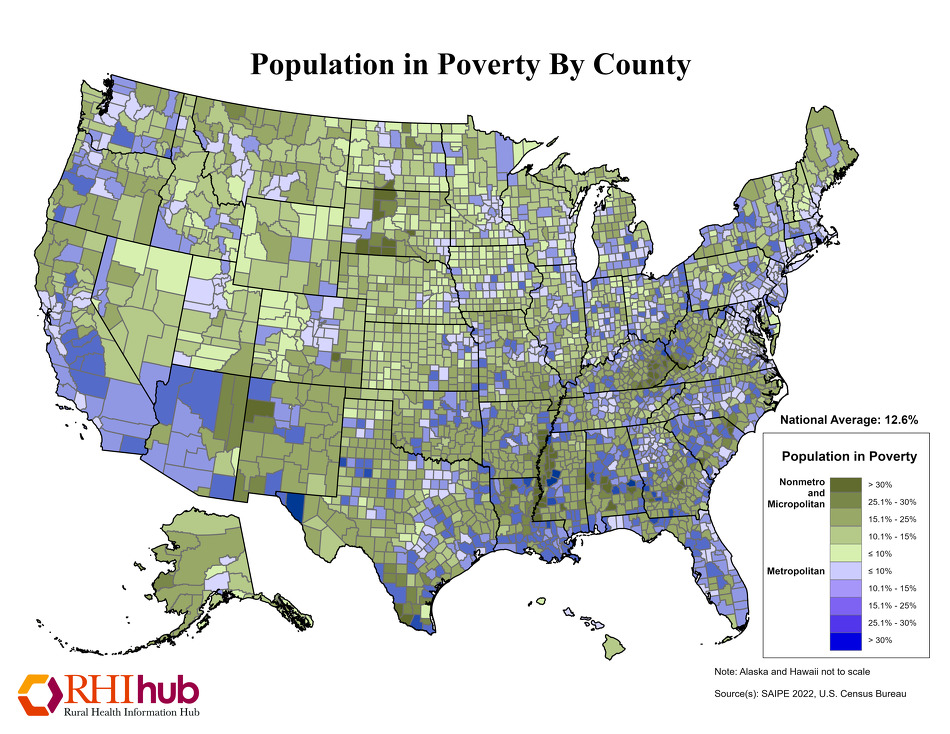
Figure 4 shows how the number of young people has changed between 2000 and 2009 in rural counties (urban counties are white and not included – red means a decrease).  Figure 5 shows population growth (or not) by county. What you see in these two maps is that the young people are moving to the rocky mountain states and vacating the high poverty counties in Figure 3.  Yong people do not see jobs in the rural area – unemployment is 20% higher in rural America and the jobs that are there pay less.  Figures 6 and 7 show unemployment by County in 2008 after the start of the Great Recession and in 2013.  What these figures show is that with exception of the Plains states and Rockies, is that many of the areas with high poverty also had high unemployment, and that the unemployment has remains stubbornly high in many rural areas in the Deep South, Appalachia and New Mexico, plus high unemployment in parts to  the Great Lakes, but the poverty rates are still lower.  Education may by a factor in why the Plains states and Rocky Mountains have less unemployment – despite being rural their students are far more likely to graduate from high school than those in the deep South, Appalachia where unemployment remains high and incomes low. 

So what does this possibly have to do with utilities?  Utilities need to understand this problem as is demands some real, on-the-ground leadership.  Small and rural utilities are more costly to operate per thousand gallons than larger utilities.  A 1997 study by the author showed that economy-of-scale manifested itself to a great extent with water and wastewater operations.  The differences were not close – it is a lot less costly to operate large utilities vs small ones.  Rural utilities complicate the issue further because not only is the number of customers limited, but the pipe per customer is less so the capital investment per customer is far higher than in urban areas.  The impact is that utilities are under pressure to reduce rates to customers, or create a set of lower cost rates for those in poverty, while at the same time their costs are increasing and infrastructure demands are incrementally higher than their larger neighbors.  The scenario cannot be sustained, especially when large portions of rural infrastructure was installed with FHA grants, meaning the customers never paid for the capital cost in the first place.  There was no or lower debt, than what larger utility customers have.  The rural rates since these investments have been set artificially lower than they should as a result. But with Congress talking about reducing SRF and FHA programs, FHA is unlikely to step in to replace their initial investment, meaning that the billions of rural investment dollars that will be needed in the coming years will need to be locally derived, and rate shock will become a major source of controversy in areas that are largely very conservative politically and tend to vote against projects that will increase costs to them.

The good news is that much of the rural infrastructure may be newer when compared to much of the urban infrastructure.  So there is time to build the argument that local investment is needed.  The community needs to be engaged in this discussion sooner as opposed to when problems occur.  Saving for the infrastructure may be the best course since rural utilities will have limited access to the borrowing market because of their size, but that means raising rates now and keeping those saved funds as opposed to using them to deer rate increases.  If ongoing efforts in the House deplete federal funding further, the pinch will be felt sooner by rural customers who will lose the federal dollars from SRF and FHA programs. 


Image

Figures 1 – Rural Counties

The United States: By Rural, Urban and Exurban Counties


Image


Figure 2.  100 lowest income Counties in the US


http://en.wikipedia.org/wiki/List_of_lowest-income_counties_in_the_United_States


Image

Figure 3.  Estimated population in poverty

http://www.raconline.org/racmaps/mapfiles/poverty.jpg


Image

Figure 4.  Where the Young People Are

http://www.raconline.org/maps/topic_details.php?topic=55


Image


Figure 5.  Where people are moving to http://www.raconline.org/maps

Image


Figure 6  Unemployment 2008

http://en.wikipedia.org/wiki/Unemployment

Image

Figure 7  Unemployment 2013 http://www.huduser.org/portal/pdredge/pdr_edge_featd_article_040


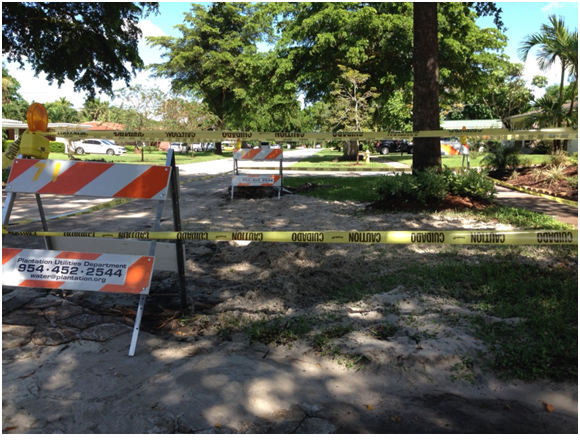
In front of house

The doorbell rang and it was 1:30 am on a Saturday morning.  It was my neighbor telling me about a small problem on the street.  I looked out and the entire block was flooded.  Water was moving. It was dark, and while my street light was working, it shed little light in the blackness.  However I figured out the old AC pipeline in front of my house had sheared and the block’s leak was actually my problem.  We had no water.  Fortunately the water department was able to get the main repaired in a couple hours.

The next morning we were not as lucky.  Another break on the next street over had shut us down again.  AC water main, but this time under a tree.  They had to remove the tree before fixing the line.  We were out all day.  The water plant guys and the repair crew said that the lines were supposed to be replaced a couple years ago, but that the City had delayed the replacement for budget problems.  


SUSTAINABILITY OF UTILITIES – PART 2

Let’s take a look at some scenarios. Let’s assume you are a utility that serves 20,000 people (8000 customers), with 60 miles of water pipe, 60 miles of sewer pipe, 17 lift stations, and a water and wastewater plant.  Replacing this infrastructure might be valued at $90 million for pipe, $35 million for treatment plants, water supply and pumping equipment (current day dollars).  Let’s also assume that their annual budget is $11 million and the typical demands are 3 MGD yielding a monthly bill of $115/mo (water and sewer).

Let’s make some general assumptions like that the pipe infrastructure might last 100 years, but clearly the treatment and mechanical parts would mot.  They would need ongoing maintenance and replacement.  50 years is probably too long, but let’s go with it.  If the overall costs increase at 3% per year and money is set aside for repair and replacement. The utility will see fairly steady rates if the customer base grows 2-3% per year.  Ten years out, the budget will be $16 million.  Now for the scenarios.

If the customer base has grown at 3% per year, the customers will increase to almost 27,000.  More of an issue is what happens if that increase in demand (from 3 to over 3.4 MGD) needs to come from a new water source and requires new capacity.  Many utilities will use impact fees to offset this cost to current customers so as not to adversely impact current customers too severely .That’s the current assumption.  The result looks like this at 10 and 20 years:


Component


Value today

10 years

20 years

Customers


20000

26878

36122


Accounts


8000

10751

14449


Water  Pipe

60 mi

 $   45,000,000

 $     98,509,418

 $215,646,786

Sewer Pipe

60 mi

 $   45,000,000

 $     98,509,418

 $215,646,786

Treatment Plants and Pumping

3 MGD

 $   35,000,000

 $     76,618,436

 $167,725,278

Operations budget


 $     9,000,000

 $     16,255,001

 $  29,358,340

Capital Budget


 $     1,600,000

 $       3,502,557

 $    7,667,441

Debt


 $        400,000

 $         400,000

 $      400,000

Monthly Amount


 $              115

 $                156

 $             216

Increase per year


5%

5%


Assume 1% of pipe Replacement Costs +2% Plant


Assume operating budget inc 3%/yr but construction increases 5%/yr


But what if the new treatment and supply are 50% more costly and impact fees assume the lower investment (typical)?  The cost for the budget and for the infrastructure replacement increases (with the delta from debt).  Cost are 50% higher:


Component


Value today

10 years

20 years

Customers


20000

26878

36122

Accounts


8000

10751

14449

Water  Pipe

60 mi

 $   45,000,000

 $     98,509,418

 $215,646,786

Sewer Pipe

60 mi

 $   45,000,000

 $     98,509,418

 $215,646,786

Treatment Plants and Pumping

3 MGD

 $   35,000,000

 $     92,289,117

 $202,029,937

Operations budget


 $     9,000,000

 $     23,731,487

 $  42,861,706

Capital Budget


 $     1,600,000

 $       3,815,971

 $    8,353,534

Debt


 $        400,000

 $       1,325,000

 $    2,825,000

Monthly Amount


 $              115

 $                224

 $             312

Increase per year


8%

7%


The normal assumptions are that growth will continue, but what if it does not?


What can be gleaned as a result of a non-growth or net decrease scenario?  How does sustainability get affected?  Let’s look at the no growth scenario.  In this light, rates will need to increase at least 5% per year to insure that the utility remains rate neutral.  If there is significant deferred maintenance, which is typical of may utilities, that cost will be added to the bill.  There are examples of utilities in Florida who finally caught up with deferred obligations which doubled their customers’ bill.  This scenario is doable, but the only real assumption changes that can be made are related to the lack of growth.  Deferring maintenance will once exacerbate the problem as there is not guarantee that growth will return.  Rate neutrality becomes a public relations issue, but not insurmountable.


Component


Value today

10 years

20 years


Customers


20000

20000

20000

Accounts


8000

8000

8000

Water  Pipe

60 mi

 $   45,000,000

 $     73,300,258

 $119,398,397

Sewer Pipe

60 mi

 $   45,000,000

 $     73,300,258

 $119,398,397

Treatment Plants and Pumping

3 MGD

 $   35,000,000

 $     57,011,312

 $  92,865,420

Operations budget


 $     9,000,000

 $     12,095,247

 $  16,255,001

Capital Budget


 $     1,600,000

 $       2,606,231

 $    4,245,276

Debt


 $        400,000

 $         400,000

 $      400,000

Monthly Amount


 $              115

 $                157

 $             218

Increase per year


5%

5%


Now let’s look at the decline issue.  If the population decreases by 25% over the ten year horizon, what does this say?  The costs will remain relatively constant, but the number of customers and demands for water will drive the rates up significantly. In ten years the rates could double in a community that is likely economically disadvantaged.  The higher rates may begin to discourage economic development, rate neutrality exacerbate the problem and may increase in costs for regulatory or deferred maintenance obligation becomes a significant issue:


Component


Value today

10 years

20 years

Customers


20000

16341

13352


Accounts


8000

6537

5341


Water  Pipe

60 mi

 $   45,000,000

 $     73,300,258

 $119,398,397


Sewer Pipe

60 mi

 $   45,000,000

 $     73,300,258

 $119,398,397


Treatment Plants and Pumping

3 MGD

 $   35,000,000

 $     57,011,312

 $  92,865,420


Operations budget


 $     9,000,000

 $     12,095,247

 $  16,255,001


Capital Budget


 $     1,600,000

 $       2,606,231

 $    4,245,276


Debt


 $        400,000

 $         400,000

 $      400,000


Monthly Amount


 $              115

 $                193

 $             326


7%

7%


Assume 1% of pipe Replacement Costs +2% Plant


Assume operating budget inc 3%/yr but construction increases 5%/yr


 What can we glean from this?  Interestingly the failure to accumulate costs for growth, and the declining rate base end up with similar monthly costs.  Only by the no growth and collecting appropriate impact fees will costs be controlled, and even in that case, costs will double every 20 years or less.  The reality is that the failure to follow proper revenue collection protocols will severely limit the utility in future years.  High capital costs impact rates significantly.  Leaving it to some future commissioner to raise the rates is unfair to both the future decision-makers and customers.  It does not make you a leader either. 


Why are health care costs increasing so fast?  Did you ever wonder about that?  We keep hearing about how health care costs, Medicare, Medicare, Obamacare are going to bankrupt us, but why is that?  Why are the cots going up so fast?  It is an important challenge for local officials and utilities who generally pay the health insurance costs for their workers.  There is more to the story that we are not being told.

One problem that get identified quickly is that only 80% of the population is included in the health care system.  Many who are not are “healthy” young people who don’t demand the services.  The concept of the health care bill was to solve this problem by spreading the costs of health care across the entire population using private and public providers.  First, I think there are way more unhealthy  people included in the 20% than we realize because the political dialogue keeps focusing on the few that want to live off the grid – I feel great so I don’t need insurance.  That guy is part of the problem.  That guy gets into a car accident, gets taken to a public hospital, gets treated, gets a bill for $26,000 to fix his broken leg, refuses to pay anything, and the taxpayers get stuck with the bill.  My solution to that guy is if you don’t want to pay for health insurance, bring cash.  Otherwise, “no soup for you!” to paraphrase a famous Seinfeld episode.  Of course my doctor, nurse and therapy friends think that’s a little cold hearted. 

The next argument is the cost of doctors, therapists and nurses.  Okay, I know a bunch of them, and that’s not where the money goes.  These people have lost money in the past 10 years.  Many are going form full-time to part-time employments as Medicare, Medicaid and health insurance bureaucrats decide services are no longer needed.  They will tell you the major change in their lives is paperwork….hold that thought for a moment.

The cost of drugs comes up.  Medicare and Medicare are the largest purchasers of pharmaceuticals in the world.  So in other works, they set the lowest price by supposedly bidding the “contracts” for services. Only there is often only one provider, so exactly how does that work?   Sounds like we don’t get a good deal there, which is why the arguments for importing Canadian drugs or drugs from Mexico keeps popping up.  They get a better deal than we do and most of these are supposedly AMERICAN companies.  No home town discount (I guess I know where free agent baseball players get the idea).   And my medical friends confirm this as an issue.  Check out the comments from Mr. Falloon at Life Extension (www.lef.org) for discussion. 

So let’s go back to the paperwork discussion.  Once upon a time doctors simply sent a little paperwork to the health insurance company or the federal government and said you needed some service.  And the insurance company processed the bill for the services.  The cost was paid by insurance premiums collected by the insurance company.  Everyone was happy.  But then someone at an insurance company said, “wait we could make more money if we asked more questions and paid less for these services.  It would help our bottom line.”  So you hear the complaint that the folks at the insurance companies are deciding whether you need that procedure or not.  And contractors decide if someone needs Medicare or Medicaid services, not the government, not your doctor, your nurse or your therapist.  Not any person that knows you, but some unseen, private sector bureaucrat who’s goal is to minimize the amount of your premium spent on services so they can enhance their bottom line.  And apparently they are very effective because the health insurance industry is very lucrative.  So maybe we have stumbled onto something here.  Maybe the cost of medical coverage is more related to drugs and bureaucracy (and it is not government bureaucracy!!) than the actual cost of services.  Maybe the old system, even if there was some fraud in it, wasn’t nearly as bad as it was made out to be.  It reminds me of one of the 4 laws of City management I developed years ago:  Never give elected officials a bad alternative – it becomes a magnet.  It always worked (hence a law).  I didn’t learn why until years later when I realized, that the worst option was the one all the lobbyists lobbied for even at the local level.  It was the option where they could make the most money “fixing


A new GAO report suggests that the short and long-term future for state and local revenues may be more difficult that currently anticipated, despite the economy recovering in many places.  My last blog outlined a number of the problems including that many public entities chose to reduce tax rates to balance the budget as opposed to restocking reserve funds.  When property values plummented and tourism and consumer buying diminished, the taxes related to all three plummented as well.  None have yet returned to their pre-2008 levels.  The failure to stockpile reserves caused many governments to spend down what limited reserves they had in the past 5 years as a means to avoid the hard and unpopular decision – raising taxes to collect the same revenues as before the mid-2000s cuts.  Now the lack of reserves creates an issue going forward – as costs increase faster than revenues, there are no reserves to tap into.  It is a problem that just keeps on giving. –

As I noted, I never like Chicken Little, because he never had a solution for the problem. There are solutions for local governments, some good and some bad.  Clearly local governments need to revisit the revenue production tools.  Taxes and fees will go up.  Taking more money from the utility, an all too popular decision in the past 5 or more years IS NOT THE ANSWER!  That just transfers the problem to the utility system and we already know that there are huge amounts of deferred maintenance and capital projects with utilities – $300 billion and counting at last count. The utility should be run as an enterprise, not as a cash cow to avoid hard political decisions.  Solutions for replacing those ARRA funds and federal grants for police are needed.  Just saying “We ran out of money so lay those people off” is not a solution.  What that is, is poor leadership and planning – a failure to develop the investment made by the feds to better the fiscal position of the community.  A lost opportunity.

There are many options.  And we can lay blame at the feet of elected officials, but it does not all belong there.  The citizens who elect those officials, are to blame.  Most elected officials react to citizenry, not the other way around.  And don’t forget the managers who bring bottom line business practice to local government management who recommend options. We’ve lost a generation of good government managers who understood the service aspect of government who have been banished in favor of the bottom line approach.  We need to change this as well. 

A more entrepreneurial spirit is needed.  I recall a prior entity I worked for where we proposed doing lab work in our certified water lab for other utilities.  That got shot down because it was “unfair to compete with the private sector for this work.”  Really?  That sounds like a private sector red herring.  They know they will lose business, and they can’t compete.  How is that in the spirit of capitalism? It cost less for other entities to have us do it?  A huge missed opportunity.  There are many.  If we want government to operate more like a business, we need accept the opportunities that come with it, not quash them. 

We need to market the community.  Not just give money away hoping to attract businesses that will locate for a short while.  That certainly has been a fiasco in Florida.  Other places as well I am sure.  No, we need to “sell ourselves.”  We need to marketing program to distinguish the community, its assets, its water and sewer reliability and quality, its people, education and opportunities.  It means spending money to invest in the community, not just spending money to fix a few roads and install some pavers, although they are good.  It’s also not just fixing up the distressed neighborhoods, but investing in the better ones as well. The most distressed City in America is quietly encouraging new artists and startup businesses to relocate to Detroit to take advantage of the availability of warehouses, cheap rents and a talented workforce.

We need to avoid the pitfalls of falling victim to reinforcing the past.  Florida’s economy is based on tourism, agriculture and building housing to attract retirees.  Weird business model.  Two of the three are highly susceptible to economic disruptions.  We are still recovering from 2008.  The economy also produces mostly minimum wage jobs, not the way to build a better tax base of encourage investment in education.  The state manufactures nothing, yet fails to take full advantage of what assets it might have to create industry.  As Sun-Sentinel writer Stephen Goldstein noted recently, why is it that south Florida has yet to take advantage of the private sector interest in investing in understanding age –related diseases?  Much of the local economy and the two local public universities are not positioned to take a leadership role?  Yet it is an easily marketed issue given the current population, assuming funds can be secured.  Public investment is needed, and of course that’s the rub.

We can market ourselves.  May communities have.  And most deserve better than their current lot in life.  Alexis de Tocqueville,” you get the government you deserve.”  I think we deserve better, and I think we can do better.  I think we can develop a better future and I think we can overcome challenges.  So maybe it is time for to us to change the perspective!


Jim DeMint is a smart guy.  He parlayed a short stint as a Tea-Party Senator from South Carolina into a million dollar a year executive position with a conservative think tank.  Then he sends out surveys to figure out where the “public” stands on certain issues.  For example: 

Because of uncontrolled spending, the federal government ran a $4 trillion budget deficit for 232012 and our national debt is not a staggering #16 billion.  Do you want Congress to take serious action to rein in out-of-control spending?  Yes or no. 

Ok, first the deficit was not $4 trillion in 2012.  So that’s a lie.  But what are the other options?  Reining in spending is not the only option, but it is the only one given.  Certainly the question is most likely to get a “yes” answer which is exactly what DeMint’s organization is looking for. 

Let’s look at another one.  

How would you consider yourself politically:  Very conservative, somewhat conservative, Independent, but lean conservative, independent, but lean liberal, somewhat liberal and very liberal.  

Clearly a “you are either with us or against us” question, but one that tells you everything you need to know about Congress and politics in general.  You can’t be in the middle.  You can’t draw the best ideas from both sides of the aisle.  Precisely the problem gripping Washington and many State capitols.  No one can compromise, so we get sequestered.  This type of polarization does not help America move forward nor does it help use solve problems. It increases the burden on local governments to address the problems that the failure to compromise at higher levels allow to persist, or may even create.