You asked for more figures – so here you go Very cool stuff. All done by students.


You asked for more figures – so here you go Very cool stuff. All done by students.


Collaboration between students, faculty and the real world is an excellent means to integrate students into real world situation and provide them valuable experience. I have done this with several communities to date. Below are the installed OASIS street improvements in Dania Beach. Students did the drafting. Also a stormwater pipe in Boynton Beach. Excellent learning experience. The campus mapping project is one that our Facilities Management Department needed. Very cool 3D map. We did stormwater assessments in Davie, plus flood mapping. Of course the Dania Beach nanofiltration plant, the first LEED Gold water plant in the world. Still. Here is the cool thing with working with students – they have all kinds of ideas and have all kinds of tools that they can access – they just need guidance. They will create tools (our app for asset management). to make the job easier. Most collaborate well. And most want to learn about the profession. As an industry we should promote this more. Go to the local universities, talk with faculty. Find the right faculty mentor who is interested in local outreach. Work with them. But students should not work free. Pay or pay in grades. It’s only fair.
Asset management plays a vital role to help minimize unnecessary or misplaced spending while meeting the health and environmental needs of a community. The goal is to provide strategic continuous maintenance to the infrastructure before total failure occurs. Costs should be well distributed over the life of the asset to help avoid emergency repairs. Emergency repairs can cost up to multiple times the cost of a planned repair. Therefore the ultimate goal of asset management is to provide quality, economical infrastructure by identifying the system’s needs and addressing the needs appropriately. At some point repairs cost more than replacement, or technology may make repairs obsolete.
An asset management program should be developed accordingly to the client’s goals and objectives. It consists of determining the selected area of study, type of system and the quality of data used for evaluation (see Figure 1). Before a condition assessment can be determined, an inventory of assets needs to be established. Depending on the accuracy wanted, the data can be gathered in many ways ranging from onsite field investigation which could take a lot of time, to using existing maps, using maps while verifying the structures using aerial photography and video, or field investigations. Not doing destructive testing is important to reduce costs. The question is how you do it. One project we did was the downtown area of Dania Beach. You can see the areas that are a problem.

Figure 1
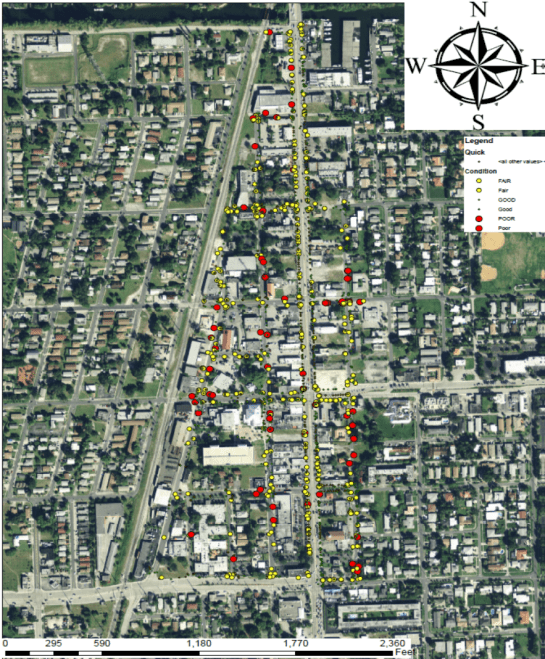
FIgure 2
Public infrastructure has been poorly rated by the American Society of Civil Engineers and most public officials acknowledge the deterioration of the infrastructure we rely on daily. However, many jurisdictions have limited information about their systems, and little data to use to justify spending. The resistance to impose fees or taxes to upgrade infrastructure also remains high. Hence the infrastructure tends to deteriorate further each year. At present the United States spends about 1.6% of its GNP of infrastructure, as compared to 3.1 % prior to 1980. Half as much money, and a large portion of that was for growth as opposed to repair and replacement. Hence the need for better tools for asset management.
Utilities that utilize asset management programs experience prolonged asset life by aiding in rehabilitation and repair decisions while meeting customer demands, service expectation and regulatory requirements. The general framework of asset management programs involves collecting and organizing the physical components of a system and evaluating the condition of these components. The importance and the potential consequences associated with the failure of the individual assets are determined by this evaluation. Managers and operators can then prioritize which infrastructure are most critical to the operation of the system and furthermore which infrastructure to consider for repair, rehabilitation or replacement. It is a continuously reviewed and revised strategy that implements the acquisition, use and disposal of assets to optimize service and minimize costs over the life of the assets. An asset management plan (AMP) considers financial, economic and engineering goals in an effort to balance risk and benefits as they relate to potential improvement to the overall operation of the system.
Over the last 2 years, we have been working to develop a means to quickly, effectively and in a cost efficient manner to collect data and assess public infrastructure using simple, readily available means, without the need for significant training and expertise. The idea was to use student efforts to coalesce a common evaluation without the need for destructive testing. There are three successive projects used to improve the collection of data for ultimate use in an asset management program. Students were provided with Leica and Trimble units to gather data. For the first project, an app was created by FAU students that included photographic tools and entries to document the asset condition and location and permit offsite QA/QC from the cloud. This app was initially developed for stormwater, but was updated to include all public assets for the second community. Data retrieval was created to be able to log data directly onto a smart phone or tablet in the field to save time and the information is instantly downloaded to the internet for quality assurance. The collection system also was programmed with a condition index to help with organization A session was held in the field with student groups to normalize the assessment process. The approach began with an inventory and location of each asset. The assets were field inspected and assessed for condition. A numbering system and photographic tools was used to document the asset condition. This was accomplished by physically locating each asset in the field and marking it with a global position system (GPS) coordinate which allowed the data to be populated in a geographic information system (GIS) and organized with the other assets of the system
The results include this senior design project by our geomatics students. It is a 3-dimensional map of all infrastructure from the ground down on FAU’s Boca Raton campus. 800 acres and over 5000 points, many of which must be stitched together. They also created building extrusions for a future project. Very cool and useful from a tablet. So the question is – do you have a 3D map of your utility?
 Curtailed water use and conservation are common topics of conversation in areas with water supplies limitations. As drought conditions worsen, the need for action increases, so when creating a regulatory framework, or when trying to measure water use efficiency, water supply managers often look for easily applied metrics to determine where water use can be curtailed. Unfortunately, the one-size-fits-all mentality comes with a potential price of failing to fully grasp the consequences decision-making based on such metrics.
One of the issues that water supply regulator like to use is per capita water use. Per capital water use is often used to show where there is “wasted” water use, such as excessive irrigation. However such a metric may not be truly applicable depending on other economic factors, and may even penalize successful communities with diverse economic bases. A heavy industrial area or dense downtown commercial center may add to apparent per capita use, but is actually the result of vibrant economic activity. Large employment centers tend to have higher per capital use than their neighbors as a result of attracting employees to downtown, which are not included in the population.
In south Florida, a recent project I was involved with with one of my students showed that while there was significant variability among utilities, but the general trend of increased economic activity was related to increased per capita use. Among the significant actors were health care, retail trade, food service and scientific and technical services. It appears to be these sectors that drive water use upward. As a result when evaluating the efficiency of a utility, an analysis should be conducted on the economic sectors to insure that water regulations do not stifle economic growth and jobs in a community. And conversely if you do not have these sectors, you water use should be lower. Something to think about when projecting or regulating water use. Limited water use may in fact be limiting economic activity in the area. Of course if you are water limited, limited new withdrawals may be perfectly acceptable if you want to encourage other options, like direct or indirect potable reuse, irrigation, etc.
It would be interesting to expand this study across the country to see what the national trends look like and how different tourism oriented South Florida might actually be.

Water and wastewater utilities spend a lot of time dealing with current issues =- putting out “fires.” But there are larger trends that will affect the industry. Here are a couple recent topics that we should consider in our industry:
Will robots be doing all our repetitive jobs? If so what does that mean for all the people doing those jobs now. Most do not require a lot of skills, and many of those in the jobs that will be lost, do not have the skills for other jobs? Does the $15 per hour minimum wage accelerate this transition? How does this affect the water industry? Meter readers might be replaced with AMR systems. Customer service is already migrating to direct banking. There is a change coming.
What does the driverless car mean for us? I am thinking about an old Arnold Schwartzenegger movie. For utilities the issue may be how we interact with unmanned vehicles, especially when what we do can be disruptive to traffic. What happens if those cars get into an accident? And Warren Buffett is thinking about the impact of this on the insurance industry. He owns a lot of GEICO stock. It is doubtful many utility vehicles will be unmanned, in the near-term, but do our manned vehicles and the potential disruption leave us open to greater risk of loss?
Speaking of Warren Buffett says the economy is far better than certain candidates suggest. I tend to trust Mr. Buffett. He’s been doing this a long time and has been fabulously successful. But he notes structural changes to the economy like those noted above, are ongoing. That will create conflict for certain professions that migrate to automation, much as manufacturing did in the 1970s. He raises concern about what happens to those workers and suggests that we have not planned enough for those workers who get displaced as the economy undergoes continuing transitions. In the late 1970s we had CETA and other jobs training programs as we moved from manufacturing to other jobs. He does not see that in place now. The at-risk – the poor, minorities, the less educated, rural citizens…. in other words, the usual groups will be hit harder than the rest of the population. I don’t hear that discussion on the campaign trail but utilities may want to follow these trends is the hope that we can acquire some of the skillsets that we need. Or provide that training.
Florida’s flood protection plan received a C- from a study called States at Risk. It said Florida lacks a long term plan for rising seas, despite being vulnerable. On an unrelated note, the state is expecting insurance premiums to increase 25% or more for flood insurance for homeowners. And local officials are working busily on FEMA maps to exclude as many properties as possible from flood insurance requirements. Maybe those things are all related, just at opposite purposes, but who is going to get the calls when flooding occurs? Storm water utilities, and sewer systems where the manholes are opened to “facilitate drainage.” The question is what the ratings are for other states as Florida was not the least prepared nor is it the only state with exposure.
A final current trend to think about is this: Current sea level rise projections have increase the high end, but remained steady for the 50 percentile case. By 2200 we may see seas at 10 ft higher. That would be a major problem for south Florida. But the world population will be over 15 billion, which exceeds the carrying capacity of agriculture (at present projections and techniques). It also places over half the world in water limited areas. So sea level rise is going to be huge in south Florida, but will concern be localized because of more pressing issues? Is the number of people going to be our biggest issue in 2200? Note both will be critical for a large portion of those 15 billion people, but the solution to either is…..?
Congratulations FAU owls for placing 7th overall at the Southeastern ASCE student Competition. (28 schools) In under 15 years we moved into the top 10 in a region with SEC schools like Alabama, Auburn, and Vanderbilt (that we finished ahead of), Tennessee and Florida (#2 and 3). It’s FAU’s first time in the top 10. It is a good launching point for next year when FAU hosts the competition – Civil Goes Green in 2017 (for St. Patty’s day). And you all should be there! Sponsorships available. 🙂

http://public.eng.fau.edu/design/asce2017/index.html
For those wondering what the big report was going yo say, interesting reading, and a lot like Walkerton – plenty of blame to go around.
Click to access FWATF_FINAL_REPORT_21March2016_517805_7.pdf
And some related articles:
http://www.fox2detroit.com/news/flint-water-crisis/112311306-story
How to Predict the next Flint?
 In the last blog we talked about Flint’s water quality problem being brought on by a political/financial decision, not a public health decision. Well, the news get worse. Flint’s deteriorated water system is a money thing as well – the community has a lot of poverty and high water bills, so they can’t pay for improvements. They are not alone. Utilities all over the country have increasing incidents of breaks, and age related problems. So the real question then is who are the at risk utilities? Who is the next Flint? It would be an interesting exercise to see if a means could be developed to identify those utilities at risk for future crises, so we can monitor them in more detail as a means to avoid such crises.
So what would be the measures that might identify the future “Flint?” These could be things like age of the system, materials used, economic activity trends, income, poverty rate, unemployment rate, utility size, reserves, utility rates, history of rate increases, etc.? Could these be developed into a means to evaluate risk? If so, who would use it and how would we address the high risk cases? I suggest that lenders have means to evaluate this using many of these same measures, but from a risk of events, this method has not been applied. So I think this would be a useful research project. So if anyone has some ideas, time or ideas for funding, let me know. Let’s get rolling!
 publicutilitymanagement