Archive

Risk


The good news is that for many local governments, property values are up and so is the economy, especially in urban areas.  However that does not mean that the budget approval difficulties of 2009-2012 have passed or been resolved.  In fact the arguments may continue despite improvements in financial position.  Why?  There are a number of policies that were implemented in the recession years that were especially difficult for utilities:

  1. Borrowed or transferred water and sewer monies to avoid raising taxes against falling property values (note that raising taxes on falling values would have yielded a zero sum game, but raising taxes commensurate might have “un”elected a few people
  2. Failing to have long-term financial plan and even fewer have multiyear budgets.  Included are automatic rate adjustments that some are questioning or deferring now, despite having been approved several years ago
  3. Bad investments – public or private.  In either case, if the revenues are not realized, the local entity gains no benefit.  This can include public private infrastructure investments, privatization or investing cash.  Scenarios need to be created to figure out what happens when things don’t go as planned.
  4. Failing to save for a rainy day before the crash.  Our grandparents knew we need to save for a rainy day.  We talk about the lowered level of savings among Americans and the potential issues that could arise if economic difficulties occur.  So exactly why do our elected leaders think it is a great idea not to collect monies in good times for a rainy day?  Other than politics that is?


We have identified four errors in public policy at the local level.  The questions for the 2015 budget are:


  1. Can we repay those funds we “borrowed” from during the down years?
  2. Can we keep the total revenues increasing (may not mean a tax increase, but certainly not a rollback)?
  3. Can we develop realistic scenarios for public investments.  Nothing worse than stranded infrastructure like that $6milion parking garage that grossed under $100 in the last 6 months because no one uses it because there is not business need for it.
  4. Can we develop reserve policies that allow local governments and especially utilities to create and maintain repair and replacement funds, reserves, and “savings” for the next rainy day.  It’s coming.  At some point.
  5. Can we develop a 5 year plan of where the community vision is?

I think this would be a start for a lot of us.


We are all cognizant of the low grades on infrastructure given annually by ASCE and periodically by USEPA.  We spend about 1.8% of our GNP on infrastructure.  We used to spend twice that much and it is likely that we need to spend upwards of 2.4% to stay even.  Much or our infrastructure is “forgotten” because it is buried.  American Water Works Association published a book to highlight his problem – Buried No Longer.  But is it helping.  In a recent Roads & Bridges article, they noted that the bridge system continues to age faster than the repair rate.  The states with more than 15% deficient bridges are mostly Great Plains states, and the northeast.  The latter is no surprise because the infrastructure is generally much older in the northeast.  What was also interesting was that in a recent American City and County magazine, many of the states that have bridge issues, also have below average trust among the public.  And most of the areas with the bridge issues are rural states, like North Dakota and West Virginia.  This harkens back to a prior couple blogs when it was noted that poorer, less educated people tend to live rural lifestyles, and lobby for less taxes, yet expect government to be there to resolve crises.  Interesting….


In the last blog we discussed 10 planning steps for sea level rises.  When planning 50-100 years other factors can come into play as well.  As a result, to allow flexibility in the analysis due to the range of increases within the different time periods, an approach that uses incremental increases of 1, 2, and 3 feet of SLR is suggested.  Hence infrastructure is built to meet milestones, not arbitrary dates lessening the potential for stranded assets.. The increments can work as threshold values in planning considerations in terms of allowing planners the ability to know ahead of time where the next set of vulnerable areas will be to allow a for proactive response approach that can be matched to the observed future sea levels.

But prior to developing infrastructure plans, the local community needs to define an acceptable level of service (LOS) for the community. A level service would indicate how often it is acceptable for flooding to occur in a community on an annual basis.  1% is 4 days per years and for a place like Miami Beach, this is nearly 2 ft NAVD88, well above the mean high tide.  The failure to establish an acceptable LOS is often the cause of failure or loss of confidence in a plan at a later point in time.  The effects of SLR of the level of service should be used to update the mapping to demonstrate how the level of service changes, so that a long-term LOS can be defined and used for near-term planning.

With the LOS known, the vulnerability assessment is developed using a GIS based map of topography and the groundwater levels associated with wet and dry season water levels.  LiDAR is a useful tool that may be available at very high resolution in coastal areas.  Topographic maps must be “ground-truthed” by tying it to local benchmarks and transportation plans.  USGS groundwater and NOAA tidal data from local monitoring stations to correlate with the groundwater information. Based on the results of these efforts, the GIS-based mapping will provide areas of likely flooding.

GIS map should be updated with layers of information for water mains, sewer mains, canals, catch basins, weirs and stormwater facilities.  Updating with critical infrastructure will provide a view of vulnerability of critical infrastructure that will be funded by the public sector. Ultimately policy makers will need more information to prioritize the needed improvements.  For example, a major goal may be to reduce Economic Vulnerability.  This means identifying where economic activity occurs and potential jobs.  At-risk populations, valuable property (tax base) and emergency response may be drivers, which means data from other sources should be added.

The next step is to analyze vulnerability spatially, by overlaying development priorities with expected climate change on GIS maps to identify hotspots where adaptation activities should be focused. This effort includes identification of the critical data gaps which, when filled, will enable more precise identification of at risk infrastructure and predictions of impacts on physical infrastructure and on communities. The final deliverable will include descriptions of the recommended concepts including schematics, cost estimates, and implementation plan.

So why go through all this.  Let’s go back to the beginning.  It has to do with community confidence in its leaders.  Resident look at whether their property will be protected.  Businesses look at long-term viability when making decisions about relocating enterprises.  The insurance industry, which has traditionally been focused on a one year vision of risk, is beginning to discuss long-term risks and not insuring property rebuild is risk-prone areas.  That will affect how bankers look at lending practices, which likely will decrease property values.  Hence it is in the community’s interests to develop a planning framework to adapt to sea level rise and protect vulnerable infrastructure through a long-term plan.  Plan or….


We all know that our infrastructure is deteriorating.  Deferred maintenance increases the risk of system failure. The need for capital reinvestment within the utility industry has historically been very low. As a result, in its “2013 Report Card for America’s Infrastructure,” the American Society of Civil Engineers assigned a grade of “D” to America’s drinking water systems, citing billions of dollars of annual funding shortfalls to replace aging facilities near the end of their useful lives and to comply with existing future federal water regulations (ASCE, 2013).  AWWA estimates that investments of at least $1 trillion are needed over the next 25 years.

While a pay-as-you-go capital funding seems like the best way to go, that is difficult to accomplish with the large outlays needed to upgrade the infrastructure system and the controls on rates often exercised by local officials.  As a result, borrowing is required and the condition of infrastructure and the lack of reserves are a part of how the utility is viewed by those who lend monies.   Utility managers need to understand how the lending agencies evaluate risk. 

Lenders use many tests.  Among them are: whether the utility’s annual depreciation expense is used of accumulated as reinvestment in the system, whether adequate reserves are present, whether  annual capital spending that is below the amount of annual depreciation and the amount of revenues in excess of projected debt (debt service coverage).  The target debt service coverage may depend upon the requirements of the underwriter, the rating agencies and the investors.  Debt service coverage could be as low as 15% or as high as 50%.  In 2012, the median all-in annual debt service coverage excluding connection fees for utilities rated “AAA” by Fitch Ratings was 220%, while the median for AA-rated and A-rated utilities was 180% and 140%, respectively. (Fitch, 2012).  

A working capital target of 90 days of rate revenue is a minimum, but since 2008, more is likely to be required depending on the size of the system and the history of revenues.  Where the revenues were stable despite 2008, less may be required.  For those utilities that suffered major decreases, reserves should be far larger – perhaps a year or more.  Other criteria that could be used to evaluate the projects when borrowing money include public health and safety, regulatory compliance, system reliability, the risk and consequences of asset failure, redundancy, community/customer benefit  and sustainability. At the same time, the expectation is that  the utility systems that retain all monies in the system to be utilized to improve the system and pay for debt service, except those used  for the purchase of indirect services from the General Fund that are justified with indirect cost studies. 


Despite the above, rate are an issue.  Fitch Ratings has indicated that it considers rates for combined water and wastewater service that are higher than 2% of the median household income – or 1% for an individual water or wastewater utility – to be financially burdensome (Fitch, 2012).  The Environmental Protection Agency (EPA) considers that rates for an individual water or wastewater utility that are greater than 2% of median household income may have a high financial impact on customers. (EPA, 1997). Utilities with a stronger financial profile might have residential charges for combined water and wastewater service that are less than or equal to 1.2% of median household income, or less than or equal to 0.6% for an individual water or wastewater utility. All revenues generated through system operations generally must remain within the system and can only be used for lawful purposes of the system.

Canadian utilities employ more formal polices to establish fiscal policies to provide reserves to insure stability in the event of unforeseen circumstances. Reserve targets focus on ensuring liquidity in the event there is an interruption in funding, increased capital costs due to new regulatory requirements or a short term funding emergency – all the issues evaluated by the bankers.  Reserve targets are policy decisions. Benchmarking is an evolving practice within Canadian public sector utilities particularly as it relates to financial planning and capital financing. The benchmarking exercise provides valuable information to help assess fiscal performance, the needs of customers, and provide the tools to help support optimum performance. 


We have talked about reserves, the need for them, reasons why they are neglected and how to establish appropriate numbers (an area where more research is needed).  Reserves are an issue when the economy tanks.  We all recall the problem in 2008, but this is where utilities need to look beyond just their system to see what might be coming.  2008 was a problem that we should have seen coming, or at least planned for, but did not.  But it means that we need to look at the national and local economic picture and understand a little about events beyond our reach that can affect us.  Utilities and governments generally do not do this well. 

In 2005-2007, it was very clear we had a property bubble going on.  There was discussion on the news, financial channels, Wall Street Journal and even columns by economist like Paul Krugman.  A few of us may have taken advantage of the bubble through prudent real estate sales, but many did not.  Likewise, few utilities or governments planned for its inevitable fall.  After the crunch hit, those who owed the least amount of money, had savings and had stable incomes fared better than those who did not.  Same for governments.  Unfortunately most Americans and most governments fell into the “did not” category. 

So let’s look at a couple issues.  First, we knew there was a bubble and should know that all bubbles pop.  We had the tech stock bubble in the late 1990s.  People on Wall Street knew that the investments had turned to real estate and bankers where busy loaning money out with no interest for two years, no money down, adjustable rate mortgages and the like.  If you owned a computer you were inundated with Countryside and various other folks trying to loan you money.  Or buy your house and pay you an annuity if you were older. 

The reason that these “opportunities” were so prevalent was to help speculators who expected to own the property for short periods of time, or help those who might not have the means to buy time to get the means to support the payments.  All the subsequent financial instruments discussed in books like “Too Big to Fail” come from tools used by bankers to disperse the risk associated with speculators and the risky.  It made money for bankers and investment houses (remember they are private businesses beholden to their private stockholders). 

Like all bubbles, we get caught up in the money being made by speculators (and yes if you invest in the stock market you are speculating).  We try to grab onto the rising instruments to get ahead, but we forget that especially with real estate, the growth overall rate across the nation could only grow at the rate of population growth.  It is basic supply and demand. 

For governments, revenues rise, especially during real estate bubbles.  Some bubbles last for years, which creates a distorted view of the future.  In south Florida, there was a lot of buzz concerning water supply projections and arguments between regulatory staff and utilities over water supplies that were projected 20 years in the future, based on demand projections from 2000-2005.  When the dust settled in 22011, most of those issued disappeared because virtually all projections were substantially revised downward.  And most revenue growth projections were likewise revised downward and capacity needs delayed.  Planning 20 years out is historically inaccurate because the global economy can impact local growth.

Of course these new projections are incorrect as well.  Because the test period was 2005-2010 or 2000- 2010, the growth is stunted.  So they are likely underestimating demand and revenues.  Uncertainty with time means that the accuracy of projection decreases with time.  As a result, simply relying on past projection methods increases risk that of significant deviations.

I do an exercise n class where I give students three sets of projections.  10 years apart, for 50 years.  I tell them nothing else.  The examples are The State of Nevada, Cleveland, and Collier County, FL.  All are in the past (Cleveland is 1910-1950) There is absolutely no easy method that can project the growth in either Collier County or the State of Nevada, or that Cleveland’s population will drop in half. We could do the same with Detroit and never project that decrease either.  But when you tell them where the population are and what year, the wheels start to turn.  They realize that economics is a major issue.  While Nevada and Collier grew from 1960-2000, the rate of change is likely to be very different in 2010 to 2020 due to the 2008 recession. 

Tracking economic activity is a utility responsibility.  We need to know what is really happening, and understand bubbles.  We need to recognize that when property values and housing number increase fast, it will be short term.  Plan for savings and reserves.  Figure out what your recovery period might be.  We need to understand our economic base.  For example try this out and see what your conclusion is.  Florida’s economy is based on three major industries: agriculture, tourism and housing.  What could possibly go wrong with that model?  Well if we have an economic problem nationally, 2 of 3 take major hits because people outside the state do not travel to Florida and retirements get put off.  The economy gets hit hard and recovery is slow.  We have experienced that exact phenomenon from 2009 to date.  And many of those jobs are low wage positions which means the people who struggle most get hit hardest.  Storm events can impact the state.  Bit hits to all three, and agriculture is also a low wage industry.  It is a precarious economic model that sets itself up for potential fluctuations.  We need to plan for this.  It is our responsibility, utility staff and decision-makers to plan and prepare for the next big event.  

Several weeks ago we looked at the phenomenon of population, income, education and unemployment.  The impact to from the combination of these factors in certain communities can be difficult.  Let’s explore a little further as there is more, interesting data every day.  The US Department of Agriculture is releasing its report of rural America.  The findings are interesting and counter-intuitive to the understanding of voters in many of those communities.  Their findings include:

  • The rural areas grew 0.5 % vs 1.6% in urban areas from mid-2011-mid 2012
  • Rural incomes are 17% lower than urban incomes.
  • The highest income rural works (95th percentile) earn 27% less than their urban counterparts
  • 17.7% of rural constituents live in poverty vs 14.5% in urban areas
  • 80% of the high poverty rate counties were rural
  • All the high income counties are urban.

Wow!  So the ghetto has move to the country? According to these statistics there is truth in that statement.  Let’s look a little further using some on-line mapping. 

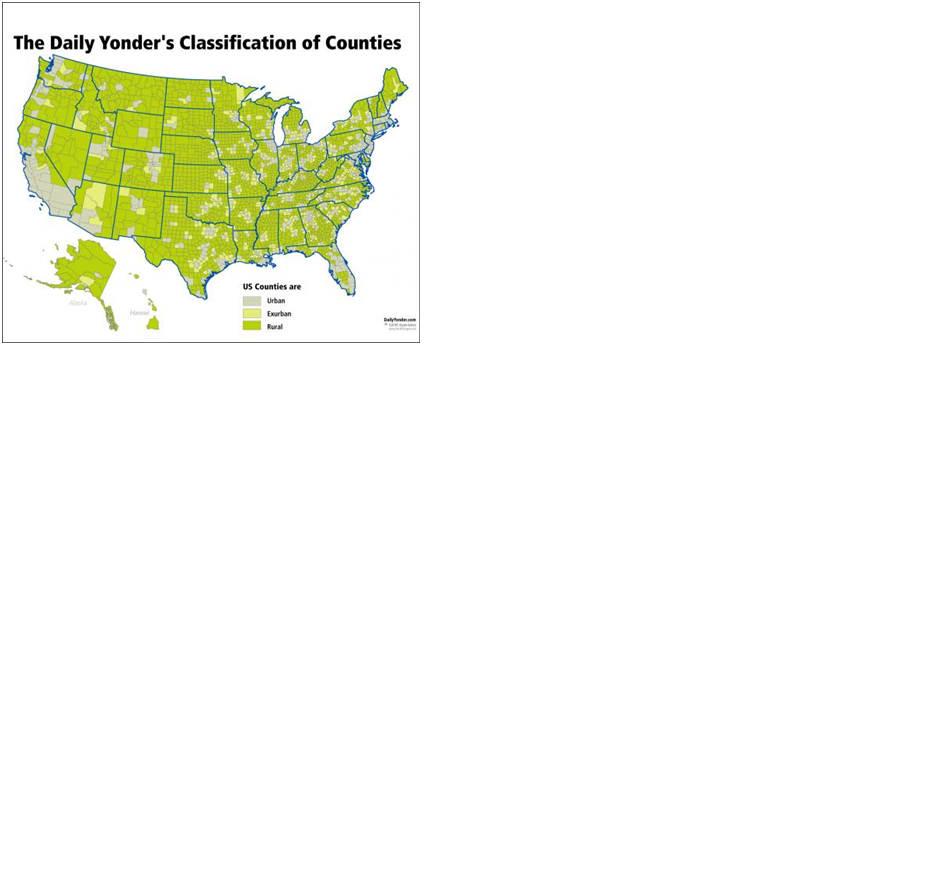
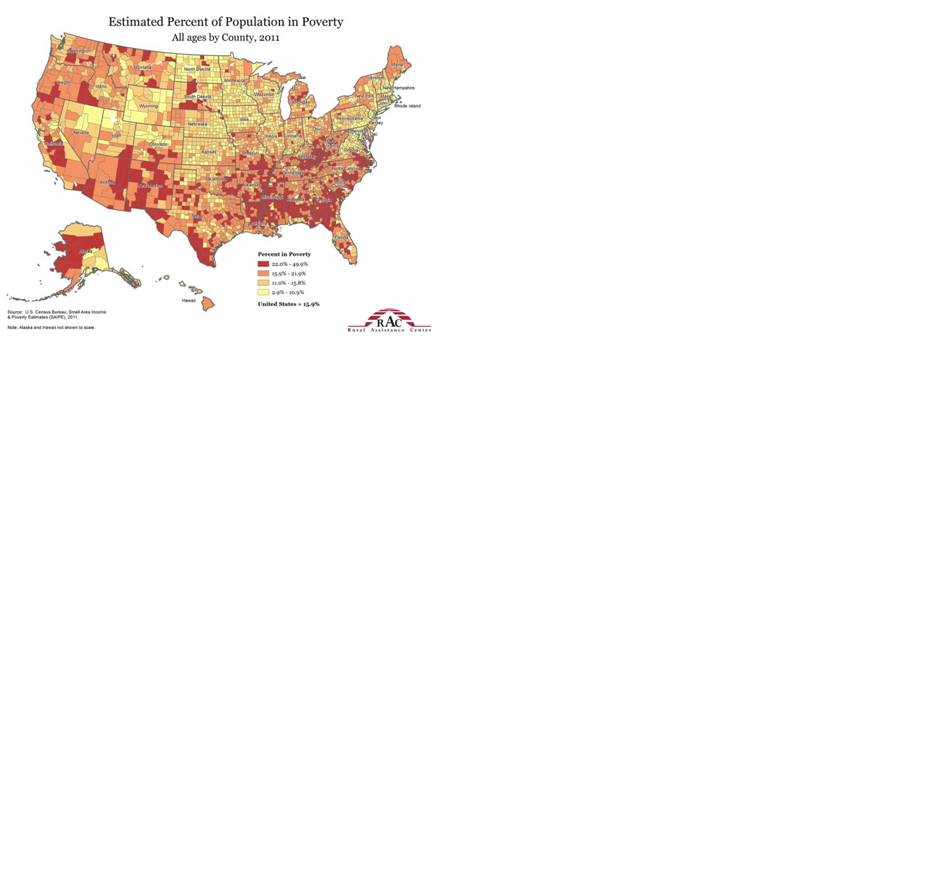
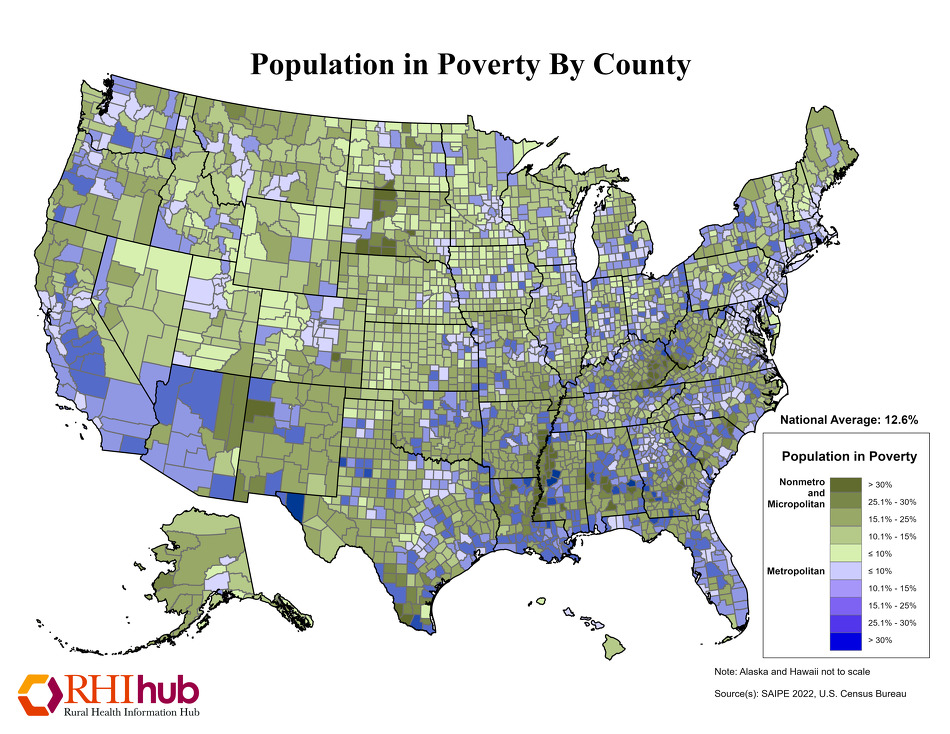
First let’s look at where these rural counties are.  Figure 1 is a map from www.dailyyonder.com  that shows (in green) the rural counties in the US.  Wikipaedia shows the 100 lowest income counties in Figure 2.  For the most part, these counties are rural, with the exceptions being a few areas in south Texas and in the Albuquerque/Santa Fe area of New Mexico. Raceonline.com shows the populations in poverty by county.  The red areas are the highest poverty rates.  The red areas in Figure 3 expand Figure 2 to include much of the rural deep south, Appalachia, more of Texas and New Mexico and part of the central valley in California.

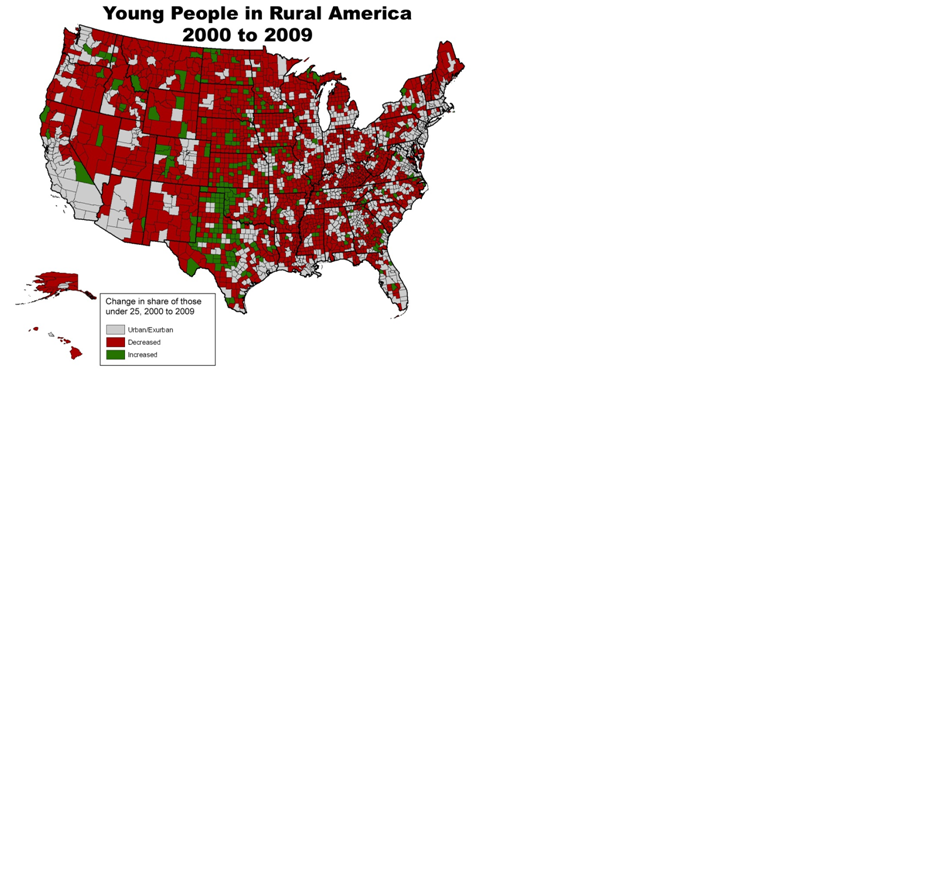
Figure 4 shows how the number of young people has changed between 2000 and 2009 in rural counties (urban counties are white and not included – red means a decrease).  Figure 5 shows population growth (or not) by county. What you see in these two maps is that the young people are moving to the rocky mountain states and vacating the high poverty counties in Figure 3.  Yong people do not see jobs in the rural area – unemployment is 20% higher in rural America and the jobs that are there pay less.  Figures 6 and 7 show unemployment by County in 2008 after the start of the Great Recession and in 2013.  What these figures show is that with exception of the Plains states and Rockies, is that many of the areas with high poverty also had high unemployment, and that the unemployment has remains stubbornly high in many rural areas in the Deep South, Appalachia and New Mexico, plus high unemployment in parts to  the Great Lakes, but the poverty rates are still lower.  Education may by a factor in why the Plains states and Rocky Mountains have less unemployment – despite being rural their students are far more likely to graduate from high school than those in the deep South, Appalachia where unemployment remains high and incomes low. 

So what does this possibly have to do with utilities?  Utilities need to understand this problem as is demands some real, on-the-ground leadership.  Small and rural utilities are more costly to operate per thousand gallons than larger utilities.  A 1997 study by the author showed that economy-of-scale manifested itself to a great extent with water and wastewater operations.  The differences were not close – it is a lot less costly to operate large utilities vs small ones.  Rural utilities complicate the issue further because not only is the number of customers limited, but the pipe per customer is less so the capital investment per customer is far higher than in urban areas.  The impact is that utilities are under pressure to reduce rates to customers, or create a set of lower cost rates for those in poverty, while at the same time their costs are increasing and infrastructure demands are incrementally higher than their larger neighbors.  The scenario cannot be sustained, especially when large portions of rural infrastructure was installed with FHA grants, meaning the customers never paid for the capital cost in the first place.  There was no or lower debt, than what larger utility customers have.  The rural rates since these investments have been set artificially lower than they should as a result. But with Congress talking about reducing SRF and FHA programs, FHA is unlikely to step in to replace their initial investment, meaning that the billions of rural investment dollars that will be needed in the coming years will need to be locally derived, and rate shock will become a major source of controversy in areas that are largely very conservative politically and tend to vote against projects that will increase costs to them.

The good news is that much of the rural infrastructure may be newer when compared to much of the urban infrastructure.  So there is time to build the argument that local investment is needed.  The community needs to be engaged in this discussion sooner as opposed to when problems occur.  Saving for the infrastructure may be the best course since rural utilities will have limited access to the borrowing market because of their size, but that means raising rates now and keeping those saved funds as opposed to using them to deer rate increases.  If ongoing efforts in the House deplete federal funding further, the pinch will be felt sooner by rural customers who will lose the federal dollars from SRF and FHA programs. 


Image

Figures 1 – Rural Counties

The United States: By Rural, Urban and Exurban Counties


Image


Figure 2.  100 lowest income Counties in the US


http://en.wikipedia.org/wiki/List_of_lowest-income_counties_in_the_United_States


Image

Figure 3.  Estimated population in poverty

http://www.raconline.org/racmaps/mapfiles/poverty.jpg


Image

Figure 4.  Where the Young People Are

http://www.raconline.org/maps/topic_details.php?topic=55


Image


Figure 5.  Where people are moving to http://www.raconline.org/maps

Image


Figure 6  Unemployment 2008

http://en.wikipedia.org/wiki/Unemployment

Image

Figure 7  Unemployment 2013 http://www.huduser.org/portal/pdredge/pdr_edge_featd_article_040


A recent Manhatten Institute for Policy Research report titled “America’s Growth Corridor: The Key to National Revisal” noted that the future economy in the US will tend to growth in certain corridors, which echos a prior report that identified “super-regions” where population, manufacturing, education and economic growth were likely to be concentrated. Both reports suggest that the super-regions will prosper, with the rest of the country lagging behind. The seven high growth areas in the Mnahatten Institute report are the Pacific Coast, the Northeast, the Front Range, Great Lakes, the southeast/piedmont, Florida/Gulf Coast, and Texas/southern plains. This new report focuses more on the politics of the region, noting that each region is politically fairly consistent internally, indicating there is more than one way to do business. The current business climate, driven primarily by energy favors the Plains, with the southeast starting to import jobs from Japan and Korean as a result of low wage rates. The report goes on to draw a series of political conclusions about business climates and the politics of why growth is occurring in certain areas. But let’s look at a different view of the report. Each of these regions has had “ it’s day in the sun” so to speak, and some a couple of days, like California. Business cycles are cyclical so shifts in growth corridors is not unexpected. However there are some potential limiting issues that are not addressed in the report that are of significant interest or concern.

First, where is the water? Texas and the Plains have significant water limitations, as does much of the southeast. Trying to build an economy when you lack a major resource becomes difficult. That is why the Northeast, Great Lakes and later the Pacific grew earlier than the south, mountain and Gulf states. The Northeast and Great Lakes had water for industrial use and transport of goods, a real key historically for industry. Those regions also had (and still have) better embedded transportation facilities (rail, roads, airports).

The next question is where is the power coming from? The answer that will be given is that the Plains states and Texas have created 40 % of the jobs in the energy sector in the past 4 years so that is where the energy comes from, but having energy and being able to convert it efficiently to power that is useful to people or industry is a different issue. You need water to cool natural gas plants, unless you want to sacrifice a lot of efficiency. Back to water again. Moving the gas to other parts of the country to convert coal or oil plants to natural gas would work, but getting the electricity back does not come without 6% losses and a real need to make major improvements to the electrical grid. Not a small job.

So while the Manhatten Institute reprort suggest that all seven corridors will grow, but that the southern corridors are growing faster, the sustainability of this growth is at question. I recall a similar prediction when I graduated from college in the early 1980s, when the jobs for engineers were limited to the energy fields in Texas and Louisiana and the prediction was that al the industrial growth would be in the south. And then Silicon Valley happened, and then the housing boom in California, Nevada and Florida happened, and a few things in between. Oh and that energy economy collapsed in the late 1980s …. You get the picture. This is not to say that some marketing the power, water and transportation benefits of the historical industrial areas of the north are not needed – they are, but the fact is that there is significant available water, power, transportation and people capacity that is unused. If I am an industry, I may want to look at the power/water issue a little more closely.


In the past week I have had the opportunity to experience the extremes with water – heavy rains/tropical weather in SE Florida, and dry weather in Denver at America Water Works Association’s Annual Conferences and Exposition. Two months ago with was snowing in Denver and there had been limited rain in SE Florida. Six months ago we were both dry and there was significant concern about drought in both places. How quickly fortunes change and the associated attitudes as well. It is part of a perception problem – looking at the near term – instant gratification, as opposed the long-term consequences. In truth neither set of conditions is historically different or should have created major panic or much shift in attitudes, but it is the potential to predict conditions that require the water manager’s scrutiny. We have all become risk managers.

Managing risk is not in the job description of most water and sewer personnel (risk managers aside, and they are focused on liability risks from incidents caused by or incurred by the utility like accidents, not water supply risks). We spend a lot of effort on the engineering, operation and business side, but less on planning or risk/vulnerability assessments. EPA has required vulnerability assessments in the past, but having seen some of those exercises, most are fairly superficial and many put on a shelf and forgotten. I have had clients ask me if I still had copies because they did not. Clearly we need a renewed commitment to vulnerability assessment.

Vulnerability starts with water supplies. Groundwater is particularly tricky. A new USGS study reports significant decreases in water levels in many aquifers across the US, especially confined aquifers in the west. That situation is not improving, and the situation will not correct itself. Loss of your water supply is a huge vulnerability for a community. Finding a new supply is not nearly as simple as it sounds or as many are led to believe. Confined aquifers do not recharge quickly and therefore have finite amounts of water in them. Remove too much water and all too often land subsidence occurs, which means the aquifer collapses and will never hold the same amount of water. USGS has mapped this and it matches up well with the drawn down aquifers. More data needs to be collected, but Congress is looking to cut USGS funds for such purposes, just when conditions suggest the data is needed most.

Many watershed basins and many aquifers are over allocated and overdrawn, and not just in the west. New England and the Carolinas have examples. Overallocation means competition for water will increase with time and it will be utilities that everyone will look at to solve the problem. Afterall the utilities have money as opposed to agriculture and other users, right? To protect themselves, water utility managers will need to look beyond their “slice of the pie” to start discussions on the holistic benefits to water users throughout the watershed, which will extend to understanding economic and social impacts of water use decisions. It is not just about us, and paradigm shift that is coming and one that we as an industry need to be the leading edge for. Our use impacts others and vice versa. Every basin wants to grow and prosper, but decisions today may reduce our future potential. Klamath River is a great example of misallocated water priorities. The biggest potential economy in the basin is Salmon ($5B/yr), followed by tourism ($750 M and growing), which relies on fishing and hiking. But agriculture ($0.2 B/yr) get the water first. Then power, which warms the water (salmon like cold water). Then a few people (a few 100,000 at the most in the basin). The result, the salmon industry gets reduced to $50 M/yr. Now how could we create more jobs, which would result in more income and a bigger economy? The easy answer is encourage the salmon industry, but that doesn’t sit well with the other, smaller users that will become more vulnerable to losses.

I suggest that to harden our water future in any given basin, we need to start looking a little more holistically at the future. This type of analysis is clearly not in the job description of the utility or its managers, utility managers may have the best access to technical expertise and information. As a result to protect their interests and manage risk, we may need to shift that paradigm and become holistic water managers.