Archive

sustainability


We have spent some time talking about the need to fund and maintain reserves.  I think most people reading this concur but how do you track reserves?  Every public sector utility gets audited annually.  How many people have actually looked at that audit?  Or attend the discussion with the elected officials with the auditors.  Or know how to read it?  This is an important part of our job.  We need to defend the utility and knowing the financial position is part of the defense. 

The annual audit is commonly called the Comprehensive Annual Financial Report of CAFR.  The finance director normally controls the process.  The CAFR is many, many pages long and include information on revenues and expenses, but also a bunch of other things like assets, depreciated assets, transfers to other funds, outstanding long and short term debt, fund balance and reserves.   The CAFR is designed to be a management tool to help with tracking performance of the entity with time.  CAFRs were redesigned by the Governmental Accounting Standards Board (GASB) about 15 years ago to provide more useful information to lenders and oversight agencies.  It was redesigned to help with management, discussion and analysis of the financial position.  The utility director should be a part of this management, discussion and analysis team and should fully understand its contents as it affects the utility. The CAFR should not be viewed simply as a compliance tool to submit and forget about. 

For example, the assets should include the value of all installed infrastructure (fixed) and all mobile equipment (non-fixed) as assets.  The depreciation is the total amount of depreciation, assigned as a straight line, since the acquisition of the assets.  You should always have more than 50% of the asset value remaining.  You should understand outstanding debt and debt plus depreciation should be less than your asset values, otherwise you are underwater with your assets.  You should understand the transfers to other funds and the justification for same.

But the reserves are key.  Some of these reserves may be restricted, which means they are likely impact fees, reserves to cover debt coverage requirements or covenants for repair and replacement of other purposes.  Most utilities do not have a separate repair and replacement reserve, but this would be useful for those capital expenses,  Likewise, operating reserves, for use to balance the budget in lean periods should be identified.  The reporting reserves for rate stabilization should be separate from the operating reserves (usually 1.5 to 3 months) to cover the day-to-day expenses.  An understanding of the value and tracking of these reserves is useful to long and short term decision making by utility managers.  Unfortunately most auditors and most finance director do not make separate reserves and tracking becomes a challenge.  But the utility is an operating entity.  Finance, like purchasing and human resources and support agencies designed to provide service to help accomplish the mission of the operating elements of the utility.  You need the support agencies to provide the necessary information to help your decision-making.  Doubtful your finance director wants to hear this, but really, does the utility operate because the finance department does the work or because the utility does?  Just food for though.

As water and sewer utilities, the public health and safety of our customers is our priority – it is both a legal and moral responsibility. The economic stability and growth of our community depends on reliable services or high quality. The priority is not the same with private business. Private businesses have a fiduciary responsibility to their stockholders, so cutting services will always be preferred to cutting profits. Therein lies the difference and yet the approach is different. Many corporations retain reserves for stability and investment and to protect profits. Many governments retain inadequate reserves which compromises their ability to be stable and protect the public health and safety. Unlike corporations, for government and utilities, expenses are more difficult to change without impacting services that someone is using or expects to use or endangering public health. Our recent economic backdrop indicates that we cannot assume income will increase so we need to reconsider options in dealing with income (revenue) fluctuations. If there are no reserves, when times are lean or economic disruptions occur (and they do regularly), finding funds to make up the difference is a problem. The credit market for governments is not nearly as “easy” to access as it is for people in part because the exposure is much greater. If they can borrow, the rates may be high, meaning greater costs to repay. Reserves are one option, but reserves are a one-time expense and cannot be repeated indefinitely. So if your reserves are not very large, the subsequent years require either raising taxes/rates or cutting costs. An example of the problem is illustrated in Figure 1. In this example the revenues took a big hit in 2009 as a result of the downturn in the economy. Note it has yet to fully return to prior levels as in many utilities. This system had accumulated $5.2 million in reserves form 2000-2008, but has a $5.5 million deficit there after. Reserves only go so far. Eventually the revenues will need to be raised, but the rate shock is far less if you have prudently planned with reserves. You don’t get elected raising rates, but you have a moral responsibility to do so to insure system stability and protection of the public health. So home much is enough for healthy reserves? That is a far more difficult question. In the past 1.5 months of operating reserves was a minimum, and 3 or more months was more common. However, the 2008-2011 economic times should change the model significantly. Many local governments and utilities saw significant revenue drops. Property tax decreases of 50% were not uncommon. It might take 5 to 10 years for those property values to rebound so a ten year need might be required. Sales taxes dropped 30 percent, but those typically bounce back more quickly - 3-5 years. Water and sewer utilities saw decreases of 10-30%, or perhaps more in some tourist destinations. Those revenues may take 3-5 years to rebound as well. Moving money from the utility to the general fund, hampers the situation further. Analysis of the situation, while utility (government) specific, indicates that appropriate reserves to help weather the economic downturns could be years as opposed to months. The conclusion is that governments and utilities should follow the model of trying to stabilize their expenses. Collect reserves. Use them in lean times. Develop a tool to determine the appropriate amounts. Educate local decision-makers and the public. Develop a financial plan that accounts for uncertainty and extreme events that might impact their long-term stability. Take advantage of opportunities and most of all be ready for next time. In other words, plan for that rainy day.


My last blog was a discussion about surpluses.  The State of Florida will have a $1.3 billion surplus this year and a host of politically expedient answers for where that money goes (tax cuts, pork projects, projects to help election results), but little mention of replenishing trust funds and reserves that were emptied to balance the budget amid tax cuts from 2010 – 2012.  But perhaps it is not the legislators or their constituents that we should blame for not understanding the need for reserves because the truth is that most people are not used to saving.  A recent article I read noted that 72 percent of Americans live paycheck to paycheck and would have difficulty putting $2000 together if needed.  $2000 is not a lot of money these days – it won’t buy you a transmission for example or a new engine for your car.  It won’t cover first, last and a deposit on a rental.  And it won’t cover the down payment on a house or most cars.  There are people who do not receive enough income to achieve some degree of savings, but not 72% of us.  We have come to perceive that having little savings is normal, but it wasn’t always this way and it is not this way everywhere in the world.  Back in the day, American saved more than they do now.  The reason is not that they had more money (they didn’t) or that they had less to spend money on (as things cost more proportionately).  But it was that “rainy day” they all knew would come and when they would need money.  They had been through depressions, recession and losses of industries (remember those Concord coachmakers did not get a federal bailout in trying to compete with Henry Ford).  They knew that there would be times when they needed to rely on themselves to survive and savings was the key.

There are two major differences from the past.  The most important is the fact is that credit was a lot harder to come by back in the day, so you needed cash for those big purchases.  That has changed dramatically in 50 years.  Today we get advertisements for credit cards – in the mail, instant credit at stores, easy credit for cars, and in the early 2000s, no-money-down-no-income-verification loans on real estate.  The need to save evaporated.  The access to easy credit has eliminated much of the need to save for those big expenses.  We can borrow to acquire them.  If we have a job problem, we borrow against the house or life insurance policy.  These are good backstops that help us maintain our way of life.

At the same time as we are being extended opportunities to secure funds to spend, we are barraged by advertisements and flyers and pitches to spend that money on products and services, many of which we probably don’t need, but are “cool” to have.  We are encouraged to compete to have better “stuff” than the other guy, and make sure we have the newest technology.  We all do it.  Just look at all phones can do, while keeping in mind that the old Bell phone I bought in college still works regardless of the situation and still sounds good.  No cool ringtones however, nor photo capability.  All that means we spend less on “needs” and more on “stuff.” 

Given this backdrop it is no surprise the attitude of decision-makers in government toward revenues and expenses.  Re-education of the public is needed as opposed to rhetoric.  We need to move the public discussion away from the concept of a balanced budget being expenses equal revenues to the correct concept of revenues + reserve expenses = expenses plus savings.  At times you use reserves (and savings =0) while other times reserve expenses are 0, while savings are positive. When big expenses come, borrow, but recurring expenses should not be funded through borrowing (credit).  We should seek to avoid is the desire to cut taxes (akin to cutting our salaries) to bring the budget back into balance that if we run a surplus, or spend it on “stuff.”  Such a system leaves room for those lean times when revenues may fluctuate but expenses do not (or increase).  


It was not so long ago that we were talking about local and state governments suffering major shortfalls in their revenues as a result of the downturn in the economy.  Cuts were being made to police, fire, education and parks.  Politicians were fussing over the need to cut taxes and cut government expenditures in the process.  Employees lost jobs and benefits were cut.   In a prior blog we discussed the fact that economic upticks and downturns were cyclical, and unlike people, there is a tendency for local and state government policy makers to “hang with the curve” so to speak and have government expenses track the economy as opposed to try to stabilize spending by taking advantage of the ups to create reserves in order to take advantage of the downs.  They ignore the old adage that their grandparents told them – save for a rainy day.  And we don’t recognize those rainy days approaching!  It is not a lot different unfortunately than many citizens who spend when they have money, and are short when they don’t.  We are not a country of savers and it hurts us often.

There is however a major benefit for government to have reserves.  When government has reserves, it can take advantage of lower competition to construct or invest in infrastructure in lean times. There are many examples of governments getting construction done at discounted rates based on timing their projects to economic downturns.  A side benefit is that those governments are spending money at the time when they need to keep people employed.  FDR did this during the Great Depression.  Obama attempted to copy him in 2009 with the AARA monies.  In both cases they may not have invested enough, but both were faced with deficits on the federal level and a Congress that was reluctant to spend. 

The economy has rebounded and state and local governments are starting to run surpluses. The South Florida Sun-Sentinel recently reported that the big “challenge” for the Florida Legislature and many other state and local governments, is they are running surpluses.  Recall the last time the federal government ran a surplus, we got tax cuts that immediately put the feds back in the red because they had not built up any reserves, and won’t even with a balanced budget anytime soon.  Well Florida has $1.3 billion extra on hand and guess what we hear in this election year  – tax cuts, more money for special projects, extended sales tax exemption dates, etc.  Those running for office are thrilled with the surplus because it helps their platform but we hear nothing about restocking the trust funds that were raided during the 2009, 2010 and to some extent the 2011 budgets! 

Expect this to be the norm, and the rhetoric should be troubling to fiscally responsible people.   If we have surpluses, times must be better.  In good times we should be encouraging decision-makers to sock money away in reserves, savings and other solid investments, and at the same time restocking those accounts drained to pay the bills during the down time of the Great Recession.   In Florida, our highway trust fund, environmental trust funds and education funds were drained.  They have not been restocked.  In fact the cuts to most of those programs has not been restored either. The next economic downturn will come – will we be prepared to weather storm by spending our savings as opposed to cutting services which magnifies the impact of residents?

As times get better, utilities owned by local governments should pay particular attention to General Fund revenues.  Many of those General Funds increased contributions from the water and sewer funds to make up the difference in losses of property and sales tax dollars.  That prevented utilities from making investments, or forced them to borrow money to cover investments that might otherwise have been paid for in cash.  Time for the General Fund to pay the utility back!  Time to restock the reserves and time to spend money to catch-up with the deferred maintenance and capital.  Of course the costs are not what they were 3 or 4 years ago, and neither are the interest rates, so we all pay more for the same projects because we could not spend the reserves in the down period.

Utilities should always have significant reserves.  Nothing we do is inexpensive, so having reserves makes it possible to fix things that inevitably go wrong.  Reserves are a part of a well operated, fiscally sound utility. Taking money from the utility during down times hurts both the utility and the local government.  Total reserves diminish of the entity, making it less possible to deal with emergencies, cover the loss of revenues, or take advantage of lower costs for construction projects.  Meanwhile, creating reserves and a pay-as-you-go system for ongoing replacement of pipes and pumps is good business.  It insures that ongoing money is spent to prevent deterioration of the utility system.  The reserves allow for accelerated expenditures when times are tough, prices are down and people need work.  When utilities spend money, it translates to local jobs.  But the only way to do this is make convincing argument of the benefits of reserves and spending.  


Regardless of the causes, southeast Florida, with a population of 5.6 million (one-third of the State’s population), is among the most vulnerable areas in the world for climate change due its coastal proximity and low elevation (OECD, 2008; Murley et al. 2008), so assessing sea level rise (SLR) scenarios is needed to accurately project vulnerable infrastructure (Heimlich and Bloetscher, 2011). Sea level has been rising for over 100 years in Florida (Bloetscher, 2010, 2011; IPCC, 2007).  Various studies (Bindoff et al., 2007; Domingues et al., 2008; Edwards, 2007; Gregory, 2008; Vermeer and Rahmstorf, 2009; Jevrejeva, Moore and Grinsted, 2010; Heimlich, et al. 2009) indicate large uncertainty in projections of sea level rise by 2100. Gregory et al. (2012) note the last two decades, the global rate of SLR has been larger than the 20th-century time-mean, and Church et al. (2011) suggested further that the cause was increased rates of thermal expansion, glacier mass loss, and ice discharge from both ice-sheets. Gregory et al. (2012) suggested that there may also be increasing contributions to global SLR from the effects of groundwater depletion, reservoir impoundment and loss of storage capacity in surface waters due to siltation.

Why is this relevant?  The City of Fort Lauderdale reported last week that $1 billion will need to be spent to deal with the effect of sea level rise in Fort Lauderdale alone.  Fort Lauderdale is a coastal city with canals and ocean property, but it is not so different from much of Miami-Dade County, Hollywood, Hallandale Beach, Dania Beach and host of other coastal cities in southeast Florida.  Their costs may be a harbinger of costs to these other communities. Doing a “back of the napkin”  projection of Fort Lauderdale’s cost for 200,000 people to the additional million people in similar proximity to Fort Lauderdale means that $5 billion could easily be spent over the next 100 years for costal impoundments like flap gates, pumping stations, recharge wells, storm water preserves, exfiltration trenches and as discussed in this blog before, infiltration galleries. Keep in mind that would be the coastal number and we often ignore ancillary issues.  At the same time, an addition $5 to 10 billion may be needed for inland flooding problems due to the rise of groundwater as a result of SLR.

The question raised in conjunction with the announcement was “is it worth it?”  I suggest the answer is yes, and not just because local politicians may be willing to spend money to protect their constituents.  The reality is that $178 billion of the $750 billion economy of Florida, and a quarter of its population, is in the southeast. With nearly $4 trillion property values, raising a few billion for coastal improvements over 100 years is not an insurmountable task.  It is billions in local engineering and construction jobs, while only impacting taxpayers to the tune of less than 1/10 of a mill per year on property taxes. This is still not an insurmountable problem.

I think with good leadership, we can see our way.  However, that leadership will need to overcome a host of potential local community conflicts as some communities will “get more” than others, yet everyone benefits across the region.  New approaches to working together will need to be tried.  But the problem is not insurmountable, for now…


A number of years ago I had the pleasure of speaking with archeaologist Bryan Fagan for an hour or so before a presentation he gave at a conference.   Dr. Fagan is a modern-day Indiana Jones, who has been all over the world studying ancient ruins.  Dr. Fagan expressed his career as “50 years of studying drainage ditches,” but with studying drainage ditches he could provide you with the rise and fall of civilizations through history.  His book Elixir outlines a number of these civilizations:  Egyptian, Babylonia, Southeast Asia, and even the American West.  His findings were that the civilization expended as far as infrastructure could be constructed to allow water to flow to where it was needed, whether that was Alexandria or Ur.  Later civilizations expanded and developed as technology allowed water to flow further.  Rome demonstrated that water could be moved with more than ditches, which would have been a severe limitation for Rome and other civilizations based in dry areas with topography.  The Romans constructed extensive tunnels and aqueducts to supply Rome with water from mountains to the east and north. A recent article noted that we probably know about 20% of the Roman tunnel system as we keep discovering more of it each year – tunnels lost in the Dark Ages after the fall of Rome.  Dr. Fagan notes that it was access to water that allowed human civilizations to develop and evolve.  It is why a number of engineering organizations like Water for People and Engineers Without Borders focus their efforts on providing access to clean water to people in Third World countries.  It is their only way to get to the modern world.  All other infrastructure:  roads, major buildings, etc., result from the access to clean water that allows people to be healthy and productive.

So if civilization rises and falls with access to water, why is it so hard to get public officials to fund water supply and rehabilitation projects?  We talk of an infrastructure crisis in the United States because our average water and sewer infrastructure systems are working on 50 years old and deterioration is evident.  We have many mid-western communities with water, but no customers to pay for deteriorating infrastructure (Detroit), and southeastern utilities that have lost factories that supported the bulk of their utility, and insufficient growth in the customer base to deal with operations and maintenance.  As a result, outages and breaks occur more frequently, costing more money to repair, but under the auspices of maintaining rates, the revenues do not increase to support the needed repairs. 

At least the southeast has surface supplies, albeit perhaps limited, which constrains growth (Atlanta), but our fastest growth often occurs in areas we know have limited precipitation, like a lot of the American West.  Yet somehow we expect groundwater sources that do not recharge locally, to sustain the community indefinitely without disruption – ignoring the fact that history tells us communities cease to function when water supplies are exhausted.  USGS identified many areas that have long-term permanent declines in aquifers as a result of pumpage for agricultural and community uses.  No one raises the question about the aquifer levels – permits get issued, but little data is gathered and very limited plans are available in most places to deal with the declines.  And no one raises a question about aquifer levels because stopping growth to deal with water supplies is not in conformance with the desire to grow, which is required to support additional services demanded by the community. 

No one questions how to secure the water either, much of which has been “created” by federal tax dollars spend over 50 years ago during the era of great dam building (1920-1960).  However, as these systems and populations age, the concern about costs will continue to engender discussion.  And hand wringing.  Water costs money.  Water creates civilization and sustains it.  When we take it for granted, it becomes all too easy to fall behind the proverbial “eight-ball,” and the system crashes.  It is a testament to the utility personnel – the managers, engineers and operators – that these systems continue to operate as they do.  But bailing wire and duct tape only go so far.  We need to develop a frank discussion about the need to infuse funds – local, federal, state and private – into addressing our infrastructure needs.  The dialog needs to commence sooner, as opposed to after failure. 


In the last blog I talked about the challenge to rural utilities, many of which serve relatively few people and have used federal monies to pay for a lot of their infrastructure.  In this blog we will take a look at the trends for community water systems which are defined as systems that serve at least 15 service connections or serve an average of at least 25 people for at least 60 days a year. EPA breaks the size of systems down as follows:

  • Very Small water systems serve 25-500 people
  • Small water systems serve 501-3,300 people
  • Medium water systems serve 3,301-10,000 people
  • Large water systems serve 10,001-100,000 people
  • Very Large water systems serve 100,001+ people

Now let’s take a look at the breakdown (from NRC 1997).  In 1960, there were about 19,000 community water utilities in the US according to a National Research Council report published in 1997.  80% of the US population was served.  in 1963 there were approximately 16,700 water systems serving communities with populations of fewer than 10,000; by 1993 this number had more than tripled—to 54,200 such systems. Approximately 1,000 new small community water systems are formed each year (EPA, 1995). In 2007 there were over 52,000 community water systems according to EPA, and by 2010 the number was 54,000.  85% of the population is served. So the growth is in those small systems with incidental increases in the total number of people served (although the full numbers are more significant). 


TABLE 1 – U.S. Community Water Systems: Size Distribution and Population Served


Number of Community Systems Serving This Size Community a

Total Number of U.S. Residents Served by Systems This Size b>

Population Served

1963

1993

1963

1993

Under 500

5,433 (28%)

35,598 (62%)

1,725,000 (1%)

5,534,000 (2%)

501-10,000

11,308 (59%)

18,573 (32%)

27,322,000 (18%)

44,579,000 (19%)

More than 10,000

2,495 (13%)

3,390 (6%)

121,555,000 (81%)

192,566,000 (79%)

Total

19,236

57,561

150,602,000

242,679,000

a Percentage indicates the fraction of total U.S. community water supply systems in this category.

b Percentage is relative to the total population served by community water systems, which is less than the size of the U.S. population as a whole.

SOURCES: EPA, 1994; Public Health Service, 1965.


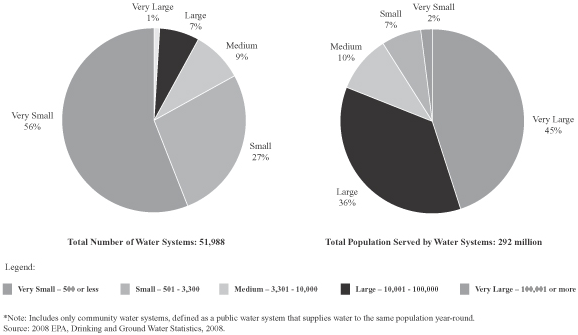
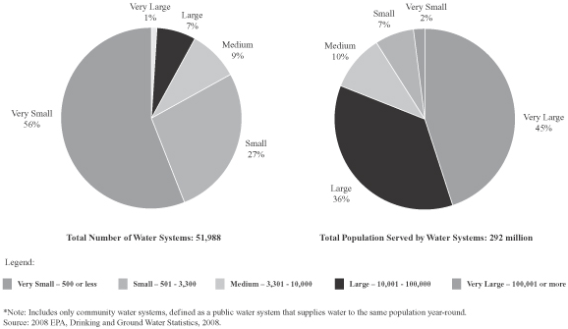
Updating these numbers, there are over 54,000 systems in the US, and growth is almost exclusively in the very small sector.  93% are considered to be small or very small systems—serving fewer than 10,000 people. Even though these small systems are numerous, they serve only a small fraction of the population. Very small systems, those that serve 3,300 people or fewer make up 84 percent of systems, yet serve 10 percent of the population.  Most critical is the 30,000 new very small systems that serve only 5 million people (averaging 170 per system).  In contrast, the very large systems currently serve 45% of the population.  Large plus very large make it 80%.  The 800 largest systems (1.6%) serve more than 56 percent of the population. 900 new systems were added, but large systems served an additional 90 million people.

What this information suggests if that the large and very large sector has the ability to raise funds to deal with infrastructure needs (as they have historically), but that there may be a significant issue for smaller, rural system that have grown up with federal funds over the past 50 years.  As these system start to come to the end of their useful life, rural customers are in for a significant rate shock. Pipeline average $100 per foot to install.  In and urban area with say, 60 ft lots, that is $3000/household.  In rural communities, the residents may be far more spread out.  As an example, a system I am familiar with in the Carolinas, a two mile loop served 100 houses.  That is a $1.05 million pipeline for 100 hours or $10,500 per house.  With dwindling federal funds, rural customers, who are already making 20% less than their urban counterparts, and who are used to very low rates, that generally do not account for replacement funding, will find major sticker shock. 

This large number of relatively small utilities may not have the operating expertise, financial and technological capability or economies of scale to provide services or raise capital to upgrade or maintain their infrastructure.  Keep in mind that small systems have less resources and less available expertise.  In contrast the record of large and very large utilities, EPA reports that 3.5 percent of all U.S. community water systems violated Safe Drinking Water Act microbiological standards one or more times between October 1992 and January 1995, and 1.3 percent violated chemical standards, according to data from the U.S. Environmental Protection Agency (EPA).. 

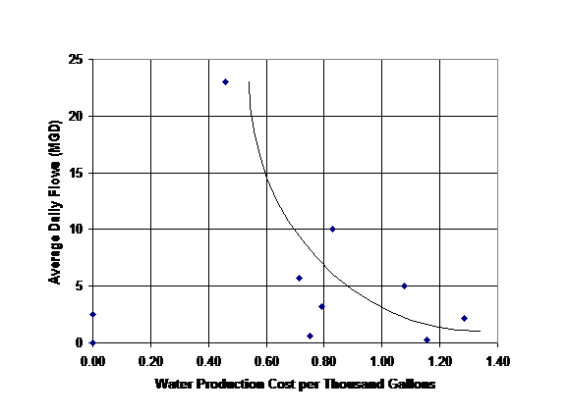
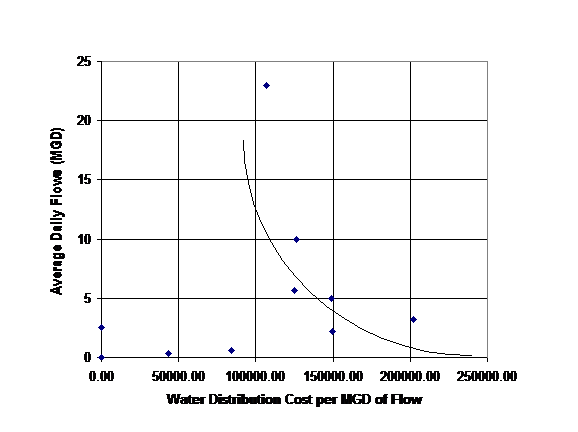
EPA and professionals have long argued that centralized infrastructure for water and sewer utilities makes sense form an economy of scale perspective.  Centralized drinking water supply infrastructure in the United States consists dams, wells, treatment plants, reservoirs, tanks, pumps and 2 million miles of pipe and appurtenances.   In total this infrastructure asset value is in the multi-trillion dollar range.  Likewise centralized sanitation infrastructure in the U.S. consists of 1.2 million miles of sewers and 22 million manholes, along with pump stations, treatment plants and disposal solutions in 16,024 systems.  It is difficult to build small reservoirs, dams, and treatment plants as they each cast far more per gallon to construct than larger systems.  Likewise operations, despite the allowance to have less on-site supervision, is far less per thousand gallons for large utilities when compared to small ones.  The following data shows that the economy-of-scale argument is true:

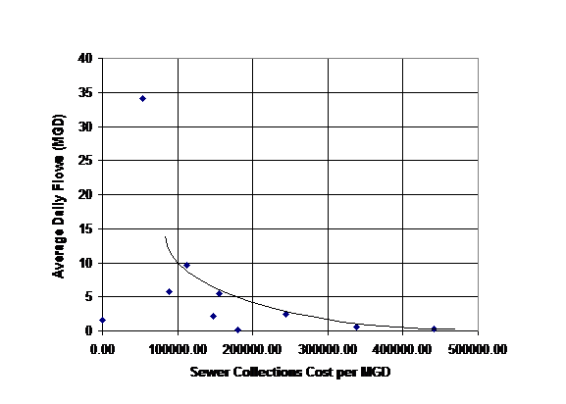
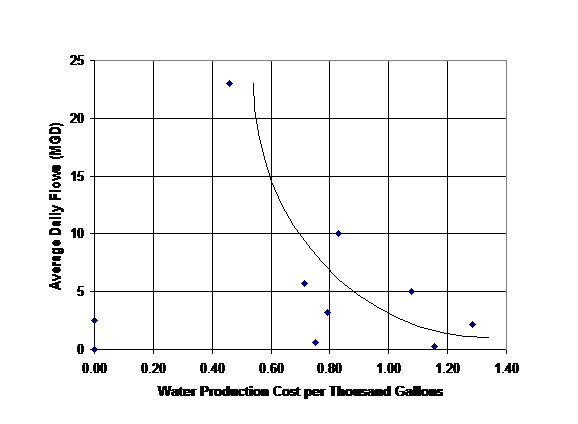
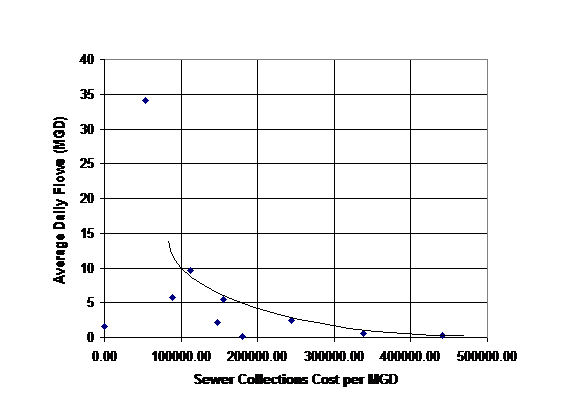
  • For water treatment, water distribution, sewer collection and wastewater treatment, the graphics clearly demonstrated the economy-of-scale of the larger utility operations versus small scale operations (see Figures 2-5). 
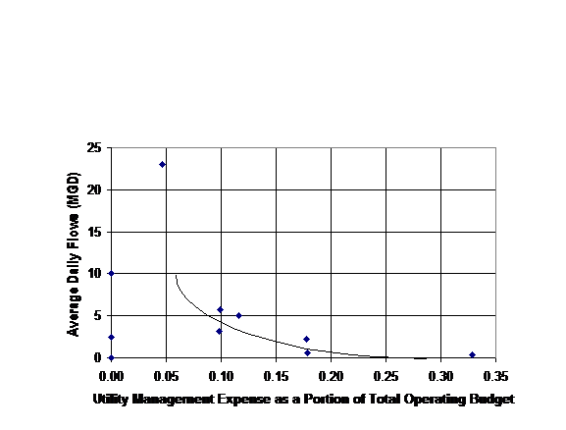
  • The administrative costs as a percentage of the.total budget parameter also demonstrated the economy-of-scale argument that larger utilities can perform tasks at a lesser cost per unit than the smaller utilities (see Figure 6).

Having reviewed the operations costs, the next step was to review the existing rates.  Given the economy-of-scale apparent in Figures 2 to 6, it was expected that there would be a tendency for smaller system to have higher rates.  Figures 2-6 demonstrate this phenomena. 

So what to do?  This is the challenge.  Rate hikes are the first issue, a tough sell in areas generally opposed to increases in taxes, rates and charges and who use voting to impose their desires.  Consolidation is anothe5r answer, but this is on contrast to the independent nature of many rural communities.  Onslow County, NC  figured out this was the only way to serve people efficiently 10 years ago, but it is a rougher sell in many, more rural communities.  Infrastructure banks might help, the question is who will create them and will the small system be able to afford to access them.  Commercial financing will be difficult because there is simply not enough income to offset the risk.  The key is to start planning now for the coming issue and realize that water is more valuable than your iPhone, internet, and cable tv.  In most cases we pay more for each of them than water (see Figure 7).  There is something wrong with that…
 Image


Figure 1  Breakdown of Size of Systems
Image


Fig 2 Cost of Water Treatment

Image


Fig 3 Cost of Water Distribution

Image


Fig 4 Cost of Sewer Collection

Image


Fig 5 Cost of Sewer Treatment

Image

Fig 6 Cost of Administration as a percent of total budget


Image

FIgure 7 Water vs other utilities


I recent Wall Street Journal article outlined where growth is likely to be coming.  Of no surprise, Arizona, Las Vegas, Central Valley, San Antonio, Dallas, Houston, Denver, Albuquerque, Boise, Pensacola, Tallahassee, Raleigh, Atlanta, and the Washington DC area.  Only one of those areas is has water much water availability.  It means that all of these communities are in areas that are water limited.  We already know that Texas, Las Vegas and Arizona have lots of water problems.  Most of these areas have had issues in the past as well, and will have more in the future. 

Low growth areas:  Detroit, Cleveland, Chicago, Buffalo, Cincinnati, Omaha, and a variety of areas with plenty of water, but old infrastructure and limited funding.  So the big questions is how do we redirect development to areas with plenty of water as opposed to allowing development in areas where we know that there will be serious water supply consequences in the future?  It’s a leadership issue, but local officials and states are so in need to the growth we have discussed in prior blogs, that the long-term realities of water supply limits overrides the short term need to show growth in the communities to delay tax increases, water increases and the like.  But is delays the inevitable, with potentially serious future impacts.


In front of house

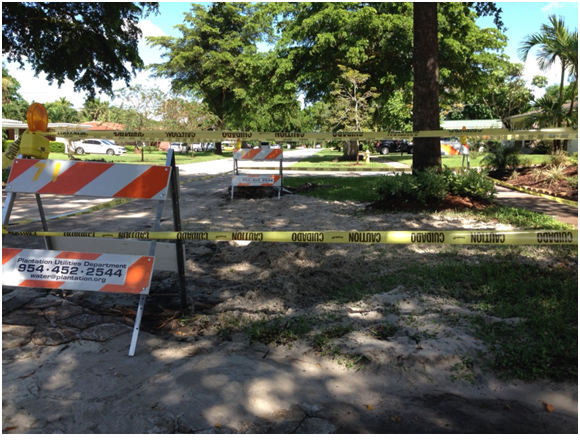
The doorbell rang and it was 1:30 am on a Saturday morning.  It was my neighbor telling me about a small problem on the street.  I looked out and the entire block was flooded.  Water was moving. It was dark, and while my street light was working, it shed little light in the blackness.  However I figured out the old AC pipeline in front of my house had sheared and the block’s leak was actually my problem.  We had no water.  Fortunately the water department was able to get the main repaired in a couple hours.

The next morning we were not as lucky.  Another break on the next street over had shut us down again.  AC water main, but this time under a tree.  They had to remove the tree before fixing the line.  We were out all day.  The water plant guys and the repair crew said that the lines were supposed to be replaced a couple years ago, but that the City had delayed the replacement for budget problems.  


SUSTAINABILITY OF UTILITIES – PART 2

Let’s take a look at some scenarios. Let’s assume you are a utility that serves 20,000 people (8000 customers), with 60 miles of water pipe, 60 miles of sewer pipe, 17 lift stations, and a water and wastewater plant.  Replacing this infrastructure might be valued at $90 million for pipe, $35 million for treatment plants, water supply and pumping equipment (current day dollars).  Let’s also assume that their annual budget is $11 million and the typical demands are 3 MGD yielding a monthly bill of $115/mo (water and sewer).

Let’s make some general assumptions like that the pipe infrastructure might last 100 years, but clearly the treatment and mechanical parts would mot.  They would need ongoing maintenance and replacement.  50 years is probably too long, but let’s go with it.  If the overall costs increase at 3% per year and money is set aside for repair and replacement. The utility will see fairly steady rates if the customer base grows 2-3% per year.  Ten years out, the budget will be $16 million.  Now for the scenarios.

If the customer base has grown at 3% per year, the customers will increase to almost 27,000.  More of an issue is what happens if that increase in demand (from 3 to over 3.4 MGD) needs to come from a new water source and requires new capacity.  Many utilities will use impact fees to offset this cost to current customers so as not to adversely impact current customers too severely .That’s the current assumption.  The result looks like this at 10 and 20 years:


Component


Value today

10 years

20 years

Customers


20000

26878

36122


Accounts


8000

10751

14449


Water  Pipe

60 mi

 $   45,000,000

 $     98,509,418

 $215,646,786

Sewer Pipe

60 mi

 $   45,000,000

 $     98,509,418

 $215,646,786

Treatment Plants and Pumping

3 MGD

 $   35,000,000

 $     76,618,436

 $167,725,278

Operations budget


 $     9,000,000

 $     16,255,001

 $  29,358,340

Capital Budget


 $     1,600,000

 $       3,502,557

 $    7,667,441

Debt


 $        400,000

 $         400,000

 $      400,000

Monthly Amount


 $              115

 $                156

 $             216

Increase per year


5%

5%


Assume 1% of pipe Replacement Costs +2% Plant


Assume operating budget inc 3%/yr but construction increases 5%/yr


But what if the new treatment and supply are 50% more costly and impact fees assume the lower investment (typical)?  The cost for the budget and for the infrastructure replacement increases (with the delta from debt).  Cost are 50% higher:


Component


Value today

10 years

20 years

Customers


20000

26878

36122

Accounts


8000

10751

14449

Water  Pipe

60 mi

 $   45,000,000

 $     98,509,418

 $215,646,786

Sewer Pipe

60 mi

 $   45,000,000

 $     98,509,418

 $215,646,786

Treatment Plants and Pumping

3 MGD

 $   35,000,000

 $     92,289,117

 $202,029,937

Operations budget


 $     9,000,000

 $     23,731,487

 $  42,861,706

Capital Budget


 $     1,600,000

 $       3,815,971

 $    8,353,534

Debt


 $        400,000

 $       1,325,000

 $    2,825,000

Monthly Amount


 $              115

 $                224

 $             312

Increase per year


8%

7%


The normal assumptions are that growth will continue, but what if it does not?


What can be gleaned as a result of a non-growth or net decrease scenario?  How does sustainability get affected?  Let’s look at the no growth scenario.  In this light, rates will need to increase at least 5% per year to insure that the utility remains rate neutral.  If there is significant deferred maintenance, which is typical of may utilities, that cost will be added to the bill.  There are examples of utilities in Florida who finally caught up with deferred obligations which doubled their customers’ bill.  This scenario is doable, but the only real assumption changes that can be made are related to the lack of growth.  Deferring maintenance will once exacerbate the problem as there is not guarantee that growth will return.  Rate neutrality becomes a public relations issue, but not insurmountable.


Component


Value today

10 years

20 years


Customers


20000

20000

20000

Accounts


8000

8000

8000

Water  Pipe

60 mi

 $   45,000,000

 $     73,300,258

 $119,398,397

Sewer Pipe

60 mi

 $   45,000,000

 $     73,300,258

 $119,398,397

Treatment Plants and Pumping

3 MGD

 $   35,000,000

 $     57,011,312

 $  92,865,420

Operations budget


 $     9,000,000

 $     12,095,247

 $  16,255,001

Capital Budget


 $     1,600,000

 $       2,606,231

 $    4,245,276

Debt


 $        400,000

 $         400,000

 $      400,000

Monthly Amount


 $              115

 $                157

 $             218

Increase per year


5%

5%


Now let’s look at the decline issue.  If the population decreases by 25% over the ten year horizon, what does this say?  The costs will remain relatively constant, but the number of customers and demands for water will drive the rates up significantly. In ten years the rates could double in a community that is likely economically disadvantaged.  The higher rates may begin to discourage economic development, rate neutrality exacerbate the problem and may increase in costs for regulatory or deferred maintenance obligation becomes a significant issue:


Component


Value today

10 years

20 years

Customers


20000

16341

13352


Accounts


8000

6537

5341


Water  Pipe

60 mi

 $   45,000,000

 $     73,300,258

 $119,398,397


Sewer Pipe

60 mi

 $   45,000,000

 $     73,300,258

 $119,398,397


Treatment Plants and Pumping

3 MGD

 $   35,000,000

 $     57,011,312

 $  92,865,420


Operations budget


 $     9,000,000

 $     12,095,247

 $  16,255,001


Capital Budget


 $     1,600,000

 $       2,606,231

 $    4,245,276


Debt


 $        400,000

 $         400,000

 $      400,000


Monthly Amount


 $              115

 $                193

 $             326


7%

7%


Assume 1% of pipe Replacement Costs +2% Plant


Assume operating budget inc 3%/yr but construction increases 5%/yr


 What can we glean from this?  Interestingly the failure to accumulate costs for growth, and the declining rate base end up with similar monthly costs.  Only by the no growth and collecting appropriate impact fees will costs be controlled, and even in that case, costs will double every 20 years or less.  The reality is that the failure to follow proper revenue collection protocols will severely limit the utility in future years.  High capital costs impact rates significantly.  Leaving it to some future commissioner to raise the rates is unfair to both the future decision-makers and customers.  It does not make you a leader either.