Archive

Uncategorized


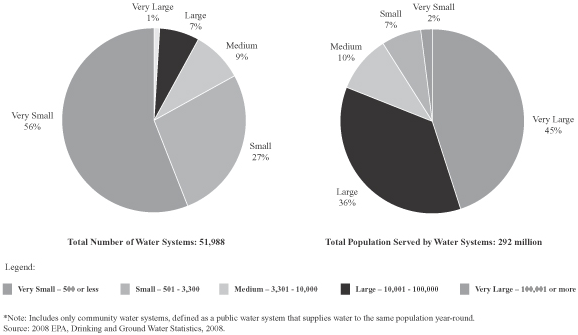
In the last blog I talked about the challenge to rural utilities, many of which serve relatively few people and have used federal monies to pay for a lot of their infrastructure.  In this blog we will take a look at the trends for community water systems which are defined as systems that serve at least 15 service connections or serve an average of at least 25 people for at least 60 days a year. EPA breaks the size of systems down as follows:

  • Very Small water systems serve 25-500 people
  • Small water systems serve 501-3,300 people
  • Medium water systems serve 3,301-10,000 people
  • Large water systems serve 10,001-100,000 people
  • Very Large water systems serve 100,001+ people

Now let’s take a look at the breakdown (from NRC 1997).  In 1960, there were about 19,000 community water utilities in the US according to a National Research Council report published in 1997.  80% of the US population was served.  in 1963 there were approximately 16,700 water systems serving communities with populations of fewer than 10,000; by 1993 this number had more than tripled—to 54,200 such systems. Approximately 1,000 new small community water systems are formed each year (EPA, 1995). In 2007 there were over 52,000 community water systems according to EPA, and by 2010 the number was 54,000.  85% of the population is served. So the growth is in those small systems with incidental increases in the total number of people served (although the full numbers are more significant). 


TABLE 1 – U.S. Community Water Systems: Size Distribution and Population Served


Number of Community Systems Serving This Size Community a

Total Number of U.S. Residents Served by Systems This Size b>

Population Served

1963

1993

1963

1993

Under 500

5,433 (28%)

35,598 (62%)

1,725,000 (1%)

5,534,000 (2%)

501-10,000

11,308 (59%)

18,573 (32%)

27,322,000 (18%)

44,579,000 (19%)

More than 10,000

2,495 (13%)

3,390 (6%)

121,555,000 (81%)

192,566,000 (79%)

Total

19,236

57,561

150,602,000

242,679,000

a Percentage indicates the fraction of total U.S. community water supply systems in this category.

b Percentage is relative to the total population served by community water systems, which is less than the size of the U.S. population as a whole.

SOURCES: EPA, 1994; Public Health Service, 1965.


Updating these numbers, there are over 54,000 systems in the US, and growth is almost exclusively in the very small sector.  93% are considered to be small or very small systems—serving fewer than 10,000 people. Even though these small systems are numerous, they serve only a small fraction of the population. Very small systems, those that serve 3,300 people or fewer make up 84 percent of systems, yet serve 10 percent of the population.  Most critical is the 30,000 new very small systems that serve only 5 million people (averaging 170 per system).  In contrast, the very large systems currently serve 45% of the population.  Large plus very large make it 80%.  The 800 largest systems (1.6%) serve more than 56 percent of the population. 900 new systems were added, but large systems served an additional 90 million people.

What this information suggests if that the large and very large sector has the ability to raise funds to deal with infrastructure needs (as they have historically), but that there may be a significant issue for smaller, rural system that have grown up with federal funds over the past 50 years.  As these system start to come to the end of their useful life, rural customers are in for a significant rate shock. Pipeline average $100 per foot to install.  In and urban area with say, 60 ft lots, that is $3000/household.  In rural communities, the residents may be far more spread out.  As an example, a system I am familiar with in the Carolinas, a two mile loop served 100 houses.  That is a $1.05 million pipeline for 100 hours or $10,500 per house.  With dwindling federal funds, rural customers, who are already making 20% less than their urban counterparts, and who are used to very low rates, that generally do not account for replacement funding, will find major sticker shock. 

This large number of relatively small utilities may not have the operating expertise, financial and technological capability or economies of scale to provide services or raise capital to upgrade or maintain their infrastructure.  Keep in mind that small systems have less resources and less available expertise.  In contrast the record of large and very large utilities, EPA reports that 3.5 percent of all U.S. community water systems violated Safe Drinking Water Act microbiological standards one or more times between October 1992 and January 1995, and 1.3 percent violated chemical standards, according to data from the U.S. Environmental Protection Agency (EPA).. 

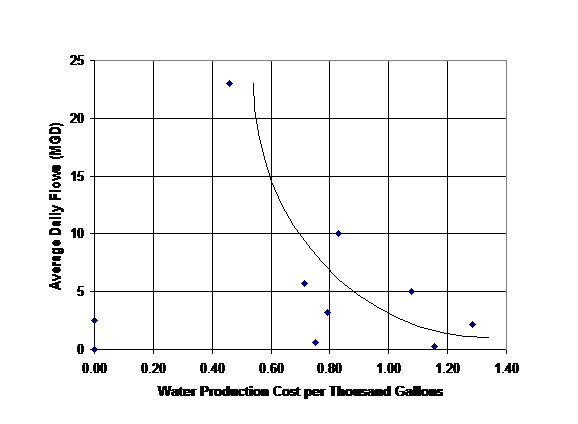
EPA and professionals have long argued that centralized infrastructure for water and sewer utilities makes sense form an economy of scale perspective.  Centralized drinking water supply infrastructure in the United States consists dams, wells, treatment plants, reservoirs, tanks, pumps and 2 million miles of pipe and appurtenances.   In total this infrastructure asset value is in the multi-trillion dollar range.  Likewise centralized sanitation infrastructure in the U.S. consists of 1.2 million miles of sewers and 22 million manholes, along with pump stations, treatment plants and disposal solutions in 16,024 systems.  It is difficult to build small reservoirs, dams, and treatment plants as they each cast far more per gallon to construct than larger systems.  Likewise operations, despite the allowance to have less on-site supervision, is far less per thousand gallons for large utilities when compared to small ones.  The following data shows that the economy-of-scale argument is true:

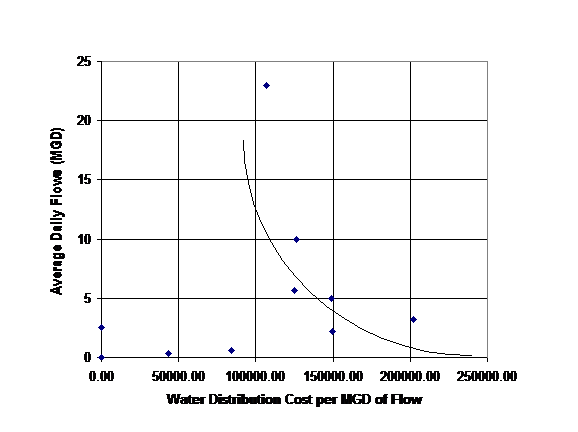
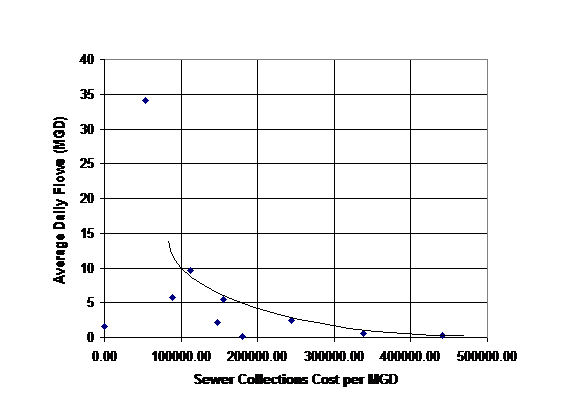
  • For water treatment, water distribution, sewer collection and wastewater treatment, the graphics clearly demonstrated the economy-of-scale of the larger utility operations versus small scale operations (see Figures 2-5). 
  • The administrative costs as a percentage of the.total budget parameter also demonstrated the economy-of-scale argument that larger utilities can perform tasks at a lesser cost per unit than the smaller utilities (see Figure 6).

Having reviewed the operations costs, the next step was to review the existing rates.  Given the economy-of-scale apparent in Figures 2 to 6, it was expected that there would be a tendency for smaller system to have higher rates.  Figures 2-6 demonstrate this phenomena. 

So what to do?  This is the challenge.  Rate hikes are the first issue, a tough sell in areas generally opposed to increases in taxes, rates and charges and who use voting to impose their desires.  Consolidation is anothe5r answer, but this is on contrast to the independent nature of many rural communities.  Onslow County, NC  figured out this was the only way to serve people efficiently 10 years ago, but it is a rougher sell in many, more rural communities.  Infrastructure banks might help, the question is who will create them and will the small system be able to afford to access them.  Commercial financing will be difficult because there is simply not enough income to offset the risk.  The key is to start planning now for the coming issue and realize that water is more valuable than your iPhone, internet, and cable tv.  In most cases we pay more for each of them than water (see Figure 7).  There is something wrong with that…
 Image


Figure 1  Breakdown of Size of Systems
Image


Fig 2 Cost of Water Treatment

Image


Fig 3 Cost of Water Distribution

Image


Fig 4 Cost of Sewer Collection

Image


Fig 5 Cost of Sewer Treatment

Image

Fig 6 Cost of Administration as a percent of total budget


Image

FIgure 7 Water vs other utilities


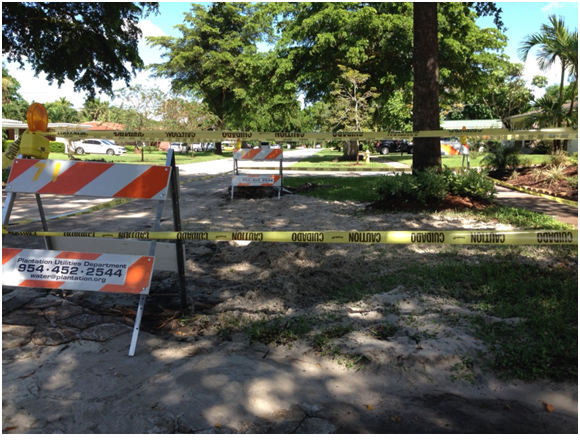
In front of house

The doorbell rang and it was 1:30 am on a Saturday morning.  It was my neighbor telling me about a small problem on the street.  I looked out and the entire block was flooded.  Water was moving. It was dark, and while my street light was working, it shed little light in the blackness.  However I figured out the old AC pipeline in front of my house had sheared and the block’s leak was actually my problem.  We had no water.  Fortunately the water department was able to get the main repaired in a couple hours.

The next morning we were not as lucky.  Another break on the next street over had shut us down again.  AC water main, but this time under a tree.  They had to remove the tree before fixing the line.  We were out all day.  The water plant guys and the repair crew said that the lines were supposed to be replaced a couple years ago, but that the City had delayed the replacement for budget problems.  


SUSTAINABILITY OF UTILITIES – PART 2

Let’s take a look at some scenarios. Let’s assume you are a utility that serves 20,000 people (8000 customers), with 60 miles of water pipe, 60 miles of sewer pipe, 17 lift stations, and a water and wastewater plant.  Replacing this infrastructure might be valued at $90 million for pipe, $35 million for treatment plants, water supply and pumping equipment (current day dollars).  Let’s also assume that their annual budget is $11 million and the typical demands are 3 MGD yielding a monthly bill of $115/mo (water and sewer).

Let’s make some general assumptions like that the pipe infrastructure might last 100 years, but clearly the treatment and mechanical parts would mot.  They would need ongoing maintenance and replacement.  50 years is probably too long, but let’s go with it.  If the overall costs increase at 3% per year and money is set aside for repair and replacement. The utility will see fairly steady rates if the customer base grows 2-3% per year.  Ten years out, the budget will be $16 million.  Now for the scenarios.

If the customer base has grown at 3% per year, the customers will increase to almost 27,000.  More of an issue is what happens if that increase in demand (from 3 to over 3.4 MGD) needs to come from a new water source and requires new capacity.  Many utilities will use impact fees to offset this cost to current customers so as not to adversely impact current customers too severely .That’s the current assumption.  The result looks like this at 10 and 20 years:


Component


Value today

10 years

20 years

Customers


20000

26878

36122


Accounts


8000

10751

14449


Water  Pipe

60 mi

 $   45,000,000

 $     98,509,418

 $215,646,786

Sewer Pipe

60 mi

 $   45,000,000

 $     98,509,418

 $215,646,786

Treatment Plants and Pumping

3 MGD

 $   35,000,000

 $     76,618,436

 $167,725,278

Operations budget


 $     9,000,000

 $     16,255,001

 $  29,358,340

Capital Budget


 $     1,600,000

 $       3,502,557

 $    7,667,441

Debt


 $        400,000

 $         400,000

 $      400,000

Monthly Amount


 $              115

 $                156

 $             216

Increase per year


5%

5%


Assume 1% of pipe Replacement Costs +2% Plant


Assume operating budget inc 3%/yr but construction increases 5%/yr


But what if the new treatment and supply are 50% more costly and impact fees assume the lower investment (typical)?  The cost for the budget and for the infrastructure replacement increases (with the delta from debt).  Cost are 50% higher:


Component


Value today

10 years

20 years

Customers


20000

26878

36122

Accounts


8000

10751

14449

Water  Pipe

60 mi

 $   45,000,000

 $     98,509,418

 $215,646,786

Sewer Pipe

60 mi

 $   45,000,000

 $     98,509,418

 $215,646,786

Treatment Plants and Pumping

3 MGD

 $   35,000,000

 $     92,289,117

 $202,029,937

Operations budget


 $     9,000,000

 $     23,731,487

 $  42,861,706

Capital Budget


 $     1,600,000

 $       3,815,971

 $    8,353,534

Debt


 $        400,000

 $       1,325,000

 $    2,825,000

Monthly Amount


 $              115

 $                224

 $             312

Increase per year


8%

7%


The normal assumptions are that growth will continue, but what if it does not?


What can be gleaned as a result of a non-growth or net decrease scenario?  How does sustainability get affected?  Let’s look at the no growth scenario.  In this light, rates will need to increase at least 5% per year to insure that the utility remains rate neutral.  If there is significant deferred maintenance, which is typical of may utilities, that cost will be added to the bill.  There are examples of utilities in Florida who finally caught up with deferred obligations which doubled their customers’ bill.  This scenario is doable, but the only real assumption changes that can be made are related to the lack of growth.  Deferring maintenance will once exacerbate the problem as there is not guarantee that growth will return.  Rate neutrality becomes a public relations issue, but not insurmountable.


Component


Value today

10 years

20 years


Customers


20000

20000

20000

Accounts


8000

8000

8000

Water  Pipe

60 mi

 $   45,000,000

 $     73,300,258

 $119,398,397

Sewer Pipe

60 mi

 $   45,000,000

 $     73,300,258

 $119,398,397

Treatment Plants and Pumping

3 MGD

 $   35,000,000

 $     57,011,312

 $  92,865,420

Operations budget


 $     9,000,000

 $     12,095,247

 $  16,255,001

Capital Budget


 $     1,600,000

 $       2,606,231

 $    4,245,276

Debt


 $        400,000

 $         400,000

 $      400,000

Monthly Amount


 $              115

 $                157

 $             218

Increase per year


5%

5%


Now let’s look at the decline issue.  If the population decreases by 25% over the ten year horizon, what does this say?  The costs will remain relatively constant, but the number of customers and demands for water will drive the rates up significantly. In ten years the rates could double in a community that is likely economically disadvantaged.  The higher rates may begin to discourage economic development, rate neutrality exacerbate the problem and may increase in costs for regulatory or deferred maintenance obligation becomes a significant issue:


Component


Value today

10 years

20 years

Customers


20000

16341

13352


Accounts


8000

6537

5341


Water  Pipe

60 mi

 $   45,000,000

 $     73,300,258

 $119,398,397


Sewer Pipe

60 mi

 $   45,000,000

 $     73,300,258

 $119,398,397


Treatment Plants and Pumping

3 MGD

 $   35,000,000

 $     57,011,312

 $  92,865,420


Operations budget


 $     9,000,000

 $     12,095,247

 $  16,255,001


Capital Budget


 $     1,600,000

 $       2,606,231

 $    4,245,276


Debt


 $        400,000

 $         400,000

 $      400,000


Monthly Amount


 $              115

 $                193

 $             326


7%

7%


Assume 1% of pipe Replacement Costs +2% Plant


Assume operating budget inc 3%/yr but construction increases 5%/yr


 What can we glean from this?  Interestingly the failure to accumulate costs for growth, and the declining rate base end up with similar monthly costs.  Only by the no growth and collecting appropriate impact fees will costs be controlled, and even in that case, costs will double every 20 years or less.  The reality is that the failure to follow proper revenue collection protocols will severely limit the utility in future years.  High capital costs impact rates significantly.  Leaving it to some future commissioner to raise the rates is unfair to both the future decision-makers and customers.  It does not make you a leader either. 


Pipe wears out.  Concrete deteriorates, Steel rusts.  Aluminum pits. Mines play out.  Wells run dry.  But we strive for sustainability.  How do these disparate facts coexist simultaneously?  And if they don’t, how does this impact our long term prospects for our utility systems and communities.  And how do the decisions impact our understanding of sustainability.

An AWWA publication from 2010 was a compendium of thoughts on the meaning of sustainability form the perspective of water utilities.  One of the findings of the publication was that the understanding of sustainability had more to do with the perspective of the person being asked about sustainability than an overall comprehension of the inter-relationships of the concept of sustainability among different sectors.  For water supply entities, the economic sustainability of the community is not really their primary concern.  Instead they focus more on impacts to customers.  But water is a driver for economic development in a community. 

The message is that water utilities may need to look at the broader picture of sustainability in their community and extend the definitions to a wider range because no one else is and the community is looking for leadership.  The first paragraph focuses on infrastructure issues, which are commonly ignored in dealing with the concept of sustainability, but they are the ones traditionally focused on water supply issues.  The utility needs to look at infrastructure and financial outlook as a part of an overall sustainability strategy. 

There are certain assumptions that we make on many of our systems, and perhaps we need to revisit some of these assumptions in light of potential future realities.  For example, what happens to communities that do not grow?  Our current assumptions generally assume that there will be an ongoing increase in population or water use that will drive increases in revenues without specific increases on customers.  However what if you are Detroit where the populations has dropped in half in the past 50 years.  How do we deal with aging infrastructure and demands for increased water quality and reliability while maintaining fees at affordable levels for customers?  This is a particular problem when there are economic disruptions that create a large group of disenfranchised people who become more economically disadvantaged than they might otherwise already be.  The competition for sustaining water rates, infrastructure condition and water supplies can be a difficult conundrum.


A recent article in the South Florida SunSentinel newspaper raised an interesting question.  What they did was line up all the cities in the county and identify the total fees paid to the City by residents.  They took the tax rates, plus water, sewer, storm water, fire, garbage and any other fees.  The article raised an interesting question.  For example, Hollywood, West Park and Lauderdale Lakes had the highest cost per household – in excess of $3500/year.  The other end of the spectrum was Hillsboro Beach, Sea Ranch Lakes and Southwest Ranches, each under $2000/household.  Of note is that Southwest Ranches provides no water or sewer service (all wells and septic tanks on large lots), so a direct comparison is not really appropriate.  Property taxes were low, but fire fees were really high.  Sea Ranch Lakes is a tiny community with no sewer, so again, not really a good comparison.  Hillsboro Beach is among the wealthiest communities, but also tiny. 

 Most communities had total fees between $2100 and 3200/resident.  Why the difference? First, the value of property varies widely.  West Park and Lauderdale lakes have among the lowest values per household, so their taxes must be higher to provide the same level of service.  Hollywood, and Dania Beach (#4 on the list) had higher water, sewer and storm water costs.  While both have recent, ongoing infrastructure programs, both have large transfers from the water and sewer fund to the general fund, and in both cases the water and sewer customer base does not match the property tax base.  In Dania Beach’s case, the service area is half the City, so those residents are supporting the property tax funded services at a higher rate than their neighbors.  Hollywood struggled with major budget issues to used water and sewer funds to balance the budget.

The problem that this article did not address, but should have was that where water, sewer and storm water costs were high, what was driving this? Was in infrastructure investments that others simply have yet to make?  That’s ok and the fact that these utilities invested now may be more timing.  If the result is due to transfers to the general fund, that is an entirely different, and somewhat disconcerting problem.  First since the service areas are not the same. There is a fairness issue.  Some residents pay more for the same services.  It means the water and sewer system is not really an enterprise, with rates based on service costs.  Instead it is being used as a tax source.


One of the more interesting issues in Congress the past years is the Farm Bill which did not pass the House.  The issue was too many food stamp recipients.  The program has doubled in the past 10 years and now 1 in 7 families depend on supplemental assistance.   But here is an interesting question – wouldn’t you assume that the states with the greatest percentage of people getting food stamps would be those states that voted for the Farm Bill.  That would be those Democratic states like California, Colorado, the New England States, Pennsylvania and New York?  Well interestingly enough, you would be wrong.  The state with the highest percentage of people receiving food stamps is Alabama, followed by New Mexico and Tennessee, which are red states.  In fact all of the southeastern states are in the upper two third, all exceeding 15% of households.  Yet their representatives voted against their constituents!  This should not be a surprise.  All of the “blue” states, except Washington and Oregon were below 15%.  Some were below 10%. 

So how does this affect water and sewer systems?  There is an ongoing effort at the EFC at UNC Chapel Hill and other areas regarding the concept of affordability of water and sewer services.  The concept is that costs in excess of 3.5 or 4.5 % of income may be burdensome on residents.  Effort is trying to come up with ideas to address low income ratepayers.  The loss of food stamps actually exacerbates this problem since most of these same ratepayers are the ones receiving food stamps.  The conflict between paying for food and water/sewer service increases, putting more low income residents at risk.  Congress is doing utilities no favors by disrupting embedded programs that people depend on.  We can debate whether the program, a transfer of funding from wealthier, blue states, to poorer, red states is a appropriate federal revenue transfer, but the reality is that the dependency has been created.  Compounding the problem is that employment is not nearly back to 2007 levels, and salaries for most of us have declined with respect to buying power over the past 30 years.  As a result, many residents, including many hardworking, employed residents, continue to struggle.  We should be concerned about the acts of Congress and remember some of our representatives may not be voting to help their constituents.  


In June, President Obama made a speech about the increase in renewable power that the United States had created in the last 4 years, and announced goals to double this amount in the next four.  Virtually all of this power was solar and wind power.  Little mention was made of hydroelectric or onsite sources.  But the latter have been around much longer than the former sources and there may be options to increase their contributions under the right circumstances. 


Hydroelectric power has been in use in the US for over 100 years.  By the 1930s, 40 percent of the nation’s power came from hydroelectric dams, including some fantastic accomplishments of the time like the Hoover Dam.  Today we have over 100,000 dams in the US, most of which provide power.  Today hydroelectric is only 6 percent of our total.   The reluctance to continue with hydroelectric power involved fisheries, land acquisition costs and legal issues.  Some hydropower options are excellent.  Hurting fisheries (which disrupt local economies dependent on those fisheries) may not be, and therein lies part of the dilemma.


But water and wastewater utilities are actively looking for means to reduce power costs.  Depending on the utility, pumping water can account for 80-90 percent of total power consumption, especially with high service pumps on water systems that require high pressures.  More efficient pumps is one obvious answer, but of fairly limited use unless your pumps are really old.  Variable speed drives can increase efficiency, and the cost is dropping.  But note that with all that high pressure, how do utilities recapture the energy?  We often don’t and the question is whether there is a means to do so that can benefit up.  The first step is looking at plant hydraulics.  Is there a way to recapture energy in the form a pressure.  For example of reverse osmosis systems, we can install a turbine to recapture the pressure on the concentrate side.  They are not very efficient at present, but the potential is there.  On long gravity pipe runs for water supply, a means to recapture pressure might also be available. 


Of course on-site generation of power is a potential solution. Water and sewer utilities have land, and on the wastewater side, methane, so producing power is possible.  This solution, however, may not be embraced by power utilities due to the potential revenue reduction potential and loss of embedded reserve capacity at water and wastewater plants.  As the water facility takes on on-site generation, their load profile may shift significantly placing them in under a different rate structure. This may greatly reduce the benefit to the facility.  There are, however, approaches to permit win-win solutions. The goal is to put willing power and water utilities together to permit local generation that will benefit both power and water utility systems to encourage public – private partnerships.  A medium to large wastewater plant can generate at least a third of its power needs.  Some even more if they take in grease, oils and other substances that should not be put into the sewer system.  The potential there is significant.  EBMUD has a plant that is a net seller of power.  We should look for opportunities.  But don’t forget, water utilities can create hydropower without impacting fish populations. We just need to seek out the right opportunities.