Archive

Water Funding


I had to share this, from a nonscientific survey of people adamantly opposed to any consideration of changes to our climate:

1. I can’t do anything about it so I don’t care about it
2. People can’t alter what is happening with the earth because it is too big
3. It’s natural, so we can’t do anything about it
4. It’s not an issue now, so it’s somebody else’s future problem
5. The science is inconclusive so why do anything yet. Let’s see what happens
6. Trying to address it will cut jobs
7. We won’t be competitive (i.e our profits will drop)
8. It requires changing our business model (energy)
9. If we talk about it no one will develop in our community
10. Costs too much

I had to post this as many of you will have comments. But before you do, these about this a minute……

The first five are based on no facts, but a desire to ignore the issue entirely. The second five are more poignant because aren’t these pretty much the same arguments to deny the need to correct water pollution concerns in the 1930s? Or 1950s? Or even 1970s? Or even today with hog farms, frack water, acid mine waste, coal dust slurries, etc.? Or actually pretty much every regulation? I seem to recall Tom Delay making this argument when he was in Congress before he was indicted.

Now think about the Clean Water Act, Clean Air Act, Safe Drinking Water Act, and others. These regulations are designed to correct ills of the past that were simply ignored due to the first five arguments above, ignoring the fact that prevention is always less costly than cleanup afterward. To we pass regulations to clean up problems and protect the public health going forward. Otherwise why have a regulation?

So let’s talk about that jobs impact. The reason is that after the passage of these regulations, didn’t the number of professional jobs (like civil and environmental engineers, environmental and other scientists – STEM jobs) increase? Isn’t increasing STEM jobs a priority? So won’t dealing with climate issue perhaps create a similar increase in STEM jobs? Yes, costs for water increased and the cost for the effects of climate changes will cost money, but don’t these challenges create opportunities? Isn’t this akin to dealing with problems with development from the past? Just asking…..


At a recent conference I was listening to a presentation by the Army Corps of Engineers explaining the investments made over the last 80 years.  Subsequent presentations discussed that the need to reinvest in infrastructure appears to be about 3.6% of infrastructure value per year, but that the US is spending about 2.4%.  The best condition of our infrastructure was in the 1980s, but decreases in reinvestment due to funding limitations has caused an ongoing decline in infrastructure value, which is why the ASCE report cards show most of our infrastructure at the D or D- level.  It is getting old and it needs repair and replacement.  You would rarely buy a house, never maintain it, and expect it to live in it without problems for 50 years.  Roofs leak, pipes need replacing, mechanical equipment, lights and appliances fail.  It is the cost of owning a home. You have to update.  Most times the new equipment is more efficient that the old stuff, saving money.  So why do we do this with infrastructure?

More interesting was the response to how some of these agencies may deal with this backlog of deferred maintenance.  So far I have heard the Corps, state transportation agencies, state land agencies and another federal government say that they are figuring out means to prioritize the assets and dispose of those not needed.  So let’s see how that would work and I kid you not, these are suggestions:

  •          Abandon state roadways and let local governments deal with them.  Of course these are roads that are challenged – like they flood constantly and the cost to raise them is cost prohibitive, but the city has development along the corridor
  •          The state has low value wetlands they will donate to the underlying county – not that you can do anything with this land- it is not developable, but needs to be monitored and maintained
  •          There is a waterway that has leaking dikes but serves very few people.  Let’s give it to the local community as they are the only ones who use it.
  •          We have monitoring equipment, but it really provides more information locally that regionally, so let’s give it to them 

Hey I like the idea of giving, but seriously, how does the “recipient” deal with this problem.  The low value assets are low value because they serve limited people and are deemed to have little economic or useful value or are too expensive to maintain.  So what does the recipient do with it?  They do not have nearly the resources that larger governmental entities have, and if the big guys cannot find the money, will locals?  Are we just kicking the problem to the next guy?  Sounds like used car sales to me.

It sounds suspiciously like the argument I have heard several times from a city manager who talked about cutting the size of local government, only what he did was contract with other entities to do the services, which means cuts in employees for his city, but the cost is just transferred to another entity.  The rate/taxpayers will foot the bill unless the service is completely discontinued.  In his case, they all paid more.

The State of Florida and the federal government have both cut employees and both contract heavily for services that never used to be contracted.  There is a whole industry of contracting for government work that used to be done in-house.  In other words, they privatized portions of the operations.  But did the cost of government decrease in either case?  No. 

So going back to the initial question – will governments abandon infrastructure?  The answer appears to be yes, but the problem is that that infrastructure IS being used by people so the reality of full abandonment is impossible.  The result will be that underlying local entities will be stuck with the bill.  Planning is needed.  “Fail to plan = Plan to fail” as my friend Albert says.  We need to identify where these “gifts” may occur and identify a means to deal with the inherent obligation that goes with them.  For water and sewer utilities, waterways and roadways are of particular concern, but so could watersheds and well sites. 


We all know that our infrastructure is deteriorating.  Deferred maintenance increases the risk of system failure. The need for capital reinvestment within the utility industry has historically been very low. As a result, in its “2013 Report Card for America’s Infrastructure,” the American Society of Civil Engineers assigned a grade of “D” to America’s drinking water systems, citing billions of dollars of annual funding shortfalls to replace aging facilities near the end of their useful lives and to comply with existing future federal water regulations (ASCE, 2013).  AWWA estimates that investments of at least $1 trillion are needed over the next 25 years.

While a pay-as-you-go capital funding seems like the best way to go, that is difficult to accomplish with the large outlays needed to upgrade the infrastructure system and the controls on rates often exercised by local officials.  As a result, borrowing is required and the condition of infrastructure and the lack of reserves are a part of how the utility is viewed by those who lend monies.   Utility managers need to understand how the lending agencies evaluate risk. 

Lenders use many tests.  Among them are: whether the utility’s annual depreciation expense is used of accumulated as reinvestment in the system, whether adequate reserves are present, whether  annual capital spending that is below the amount of annual depreciation and the amount of revenues in excess of projected debt (debt service coverage).  The target debt service coverage may depend upon the requirements of the underwriter, the rating agencies and the investors.  Debt service coverage could be as low as 15% or as high as 50%.  In 2012, the median all-in annual debt service coverage excluding connection fees for utilities rated “AAA” by Fitch Ratings was 220%, while the median for AA-rated and A-rated utilities was 180% and 140%, respectively. (Fitch, 2012).  

A working capital target of 90 days of rate revenue is a minimum, but since 2008, more is likely to be required depending on the size of the system and the history of revenues.  Where the revenues were stable despite 2008, less may be required.  For those utilities that suffered major decreases, reserves should be far larger – perhaps a year or more.  Other criteria that could be used to evaluate the projects when borrowing money include public health and safety, regulatory compliance, system reliability, the risk and consequences of asset failure, redundancy, community/customer benefit  and sustainability. At the same time, the expectation is that  the utility systems that retain all monies in the system to be utilized to improve the system and pay for debt service, except those used  for the purchase of indirect services from the General Fund that are justified with indirect cost studies. 


Despite the above, rate are an issue.  Fitch Ratings has indicated that it considers rates for combined water and wastewater service that are higher than 2% of the median household income – or 1% for an individual water or wastewater utility – to be financially burdensome (Fitch, 2012).  The Environmental Protection Agency (EPA) considers that rates for an individual water or wastewater utility that are greater than 2% of median household income may have a high financial impact on customers. (EPA, 1997). Utilities with a stronger financial profile might have residential charges for combined water and wastewater service that are less than or equal to 1.2% of median household income, or less than or equal to 0.6% for an individual water or wastewater utility. All revenues generated through system operations generally must remain within the system and can only be used for lawful purposes of the system.

Canadian utilities employ more formal polices to establish fiscal policies to provide reserves to insure stability in the event of unforeseen circumstances. Reserve targets focus on ensuring liquidity in the event there is an interruption in funding, increased capital costs due to new regulatory requirements or a short term funding emergency – all the issues evaluated by the bankers.  Reserve targets are policy decisions. Benchmarking is an evolving practice within Canadian public sector utilities particularly as it relates to financial planning and capital financing. The benchmarking exercise provides valuable information to help assess fiscal performance, the needs of customers, and provide the tools to help support optimum performance. 


We have talked about reserves, the need for them, reasons why they are neglected and how to establish appropriate numbers (an area where more research is needed).  Reserves are an issue when the economy tanks.  We all recall the problem in 2008, but this is where utilities need to look beyond just their system to see what might be coming.  2008 was a problem that we should have seen coming, or at least planned for, but did not.  But it means that we need to look at the national and local economic picture and understand a little about events beyond our reach that can affect us.  Utilities and governments generally do not do this well. 

In 2005-2007, it was very clear we had a property bubble going on.  There was discussion on the news, financial channels, Wall Street Journal and even columns by economist like Paul Krugman.  A few of us may have taken advantage of the bubble through prudent real estate sales, but many did not.  Likewise, few utilities or governments planned for its inevitable fall.  After the crunch hit, those who owed the least amount of money, had savings and had stable incomes fared better than those who did not.  Same for governments.  Unfortunately most Americans and most governments fell into the “did not” category. 

So let’s look at a couple issues.  First, we knew there was a bubble and should know that all bubbles pop.  We had the tech stock bubble in the late 1990s.  People on Wall Street knew that the investments had turned to real estate and bankers where busy loaning money out with no interest for two years, no money down, adjustable rate mortgages and the like.  If you owned a computer you were inundated with Countryside and various other folks trying to loan you money.  Or buy your house and pay you an annuity if you were older. 

The reason that these “opportunities” were so prevalent was to help speculators who expected to own the property for short periods of time, or help those who might not have the means to buy time to get the means to support the payments.  All the subsequent financial instruments discussed in books like “Too Big to Fail” come from tools used by bankers to disperse the risk associated with speculators and the risky.  It made money for bankers and investment houses (remember they are private businesses beholden to their private stockholders). 

Like all bubbles, we get caught up in the money being made by speculators (and yes if you invest in the stock market you are speculating).  We try to grab onto the rising instruments to get ahead, but we forget that especially with real estate, the growth overall rate across the nation could only grow at the rate of population growth.  It is basic supply and demand. 

For governments, revenues rise, especially during real estate bubbles.  Some bubbles last for years, which creates a distorted view of the future.  In south Florida, there was a lot of buzz concerning water supply projections and arguments between regulatory staff and utilities over water supplies that were projected 20 years in the future, based on demand projections from 2000-2005.  When the dust settled in 22011, most of those issued disappeared because virtually all projections were substantially revised downward.  And most revenue growth projections were likewise revised downward and capacity needs delayed.  Planning 20 years out is historically inaccurate because the global economy can impact local growth.

Of course these new projections are incorrect as well.  Because the test period was 2005-2010 or 2000- 2010, the growth is stunted.  So they are likely underestimating demand and revenues.  Uncertainty with time means that the accuracy of projection decreases with time.  As a result, simply relying on past projection methods increases risk that of significant deviations.

I do an exercise n class where I give students three sets of projections.  10 years apart, for 50 years.  I tell them nothing else.  The examples are The State of Nevada, Cleveland, and Collier County, FL.  All are in the past (Cleveland is 1910-1950) There is absolutely no easy method that can project the growth in either Collier County or the State of Nevada, or that Cleveland’s population will drop in half. We could do the same with Detroit and never project that decrease either.  But when you tell them where the population are and what year, the wheels start to turn.  They realize that economics is a major issue.  While Nevada and Collier grew from 1960-2000, the rate of change is likely to be very different in 2010 to 2020 due to the 2008 recession. 

Tracking economic activity is a utility responsibility.  We need to know what is really happening, and understand bubbles.  We need to recognize that when property values and housing number increase fast, it will be short term.  Plan for savings and reserves.  Figure out what your recovery period might be.  We need to understand our economic base.  For example try this out and see what your conclusion is.  Florida’s economy is based on three major industries: agriculture, tourism and housing.  What could possibly go wrong with that model?  Well if we have an economic problem nationally, 2 of 3 take major hits because people outside the state do not travel to Florida and retirements get put off.  The economy gets hit hard and recovery is slow.  We have experienced that exact phenomenon from 2009 to date.  And many of those jobs are low wage positions which means the people who struggle most get hit hardest.  Storm events can impact the state.  Bit hits to all three, and agriculture is also a low wage industry.  It is a precarious economic model that sets itself up for potential fluctuations.  We need to plan for this.  It is our responsibility, utility staff and decision-makers to plan and prepare for the next big event.  

As water and sewer utilities, the public health and safety of our customers is our priority – it is both a legal and moral responsibility. The economic stability and growth of our community depends on reliable services or high quality. The priority is not the same with private business. Private businesses have a fiduciary responsibility to their stockholders, so cutting services will always be preferred to cutting profits. Therein lies the difference and yet the approach is different. Many corporations retain reserves for stability and investment and to protect profits. Many governments retain inadequate reserves which compromises their ability to be stable and protect the public health and safety. Unlike corporations, for government and utilities, expenses are more difficult to change without impacting services that someone is using or expects to use or endangering public health. Our recent economic backdrop indicates that we cannot assume income will increase so we need to reconsider options in dealing with income (revenue) fluctuations. If there are no reserves, when times are lean or economic disruptions occur (and they do regularly), finding funds to make up the difference is a problem. The credit market for governments is not nearly as “easy” to access as it is for people in part because the exposure is much greater. If they can borrow, the rates may be high, meaning greater costs to repay. Reserves are one option, but reserves are a one-time expense and cannot be repeated indefinitely. So if your reserves are not very large, the subsequent years require either raising taxes/rates or cutting costs. An example of the problem is illustrated in Figure 1. In this example the revenues took a big hit in 2009 as a result of the downturn in the economy. Note it has yet to fully return to prior levels as in many utilities. This system had accumulated $5.2 million in reserves form 2000-2008, but has a $5.5 million deficit there after. Reserves only go so far. Eventually the revenues will need to be raised, but the rate shock is far less if you have prudently planned with reserves. You don’t get elected raising rates, but you have a moral responsibility to do so to insure system stability and protection of the public health. So home much is enough for healthy reserves? That is a far more difficult question. In the past 1.5 months of operating reserves was a minimum, and 3 or more months was more common. However, the 2008-2011 economic times should change the model significantly. Many local governments and utilities saw significant revenue drops. Property tax decreases of 50% were not uncommon. It might take 5 to 10 years for those property values to rebound so a ten year need might be required. Sales taxes dropped 30 percent, but those typically bounce back more quickly - 3-5 years. Water and sewer utilities saw decreases of 10-30%, or perhaps more in some tourist destinations. Those revenues may take 3-5 years to rebound as well. Moving money from the utility to the general fund, hampers the situation further. Analysis of the situation, while utility (government) specific, indicates that appropriate reserves to help weather the economic downturns could be years as opposed to months. The conclusion is that governments and utilities should follow the model of trying to stabilize their expenses. Collect reserves. Use them in lean times. Develop a tool to determine the appropriate amounts. Educate local decision-makers and the public. Develop a financial plan that accounts for uncertainty and extreme events that might impact their long-term stability. Take advantage of opportunities and most of all be ready for next time. In other words, plan for that rainy day.


My last blog was a discussion about surpluses.  The State of Florida will have a $1.3 billion surplus this year and a host of politically expedient answers for where that money goes (tax cuts, pork projects, projects to help election results), but little mention of replenishing trust funds and reserves that were emptied to balance the budget amid tax cuts from 2010 – 2012.  But perhaps it is not the legislators or their constituents that we should blame for not understanding the need for reserves because the truth is that most people are not used to saving.  A recent article I read noted that 72 percent of Americans live paycheck to paycheck and would have difficulty putting $2000 together if needed.  $2000 is not a lot of money these days – it won’t buy you a transmission for example or a new engine for your car.  It won’t cover first, last and a deposit on a rental.  And it won’t cover the down payment on a house or most cars.  There are people who do not receive enough income to achieve some degree of savings, but not 72% of us.  We have come to perceive that having little savings is normal, but it wasn’t always this way and it is not this way everywhere in the world.  Back in the day, American saved more than they do now.  The reason is not that they had more money (they didn’t) or that they had less to spend money on (as things cost more proportionately).  But it was that “rainy day” they all knew would come and when they would need money.  They had been through depressions, recession and losses of industries (remember those Concord coachmakers did not get a federal bailout in trying to compete with Henry Ford).  They knew that there would be times when they needed to rely on themselves to survive and savings was the key.

There are two major differences from the past.  The most important is the fact is that credit was a lot harder to come by back in the day, so you needed cash for those big purchases.  That has changed dramatically in 50 years.  Today we get advertisements for credit cards – in the mail, instant credit at stores, easy credit for cars, and in the early 2000s, no-money-down-no-income-verification loans on real estate.  The need to save evaporated.  The access to easy credit has eliminated much of the need to save for those big expenses.  We can borrow to acquire them.  If we have a job problem, we borrow against the house or life insurance policy.  These are good backstops that help us maintain our way of life.

At the same time as we are being extended opportunities to secure funds to spend, we are barraged by advertisements and flyers and pitches to spend that money on products and services, many of which we probably don’t need, but are “cool” to have.  We are encouraged to compete to have better “stuff” than the other guy, and make sure we have the newest technology.  We all do it.  Just look at all phones can do, while keeping in mind that the old Bell phone I bought in college still works regardless of the situation and still sounds good.  No cool ringtones however, nor photo capability.  All that means we spend less on “needs” and more on “stuff.” 

Given this backdrop it is no surprise the attitude of decision-makers in government toward revenues and expenses.  Re-education of the public is needed as opposed to rhetoric.  We need to move the public discussion away from the concept of a balanced budget being expenses equal revenues to the correct concept of revenues + reserve expenses = expenses plus savings.  At times you use reserves (and savings =0) while other times reserve expenses are 0, while savings are positive. When big expenses come, borrow, but recurring expenses should not be funded through borrowing (credit).  We should seek to avoid is the desire to cut taxes (akin to cutting our salaries) to bring the budget back into balance that if we run a surplus, or spend it on “stuff.”  Such a system leaves room for those lean times when revenues may fluctuate but expenses do not (or increase).  


It was not so long ago that we were talking about local and state governments suffering major shortfalls in their revenues as a result of the downturn in the economy.  Cuts were being made to police, fire, education and parks.  Politicians were fussing over the need to cut taxes and cut government expenditures in the process.  Employees lost jobs and benefits were cut.   In a prior blog we discussed the fact that economic upticks and downturns were cyclical, and unlike people, there is a tendency for local and state government policy makers to “hang with the curve” so to speak and have government expenses track the economy as opposed to try to stabilize spending by taking advantage of the ups to create reserves in order to take advantage of the downs.  They ignore the old adage that their grandparents told them – save for a rainy day.  And we don’t recognize those rainy days approaching!  It is not a lot different unfortunately than many citizens who spend when they have money, and are short when they don’t.  We are not a country of savers and it hurts us often.

There is however a major benefit for government to have reserves.  When government has reserves, it can take advantage of lower competition to construct or invest in infrastructure in lean times. There are many examples of governments getting construction done at discounted rates based on timing their projects to economic downturns.  A side benefit is that those governments are spending money at the time when they need to keep people employed.  FDR did this during the Great Depression.  Obama attempted to copy him in 2009 with the AARA monies.  In both cases they may not have invested enough, but both were faced with deficits on the federal level and a Congress that was reluctant to spend. 

The economy has rebounded and state and local governments are starting to run surpluses. The South Florida Sun-Sentinel recently reported that the big “challenge” for the Florida Legislature and many other state and local governments, is they are running surpluses.  Recall the last time the federal government ran a surplus, we got tax cuts that immediately put the feds back in the red because they had not built up any reserves, and won’t even with a balanced budget anytime soon.  Well Florida has $1.3 billion extra on hand and guess what we hear in this election year  – tax cuts, more money for special projects, extended sales tax exemption dates, etc.  Those running for office are thrilled with the surplus because it helps their platform but we hear nothing about restocking the trust funds that were raided during the 2009, 2010 and to some extent the 2011 budgets! 

Expect this to be the norm, and the rhetoric should be troubling to fiscally responsible people.   If we have surpluses, times must be better.  In good times we should be encouraging decision-makers to sock money away in reserves, savings and other solid investments, and at the same time restocking those accounts drained to pay the bills during the down time of the Great Recession.   In Florida, our highway trust fund, environmental trust funds and education funds were drained.  They have not been restocked.  In fact the cuts to most of those programs has not been restored either. The next economic downturn will come – will we be prepared to weather storm by spending our savings as opposed to cutting services which magnifies the impact of residents?

As times get better, utilities owned by local governments should pay particular attention to General Fund revenues.  Many of those General Funds increased contributions from the water and sewer funds to make up the difference in losses of property and sales tax dollars.  That prevented utilities from making investments, or forced them to borrow money to cover investments that might otherwise have been paid for in cash.  Time for the General Fund to pay the utility back!  Time to restock the reserves and time to spend money to catch-up with the deferred maintenance and capital.  Of course the costs are not what they were 3 or 4 years ago, and neither are the interest rates, so we all pay more for the same projects because we could not spend the reserves in the down period.

Utilities should always have significant reserves.  Nothing we do is inexpensive, so having reserves makes it possible to fix things that inevitably go wrong.  Reserves are a part of a well operated, fiscally sound utility. Taking money from the utility during down times hurts both the utility and the local government.  Total reserves diminish of the entity, making it less possible to deal with emergencies, cover the loss of revenues, or take advantage of lower costs for construction projects.  Meanwhile, creating reserves and a pay-as-you-go system for ongoing replacement of pipes and pumps is good business.  It insures that ongoing money is spent to prevent deterioration of the utility system.  The reserves allow for accelerated expenditures when times are tough, prices are down and people need work.  When utilities spend money, it translates to local jobs.  But the only way to do this is make convincing argument of the benefits of reserves and spending.  


I have said before in this blog that my Dad’s family were born and raised in Detroit – not the suburbs, in the City, about a mile north of Tiger Stadium.  My great-grandfather was a butcher.  His sons all became butchers, so my Dad grew up around the butcher shop as a kid.  It was the Depression, but because of the shop, my Dad had food on his table.  My Great-grandmother managed the money, and acquired a number of properties in the area of 13th and Magnolia that the sons, and extended families would eventually move to.  It was a solution to the difficulties outside the shop.  Family was the means to survive the hard times of the Depression. 

Of course Detroit was a booming city – over 100 auto companies were in Detroit at the turn of the last century, and the City was becoming the center of a new mode of transportation – the automobile.  Henry Ford developed the assembly line to allow everyone to own a car, furthering the status of the City.  As the twenties developed, Detroit and Chicago competed to become the “jewel” of the Midwest.  Elaborate stone buildings, expanding infrastructure for roads, trains, water, sewer and storm water were all centerpieces of pride in the City.  Employment and incomes were high, worker benefits were good, the workforce was highly skilled and education was good. Profits were good and the auto industry was Detroit-centric. Detroit was a vibrant City in the first 50 years of the last century. 

Scroll ahead 60 years and how the city has fallen.  The City has lost a million people.  It has $18 billion in debt, and is collecting $0.3 billion less in revenues since 2008.  The tax base has been decimated.  Houses can be purchased for minimal prices.  Churches have been abandoned.  Crime is high.  Employment is down, unemployment remains above the state and national average.  Poverty is up, incomes are down.  Huge areas must be served but serve no one or only a very few.   The City filed the highest profile bankruptcy for a municipality ever.

The television show Low Down Sun last summer provided a graphic look at the City – blocks of the City devoid or mostly so of housing or other buildings, schools no longer in use, roads in disrepair, classic stone buildings with the windows broken out.  You can see what the City was, and the haunting view of the City today are a stark reality.  To add insult to injury, the Sun-Sentinel wrote a recent article about how people are making money doing tours of abandoned buildings in Detroit, or how farming is occurring in the City limits. 

So if Detroit failed, why not Cleveland, Akron, Pittsburgh, St. Louis, Cincinnati or virtually any other large, older Midwestern industrial city?  Sadly many of these cities have lost the industries that made them famous and provided jobs and a stable tax base and incomes.  Many of these cities are also stressed, much as we found Birmingham was.  There are many arguments for what precipitated these losses:  unions, shifts in population, outsourcing offshore, competition within the US, changes in consumer preferences, technology…… the list goes on.  But the reality is it doesn’t matter why, the City must deal with the reality that is.  We all look at Detroit and its recent bankruptcy filings.  Maybe looking at Detroit allows us to feel better about our situations, but we need to learn the lesson from Detroit, Birmingham, Cleveland and others who filed for bankruptcy.  We need to look back to determine where the decisions were that created the issues.  Was it expanding to fast, poor economic assumptions, failure to manage finances better, political failures, failure to raise revenues/taxes/water fees, or failure to maintain or replace infrastructure?  Rarely is it corruption, so it is people trying to do well but failing in their jobs.  The question is why? 

I would start with training.  We need to train our public managers better, but MPA and MBA schools are not teaching about these failures.  In part it may be because we tend to teach positive lessons, versus negative ones, but they would be useful case study of the potential challenges.  In a prior blog I noted that the biggest challenge for government managers is managing in lean times.  Often lean times can be overcome by saving money as fund balances and investing (well), but long-term downturns like Detroit, Cleveland and other cities have experienced cannot be corrected this way.  There are major policy implications that must be overcome. 

From a utility perspective it is important to note that the economic difficulties are not limited to cities and counties but utilities are subject to long-term declines as well.  The problem is particularly acute in industrial communities where a large industry (think mills in the mid-Atlantic states) move away and leave water and wastewater facilities at far less capacity than they were designed for. Small systems may be especially at risk.

As an industry we need to learn from these failures.  We should study the difficult times to determine how the problems can be avoided.  The need to figure out how to manage funds better, deal with customer losses, and define strategies to overcome losses.  If anyone has some thoughts, please respond to the blog, but doesn’t this sound like a research project in the making?


Back during the dark days of the late-1970s, when America was being held hostage by Middle East oil interests, the Department of Energy was created, ostensibly to free our economy from the dependence on foreign oil and all that trappings that go with it.  It was a noble goal – the American economy could grow without the risks posed by foreign governments.  Thirty five years later, could we finally be reaching that goal? 

Interesting the often criticized billions of energy company subsidies of the Bush era do not appear to be responsible for solving the issue.  Nor are the prior efforts to subsidize or otherwise encourage investments before.  The energy subsides since 2000 do not appear to be the reason, but the arctic wilderness did not need to be disturbed either.  The success had nothing to do with any of it, but instead a series of private risk takers to a gamble on an unproven technology, to make great strides – fracking.

Based on the success of the development of fracking for natural gas, we have made major improvements.  But it is not just fracking, as many power plants are or have been rehabilitated to convert away from oil and coal to cleaner burning natural gas, thereby developing the market for natural gas.  Local governments have been migrating their fleets to natural gas for years – natural gas can use the same engine with an $8000 conversion kit that allows automobiles to run on both.  The conversions have made the demand for natural gas greater, making the investments needed to frack, more profitable.  The US has significant reserves of natural gas, and fracking has made it easier to capture this resource.  The benefit of natural gas is that the demand for oil is down, creating a glut of oil on the market and a decrease in price (at least for now).

But the question that has been left unanswered is what the domino effect of natural gas is.  Certain advertisements will argue there is 200 years of natural gas available for the US so we don’t need to worry about energy.  Others will argue that only 10-15% of that supply is actually recoverable (it should be noted that this assumes current methods), which is a far shorter horizon.  But in either case, natural gas in the ground is not a renewable resource so the question must be asked – does the fracking boom interfere with investment in truly renewable resources? 

Since 2000, Washington has invested heavily in renewable resources – wind, solar and to an extent waves.  Some energy companies like NextEra have been investing heavily in wind and solar power (they are the biggest investors in renewable power in the US), so what of these truly renewable investments?  Will the rush to frack turn resources away from truly renewables?  Or will renewable continue to be a small fraction of energy demands for the near future?  The question remains unanswered for now.

The bigger question for utilities is whether fracking will divert money away from plans for renewable efforts like digester gas capture, solar cells and wind power at reservoirs and the like that utilities are using to help reduce power purchases.  Will it impact utility efforts to become self-sufficient energy consumers like East Bay MUD?  You see the economy has few favorites.  Government can create favorites, by subsidizing products that would otherwise be too expensive like PV panels. The benefit of subsides can be to reduce costs of emerging technologies that may never otherwise see widespread use.  Subsidizing renewables fit this mode.

Utilities should be concerned that the rush to frack pulls money away from their plans for renewable power.  As the feds look to reduce their contributions to water and wastewater infrastructure, public money to energy does not appear to be decreasing.  And unlike publically owned water and sewer systems, private investment in energy is increasingly available as a result of the potential profits that can be made.  The diversion of funds may decrease prospects for funding water and sewer utility options, especially if interest rates begin to rise.  The Federal Reserve Bank’s concern about rising interest rates was manifested earlier this year when interest rate increased, housing sales decreased immediately.

Of course the issue of fracking goes beyond the potential to disrupt monies for renewable energy.  There are questions about the practice of fracking include water quality impacts, causing earthquakes, land subsidence, etc., issue that have yet to be resolved.  Keep an eye out for a risk assessment that AWWA and others will be involved with to look at these risks.  


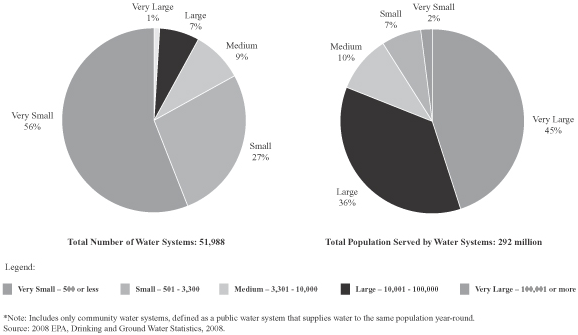
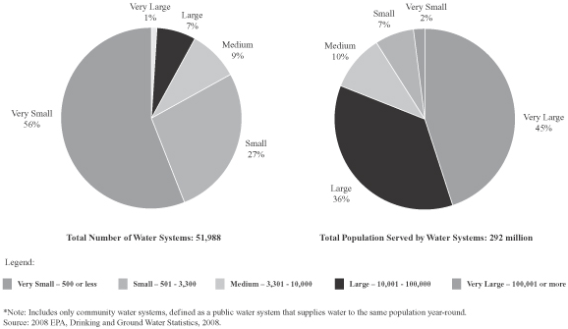
In the last blog I talked about the challenge to rural utilities, many of which serve relatively few people and have used federal monies to pay for a lot of their infrastructure.  In this blog we will take a look at the trends for community water systems which are defined as systems that serve at least 15 service connections or serve an average of at least 25 people for at least 60 days a year. EPA breaks the size of systems down as follows:

  • Very Small water systems serve 25-500 people
  • Small water systems serve 501-3,300 people
  • Medium water systems serve 3,301-10,000 people
  • Large water systems serve 10,001-100,000 people
  • Very Large water systems serve 100,001+ people

Now let’s take a look at the breakdown (from NRC 1997).  In 1960, there were about 19,000 community water utilities in the US according to a National Research Council report published in 1997.  80% of the US population was served.  in 1963 there were approximately 16,700 water systems serving communities with populations of fewer than 10,000; by 1993 this number had more than tripled—to 54,200 such systems. Approximately 1,000 new small community water systems are formed each year (EPA, 1995). In 2007 there were over 52,000 community water systems according to EPA, and by 2010 the number was 54,000.  85% of the population is served. So the growth is in those small systems with incidental increases in the total number of people served (although the full numbers are more significant). 


TABLE 1 – U.S. Community Water Systems: Size Distribution and Population Served


Number of Community Systems Serving This Size Community a

Total Number of U.S. Residents Served by Systems This Size b>

Population Served

1963

1993

1963

1993

Under 500

5,433 (28%)

35,598 (62%)

1,725,000 (1%)

5,534,000 (2%)

501-10,000

11,308 (59%)

18,573 (32%)

27,322,000 (18%)

44,579,000 (19%)

More than 10,000

2,495 (13%)

3,390 (6%)

121,555,000 (81%)

192,566,000 (79%)

Total

19,236

57,561

150,602,000

242,679,000

a Percentage indicates the fraction of total U.S. community water supply systems in this category.

b Percentage is relative to the total population served by community water systems, which is less than the size of the U.S. population as a whole.

SOURCES: EPA, 1994; Public Health Service, 1965.


Updating these numbers, there are over 54,000 systems in the US, and growth is almost exclusively in the very small sector.  93% are considered to be small or very small systems—serving fewer than 10,000 people. Even though these small systems are numerous, they serve only a small fraction of the population. Very small systems, those that serve 3,300 people or fewer make up 84 percent of systems, yet serve 10 percent of the population.  Most critical is the 30,000 new very small systems that serve only 5 million people (averaging 170 per system).  In contrast, the very large systems currently serve 45% of the population.  Large plus very large make it 80%.  The 800 largest systems (1.6%) serve more than 56 percent of the population. 900 new systems were added, but large systems served an additional 90 million people.

What this information suggests if that the large and very large sector has the ability to raise funds to deal with infrastructure needs (as they have historically), but that there may be a significant issue for smaller, rural system that have grown up with federal funds over the past 50 years.  As these system start to come to the end of their useful life, rural customers are in for a significant rate shock. Pipeline average $100 per foot to install.  In and urban area with say, 60 ft lots, that is $3000/household.  In rural communities, the residents may be far more spread out.  As an example, a system I am familiar with in the Carolinas, a two mile loop served 100 houses.  That is a $1.05 million pipeline for 100 hours or $10,500 per house.  With dwindling federal funds, rural customers, who are already making 20% less than their urban counterparts, and who are used to very low rates, that generally do not account for replacement funding, will find major sticker shock. 

This large number of relatively small utilities may not have the operating expertise, financial and technological capability or economies of scale to provide services or raise capital to upgrade or maintain their infrastructure.  Keep in mind that small systems have less resources and less available expertise.  In contrast the record of large and very large utilities, EPA reports that 3.5 percent of all U.S. community water systems violated Safe Drinking Water Act microbiological standards one or more times between October 1992 and January 1995, and 1.3 percent violated chemical standards, according to data from the U.S. Environmental Protection Agency (EPA).. 

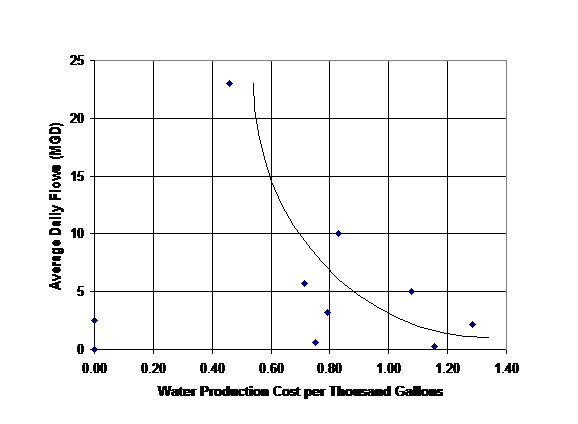
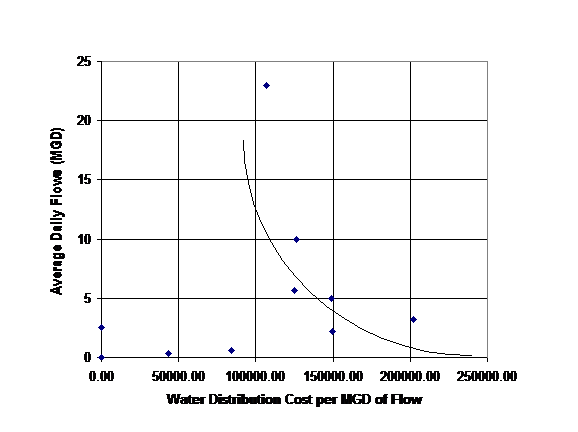
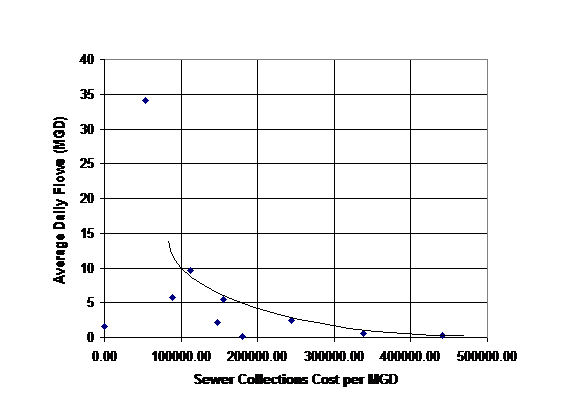
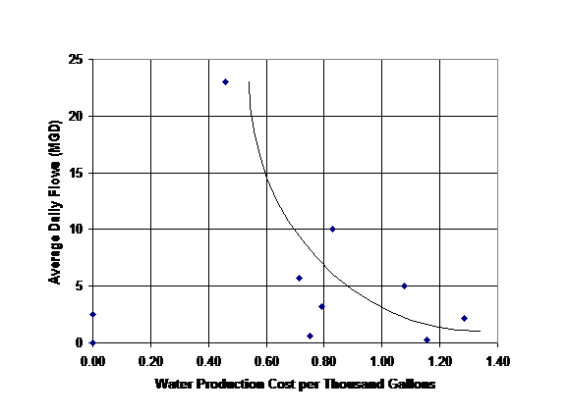
EPA and professionals have long argued that centralized infrastructure for water and sewer utilities makes sense form an economy of scale perspective.  Centralized drinking water supply infrastructure in the United States consists dams, wells, treatment plants, reservoirs, tanks, pumps and 2 million miles of pipe and appurtenances.   In total this infrastructure asset value is in the multi-trillion dollar range.  Likewise centralized sanitation infrastructure in the U.S. consists of 1.2 million miles of sewers and 22 million manholes, along with pump stations, treatment plants and disposal solutions in 16,024 systems.  It is difficult to build small reservoirs, dams, and treatment plants as they each cast far more per gallon to construct than larger systems.  Likewise operations, despite the allowance to have less on-site supervision, is far less per thousand gallons for large utilities when compared to small ones.  The following data shows that the economy-of-scale argument is true:

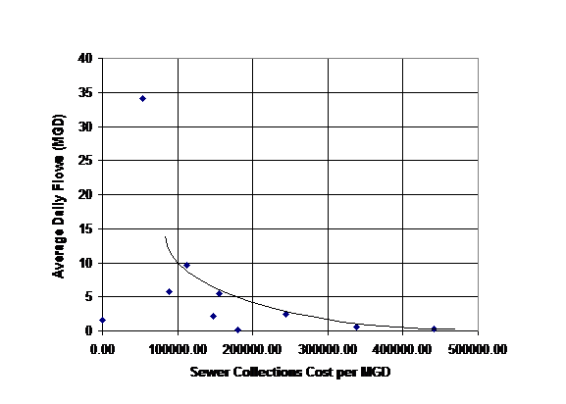
  • For water treatment, water distribution, sewer collection and wastewater treatment, the graphics clearly demonstrated the economy-of-scale of the larger utility operations versus small scale operations (see Figures 2-5). 
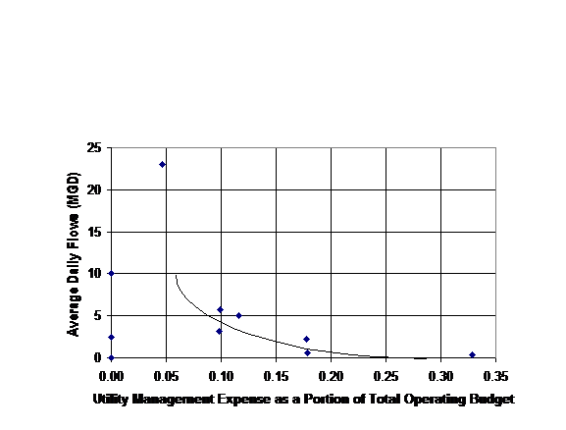
  • The administrative costs as a percentage of the.total budget parameter also demonstrated the economy-of-scale argument that larger utilities can perform tasks at a lesser cost per unit than the smaller utilities (see Figure 6).

Having reviewed the operations costs, the next step was to review the existing rates.  Given the economy-of-scale apparent in Figures 2 to 6, it was expected that there would be a tendency for smaller system to have higher rates.  Figures 2-6 demonstrate this phenomena. 

So what to do?  This is the challenge.  Rate hikes are the first issue, a tough sell in areas generally opposed to increases in taxes, rates and charges and who use voting to impose their desires.  Consolidation is anothe5r answer, but this is on contrast to the independent nature of many rural communities.  Onslow County, NC  figured out this was the only way to serve people efficiently 10 years ago, but it is a rougher sell in many, more rural communities.  Infrastructure banks might help, the question is who will create them and will the small system be able to afford to access them.  Commercial financing will be difficult because there is simply not enough income to offset the risk.  The key is to start planning now for the coming issue and realize that water is more valuable than your iPhone, internet, and cable tv.  In most cases we pay more for each of them than water (see Figure 7).  There is something wrong with that…
 Image


Figure 1  Breakdown of Size of Systems
Image


Fig 2 Cost of Water Treatment

Image


Fig 3 Cost of Water Distribution

Image


Fig 4 Cost of Sewer Collection

Image


Fig 5 Cost of Sewer Treatment

Image

Fig 6 Cost of Administration as a percent of total budget


Image

FIgure 7 Water vs other utilities