Archive

water supplies


A number of years ago I had the pleasure of speaking with archeaologist Bryan Fagan for an hour or so before a presentation he gave at a conference.   Dr. Fagan is a modern-day Indiana Jones, who has been all over the world studying ancient ruins.  Dr. Fagan expressed his career as “50 years of studying drainage ditches,” but with studying drainage ditches he could provide you with the rise and fall of civilizations through history.  His book Elixir outlines a number of these civilizations:  Egyptian, Babylonia, Southeast Asia, and even the American West.  His findings were that the civilization expended as far as infrastructure could be constructed to allow water to flow to where it was needed, whether that was Alexandria or Ur.  Later civilizations expanded and developed as technology allowed water to flow further.  Rome demonstrated that water could be moved with more than ditches, which would have been a severe limitation for Rome and other civilizations based in dry areas with topography.  The Romans constructed extensive tunnels and aqueducts to supply Rome with water from mountains to the east and north. A recent article noted that we probably know about 20% of the Roman tunnel system as we keep discovering more of it each year – tunnels lost in the Dark Ages after the fall of Rome.  Dr. Fagan notes that it was access to water that allowed human civilizations to develop and evolve.  It is why a number of engineering organizations like Water for People and Engineers Without Borders focus their efforts on providing access to clean water to people in Third World countries.  It is their only way to get to the modern world.  All other infrastructure:  roads, major buildings, etc., result from the access to clean water that allows people to be healthy and productive.

So if civilization rises and falls with access to water, why is it so hard to get public officials to fund water supply and rehabilitation projects?  We talk of an infrastructure crisis in the United States because our average water and sewer infrastructure systems are working on 50 years old and deterioration is evident.  We have many mid-western communities with water, but no customers to pay for deteriorating infrastructure (Detroit), and southeastern utilities that have lost factories that supported the bulk of their utility, and insufficient growth in the customer base to deal with operations and maintenance.  As a result, outages and breaks occur more frequently, costing more money to repair, but under the auspices of maintaining rates, the revenues do not increase to support the needed repairs. 

At least the southeast has surface supplies, albeit perhaps limited, which constrains growth (Atlanta), but our fastest growth often occurs in areas we know have limited precipitation, like a lot of the American West.  Yet somehow we expect groundwater sources that do not recharge locally, to sustain the community indefinitely without disruption – ignoring the fact that history tells us communities cease to function when water supplies are exhausted.  USGS identified many areas that have long-term permanent declines in aquifers as a result of pumpage for agricultural and community uses.  No one raises the question about the aquifer levels – permits get issued, but little data is gathered and very limited plans are available in most places to deal with the declines.  And no one raises a question about aquifer levels because stopping growth to deal with water supplies is not in conformance with the desire to grow, which is required to support additional services demanded by the community. 

No one questions how to secure the water either, much of which has been “created” by federal tax dollars spend over 50 years ago during the era of great dam building (1920-1960).  However, as these systems and populations age, the concern about costs will continue to engender discussion.  And hand wringing.  Water costs money.  Water creates civilization and sustains it.  When we take it for granted, it becomes all too easy to fall behind the proverbial “eight-ball,” and the system crashes.  It is a testament to the utility personnel – the managers, engineers and operators – that these systems continue to operate as they do.  But bailing wire and duct tape only go so far.  We need to develop a frank discussion about the need to infuse funds – local, federal, state and private – into addressing our infrastructure needs.  The dialog needs to commence sooner, as opposed to after failure. 


It’s groundhog day and Super Bowl Sunday!  The groundhog saw his shadow indicating 6 more weeks of winter, but you wouldn’t know it at the Super Bowl.  The bright lights are on in New Jersey with over 80,000 fans braving the cool, but no the harsh cold weather of last weekend.  Just like the groundhog this morning, millions will be watching.  The Super Bowl is biggest one day sporting event in the world with over 100 million viewers watching it live in the US, and over a billion around the world.  And we all enjoy the commercials too, but it speaks to our priorities when a 30 second commercial will cost $4 million.  A lot of utilities could do a lot with $4 million.  Just saying….


We get to start the new semester this week.  The economy is looking up in Florida.  Unemployment is down, although the job growth appears to be mostly minimum wage jobs.  So it is useful to look at last semester’s graduates and see how they are doing.  The good news is they are getting jobs.  In fact our seniors mostly have jobs or internships and none of them are minimum wage jobs.  Excellent news, but let’s look at the new graduates and the workplace. 

A lot of our assumptions about the workplace will change in the 21st century.  The workplace at the “office” is less necessary and younger workers are more comfortable working outside the office environment.  They may be more productive than 20th century managers think they will be because of the side benefits that flex hours allow.  Their entry into the workforce places four generations at work at once:  Traditionalists, Baby Boomers, Gen X, and Gen Y or Millennials.  The latter are the fastest growing segment of the workforce, and are already a larger percent of the workforce than Gen X or Traditionists.  The Traditionalists are retiring and are expected to be under 8 % in 2015.  Gen X and Gen Y will encompass about a third of the workforce going forward.

All of these groups have different perspectives.  Recent studies indicate the following.  Baby Boomers grew up post-WWII in a time of change and reform.  Some believe they are instruments of change.  They are optimistic, hard-working and motivated by position.  Gen X grew up in an era of both parents working, so are resourceful and hardworking, but not as motivated by position.  They are independent, and prefer to work on their own.  And many are contributing to the way government operates throughout the world. They accept technology as a way to involve others.  The use of online means to solicit feedback in government is particularly a Gen X phenomenon.  Public participation, traditionally are arena where limited public involvement actually occurs except with highly unpopular issues.

Gen Y was born in an era when both parents worked, but in their off-time, the parents spent more focus on the kids.  Think of no winners or losers in sports, but at the same time they have had unprecedented access to technology and are often well ahead of their work mates with respect to the use of tools in the workplace.  But, they are resourceful and can easily overcome technology barriers in the workplace. They care about their image and the world around them.  We can use that to implement change.

However, Gen Y is facing a workplace that clearly has winners as well as some skepticism about technology.  While we can expect some difficulties, it is up to the Gen X and Baby Boomers to help Gen Y make the transition. They have fresh viewpoints as they have had to be creative to get ahead.  Just doing things “the same old way,” doesn’t cut it.  I actually find this refreshing and a positive challenge to me because I use these challenges to go back of evaluate what my thinking was (or is).  We need to embrace this perspective and channel their energy and independence to solving today’s problems. 

We need to help them acclimate to the business world, while understanding that their motivations are not the same as Dan Pink notes in his book “Drive.”  We need new ideas and perspectives while welcoming them to the workplace.  That is how we improve productivity, product new ways to work, and develop new tools.  We need all of these in the utility industry as we need better ways to upgrade infrastructure and deliver our services.

There is a lot of talk about the difficulties that Gen Y is having getting jobs.  They often lack experience, but how do you get experience if no one hires you.  It is circular logic and we have all been there. 

We need to give the kids a chance.  I see a lot of potential in our graduates, nearly all of whom are Gen Y.  I see many who are hard working and know how to find answers to their questions.   They are far better prepared than many think.  We get comments all the time about how good our students are.  That is good, because the truth is, especially in the engineering and utility world, the Gen Y workforce does not understand why things were done a certain way in the past, nor why they should remain that way.  I actually find this refreshing and a positive challenge to me because I use these challenges to go back of evaluate what my thinking was (or is).  We need to embrace this perspective and channel their energy and independence to solving today’s problems.  They offer fresh ideas – and don’t necessary understand why.  That’s ok.  Long-term engineering graduates will make contributions to our water, sewer and other infrastructure. 


In the field of engineering, the concept of sustainability refers to designing and managing to fully contribute to the objectives of society, now and in the future, while maintaining the ecological, environmental, and economic integrity of the system.  Most people would agree that structures such as buildings that have a lifespan measured in decades to centuries would have an important impact on sustainability, and as such, these buildings must be looked at as opportunities for building sustainably. When people think about green buildings, what generally comes to mind is solar panels, high efficiency lighting, green roofs, high performance windows, rainwater harvesting, and reduced water use.  This is true, but building green can be so much more.

The truth is that the built environment provides countless benefits to society; but it has a considerable impact on the natural environment and human health (EPA 2010). U.S. buildings are responsible for more carbon dioxide emissions annually than those of any other countries except China (USGBC 2011). In 2004, the total emissions from residential and commercial buildings were 2,236 million metric tons of carbon dioxide (CO2), more than any other sector including the transportation and industrial sectors (USGBC 2011). Buildings represent 38.9% of U.S. primary energy use,72% of U.S electricity consumption (and 10% worldwide), 13.6% of all potable water, and 38% of all CO2 emissions (USGBC 2011).  Most of these emissions come from the combustion of fossil fuels to provide heating, cooling, lighting, and to power appliances and electrical equipment (USGBC 2011). Since buildings have a lifespan of 50 to 100 years during which they continually consume energy and produce carbon dioxide emissions, if half of the new commercial buildings were built to use only 50 percent less energy, it would save over 6 million metric tons of CO2 annually for the life of the buildings. This is the equivalent of taking more than one million cars off the roads each year (USGBC 2011).

The United States Green Building Council (USGBC) expects that the overall green building market (both non-residential and residential) to exceed $100 billion by 2015 (McGraw Hill Construction 2009).  Despite the economic issues post 2008, it is expected that green building will support 7.9 million U.S. jobs and pump over $100 million/year into the American economy (Booz Allen Hamilton, 2009). Local and state governments have taken the lead with respect to green building, although the commercial sector is growing.

Green building or high performance building is the practice of creating structures using processes that are environmentally responsible and resource efficient throughout a building’s life cycle, from site to design, construction, operation, maintenance, renovation, and deconstruction (EPA 2010). High performance building standards expand and complement the conventional building designs to include factors related to: economy, utility, durability, sustainability, and comfort. At the same time, green building practices are designed to reduce the overall impact of the built environment on human health and use natural resources more responsibly by more efficiently using energy, water, and other resources, while protecting occupant health and improving employee productivity.

High Performance Buildings are defined by incorporating all major high performance attributes such as energy efficiency, durability, life-cycle performance, natural lighting, and occupant productivity (EPA 2010). High performance buildings are constructed from green building materials and reduce the carbon footprint that the building leaves on the environment. A LEED-certified green building uses 32% less electricity and saves around 30% of water use annually (USGBC 2011). Building owners know that there is a return on investment of up to 40% by constructing a green building as a result of savings to energy and water (NAU 2012).

The cost per square foot for buildings seeking LEED Certification falls into the existing range of costs for buildings not seeking LEED Certification (Langdon, 2007).  An upfront investment of 2% in green building design, on average, results in life cycle savings of 20% of the total construction costs – more than ten times the initial investment (Kats, 2003), while building sale prices for energy efficient buildings are as much as 10% higher per square foot than conventional buildings (Miller et al., 2007). At the same time, the most difficult barrier to green building that must be overcome includes real estate and construction professionals who still overestimate the costs of building green (World Business Council, 2008).

New data indicates that the initial construction cost of LEED Certified buildings can sometimes cost no more than traditional building practices.  A case study done by the USGBC showed that the average premium for a LEED certified silver building was around 1.9% per square foot more than a conventional building.  The premium for gold is 2.2% and 6.8% for platinum.  These numbers are averaged from all LEED-registered projects, so the data is limited, but demonstrates that in some cases it does not cost much extra to deliver a LEED certified project which greatly improves the value of the building and lowers operating costs (Kuban 2010).  The authors’ experience with the Dania Beach nanofiltration plant indicated the premium was under 3% to achieve LEED-Gold certification compared to standard construction.

So the question is, why don’t we see more green buildings?  We know water plants can be green (Dania Beach Nanofiltration Plant), but that was the first nanofiltration plant in the world to be certified Gold.  The SRF programs prioritize green infrastructure – so why do more people not pursue them?  It may be an education process.  Or maybe the market just has not caught up.  CIties and states are leading the way here.  Utilities may want to look at this as well.Image

Happy 91st Pop! It’s been 2.5 years since you were last with us, but it’s funny how many things popped (no pun intended) up today that connect to you. Clearly you are still watching what goes on. We had a family summer cottage located 8 miles east of Grayling Michigan. So today I came across an old book entitled the Old AuSable written in 1963 by Hazen Miller, a U of M doctor (you were a U of M aerospace engineer) who wrote about the area back in the day (1870s to 1920s), just before your father purchased property along the AuSable River. It mentions the great grandfather of my dad’s summer playmates, one of whom just died last summer - his obit came up in my email today. Reminded me of many places I went as a kid. Funny it also reminded me of some of the old “names” that are now being lost to time, but created what exists today. It also helped with some perspective on a proposal I have been working on regarding water supplies and quality. The grayling fish disappeared by 1912 as a result of hanged on water quality (warming and silt), human impacts of logging on the fish and the introduction of other species. My proposal looks at impacts of human activity on SE Florida, especially as it relates to sea level rise and the need to capture additional soil storage capacity through infiltration trenches. The water cannot be discharged to tide due to Human-induced nutrient and roadway pollutants of the potential exists to impact fish populations. So we are looking at moving the infiltrated water to water plants in the future. We can treat the water there, cost effectively while solving another problem – diminishing water supplies for urban populations. This would diminish our need to deal with desalination and the disposal of concentrate, another proposal. Funny how sometimes it all comes together….Good times back then and up there. Making progress today. Thanks and keep on watching out for us!!


In front of house

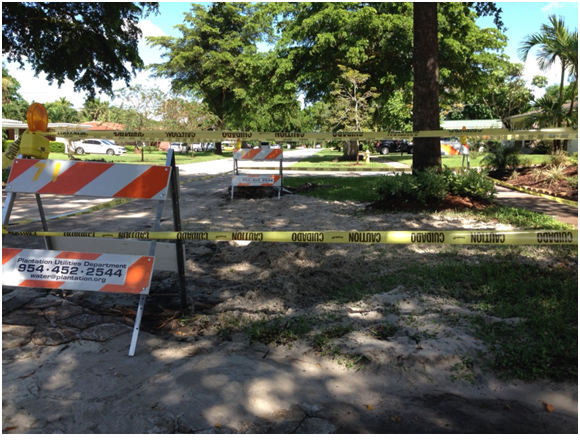
The doorbell rang and it was 1:30 am on a Saturday morning.  It was my neighbor telling me about a small problem on the street.  I looked out and the entire block was flooded.  Water was moving. It was dark, and while my street light was working, it shed little light in the blackness.  However I figured out the old AC pipeline in front of my house had sheared and the block’s leak was actually my problem.  We had no water.  Fortunately the water department was able to get the main repaired in a couple hours.

The next morning we were not as lucky.  Another break on the next street over had shut us down again.  AC water main, but this time under a tree.  They had to remove the tree before fixing the line.  We were out all day.  The water plant guys and the repair crew said that the lines were supposed to be replaced a couple years ago, but that the City had delayed the replacement for budget problems.  


Why are health care costs increasing so fast?  Did you ever wonder about that?  We keep hearing about how health care costs, Medicare, Medicare, Obamacare are going to bankrupt us, but why is that?  Why are the cots going up so fast?  It is an important challenge for local officials and utilities who generally pay the health insurance costs for their workers.  There is more to the story that we are not being told.

One problem that get identified quickly is that only 80% of the population is included in the health care system.  Many who are not are “healthy” young people who don’t demand the services.  The concept of the health care bill was to solve this problem by spreading the costs of health care across the entire population using private and public providers.  First, I think there are way more unhealthy  people included in the 20% than we realize because the political dialogue keeps focusing on the few that want to live off the grid – I feel great so I don’t need insurance.  That guy is part of the problem.  That guy gets into a car accident, gets taken to a public hospital, gets treated, gets a bill for $26,000 to fix his broken leg, refuses to pay anything, and the taxpayers get stuck with the bill.  My solution to that guy is if you don’t want to pay for health insurance, bring cash.  Otherwise, “no soup for you!” to paraphrase a famous Seinfeld episode.  Of course my doctor, nurse and therapy friends think that’s a little cold hearted. 

The next argument is the cost of doctors, therapists and nurses.  Okay, I know a bunch of them, and that’s not where the money goes.  These people have lost money in the past 10 years.  Many are going form full-time to part-time employments as Medicare, Medicaid and health insurance bureaucrats decide services are no longer needed.  They will tell you the major change in their lives is paperwork….hold that thought for a moment.

The cost of drugs comes up.  Medicare and Medicare are the largest purchasers of pharmaceuticals in the world.  So in other works, they set the lowest price by supposedly bidding the “contracts” for services. Only there is often only one provider, so exactly how does that work?   Sounds like we don’t get a good deal there, which is why the arguments for importing Canadian drugs or drugs from Mexico keeps popping up.  They get a better deal than we do and most of these are supposedly AMERICAN companies.  No home town discount (I guess I know where free agent baseball players get the idea).   And my medical friends confirm this as an issue.  Check out the comments from Mr. Falloon at Life Extension (www.lef.org) for discussion. 

So let’s go back to the paperwork discussion.  Once upon a time doctors simply sent a little paperwork to the health insurance company or the federal government and said you needed some service.  And the insurance company processed the bill for the services.  The cost was paid by insurance premiums collected by the insurance company.  Everyone was happy.  But then someone at an insurance company said, “wait we could make more money if we asked more questions and paid less for these services.  It would help our bottom line.”  So you hear the complaint that the folks at the insurance companies are deciding whether you need that procedure or not.  And contractors decide if someone needs Medicare or Medicaid services, not the government, not your doctor, your nurse or your therapist.  Not any person that knows you, but some unseen, private sector bureaucrat who’s goal is to minimize the amount of your premium spent on services so they can enhance their bottom line.  And apparently they are very effective because the health insurance industry is very lucrative.  So maybe we have stumbled onto something here.  Maybe the cost of medical coverage is more related to drugs and bureaucracy (and it is not government bureaucracy!!) than the actual cost of services.  Maybe the old system, even if there was some fraud in it, wasn’t nearly as bad as it was made out to be.  It reminds me of one of the 4 laws of City management I developed years ago:  Never give elected officials a bad alternative – it becomes a magnet.  It always worked (hence a law).  I didn’t learn why until years later when I realized, that the worst option was the one all the lobbyists lobbied for even at the local level.  It was the option where they could make the most money “fixing


Sequestration is the word we are all using to explain the failure of the Congress to put together a budget with appropriate revenues and expenditures.  Congress can’t figure out how to reach a budget agreement, so the federal government set itself up for mandatory cuts in services. I had a recent grant sequestered, then cancelled.  It really could have helped a local community with long-term water supply and quality problems identify adaptation and mitigation strategies fo rites future.  Minor money for Washington, but a big deal down here.  Likewise I have spent the last 6 months on a subcommittee for USGS that is focusing on what could be cut from USGS.  That means less testing water quality, water levels in groundwater, stream gauges and less evaluation of results.  Most of the water issues USGS looks at crosses local and even state lines.  Since we all rely on water, this is at national concern.  Precisely when we need the information most, we may be getting less.  Expect to start seeing more sequestration issues. 


The problem is that the biggest expenses, social security and debt, cannot be cut without major backlash in the financial and voter markets.  So the cuts come from the smaller accounts – things like the federal share of state revolving funds, water research and water/wastewater programs.  The community and tribal assistance account was slashed $210 million while the environmental program budget was cut $135 million. While some may be cheering EPA cutbacks, the reality for water and wastewater users is less federal assistance to our industry.  That means more of the onus is on us, and on our customers.  The  unintended consequences of the failure of Congress to act….


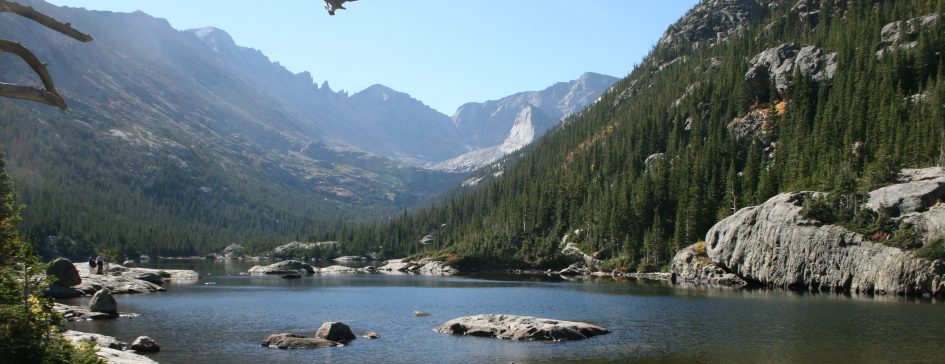
I went back to Colorado last week and it’s dry again out there.  Ok, maybe not this past week when it rained a bit, but despite late snow (March to May), the forests are dry.  The bark beetle problem has not made things easier, so lightning from thunderstorms can easily create fires, like the fire down in Colorado Springs or the Big Meadows fire that is ongoing in Rocky Mountain National Park.  The latter has been ongoing (although fortunately mostly out) for over a month, and has closed some trails in the park.  I hiked through the Fern Lake fire remnants (although virtually all the fire was around Cub Lake). That fire burned for a couple months last fall, only finally burned out in the winter after snowfall. 


The west is dry and “drier than in the past” is the new normal it seems in Colorado.  So now water managers are faced with three new challenges:  less water, faster runoff and more difficult water to treat.  The fires cause the loss of protective vegetation, which means less water is kept in the forest.  As a result, the tiny, light ash particles easily run off in the rain.  Ash is hard to remove without activated carbon or other advanced processes.  The loss of vegetation increases runoff, which means larger sediment content in otherwise pristine water supplies.  That can make a major impact on downstream water plants that may not have planned for such events.  The cost of fire suppression for the last 60 years confounds the current water supply and quality problems.  There are also ecological effects that may impact local economies. 


All this said, I am unsure what the solution is.  Clearly the climate in Colorado is changing.  It is unlikely we can alter the current course any time soon.  Instead we must adapt to the changes and attempt to mitigate the impacts on water supplies.  Creativity, innovation and likely more infrastructure will be required. Concepts like aquifer storage and recovery are coming back to the fore as a result of the current condition. It will be interesting to see how this all plays out. 


Close UP Radio # 4

Here’s the 4th in a series of radio shows I did on line.  These are topics discussed:

Desalination is often argued as a water supply option.  But the costs for power are significant.  Power requires water.  Water treatment requires power, we can’t make decisions in a vacuum.

We do have ongoing discussions about indirect and direct potable reuse of wastewater – ie toilet to tap.  There are regulatory and public perception barriers, but in truth we do this in rivers every day

It is hard to define that term  sustainability, and it depends on who you are and what your issues are.  But water is a medium of social change as well as economic development.  Too often we look at short term solutions, which frustrate long-term potential.  Klamath River OR is an example.  

Enjoy