Alcohol boom during the pandemic
Leave a comment

The economic havoc created by covid-19 is likely to be with us for year. State and local revenues will take years to rebound. Normally the water industry would seem to be less impacted than state and local tax bases because the people are still here. But let’s take a look at how utilities might be impacted by the covid19 pandemic. Those utilities that are primarily residential may see lesser impacts that urban, economic communities, but the we should expect impacts. AWWA estimates the loss could be $33 billion and put up to 90,000 private sector jobs that serve these utilities at risk. The question is whether this will be spread-out across all utilities to impacting certain ones more than others. Already central Florida is seeing a slowdown of construction activity with 30,000 jobs lost.
But people do want their utilities protected and funded. recent Value of Water Campaign noted that 84 percent of American want more investment in water. The HEROS Act approved by the US House of Representatives would help provide funding to state and local communities who have suffered losses, although the US Senate has steadfastly refused to discuss the proposed $1 trillion in funding that is earmarked for states and local governments. The House has also proposed $1.5 billion for helping people pay their water bills. A potential infrastructure bill might provide some help in this arena – the US House has proposed $2.2. trillion for infrastructure – communications, as well as water/wastewater funding would be part of this funding. Economists note the payback in economic activity is at least 1.57:1. And another bill for $50 billion over 5 years for clean water has been proposed. Whether that comes via WIFIA’s proposed $6 billion is unclear. The US Senate has proposed $17 billion for AWIA funding, a far cry from the $2.2 trillion prior infrastructure bill and the needs projected. But perhaps a start. Stay tuned.
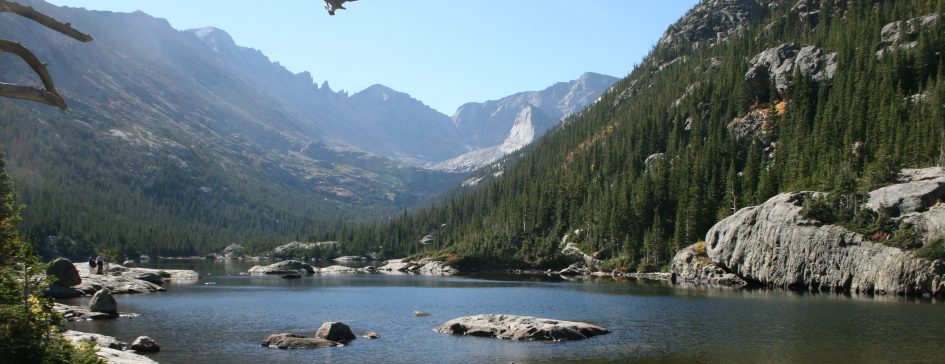
One day last week I traveled from Grand County through Rocky Mountain National Park on Trail Ridge Road and through the Big Thompson Canyon into Fort Collins.As I left
— Read on www.skyhinews.com/news/county-knows-true-meaning-of-drought/
The economy is actually more fragile than most realize. In the past 20 years we have had the economic downturns in 1999/2000 from tech stock, the 2008 recession from housing prices and the 2020 recession from covid -19, although it has been predicted as coming for at least 4 years. Covid-19 has demonstrated fragility associated with supply lines, which are critical to a functioning economy. Disruptions of medical supplies, meat and poultry, medicine and coinage have occurred in the wake of the pandemic. These will be others and it is important that the federal government figure out a way to shore up the supply lines so we are less dependent on others for the supplies.
Supply lines are but one obvious economic problem. There are others. While the real estate market remains, for whatever reason hot (probably because people feel that is the best place to invest right now, but remember 2008!), other sectors have been a problem. Obviously tourism has sunk. That means states like Florida that rely on tourism for State taxes will be feeling the crunch. Changing means of travel has also impacted the oil and gas market – both are at very low prices and as I have noted previously in this blog, there are a number of states that rely on oil and gas for their economic stability – Alaska, North Dakota, Oklahoma, Texas, Louisiana. Those state will face major deficits as well. States face major challenges going forward as a results of the economic damage done by the covid-19 pandemic in the service industries that may never rebound, meaning high unemployment. This is why the push to approve the funding in the Heroes Act for state and local governments – otherwise state and local governments, which must balance their budgets each year, will face huge decisions in the coming months.
There are other cracks that have gotten exposed. Lower oil use means that oil prices are very low, but covid19 is not the only reason that oil prices are low – there are also political issues that have depressed oil process. While the US has become the largest oil producer in the world as a result of fracking, Russia and Saudi Arabia vie for the #2 slot. As oil demand dropped, neither entity reduced oil production. In part the price drop may have been a political ploy to disrupt the US oil economy, but it impacts Russia more severely because more of their economy is based on oil and gas. Ultimately all three producers agreed to reduce production to stabilize prices (under a series of threats associated with other countries), but what does that say about the challenges with international political/economic stability?
In the US, the wreckage includes energy companies like Chesapeake Energy filing for bankruptcy. When energy companies go broke, thousands of oil and gas wells remain unplugged after use, raising the specter of who cleans them up (hint its probably us unless we can get Congress to fix the laws)? Economic stability is needed for long term growth. The impacts of economic disruption linger for many years beyond the downturn, like old oil wells, reduced services, and unplugged wells. Shoring up the economic framework is needed during good times to protect us from the bad. We have not yet learned this lesson.
Supply lines are but one obvious economic problem. There are others. While the real estate market remains, for whatever reason hot (probably because people feel that is the best place to invest right now, but remember 2008!), other sectors have been a problem. Obviously tourism has sunk. That means states like Florida that rely on tourism for State taxes will be feeling the crunch. Changing means of travel has also impacted the oil and gas market – both are at very low prices and as I have noted previously in this blog, there are a number of states that rely on oil and gas for their economic stability – Alaska, North Dakota, Oklahoma, Texas, Louisiana. Those state will face major deficits as well. States face major challenges going forward as a results of the economic damage done by the covid-19 pandemic in the service industries that may never rebound, meaning high unemployment. This is why the push to approve the funding in the Heroes Act for state and local governments – otherwise state and local governments, which must balance their budgets each year, will face huge decisions in the coming months.
There are other cracks that have gotten exposed. Lower oil use means that oil prices are very low, but covid19 is not the only reason that oil prices are low – there are also political issues that have depressed oil process. While the US has become the largest oil producer in the world as a result of fracking, Russia and Saudi Arabia vie for the #2 slot. As oil demand dropped, neither entity reduced oil production. In part the price drop may have been a political ploy to disrupt the US oil economy, but it impacts Russia more severely because more of their economy is based on oil and gas. Ultimately all three producers agreed to reduce production to stabilize prices (under a series of threats associated with other countries), but what does that say about the challenges with international political/economic stability?
In the US, the wreckage includes energy companies like Chesapeake Energy filing for bankruptcy. When energy companies go broke, thousands of oil and gas wells remain unplugged after use, raising the specter of who cleans them up (hint its probably us unless we can get Congress to fix the laws)? Economic stability is needed for long term growth. The impacts of economic disruption linger for many years beyond the downturn, like old oil wells, reduced services, and unplugged wells. Shoring up the economic framework is needed during good times to protect us from the bad. We have not yet learned this lesson.

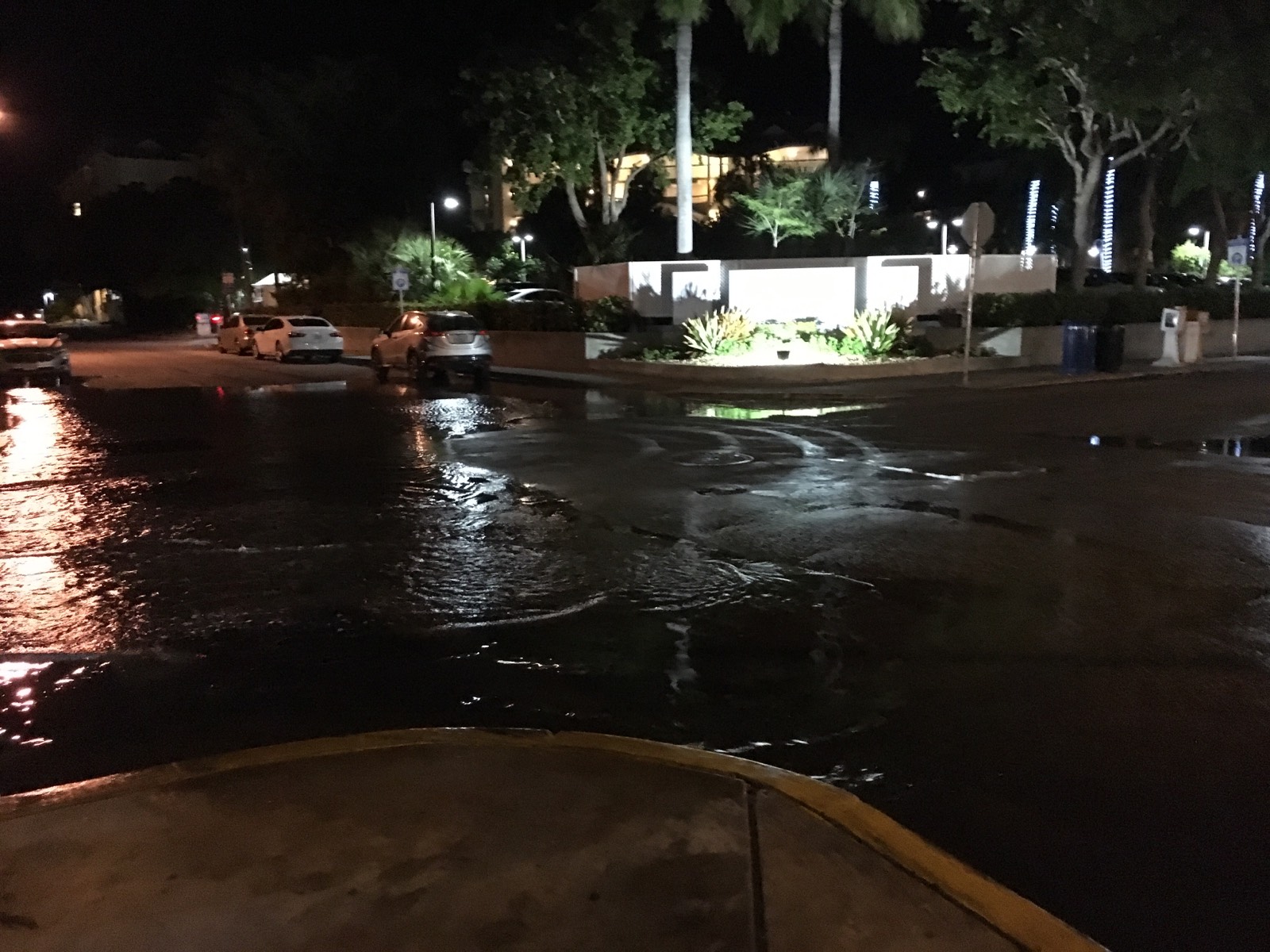 I was in Key West in January. This is a photo of January 25 at 10 pm. It had not rained. It was not a king tide. It was saltwater coming up through the drain. Glad I was not there during a King tide. Glad I was not driving through this either. Sea level rise is real – now how do we deal with it? Can’t wait for the high tides which occur in September/October if this was January!
 publicutilitymanagement
