Archive

Tag Archives: customer interface


So I am reading an article in OneEarth, which is a publication of one of the environmental groups.  The pretext is the issues with the movement of hog farm operations into Iowa and the problems it is causing.  They note that the state has cut the regulatory enforcement budget and the number of inspectors while more incidents of contaminated water are found.  The contamination threatens the raw water supply of  downstream water utilities which must do more treatment and monitoring.  Sorry, I had to giggle because I have heard this story before. 

Going back about decade many will recall the “pfiesteria hysteria” as it was called in North Carolina.  The issue was that the Department of Environmental Management had found fish kills where the fish had these weird sores on their bodies, and then a number of people were diagnosed as being infected with the same condition, some of whom died.  The cause was this pfiesteria, which is a flesh-eating organism that enters the nervous system.  Crazy is one of the side effects but it mostly leads to death.  DEM determined that the organism thrived in waters with significant loading from nutrients that they could trace to…..  wait for it…. hog farms!! 

That was not the first time hog farms were implicated in water quality issues, but due to the significant, political influence of the industry, the transgressions were largely ignored due to a lack of enforcement personnel.  Actually when I was in North Carolina we had a hog farm upstream of our wastewater plant.  Periodically the DEM would test the waters downstream of our plant and find bacteria counts to high and they would want to tag us for the violation.  But we never had any indication of violations at our plant (which we tested daily and reported).  You can’t “make” nutrients appear out of thin air – they come from somewhere.  We told DEM that it was a hog farm that periodically dumped the manure pit n the river when it got full.  No treatment was going on.  Then hog farms exploded in North Carolina which led the pfiesteria event.  Finally the State decided enough was enough and imposed a lot of regulations on hog farms which magically …. moved to Iowa where there are no regulations in place.  I guess there is nothing like a good crisis that kills a few people to get past the political influence of the lobbyists (unless you are the NRA).

But here’s the problem for Iowa, which is what North Carolina found.  The regulations actually are in place.  The Clean Water Act prohibits the contribution of pollutants that will impair the quality of water bodies.  Clearly hog farm effluent clearly falls into this category, but the historical focus of the Clean water Act has been on wastewater treatment plants, and lately stormwater, but not agriculture, which is largely exempted in many, rural states.  Yet agriculture is and has always been a major contributor to water quality degradation in watershed for two reasons.  First they disturb the earth by plowing and planting, so rainfall leads to runoff of material (silt) into streams.  With that runoff is herbicides, pesticides, fertilizer (nutrients), and of course in animal husbandry or CAFO operations, bacteria and other pathogens.  Do not forget that the two most significant examples of water quality impacts on water utilities, Milwaukee and Walkerton, were both agricultural runoff problems.

Agricultural runoff impacts the downstream users which are typically developed areas which use the streams for water supply.  So agricultural practices move land based contaminants to the utility intake, which means more treatment cost to customers.  Sometimes these contaminants are a significant health risk.  It took a significant incident for North Carolina to act. The question is what will it take for Iowa to act, and once they do where do the hog farms go next? 

What needs to happen is that the hog farms develop the treatment systems needed to clean up their act.  It would be great for them to pay the cost but history says they won’t.  So maybe the political leadership needs to participate in that solution to maintain the employment base, and maybe utilities and other source water protection agencies, and there are many of them like the US Water Endowment, can help as well.  Politicians want jobs, while ratepayers do not want to pay all the costs.  A collaborative solution seems reasonable, so we will see what Iowa comes up with.  

In the last blog I commented on the Donald Sterling, Thomas Sowell and Clive Bundy comments the week before. I wonder if letting the hate out just a way to keep us from looking at the bigger picture from a political (and maybe business) perspective? And should utilities we concerned? The answers may be yes, and yes an dhere is why. An August 2012 Pew Research Center report noted that only half of American households are middle-income, down from 61 percent in the 1970s. The shift was downward, not upward as the very rich (0.1%) control 58% of the wealth in the US. In addition, median middle-class income decreased by 5 percent in the last decade, while total wealth dropped 28 percent. The need for social programs, despite cutbacks and revisions to the welfare programs in the Clinton era, have increased – since 2000 Medicaid has increased from 34 million people to 54 million in 2011 and the Supplemental Nutrition Assistance Program (SNAP, or food stamps) from 17 million to 45 million in 2011. Keep in mind that income drives qualification for these services so it means that incomes are down for millions in America. The increase in people needing help is no surprise since there is an ongoing increase in the number of lower-wage service jobs like food preparation, retail and service industry, but the number of middle-class occupations, like teaching and construction, have declined. Since 2010, the State of Florida has added 400,000 jobs, impressive except that the vast majority are service and retail jobs that pay just above minimum wage. The job growth in low wage jobs does not replace the loss of middle income jobs which is why 47% of households did not earn enough to pay income tax in 2103. It is not because they don’t want to, it’s because they don’t get paid enough. And we have tens of millions of these low wage jobs that don’t pay enough for the recipients to pay taxes. Just the opposite of what some of the political discussion would have you believe.

The loss of wages is felt locally more than nationally. It means that local officials hear about costs more because water, sewer, power, etc competes for an ever larger portion of the shrinking paycheck. So we see more attention paid to affordability indexes, the ability to pay. The concept of affordability is to take your annual water and sewer bill and divide it by the average or median local income. The goal is water plus wastewater is under 3.5% of the median income. Keeping the percent low is great and easy when people are making more money, but creates a lot of difficulty when the incomes are static or dropping. An our costs are rising due to the increasing need to maintain and upgrade infrastructure that has been neglected since 1980 (the annual investment is under 1.4% for most of the US infrastructure for the last 30 years. We need to invest above 2.3% to keep up according to GAO).

When income drop, costs become more important, and local water and sewer costs are often easier targets to limit than groceries, rent, power, telephone, cable or other services that are not subject to local official votes. So it is in all of our interests to work with local officials, colleges, vocational schools, public schools et al. to attract or build a economy that features higher income jobs, to get everyone employed, and to provide training, infrastructure, outreach, health care and other help to establish a competent, highly skilled workforce in a community. That means that utilities must support the local efforts to effect social change in the community, to help meet the needs of residents not just with water, but with respect to the local economy as well. Does that mean we are actually agents for social change?


Last week was one heckuva week for societal problems related to race relations.  Seems like someone turned over a rock and the 1950s crawled out.  We started with Cliven Bundy, the Nevada rancher who has been using federal property (read our land) for grazing his cattle for 20 years without paying for it, said after the armed confrontation with federal officials, that “I wonder if Negros weren’t better off as slaves.”  But he says he is not a racist, but wow.  That’s right up there with Rush Limbaugh’s comments about Native Americans in his book 15 years ago. 

 Then we had newspaper columnist and right-wing wonk, Thomas Sowell, who is black, saying in a recent column that “you are poor because you don’t work.”  And it is your fault you don’t work.  In “higher income families, people work.”  So using that line of racist nonsense, given that minorities are disproportionately un- or under-employed, does Mr. Sowell really believe that it is really the choice of all of these people not to work?!  Could there be any other causal links like the lack of education, decaying infrastructure or the lack of local opportunities in their community that might just come into play? That’s like saying Detroit’s problem is not the lack of job opportunities, but the fact that no one wants to work in Detroit.  I think not.

The we have Donald Sterling, the owner of the Los Angeles Clippers NBA team, who was taped making racists comments, then received a lifetime ban and multi-million dollar fine for his comments about minorities, and then, instead of apologizing, states that he wishes he’d just paid the woman who taped him off.  Huh?   Of course it is not the first time for Mr. Sterling who lost a case several years ago over his practices of renting property in LA, so I guess we should have expected it.

Of course there are those who argue these folks were simply misunderstood.  Maybe Mr. Sowell was just pandering to his fan base, but what does that say about his fan base that he can write a column that purports that “you are poor because you don’t work” because you don’t want to work and no one says anything?  He clearly appears to be besmirching the inner city minority population, but as I noted in a prior blog, rural America is significantly worse off economically than urban America.  Rural America is where health care suffers, the lack of health insurance is pervasive, income are lower and unemployment higher.  There are poor across all races, and in all settings.  And given his fan base is includes a lot of poor, white, rural people who aren’t making a lot of money or who can’t find jobs, he’s talking about you!

The Bundy comments stem from his standoff with federal officials over many years of not paying for grazing (like the rest of us could get away with that!).  He and those that came armed to his defense are more indicative of a larger, far-right, anti-government sentiment around the country that has persisted for years.  The west has a number of these groups (recall Ruby Ridge, Waco, Black Hawk helicopter-ists, etc.) that are basically anarchists that disagree with America as it is today.    All white.  But of course as we have seen in the Sudan, Rwanda, the middle east and throughout history, hate can come from all races and religions. All harboring hatred of others not like them.  Understanding why is more difficult, but the commonality seems to be that they all have the perception that the others are somehow treated differently, which allows them to move up the economic ladder faster or allows them to “game the system.”  The perception, which may be completely false, persists because it somehow justifies the actions of these people.

So given the comments of the past week, are we back in the 1950s?  Or 1870s?  How are we here in 2014?  Prejudice and hate were not wiped away magically by civil rights legislation, integration, communication and education alone, but really, does this type of attitude have a place in today’s world? If so why?  Hate has created trouble in the world for thousands of years.  Hate is a problem because hate is a means to distract people from real problems or to force your problems on others.  But in truth, psychologists will tell you that in most cases, the Haters tend to hate themselves, which is something we all need to remember.  Hate is developed because you cannot control a situation or someone else gets something you want.  Therefore it is that someone else’s fault, not yours.  It is easier when race, sex, sexual orientation, religion or other factors represent the “somebody else,” but the reality is haters hate themselves first, then project their hate onto others.  They need help. Professional help. Counseling.  Many of them. Even whole societies. They need to go get help for themselves and the rest of us. 


I had to share this, from a nonscientific survey of people adamantly opposed to any consideration of changes to our climate:

1. I can’t do anything about it so I don’t care about it
2. People can’t alter what is happening with the earth because it is too big
3. It’s natural, so we can’t do anything about it
4. It’s not an issue now, so it’s somebody else’s future problem
5. The science is inconclusive so why do anything yet. Let’s see what happens
6. Trying to address it will cut jobs
7. We won’t be competitive (i.e our profits will drop)
8. It requires changing our business model (energy)
9. If we talk about it no one will develop in our community
10. Costs too much

I had to post this as many of you will have comments. But before you do, these about this a minute……

The first five are based on no facts, but a desire to ignore the issue entirely. The second five are more poignant because aren’t these pretty much the same arguments to deny the need to correct water pollution concerns in the 1930s? Or 1950s? Or even 1970s? Or even today with hog farms, frack water, acid mine waste, coal dust slurries, etc.? Or actually pretty much every regulation? I seem to recall Tom Delay making this argument when he was in Congress before he was indicted.

Now think about the Clean Water Act, Clean Air Act, Safe Drinking Water Act, and others. These regulations are designed to correct ills of the past that were simply ignored due to the first five arguments above, ignoring the fact that prevention is always less costly than cleanup afterward. To we pass regulations to clean up problems and protect the public health going forward. Otherwise why have a regulation?

So let’s talk about that jobs impact. The reason is that after the passage of these regulations, didn’t the number of professional jobs (like civil and environmental engineers, environmental and other scientists – STEM jobs) increase? Isn’t increasing STEM jobs a priority? So won’t dealing with climate issue perhaps create a similar increase in STEM jobs? Yes, costs for water increased and the cost for the effects of climate changes will cost money, but don’t these challenges create opportunities? Isn’t this akin to dealing with problems with development from the past? Just asking…..


At a recent conference I was listening to a presentation by the Army Corps of Engineers explaining the investments made over the last 80 years.  Subsequent presentations discussed that the need to reinvest in infrastructure appears to be about 3.6% of infrastructure value per year, but that the US is spending about 2.4%.  The best condition of our infrastructure was in the 1980s, but decreases in reinvestment due to funding limitations has caused an ongoing decline in infrastructure value, which is why the ASCE report cards show most of our infrastructure at the D or D- level.  It is getting old and it needs repair and replacement.  You would rarely buy a house, never maintain it, and expect it to live in it without problems for 50 years.  Roofs leak, pipes need replacing, mechanical equipment, lights and appliances fail.  It is the cost of owning a home. You have to update.  Most times the new equipment is more efficient that the old stuff, saving money.  So why do we do this with infrastructure?

More interesting was the response to how some of these agencies may deal with this backlog of deferred maintenance.  So far I have heard the Corps, state transportation agencies, state land agencies and another federal government say that they are figuring out means to prioritize the assets and dispose of those not needed.  So let’s see how that would work and I kid you not, these are suggestions:

  •          Abandon state roadways and let local governments deal with them.  Of course these are roads that are challenged – like they flood constantly and the cost to raise them is cost prohibitive, but the city has development along the corridor
  •          The state has low value wetlands they will donate to the underlying county – not that you can do anything with this land- it is not developable, but needs to be monitored and maintained
  •          There is a waterway that has leaking dikes but serves very few people.  Let’s give it to the local community as they are the only ones who use it.
  •          We have monitoring equipment, but it really provides more information locally that regionally, so let’s give it to them 

Hey I like the idea of giving, but seriously, how does the “recipient” deal with this problem.  The low value assets are low value because they serve limited people and are deemed to have little economic or useful value or are too expensive to maintain.  So what does the recipient do with it?  They do not have nearly the resources that larger governmental entities have, and if the big guys cannot find the money, will locals?  Are we just kicking the problem to the next guy?  Sounds like used car sales to me.

It sounds suspiciously like the argument I have heard several times from a city manager who talked about cutting the size of local government, only what he did was contract with other entities to do the services, which means cuts in employees for his city, but the cost is just transferred to another entity.  The rate/taxpayers will foot the bill unless the service is completely discontinued.  In his case, they all paid more.

The State of Florida and the federal government have both cut employees and both contract heavily for services that never used to be contracted.  There is a whole industry of contracting for government work that used to be done in-house.  In other words, they privatized portions of the operations.  But did the cost of government decrease in either case?  No. 

So going back to the initial question – will governments abandon infrastructure?  The answer appears to be yes, but the problem is that that infrastructure IS being used by people so the reality of full abandonment is impossible.  The result will be that underlying local entities will be stuck with the bill.  Planning is needed.  “Fail to plan = Plan to fail” as my friend Albert says.  We need to identify where these “gifts” may occur and identify a means to deal with the inherent obligation that goes with them.  For water and sewer utilities, waterways and roadways are of particular concern, but so could watersheds and well sites. 


Let’s start with the basic premise of this conversation – fracking is here to stay!  It doesn’t matter how many petitions you get in the mail, fracking is going to continue because the potential for gas production from fracking and the potential to fundamentally change our energy future, near or long-term, far outweighs the risk or economic and security disruptions from abandoning fracking efforts.  It looks like there is a lot of trapped gas, even if the well exponentially decay production in the first three years, although many well can be recovered by refracking.  It is an issue that residents and utilities need to accept.  The question is really how to assess the risks to water supplies from fracking and what is what can we do about it?

There are a number of immediate regulatory issues that should be pursued, none of which Vikram Rao (2010) suggests are truly deal killers.  They start with the disclosure of the fracking fluids, which for most legitimate companies that are fracking are relatively benign (and do not include diesel fuel).  Baseline and ongoing monitoring of formations above the extraction zones, and especially in water production zones is needed.  Research on water quality treatment solutions is needed because t may be impossible to completely eliminate escaping gas is needed.  Requirements to improve and verify well construction and cementing of formation is needed in all states (they are not now) and recycling frack water and brine should be pursued to avoid impacts on streams and wastewater plants, which limits the loss of water due to fracking operation and the potential for contamination of surface water bodies.  It will be important to push for these types of regulations in states like Ohio and West Virginia that need jobs and are likely places for fracking to occur, but they are also likely places where there will be political pushback that is afraid of discouraging job investments, but in reality this is unfounded.  The gas is there, so the fracking will follow. The question is will the states implement needed regulations to protect the public.

More interesting will be the ancillary issues associated with gas and wet gas.  A lot of by products come from wet gas, like polyethylene which can be used as stock for a host of plastics.  “Crakers” are chemical processing plants that are needed to separate the methane and other products.  Where will those facilities be located, is an issue.  Right now they are on the Gulf coast, which does not help the Midwest.  Do we really need to ship the gas to Louisiana for processing or do we locate facilities where the gas and byproducts are needed (in the Midwest)?  The Midwest is a prime candidate for cracker location, which will create both jobs as well as potential exports.  Also stripping the gas impurities like ethane, DEM and others needs to occur.

So what do utilities need to look at the potential impacts on their water supplies and monitor.  If the states will not make the fracking industry do it, we need to.  Finding a problem from fracking after the fact is not helpful.  We need to look at potential competition for water supplies, which is in part why recycling frack water brine is needed.  Eliminating highly salty brine from going to a treatment plant or a water supply are imperatives.  Sharing solutions to help treat some of these wastes may be useful – something we can help the industry with is treating water.

We also need to look at the processing plants.  We need to be looking at the impact of these facilities in light of water and sewer demands (and limitations). Wet gas facilities will require water as will plastics and chemical plants. Historically a lot of these facilities were in the Midwest and the research and skill sets may still be present.  How can these industries can be merged into current water/sewer scenarios without adverse impacts.  Communities will compete for these facilities, but good decisions may dictate that vying is not the best way to locate a plant. 

But there is another impact to utilities and that affects green technologies. The cost of gas is low and looks like it will remain low in the near future.  Low gas prices mean that renewable solutions like solar and wind will be less attractive, especially if federal subsidies disappear.  Wind is the largest addition to the power generation profile in the last 5 years, while many oil facilities changed to gas.  Cheap gas may frustrate efforts to create distributed power options at water and wastewater treatment plants throughout the country which can directly benefit utilities, not just where fracking occurs. So we need to be cognizant of these cost issues as well.  And you thought the fracking discussion might not affect you….


I have said before in this blog that my Dad’s family were born and raised in Detroit – not the suburbs, in the City, about a mile north of Tiger Stadium.  My great-grandfather was a butcher.  His sons all became butchers, so my Dad grew up around the butcher shop as a kid.  It was the Depression, but because of the shop, my Dad had food on his table.  My Great-grandmother managed the money, and acquired a number of properties in the area of 13th and Magnolia that the sons, and extended families would eventually move to.  It was a solution to the difficulties outside the shop.  Family was the means to survive the hard times of the Depression. 

Of course Detroit was a booming city – over 100 auto companies were in Detroit at the turn of the last century, and the City was becoming the center of a new mode of transportation – the automobile.  Henry Ford developed the assembly line to allow everyone to own a car, furthering the status of the City.  As the twenties developed, Detroit and Chicago competed to become the “jewel” of the Midwest.  Elaborate stone buildings, expanding infrastructure for roads, trains, water, sewer and storm water were all centerpieces of pride in the City.  Employment and incomes were high, worker benefits were good, the workforce was highly skilled and education was good. Profits were good and the auto industry was Detroit-centric. Detroit was a vibrant City in the first 50 years of the last century. 

Scroll ahead 60 years and how the city has fallen.  The City has lost a million people.  It has $18 billion in debt, and is collecting $0.3 billion less in revenues since 2008.  The tax base has been decimated.  Houses can be purchased for minimal prices.  Churches have been abandoned.  Crime is high.  Employment is down, unemployment remains above the state and national average.  Poverty is up, incomes are down.  Huge areas must be served but serve no one or only a very few.   The City filed the highest profile bankruptcy for a municipality ever.

The television show Low Down Sun last summer provided a graphic look at the City – blocks of the City devoid or mostly so of housing or other buildings, schools no longer in use, roads in disrepair, classic stone buildings with the windows broken out.  You can see what the City was, and the haunting view of the City today are a stark reality.  To add insult to injury, the Sun-Sentinel wrote a recent article about how people are making money doing tours of abandoned buildings in Detroit, or how farming is occurring in the City limits. 

So if Detroit failed, why not Cleveland, Akron, Pittsburgh, St. Louis, Cincinnati or virtually any other large, older Midwestern industrial city?  Sadly many of these cities have lost the industries that made them famous and provided jobs and a stable tax base and incomes.  Many of these cities are also stressed, much as we found Birmingham was.  There are many arguments for what precipitated these losses:  unions, shifts in population, outsourcing offshore, competition within the US, changes in consumer preferences, technology…… the list goes on.  But the reality is it doesn’t matter why, the City must deal with the reality that is.  We all look at Detroit and its recent bankruptcy filings.  Maybe looking at Detroit allows us to feel better about our situations, but we need to learn the lesson from Detroit, Birmingham, Cleveland and others who filed for bankruptcy.  We need to look back to determine where the decisions were that created the issues.  Was it expanding to fast, poor economic assumptions, failure to manage finances better, political failures, failure to raise revenues/taxes/water fees, or failure to maintain or replace infrastructure?  Rarely is it corruption, so it is people trying to do well but failing in their jobs.  The question is why? 

I would start with training.  We need to train our public managers better, but MPA and MBA schools are not teaching about these failures.  In part it may be because we tend to teach positive lessons, versus negative ones, but they would be useful case study of the potential challenges.  In a prior blog I noted that the biggest challenge for government managers is managing in lean times.  Often lean times can be overcome by saving money as fund balances and investing (well), but long-term downturns like Detroit, Cleveland and other cities have experienced cannot be corrected this way.  There are major policy implications that must be overcome. 

From a utility perspective it is important to note that the economic difficulties are not limited to cities and counties but utilities are subject to long-term declines as well.  The problem is particularly acute in industrial communities where a large industry (think mills in the mid-Atlantic states) move away and leave water and wastewater facilities at far less capacity than they were designed for. Small systems may be especially at risk.

As an industry we need to learn from these failures.  We should study the difficult times to determine how the problems can be avoided.  The need to figure out how to manage funds better, deal with customer losses, and define strategies to overcome losses.  If anyone has some thoughts, please respond to the blog, but doesn’t this sound like a research project in the making?


When we ask what the biggest issues facing water and sewer are in the next 20 years, the number one answer is usually getting a handle on failing infrastructure.  Related to infrastructure is sustainability of supplies and revenue needs.  Resolving the infrastructure problem will require money, which means revenues, and overcoming the resistance to fully fund water and sewer system by local officials, the potential for significant costs or shortfalls for small, rural systems and the increasing concern about economically disadvantaged people. 

The US built fantastic infrastructure systems in the mid-20th century that allowed our economy to grow and for us to be productive.  But like all tools and equipment, it degrades, or wears out with time.  Our economy and our way of life requires access to high quality water and waste water. So this will continue to be critical. 

ASCE and USEPA have both noted the deteriorated condition of the water and wastewater systems.  In the US, we used to spend 4% of the gross GNP on infrastructure.  Currently is it 2%.  Based on the needs and spending, there is a clear need to reconstruct system to maintain our way of life.  This decrease in funding comes at a time when ASCE rates water and wastewater system condition as a D+ and estimates over $3 trillion in infrastructure investment will be needed by 2020.  USEPA believes infrastructure funding for water and sewer should be increased by over $500 billion per year versus the proposed federal decrease of similar amounts or more. 

Keep in mind much of what has made the US a major economic force in the middle 20th century is the same infrastructure we are using today. Clearly there is research to indicate there is greater need to invest in infrastructure while the politicians move the other way.  The public, caught in the middle, hears the two sides and prefers less to pay on their bills, so sides with the politicians as opposed to the data.  Make no mistake, our way of life results from extensive, highly efficient and economic infrastructure systems. 

In many ways we are victims of our own success.  The systems have run so well, the public takes them for granted.  It is hard to make the public understand that our cities are sitting on crumbling systems that have suffered from lack of adequate funding to consistently maintain and upgrade.  Public agencies are almost always reactive, as opposed to pro-active, which is why we continuously end up in defensive positions and at the lower end of the spending priorities. So we keep deferring needed maintenance. The life cycle analysis concepts used in business would help. A 20 year old truck, pump, backhoe, etc. just aren’t cost effective to operate and maintain.

Another part this problem is that people have grown used to the fact that water is abundant, cheap, and safe. Open the tap and here it comes; flush the toilet and there it goes, without a thought as to what is involved to produce, treat and distribute potable water as well as to collect, treat, and discharge wastewater.

Water and Sewer utilities are being funded at less than half the level needed to meet the 30 year demands.  Meanwhile relying on the federal government, which is trying to reduce funding for infrastructure for local utilities is not a good plan either. We need education, research and demonstrations to show those that control funding of the needs. The education many be the toughest part because making the those that control funding agree to increase rates carries a potential risk to them personally.  But there are no statues to those that don’t raise rates – only those with vision.  We need to instill vision in our decision-makers.


Several weeks ago we looked at the phenomenon of population, income, education and unemployment.  The impact to from the combination of these factors in certain communities can be difficult.  Let’s explore a little further as there is more, interesting data every day.  The US Department of Agriculture is releasing its report of rural America.  The findings are interesting and counter-intuitive to the understanding of voters in many of those communities.  Their findings include:

  • The rural areas grew 0.5 % vs 1.6% in urban areas from mid-2011-mid 2012
  • Rural incomes are 17% lower than urban incomes.
  • The highest income rural works (95th percentile) earn 27% less than their urban counterparts
  • 17.7% of rural constituents live in poverty vs 14.5% in urban areas
  • 80% of the high poverty rate counties were rural
  • All the high income counties are urban.

Wow!  So the ghetto has move to the country? According to these statistics there is truth in that statement.  Let’s look a little further using some on-line mapping. 

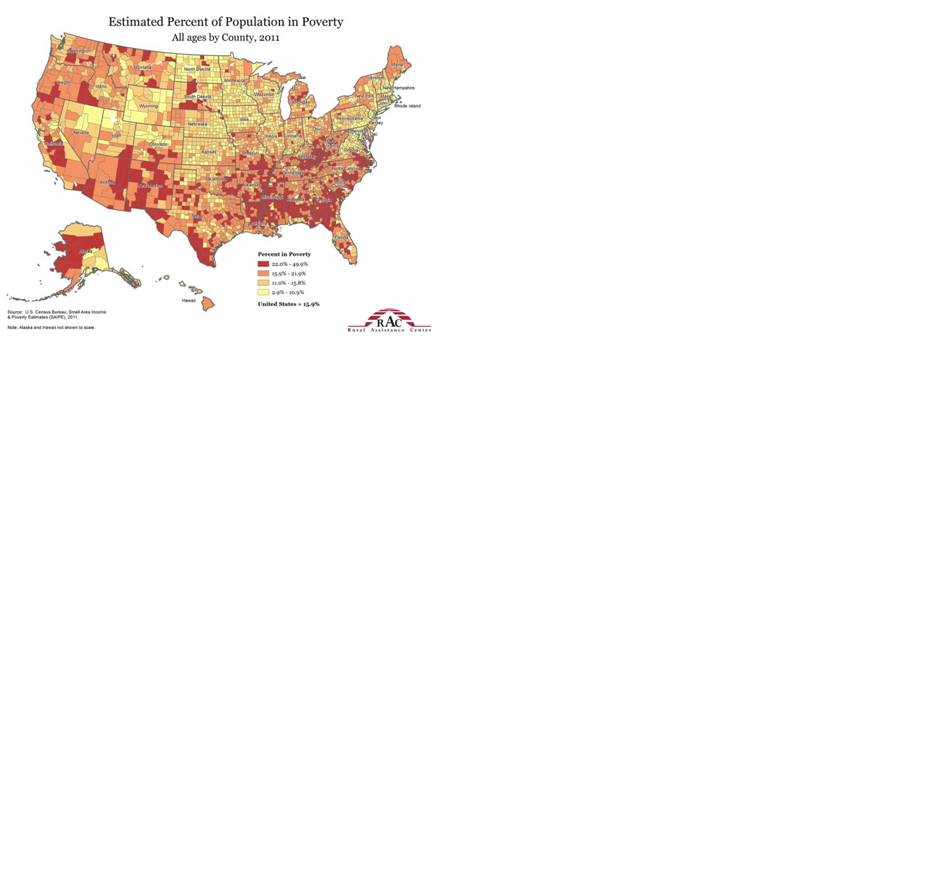
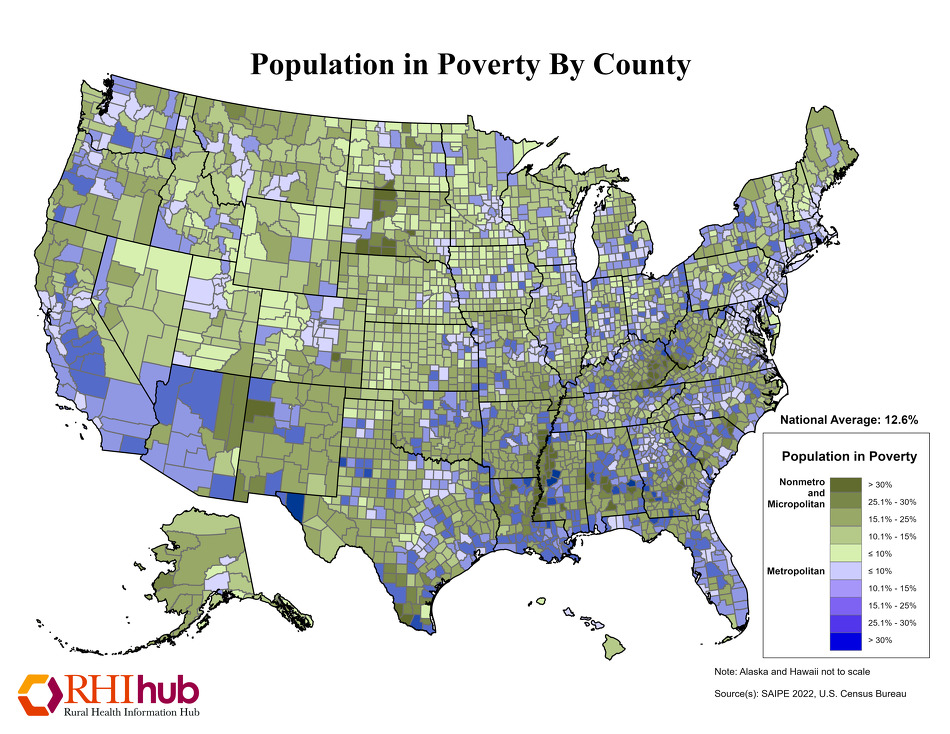
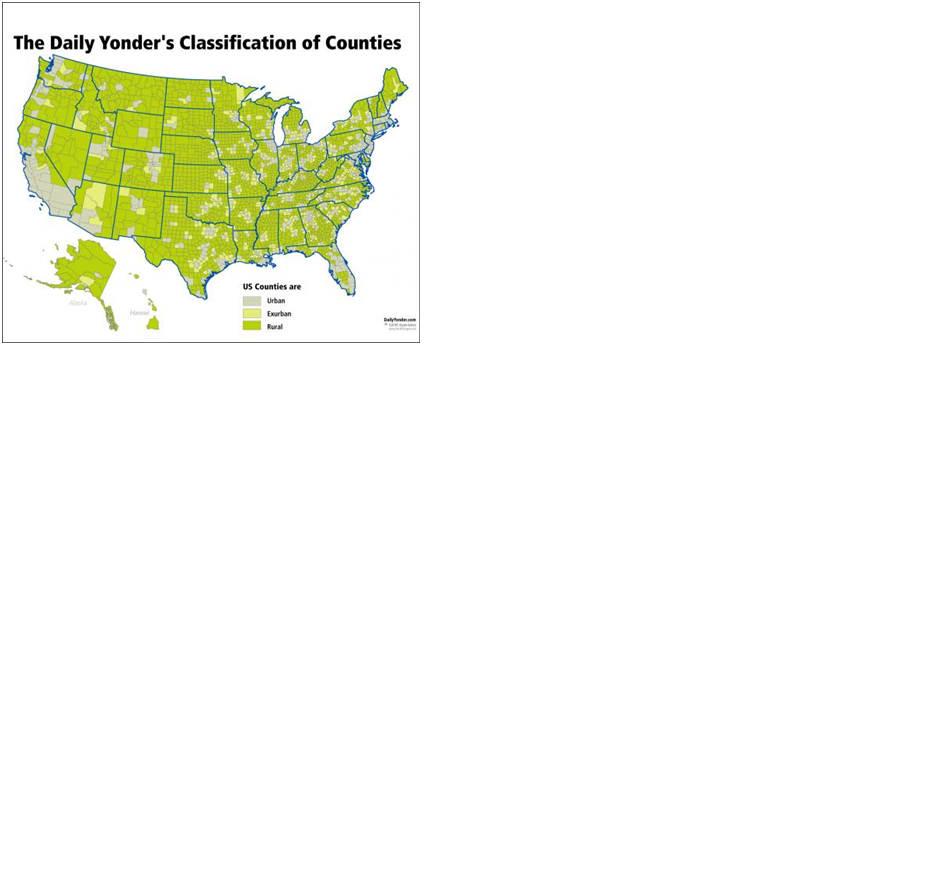
First let’s look at where these rural counties are.  Figure 1 is a map from www.dailyyonder.com  that shows (in green) the rural counties in the US.  Wikipaedia shows the 100 lowest income counties in Figure 2.  For the most part, these counties are rural, with the exceptions being a few areas in south Texas and in the Albuquerque/Santa Fe area of New Mexico. Raceonline.com shows the populations in poverty by county.  The red areas are the highest poverty rates.  The red areas in Figure 3 expand Figure 2 to include much of the rural deep south, Appalachia, more of Texas and New Mexico and part of the central valley in California.

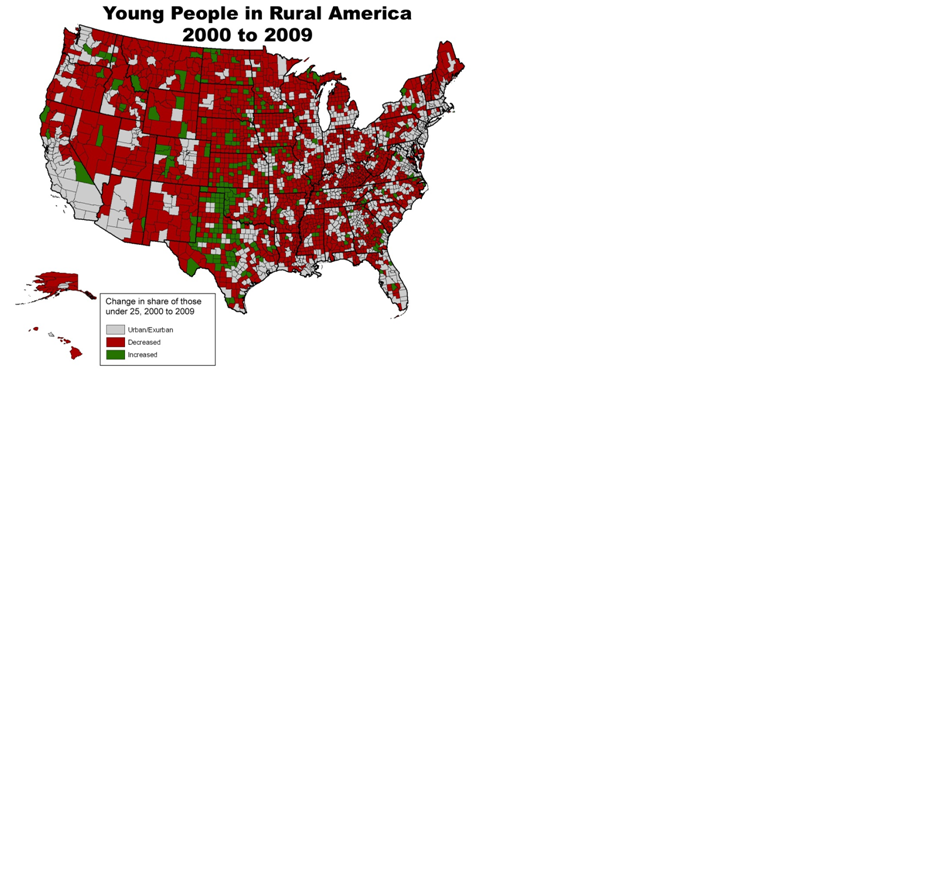
Figure 4 shows how the number of young people has changed between 2000 and 2009 in rural counties (urban counties are white and not included – red means a decrease).  Figure 5 shows population growth (or not) by county. What you see in these two maps is that the young people are moving to the rocky mountain states and vacating the high poverty counties in Figure 3.  Yong people do not see jobs in the rural area – unemployment is 20% higher in rural America and the jobs that are there pay less.  Figures 6 and 7 show unemployment by County in 2008 after the start of the Great Recession and in 2013.  What these figures show is that with exception of the Plains states and Rockies, is that many of the areas with high poverty also had high unemployment, and that the unemployment has remains stubbornly high in many rural areas in the Deep South, Appalachia and New Mexico, plus high unemployment in parts to  the Great Lakes, but the poverty rates are still lower.  Education may by a factor in why the Plains states and Rocky Mountains have less unemployment – despite being rural their students are far more likely to graduate from high school than those in the deep South, Appalachia where unemployment remains high and incomes low. 

So what does this possibly have to do with utilities?  Utilities need to understand this problem as is demands some real, on-the-ground leadership.  Small and rural utilities are more costly to operate per thousand gallons than larger utilities.  A 1997 study by the author showed that economy-of-scale manifested itself to a great extent with water and wastewater operations.  The differences were not close – it is a lot less costly to operate large utilities vs small ones.  Rural utilities complicate the issue further because not only is the number of customers limited, but the pipe per customer is less so the capital investment per customer is far higher than in urban areas.  The impact is that utilities are under pressure to reduce rates to customers, or create a set of lower cost rates for those in poverty, while at the same time their costs are increasing and infrastructure demands are incrementally higher than their larger neighbors.  The scenario cannot be sustained, especially when large portions of rural infrastructure was installed with FHA grants, meaning the customers never paid for the capital cost in the first place.  There was no or lower debt, than what larger utility customers have.  The rural rates since these investments have been set artificially lower than they should as a result. But with Congress talking about reducing SRF and FHA programs, FHA is unlikely to step in to replace their initial investment, meaning that the billions of rural investment dollars that will be needed in the coming years will need to be locally derived, and rate shock will become a major source of controversy in areas that are largely very conservative politically and tend to vote against projects that will increase costs to them.

The good news is that much of the rural infrastructure may be newer when compared to much of the urban infrastructure.  So there is time to build the argument that local investment is needed.  The community needs to be engaged in this discussion sooner as opposed to when problems occur.  Saving for the infrastructure may be the best course since rural utilities will have limited access to the borrowing market because of their size, but that means raising rates now and keeping those saved funds as opposed to using them to deer rate increases.  If ongoing efforts in the House deplete federal funding further, the pinch will be felt sooner by rural customers who will lose the federal dollars from SRF and FHA programs. 


Image

Figures 1 – Rural Counties

The United States: By Rural, Urban and Exurban Counties


Image


Figure 2.  100 lowest income Counties in the US


http://en.wikipedia.org/wiki/List_of_lowest-income_counties_in_the_United_States


Image

Figure 3.  Estimated population in poverty

http://www.raconline.org/racmaps/mapfiles/poverty.jpg


Image

Figure 4.  Where the Young People Are

http://www.raconline.org/maps/topic_details.php?topic=55


Image


Figure 5.  Where people are moving to http://www.raconline.org/maps

Image


Figure 6  Unemployment 2008

http://en.wikipedia.org/wiki/Unemployment

Image

Figure 7  Unemployment 2013 http://www.huduser.org/portal/pdredge/pdr_edge_featd_article_040


As 2014 is only a month away, expect water and sewer infrastructure to become a major issue in Congress.  While Congress has failed to pass budgets on-time for many years, already there are discussions about the fate of federal share of SRF funds.  The President has recommended reduction in SRF funds of $472 million, although there is discussion of an infrastructure fund, while the House has recommended a 70% cut to the SRF program.  Clearly the House sees infrastructure funding as either unimportant (unlikely) or a local issue (more likely).  Past budgets have allocated over $1.4 billion, while the states put up a 20% match to the federal share.  A large cut in federal funds will reverberate through to local utilities, because many small and medium size utilities depend on SRF programs because they lack access to the bond market.  In addition, a delay in the budget passage due to Congressional wrangling affects the timing of SRF funds for states and utilities, potentially delaying infrastructure investments. 

This decrease in funding comes at a time when ASCE rates water and wastewater system condition as a D+ and estimates over $3 trillion in infrastructure investment will be needed by 2020.  USEPA notes that the condition of water and wastewater systems have reached a rehabilitation and replacement stage and that infrastructure funding for water and sewer should be increased by over $500 billion per year versus a decrease of similar amounts or more.  Case Equipment and author Dan McNichol have created a program titled “Dire Straits:  the Drive to Revive America’s Ailing Infrastructure” to educate local officials and the public about the issue with deteriorating infrastructure.  Keep in mind much of what has made the US a major economic force in the middle 20th century is the same infrastructure we are using today. Clearly there is technical momentum to indicate there is greater need to invest in infrastructure while the politicians move the other way.  The public, caught in the middle, hears the two sides and prefers less to pay on their bills, so sides with the politicians as opposed to the data. 

Local utilities need to join the fray as their ability to continue to provide high quality service.  We need to educate our customers on the condition of infrastructure serving them.  For example, the water main in front of my house is a 50 year old asbestos concrete pipe that has broken twice in the past 18 months. The neighborhood has suffered 5 of these breaks in the past 2 months, and the City Commission has delayed replacement of these lines for the last three years fearing reprisals from the public.  Oh and the road in front of my house is caving in next to where the leak was.  But little “marketing” by the City has occurred to show the public the problem.  It is no surprise then that the public does not recognize the concern until service is interrupted.  So far no plans to reinitiate the replacement in front of my house.  The Commission is too worried about rates.

Water and sewer utilities have been run like a business in most local governments for years  They are set up as enterprise funds and people pay for what they use.  Just like the private sector.  Where the process breaks down is when the price is limited while needs and expenses rise.  Utilities are relatively fixed in their operating costs and I have yet to find a utility with a host of excess: workers.  They simply do not operate in this manner.  Utilities need to engage the public in the infrastructure condition discourse, show them the problems, identify the funding needs, and gain public support to operate as any enterprise would – cover your costs and insure you keep the equipment (and pipes) maintained, replacing them when they are worn out.  Public health and our local economies depend on our service. Keep in mind this may become critical quickly given the House commentary.  For years the federal and state governments have suggested future funding may not be forthcoming at some point and that all infrastructure funding should be local.  That will be a major increase in local budgets, so if we are to raise the funds, we need to solicit ratepayer support.  Now!