Archive

Tag Archives: Leadership


Most states were doing pretty well before the 2008 recession hit, but that ended in 2009. Most states had to make extremely difficult cuts or raise taxes, which was politically unacceptable. Of course invested pension systems received a lot of attention as their value dropped and long term sufficiency deteriorated, which was fodder for many changes in pensions, albeit not how they were invested. The good news is a lot of them came back in the ensuing 5 years, but 2015 may be different. A number of states have reported low earnings in 2015 and whether this may be the start of another recession. The U.S. economy has averaged a recession every six years since WWII and it has been almost seven years since the last contraction. With China devaluing their currency, this may upset the economic engine. At present there are analysts on Wall Street who suggest that some stocks may be overvalued, just like in 1999. If so, that does not bode well states like Illinois, Kansas, New Jersey, Louisiana, Alaska and Pennsylvania that are dealing with significant imbalances between their expenses and incomes. Alaska has most of its revenue tied to oil, so when oil prices go down (good for most of us), it is a huge problem for Alaska that gives $2200 to every citizen in the state. An economic downturn portends poorly for the no tax, pro-business experiment in Kansas that has been unsuccessful in attracting the large influx of new businesses, or even expansion of current ones. California and next door Missouri, often chided by Kansas lawmakers as how not to do business, outperform Kansas.

Ultimately the issue that lawmakers must face at the state and as a result the local level is that tax rates may not be high enough to generate the funds needed to operate government and protect the states against economic down turns. There is a “sweet spot” where funds are enough, to deal with short and long term needs, but starving government come back to haunt these same policy makers when the economy dips.   It would be a difficult day for a state to declare bankruptcy because lawmakers refuse to raise taxes and fees.

In the vein of more growth is always better mentality, the following struck me as I was in Colorado last month.  Front Range politics are a big deal in Colorado because virtually all the people in the state live within 60 miles of Denver.  The following table outlines the populations of the Front Range counties and their growth trends over the past three years.  Big growth.  So the local politicians are happy.  Growth is good.

The Front Range Urban Corridor
County 2012 Estimate 2010 Census Change
Larimer County 310,487 299,630 +3.62%
Weld County 263,691 252,825 +4.30%
Boulder County 305,318 294,567 +3.65%
City and County of Denver 634,265 600,158 +5.68%
Arapahoe County 595,546 572,003 +4.12%
Jefferson County 545,358 534,543 +2.02%
Adams County 459,598 441,603 +4.07%
Douglas County 298,215 285,465 +4.47%
City and County of Broomfield 58,298 55,889 +4.31%
Elbert County 23,383 23,086 +1.29%
Park County 16,029 16,206 −1.09%
Clear Creek County 9,026 9,088 −0.68%
Gilpin County 5,491 5,441 +0.92%
El Paso County 644,964 622,263 +3.65%
Teller County 23,389 23,350 +0.17%

Then I read an article by Bruce Finley of the The Denver Post entitled “Colorado shies from big fix as proliferating people seek more water.’  The concept is to continue the state’s tradition of moving water from the wetter west side of the Rockies to the drier east side.  The current fix is to build a huge reservoir by Dinosaur National Monument (in the middle of the west Colorado desert), then divert 97 billion gallons a year from the Yampa River through a 250-mile pipeline across the Continental Divide to the Front Range to defray Colorado’s projected 2050 water shortfall of 163 billion gallons.  The Yampa Pumpback would be the 31st cross divide diversion Colorado has built since the 1930s.

colorado water

Now the plan has hit a snag, whereby the EIS for the project indicates to meet needs, it would be the Front Range that bears the risks of not enough water in dry years as a part of negotiations for water entitlements under the interstate treaty that divvies the Colorado River.  Once that is resolved, the project would cost billions and take years to construct.  Ok, the Front Range is water limited. And we all know it.  The problem is people like Northern Water manager Eric Wilkinson who the article quotes as saying. “With the number of people coming here, we’re going to have to look at all alternatives. Conservation isn’t the silver bullet; it’s also going to take additional infrastructure…. These people need water, and they’re willing to pay for that water.”  In other words, we need more growth!  So in the meantime, development competes with agriculture or replaces agriculture on the semi-arid high plains.  The article suggests that cities and industries seeking more water would absorb hundreds of thousands of acres of agricultural land water rights if unable to divert more across mountains, something the governor is a little concerned about.  They would just buy them out.  So less agriculture when we probably will need that land later.

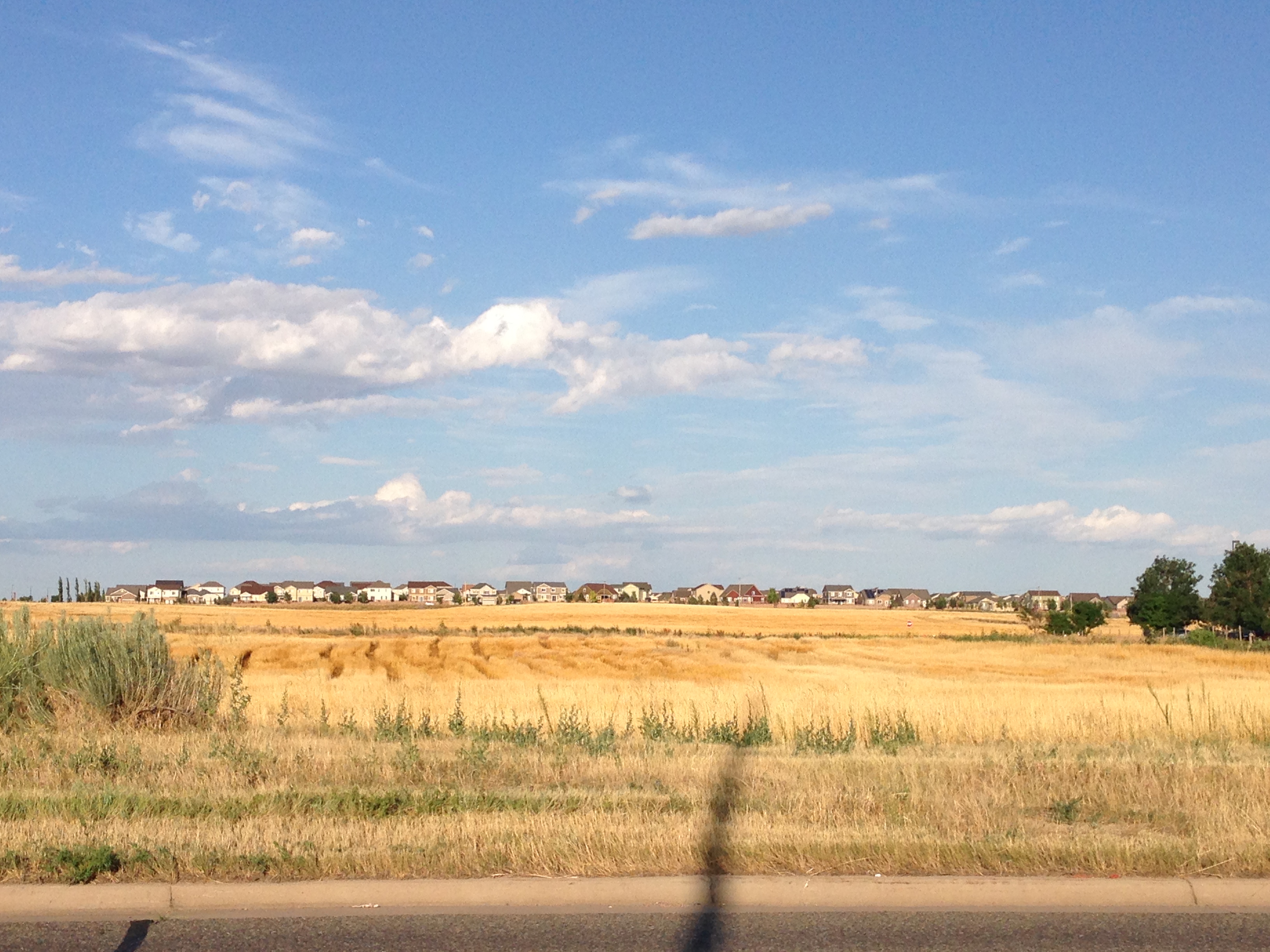
So in that vein, I noted the following at the airport.  One is a nice field of grain. Golden in the summer sun.  Across the street, the golden field is being converted to 300 houses.  You can see the pipe and the equipment.  And my question is – Is this really a good idea?

photo15b

photo15e


The other thing we learned was that we need to be far more careful about what goes in the sewer system.  Paper towels, baby wipes and hand towels do not deteriorate in the sewers.  No matter what manufacturers claim, you find them everywhere and they look just like they did when flushed.  They clog lift station pumps and pipelines.  Do not put these down the toilet for any reason?  Likewise there are no feminine hygiene products that should be flushed, ever!  Again regardless what the manufacturers claim, you can find there ubiquitously in the sewer system and they look, well just like they did when flushed.  No biodegradation.  I have included some figures.  They show up in pump clogging and at plants as well.  They are not biodegradable.  Again do not put these down the toilet!  Put all these products in the trashcan in the bathroom.

Worse, do not put grease down the drain.  One photo is a greaseball in a manhole.  It fills the whole manhole up!  Of course the feminine hygiene products, towels, wipes, etc. plus grease make almost impenetrable obstacles that block the sewer system.  So we need to remove the inflow and we need to keep grease and the reset of these products out to reduce the costs of operating the wastewater utility.  We all contribute, and we all can help.  We want systems to operate properly and dependably, so let’s do our part.

photo 3 photo 1 GREASE


Wastewater utilities and water utilities are intrinsically linked.  Wastewater utilities often discharge to water bodies that are water supplies for downstream water plants.  In other cases, wastewater plants provide additional supply options to reduce water demands in the form of reclaimed water.  However as a wastewater utility, costs are often associated with power- pumping and aeration, which can be 30% or more of the utility’s costs in the worst cases.  However, substantial savings in operations can be achieved by reducing the amount of wastewater that must be pumped and treated and in some cases that reduction also is associated with water quality benefits for the reuse of reclaimed water.  Utilities have long dealt with the infiltration and inflow (I and I) issues in their system by televising their pipes and identifying leak points, but this primarily addresses only the infiltration part of I and I.  Inflow and infiltration are not the same thing – they are very different and must be addressed differently.  Inflow causes hydraulic issues during rain events – like sanitary sewer overflows and basement flooding.  Both subject the utility liability from lawsuits and/or regulatory fines.  Inflow is the risk issue that must be addressed to protect the utility.  A cost effective solution to inflow involves low tech, low cost methods can identify the problems that can corrected easily.  Removing the inflow portion from I and I, often leads to a more focused plan for infiltration correction.  What are those tools?  Smoke testing, cleanout repairs, sealing manholes and manhole dishes.  But each of these needs to be carefully selected.  Because these solutions, pipe that leak can be seen through another low tech solution – a midnight monitoring event.  Recent efforts here in south Florida indicate that only 15-20% of the pipes in a sewer system need to be televised and within those, about half the leaky pipes are actually not leaking – they are broke laterals.  Laterals are one of the most ignored parts of the sewer system – often they are small pipes and much of the piping is on private property so the utility does not address those pipes.  And in many utilities these are the pipes in the worst condition.

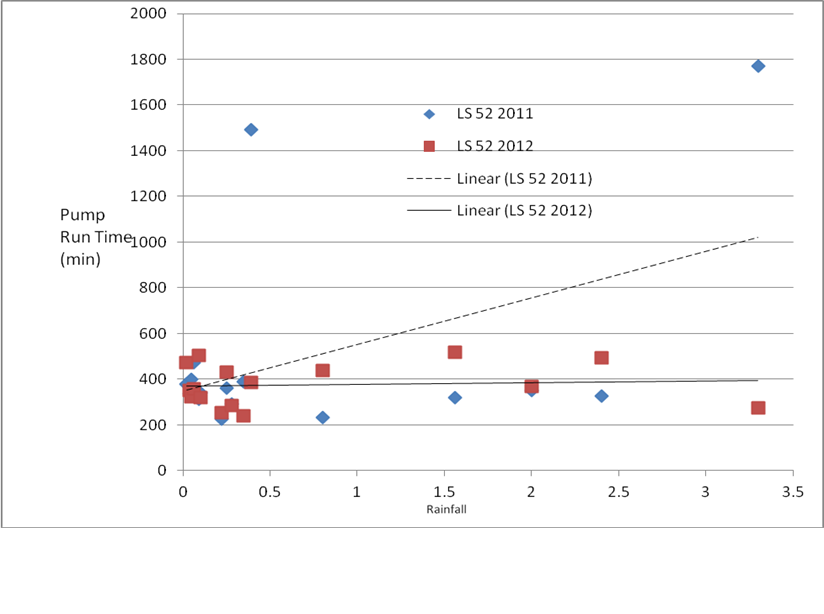
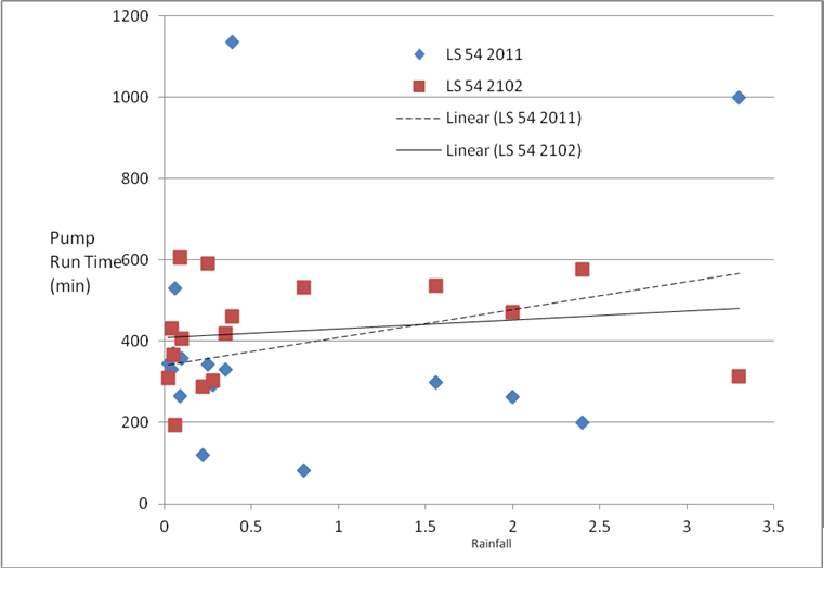
Other things that our efforts have shown are that new pipe can leak, just like old pipe, clay is not the only pipe that leaks and that the inflow solutions can be very helpful.  Figures 1-4  show how the solutions affected three lift stations and one community.  The graphs show rainfall vs flow.  Before these efforts, the flows increased with rainfall events.  After, they did not.  Hence this utility was able to resolve its risk for overflows at a cost of under $500/manhole.  That is relatively inexpensive.

LS 52 db LS 54 LS 53


As storm season arrives, I found an interesting figure which comes from Power magazine and shows all the power stations that are at risk from storms.  That’s a lot of power.  The question is how do we address this?  Water and wastewater utilities are actively looking for means to reduce power costs.  Pumping water can account for 80-90 percent of total power consumption, especially with high service pumps.

Water and wastewater power plants tend to have backup power.  Or at least we hope they do.  In Florida we created FLAWarn after the hurricanes in 2005.  The concept was to put utilities together to allow them to share generators and other assets in case of emergency.  Many utilities here have generators at pump stations, tanks and on trailers.  The goal is to insure service can be provided regardless of the damage.  And that did come in handy after Wilma in 2006.  FLAWarn serves as a model for other states.

There are also renewable power which some utilities have invested in.  Renewable power on plant sites is a means to address the potential grid interruptions.  This solution, however, may not be embraced by power utilities due to the potential revenue reduction. As the water facility takes on on-site generation, the utility load profile may shift significantly placing them in under a different rate structure which may greatly reduce the benefit to the utility.  One problem.

Also there are some at work to derail green power solutions, trying to reduce the attractiveness and subsidies on renewable power.  Interesting that many power providers are not in that group because all power in the US is subsidized – oil, gas and renewables.  The oil and gas sector is much larger and while many renewable power solutions are used by large power entities.   In some states, the states have taken action to encourage these investments because of the potential benefits to the population.  Local entities have gotten involved also.  It just makes sense if you are in the right region and the price/risk ratio is right.  A number of water and sewer utilities have pursued this option successfully.  That will help as well during outages.

Now if we can keep the trees from being planted above the pipelines ….power systems


The most recent issue of the magazine Population Connection notes several interesting things.  First, the world’s population grows by 80 million people per year, predominantly in areas that are not “first World” countries.  In many of these places water is limited – 1.2 billion people live in these areas. By 2030, 40% of the people, especially those in these areas will be facing water deficits that will increase their risks.  Some of these deficits will be exacerbated by climate changes.  Agriculture is responsible for 70% of water use, and that number is not expected to decline as the need for agricultural products increases with time.  So clearly water use and population are related, just as carbon dioxide concentrations in the atmosphere and population appear to be related. Worse yet, the number of urban residents that do not have access to wastewater services is expected to increase by 50%.  The good news, not so much in the US, where such services are expected and available to the vast majority of people.  So the problem – most of these people live in Third World countries that lack both the economic resources and social infrastructure to deal with these problems.  This is what Engineers Without Borders is trying to address but it does raise that question – what are the social consequences of trying to help them?  Surely engineering ethics say we should help protect the public health, safety and welfare, which this work does.  But on the other side, if they develop more and add more people, does that add to the strain on limited resources in these areas which might damage the public health safety and welfare.  Which is the more critical issue?  And how do we decide? How should engineers evaluate the conflict between public health and sustainability from an ethics perspective? Just asking?


Over the past couple weeks I have been at two conferences and had two interesting conversations.  The first one was in Anaheim at the AWWA Annual Conference and Exposition.  The subject was the organization Engineers Without Borders (EWB).  The organization has the mission to help get drinkable water to people in undeveloped parts of the world.  Nearly two billion people do not have clean drinking water which drastically impacts their health and ability to be productive and earn a living.  Many of these people live in Africa and Asia; some in central and South America as well.  The mission is a noble one – to help people.  But the guy I was talking to raised an interesting question – if we help all these people get water, they will demand more resources and if the resources are already limited, won’t creating more demands for those resources compromise our access and cost to those services?  Hence helping them actually creates competition with us for the same resources and that can compromise our goals.  Clearly not a fan of EWB, but, an interesting take on the issue..…

The second conversation was a few days later when a group of people were talking politics.  The conversation inevitably ended up on political parties and people and service organizations like Engineers Without Borders that are often viewed as being ”liberal” or “progressive” as opposed to “conservative.”  The discussion got around to this question – would conservative groups give money to progressive groups like EWB?  The answer was a resounding yes, because that would improve conditions which would make people more productive, which means more jobs, and more income to give more people access to buy more things, which creates a demand for more things, which expands the economy.  In other words, increase profits for those folks building the “things.”  Interesting twist, and you thought is was all about water….


As technology advances I have an observation, and a question that needs to be asked and answered.  And this could be a pretty interesting question.  Back in the day, say 100 or 150 years ago, there were not so many people.  Many activities occurred where there were few people and impacts on others were minimal.  In some cases ecological damage was significant, but we were not so worried about that because few people were impacted by that ecological damage.  In the 20th century, in urban locations, the impact of one’s activities on others became the basis for zoning laws – limiting what you could do with your property because certain activities negatively impacted others.  And we certainly had examples of this – Cuyahoga River burning for one.  Of course this phenomenon of zoning and similar restrictions was mostly an urban issue because there potential to impact others was more relevant in urban areas.  We also know that major advances in technology and human development tend to occur in population centers (think Detroit for cars, Pittsburgh and Cleveland for steel, Silicon Valley, etc.).  People with ideas tend to migrate to urban areas, increasing the number of people and the proximity to each other.  Universities, research institutions, and the like tend to grow up around these industries, further increasing the draw of talent to urban areas.  The observation is that urban areas tend to have more restrictions on what people do than rural areas.  So the question – do people consciously make the migration to urban areas realizing that the migration for the potential financial gain occur with the quid pro quo of curbing certain freedoms to do as you please?  Of does this artifact occur once they locate to the urban areas?  And is there a lack of understanding of the need to adjust certain activities understood by the rural community, or does it become yet another point of philosophical or political contention?  I have blogged previously about the difference between rural and urban populations and how that may affect the approach of utilities, but read a recent article that suggests that maybe urban citizens accept that financial gains potential of urban areas outweighs the need to limit certain abilities to do as you please to better the entire community.  They are motivated by potential financial opportunities that will increase their standing and options in the future.  So does that mean urban dwellers understand the financial tradeoff differently than rural users?  Or is it a preference issue.  And how does this translate to providing services like water to rural customers, who often appear to be more resistant to spending funds for improvements?  While in part their resistance may be that their incomes tend to be lower, but is their community benefit concern less – i.e. they value their ability to do as they please more than financial opportunities or the community good?  I have no answer, but suggest that this needs some further study since the implications may be significant as rural water systems start to approach their life cycle end.


I am working on a book on engineering ethics. My wife and I were talking about the ethical obligations of engineers and how that compares to the medical industry (which she is in).  Engineers by canon, creed, code and law, have an obligation to protect the public health, safety and welfare above all else, including their clients and their firms.  It is one of the reasons that engineering services provided to the public require a license and why codes exist to help guide design.  My wife recently raised an interesting question – if licensure means that you must protect the public health, safety and welfare, can you sign and seal a project for which the consequences are not perfectly known?  It harkens back to a lecture I do in my summer environmental science and engineering class – the infamous “What could possibly go wrong?” lecture.  In that lecture we look at logging, mining, oil and gas and agriculture.  I should note that we need each of these industries and will continue to need them for the foreseeable future, so abandoning any of them is not an acceptable answer.  But in each case there are large, historical consequences, as well as current ongoing consequences.  Let’s start with logging which fed the rapid development of many cities by providing accessible building materials.  And actually let’s just start in the upper half of the state of Michigan where loggers cut timber across the state for over 50 years, eliminating white pines form many areas.  The logs were sent down small streams and rivers, many of which had to be altered to take the logs.  Rivers like the AuSable and Manistee changed completely afterward (starting with the loss of sweepers, increased siltation, the loss of the grayling (fish), and the need to introduce trout.  Siltation is a difficult issue for water plants to deal with.  Today the AuSable is a “high quality fishing water” with open fishing season, but limits of zero trout kept in many places or only really large fish (rare in cold water), which means catch and release only, which sounds more like – “not enough fish, so put them back” as opposed to high quality fishing waters.    We needed the logs, but the impacts of logging were never considered and 150 years later, we still suffer the effects.  Few engineers were involved.

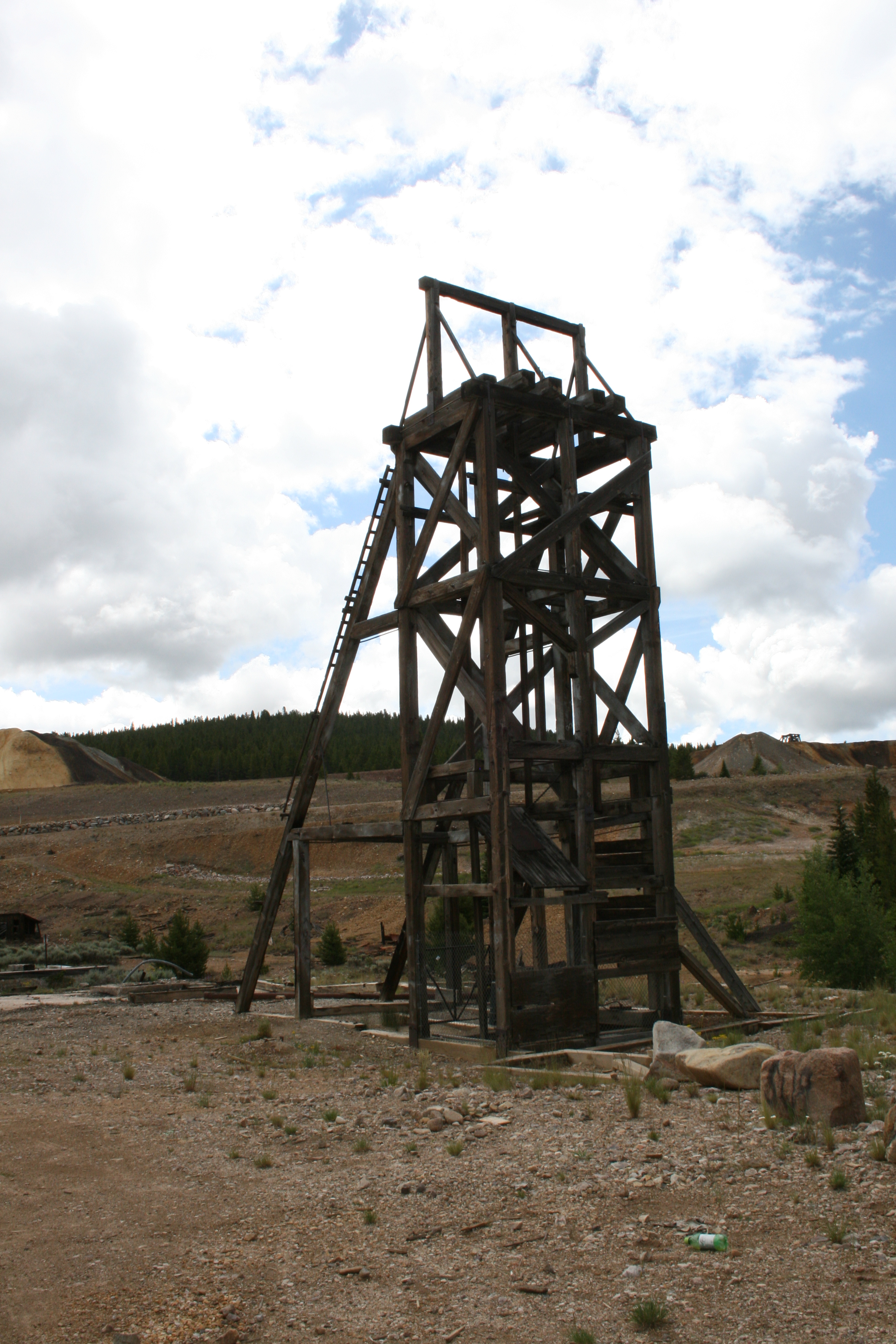
Next we look at mining.  Again we needed the gold, silver, lead, iron, etc. from the mines.  The gold rushes started in the 1840s and expanded across the west.  Material was dug out, metals processed and mines abandoned.  The tailings from these mines STILL leach metals into waterways.  The metals content remains toxic to ecology and to us in drinking water, and will continue be so for years.  Metals are often expensive to remove via treatment.  Sometimes the situation is serious enough that the federal government will construct treatment plants to protect downstream waters (drinking waters for people), as they have done in Leadville and Idaho Springs, Colorado.  The tailings issue will be with us for years, which is why the mining industry is subject to regulations today.  Maybe we learned something?  Engineers have become more involved with mining with time, but historically, not so much.

With agriculture (Ag) the big issue is runoff and siltation.  Siltation has increases as more property is farmed.  The runoff also contains pesticides herbicides, and fertilizers, which impact downstream ecological sites, as well as creating difficulty for water treatment.  Ag is largely unregulated with respect to runoff and best management practices are often lacking.  The results include dead zones in the Gulf of Mexico and the Pacific.  Engineers try to deal with water quality issues in rivers and streams, but the lack of ability to effect changes with Ag practices is limiting.  There are situations like Everglades where the engineers did exactly what was asked (drain it), but no one asked the consequences (lack of water supply), or the impact of farming north of the Everglades (nutrients).

The Everglades results, along with the unknowns associated with fracking (primarily surface and transport) brought the question to my wife — should an engineer sign off on a project for which the consequences are uncertain, unstudied or potentially damaging the public health safety and welfare, like fracking wells, or oil/gas pipelines across the arctic (or Keystone)?  Engineers design with the best codes and intentions and clearly the goal is to design to protect the public, but she has a great point – when you know there are uncertainties, and you know there are unknowns that could impact public health, safety and/or welfare, or which could create significant impacts, should we be signing off?  I am not so sure.  What are your thoughts?

photo 4IMG_6527 (2015_03_08 17_53_48 UTC)


So I am training a group of public officials about utilities. Many have limited experience; others much more so. The interesting question that came up is how these officials should communicate with their customers. Interesting question and one that often receives little thoughts. So I thought their thoughts might be enlightening, keeping in mind that I have abbreviated some of them, and this was a discussion. Here are the thoughts they provided, in no particular order:

“Not the newspaper, most residents do not receive the newspaper anymore”

“Who are our customers and how do they communicate? Until you can answer that, you will not reach them. Ask them.”

“If 37% percent of your customers are direct deposit – should we send them direct mailings?” Response: “Yes! They will not think it is a bill and they might read it.”

“Most people discard bill stuffers without reading them . That wastes a lot of time and money.”

“We have a Facebook page, but we don’t just talk utilities. We talk about things that might interst them like strawberry shortcake recipes and current community events.”

“We use twitter and Facebook”

“We have a website, but we found the website was useless if we did not keep it current constantly. It takes effort and someone with that responsibility to accomplish that.”

“We use Facebook to get people interested, then use it to direct them to our website.”

“Every utility should have a public relations person that deals with media, and can brand your utility to the public.”

“Understand your demographics and then figure out how they communicate – phone, twitter, Facebook, on line, etc. Maybe all of these, interconnected. You can find local people who will do this for your professionally. The results are worth the investment.”

“Radio is useless, just like the paper. Avoid the television because they really only want to report the bad stuff.”

“Blogs tied to websites and Facebook are helpful.”

“Many venues are needed – make the message the same.”

“Ask the young people in your community – they will know how the reach the residents.”

“Don’t focus just on utility issues, add content on topics they might be interested in.”

“Public relations is as important as providing good service.   It is part of your job.”

“worth every dollar spent.”

Interesting isn’t it. I wonder if the mainstream media will take note? And I wonder how many utilities do not have these things and will consider it as a part of the coming budget cycle?