Archive

Tag Archives: public relations


In the last blog I commented on the Donald Sterling, Thomas Sowell and Clive Bundy comments the week before. I wonder if letting the hate out just a way to keep us from looking at the bigger picture from a political (and maybe business) perspective? And should utilities we concerned? The answers may be yes, and yes an dhere is why. An August 2012 Pew Research Center report noted that only half of American households are middle-income, down from 61 percent in the 1970s. The shift was downward, not upward as the very rich (0.1%) control 58% of the wealth in the US. In addition, median middle-class income decreased by 5 percent in the last decade, while total wealth dropped 28 percent. The need for social programs, despite cutbacks and revisions to the welfare programs in the Clinton era, have increased – since 2000 Medicaid has increased from 34 million people to 54 million in 2011 and the Supplemental Nutrition Assistance Program (SNAP, or food stamps) from 17 million to 45 million in 2011. Keep in mind that income drives qualification for these services so it means that incomes are down for millions in America. The increase in people needing help is no surprise since there is an ongoing increase in the number of lower-wage service jobs like food preparation, retail and service industry, but the number of middle-class occupations, like teaching and construction, have declined. Since 2010, the State of Florida has added 400,000 jobs, impressive except that the vast majority are service and retail jobs that pay just above minimum wage. The job growth in low wage jobs does not replace the loss of middle income jobs which is why 47% of households did not earn enough to pay income tax in 2103. It is not because they don’t want to, it’s because they don’t get paid enough. And we have tens of millions of these low wage jobs that don’t pay enough for the recipients to pay taxes. Just the opposite of what some of the political discussion would have you believe.

The loss of wages is felt locally more than nationally. It means that local officials hear about costs more because water, sewer, power, etc competes for an ever larger portion of the shrinking paycheck. So we see more attention paid to affordability indexes, the ability to pay. The concept of affordability is to take your annual water and sewer bill and divide it by the average or median local income. The goal is water plus wastewater is under 3.5% of the median income. Keeping the percent low is great and easy when people are making more money, but creates a lot of difficulty when the incomes are static or dropping. An our costs are rising due to the increasing need to maintain and upgrade infrastructure that has been neglected since 1980 (the annual investment is under 1.4% for most of the US infrastructure for the last 30 years. We need to invest above 2.3% to keep up according to GAO).

When income drop, costs become more important, and local water and sewer costs are often easier targets to limit than groceries, rent, power, telephone, cable or other services that are not subject to local official votes. So it is in all of our interests to work with local officials, colleges, vocational schools, public schools et al. to attract or build a economy that features higher income jobs, to get everyone employed, and to provide training, infrastructure, outreach, health care and other help to establish a competent, highly skilled workforce in a community. That means that utilities must support the local efforts to effect social change in the community, to help meet the needs of residents not just with water, but with respect to the local economy as well. Does that mean we are actually agents for social change?


Last week was one heckuva week for societal problems related to race relations.  Seems like someone turned over a rock and the 1950s crawled out.  We started with Cliven Bundy, the Nevada rancher who has been using federal property (read our land) for grazing his cattle for 20 years without paying for it, said after the armed confrontation with federal officials, that “I wonder if Negros weren’t better off as slaves.”  But he says he is not a racist, but wow.  That’s right up there with Rush Limbaugh’s comments about Native Americans in his book 15 years ago. 

 Then we had newspaper columnist and right-wing wonk, Thomas Sowell, who is black, saying in a recent column that “you are poor because you don’t work.”  And it is your fault you don’t work.  In “higher income families, people work.”  So using that line of racist nonsense, given that minorities are disproportionately un- or under-employed, does Mr. Sowell really believe that it is really the choice of all of these people not to work?!  Could there be any other causal links like the lack of education, decaying infrastructure or the lack of local opportunities in their community that might just come into play? That’s like saying Detroit’s problem is not the lack of job opportunities, but the fact that no one wants to work in Detroit.  I think not.

The we have Donald Sterling, the owner of the Los Angeles Clippers NBA team, who was taped making racists comments, then received a lifetime ban and multi-million dollar fine for his comments about minorities, and then, instead of apologizing, states that he wishes he’d just paid the woman who taped him off.  Huh?   Of course it is not the first time for Mr. Sterling who lost a case several years ago over his practices of renting property in LA, so I guess we should have expected it.

Of course there are those who argue these folks were simply misunderstood.  Maybe Mr. Sowell was just pandering to his fan base, but what does that say about his fan base that he can write a column that purports that “you are poor because you don’t work” because you don’t want to work and no one says anything?  He clearly appears to be besmirching the inner city minority population, but as I noted in a prior blog, rural America is significantly worse off economically than urban America.  Rural America is where health care suffers, the lack of health insurance is pervasive, income are lower and unemployment higher.  There are poor across all races, and in all settings.  And given his fan base is includes a lot of poor, white, rural people who aren’t making a lot of money or who can’t find jobs, he’s talking about you!

The Bundy comments stem from his standoff with federal officials over many years of not paying for grazing (like the rest of us could get away with that!).  He and those that came armed to his defense are more indicative of a larger, far-right, anti-government sentiment around the country that has persisted for years.  The west has a number of these groups (recall Ruby Ridge, Waco, Black Hawk helicopter-ists, etc.) that are basically anarchists that disagree with America as it is today.    All white.  But of course as we have seen in the Sudan, Rwanda, the middle east and throughout history, hate can come from all races and religions. All harboring hatred of others not like them.  Understanding why is more difficult, but the commonality seems to be that they all have the perception that the others are somehow treated differently, which allows them to move up the economic ladder faster or allows them to “game the system.”  The perception, which may be completely false, persists because it somehow justifies the actions of these people.

So given the comments of the past week, are we back in the 1950s?  Or 1870s?  How are we here in 2014?  Prejudice and hate were not wiped away magically by civil rights legislation, integration, communication and education alone, but really, does this type of attitude have a place in today’s world? If so why?  Hate has created trouble in the world for thousands of years.  Hate is a problem because hate is a means to distract people from real problems or to force your problems on others.  But in truth, psychologists will tell you that in most cases, the Haters tend to hate themselves, which is something we all need to remember.  Hate is developed because you cannot control a situation or someone else gets something you want.  Therefore it is that someone else’s fault, not yours.  It is easier when race, sex, sexual orientation, religion or other factors represent the “somebody else,” but the reality is haters hate themselves first, then project their hate onto others.  They need help. Professional help. Counseling.  Many of them. Even whole societies. They need to go get help for themselves and the rest of us. 


There has been significant discussion about the potential impacts of climate change on the world:  more intense rainfall events, more severe thunderstorms and tropical cyclones, droughts, loss of glacial ice and storage, increased demand for crop irrigation.  However for much of the State of Florida, and for much of the coastal United States east of the Rio Grande River, the climate issue that is most likely to create significant risk to health and economic activity is sea-level rise.  Data gathered by NOAA from multiple sites indicates that sea level rise is occurring, and has been for over 100 years. About 8 inches since 1930.

The impact of climate change on Florida is two-fold – Florida often is water-supply limited as topography limits the ability to store excess precipitation for water use during the dry periods and sea level rise will exacerbate local flooding.  The highly engineered stormwater drainage system of canals and control structures has effectively enabled management of water tables and saltwater intrusion by gravity. The advent of sea-level rise will present new challenges, because the water table is currently maintained at the highest possible levels to counter saltwater intrusion, while limiting flood risk in southeast Florida’s low-lying terrain and providing for water supplies.  As sea level rises, the water will not flow by gravity, which disrupts that balance struck between flood risk and water supply availability in the canal system.

Occasional flooding is not new to Florida, but the increasing frequency we currently experience is related to sea level rise, not just along the coast, but for large expanses of developed property inland due to topography and groundwater levels.  As a result, the challenge for water managers in the state, especially in southeast Florida, is to control the groundwater table, because control of the water table is essential to prevent flooding of the low terrain.

The issue is not lost on local governments in south Florida nor on the educational institutions in the area.  Florida Universities are studying the impacts to the region to identify ways in which we can mitigate, respond to and adapt to these changes. My university, Florida Atlantic University, is located in this vulnerable part of the State has been proactive in partnership with the Four County Compact in addressing these issues and we have now joined with other Universities in the State to form the Florida Climate Institute, a consortium working with state and federal agencies to address the multiple challenges and opportunities facing this State. FAU in particular, has been proactive in developing tools to evaluate risk and identify adaptation strategies to protect local and regional infrastructure and property. 

Our efforts have included using high resolution NOAA data to map topography at the +/- 6 inch level, combined that topography with mapping of infrastructure and groundwater, to identify vulnerable areas throughout Broward, Miami-Dade and Monroe Counties, as well as initiated projects in Palm Beach County and other coastal regions throughout the state.  By identifying vulnerability based on sea level changes, the timing and tools for adaptation can be designed and funded to insure a “no-regrets” strategy that neither accelerates nor delays infrastructure beyond its need. 

While we have all heard the discussion of an estimated two to three feet if sea level rise is anticipated by 2100; sea level rise is a slow, albeit permanent change to our environment.  The slow part allows us to make informed decisions about adaptation strategies that may prove useful in the long term as well as the short term.  Of prime importance is the need to plan for these needs 50 or more years out so that we do not increase our exposure to risk.  Keeping development out of low lying areas, redeveloping pumping and piping systems with change in mind and reserving areas where major efforts will need to be undertaken, is important to the public interest and will affect private business, tourism and homeowners.  Sea level rise is already a problem for many low lying areas such as Miami Beach, Fort Lauderdale, Hollywood, and other coastal communities. It will be an incremental problem creeping up on us for the rest of the century and beyond.

The lowest lying areas are the roadways, which are also the location of electrical, water, sewer, phone and drainage infrastructure.  Fortunately given the current Federally funded special imagery and NOAA data systems we are able to predict pretty accurately where flooding will occur.  Linking that information with detailed projections of sea level rise impacts we can  map vulnerable areas and build adaptive measures into every action and plan we undertake.  But the impacts are not only on the coast. Sea level affects ground water table levels and with our intense rainfall areas far inland can be flooded, even subject to long term inundation.  Water levels are rising and will continue to rise as groundwater rises concurrently with sea level. Add the impact summer rains and dealing with water becomes a major priority. Figures 1 and 2 outline the roadway network degradation at present, 1, 2, and 3 ft of sea level rise.  The figures demonstrate that a major, underestimated amount of property is vulnerable on the western edge of the developed areas because the elevations are decreasing as one moves west from I95. 

Image

While time will impact our environment, there are three options to address the change:


  • Protect infrastructure from the impacts of climate change
  • Adapt to the changes, and
  • In the worst case retreat from the change.

 Retreat does not need to be considered in the short or medium term.  South Florida has developed in the last 100 years and there will be well over 100 years of life left.  As a result, the best option is adaptation.  Adaptation takes different forms depending on location.  I have developed a toolbox of options that can be applied to address these adaptation demands, resulting in an approach that will need a more managed integrated water system, more operations and inevitably more dollars.  For example we can install more coastal salinity structures, raise road beds, abandon some local roads, increase storm water pumping, add storm water retention etc. to address many of the problems.  The technology is available today.

Much of the actual needs are local, but the problem is regional and requires a concerted effort of federal, state and local agencies and the private sector to address the scales of the problem.  A community can address the local problems, but the regional canals, barriers, etc., are beyond the scope of individual agencies.  Collaboration and discussion are needed. 

The needs will be large – in the tens of billions.  But there are two things in south Florida’s favor – time and money.  The expenditures are over many, many years.  Most important in the near term need is the early planning and identification of critical components of infrastructure and policy needs and timing for same.  That is what FAU does best.  At risk are nearly 6 million of Floridians their economy and lifestyle, $3.7 trillion in property (2012) in south east Florida alone and a $260 billion annual economy.  All of these are expected to continue to increase assuming the appropriate plans are made to adapt to the changing sea level.  Protection of the area for the next 100-150 years is achievable as long as we have the science, the understanding and the will to do it.  Plan now, and over the rest of this century starting now we can raise those billions of dollars needed.


So Detroit defaulted on it’s debt obligations.  Do does that impact you?  Well, that depends on whether you are a utility looking revenue bonds, a city looking for general fund bonds or some combination.  The issue in Detroit with debt is that they pledged the full faith and credit of their taxing authority to repay the debt.  Their taxing ability was insufficient to accomplish this goal, which means that there could now be distrust in that promise for other cities.  So if you are a city and you are making this pledge, Detroit could impact you, or at least create more review on your balance sheets.  If you are a utility that is pledging revenues that have no limitations on amount, the concern is likely less.  Of course in either cases, the question is what the rest of your balance sheet looks like.  If you have no reserves, do not charge the full cost for service, have a heavy debt load, have high rates already, or send a lot of funds to the general fund, that could be a problem.  If you have avoided these pitfalls, the bond market will see much less of an issue. 

Keep in mind that Detroit is not the only default – another big one is the Birmingham and several other create questions about general fund uses of funds, which makes it of greater importance to keep our financial house in order.  IN part this can be done by creating the appropriate enterprise funds and remove those services from the general property tax fund.  That permits local focus on the true cost of general taxing users and creates a delineation between general fund and enterprise costs.  That can help elected officials focus on the true general fund issues:  police, fire, EMS, administration without hiding those costs with subsidies from other funds.


My last blog was a discussion about surpluses.  The State of Florida will have a $1.3 billion surplus this year and a host of politically expedient answers for where that money goes (tax cuts, pork projects, projects to help election results), but little mention of replenishing trust funds and reserves that were emptied to balance the budget amid tax cuts from 2010 – 2012.  But perhaps it is not the legislators or their constituents that we should blame for not understanding the need for reserves because the truth is that most people are not used to saving.  A recent article I read noted that 72 percent of Americans live paycheck to paycheck and would have difficulty putting $2000 together if needed.  $2000 is not a lot of money these days – it won’t buy you a transmission for example or a new engine for your car.  It won’t cover first, last and a deposit on a rental.  And it won’t cover the down payment on a house or most cars.  There are people who do not receive enough income to achieve some degree of savings, but not 72% of us.  We have come to perceive that having little savings is normal, but it wasn’t always this way and it is not this way everywhere in the world.  Back in the day, American saved more than they do now.  The reason is not that they had more money (they didn’t) or that they had less to spend money on (as things cost more proportionately).  But it was that “rainy day” they all knew would come and when they would need money.  They had been through depressions, recession and losses of industries (remember those Concord coachmakers did not get a federal bailout in trying to compete with Henry Ford).  They knew that there would be times when they needed to rely on themselves to survive and savings was the key.

There are two major differences from the past.  The most important is the fact is that credit was a lot harder to come by back in the day, so you needed cash for those big purchases.  That has changed dramatically in 50 years.  Today we get advertisements for credit cards – in the mail, instant credit at stores, easy credit for cars, and in the early 2000s, no-money-down-no-income-verification loans on real estate.  The need to save evaporated.  The access to easy credit has eliminated much of the need to save for those big expenses.  We can borrow to acquire them.  If we have a job problem, we borrow against the house or life insurance policy.  These are good backstops that help us maintain our way of life.

At the same time as we are being extended opportunities to secure funds to spend, we are barraged by advertisements and flyers and pitches to spend that money on products and services, many of which we probably don’t need, but are “cool” to have.  We are encouraged to compete to have better “stuff” than the other guy, and make sure we have the newest technology.  We all do it.  Just look at all phones can do, while keeping in mind that the old Bell phone I bought in college still works regardless of the situation and still sounds good.  No cool ringtones however, nor photo capability.  All that means we spend less on “needs” and more on “stuff.” 

Given this backdrop it is no surprise the attitude of decision-makers in government toward revenues and expenses.  Re-education of the public is needed as opposed to rhetoric.  We need to move the public discussion away from the concept of a balanced budget being expenses equal revenues to the correct concept of revenues + reserve expenses = expenses plus savings.  At times you use reserves (and savings =0) while other times reserve expenses are 0, while savings are positive. When big expenses come, borrow, but recurring expenses should not be funded through borrowing (credit).  We should seek to avoid is the desire to cut taxes (akin to cutting our salaries) to bring the budget back into balance that if we run a surplus, or spend it on “stuff.”  Such a system leaves room for those lean times when revenues may fluctuate but expenses do not (or increase).  


I have said before in this blog that my Dad’s family were born and raised in Detroit – not the suburbs, in the City, about a mile north of Tiger Stadium.  My great-grandfather was a butcher.  His sons all became butchers, so my Dad grew up around the butcher shop as a kid.  It was the Depression, but because of the shop, my Dad had food on his table.  My Great-grandmother managed the money, and acquired a number of properties in the area of 13th and Magnolia that the sons, and extended families would eventually move to.  It was a solution to the difficulties outside the shop.  Family was the means to survive the hard times of the Depression. 

Of course Detroit was a booming city – over 100 auto companies were in Detroit at the turn of the last century, and the City was becoming the center of a new mode of transportation – the automobile.  Henry Ford developed the assembly line to allow everyone to own a car, furthering the status of the City.  As the twenties developed, Detroit and Chicago competed to become the “jewel” of the Midwest.  Elaborate stone buildings, expanding infrastructure for roads, trains, water, sewer and storm water were all centerpieces of pride in the City.  Employment and incomes were high, worker benefits were good, the workforce was highly skilled and education was good. Profits were good and the auto industry was Detroit-centric. Detroit was a vibrant City in the first 50 years of the last century. 

Scroll ahead 60 years and how the city has fallen.  The City has lost a million people.  It has $18 billion in debt, and is collecting $0.3 billion less in revenues since 2008.  The tax base has been decimated.  Houses can be purchased for minimal prices.  Churches have been abandoned.  Crime is high.  Employment is down, unemployment remains above the state and national average.  Poverty is up, incomes are down.  Huge areas must be served but serve no one or only a very few.   The City filed the highest profile bankruptcy for a municipality ever.

The television show Low Down Sun last summer provided a graphic look at the City – blocks of the City devoid or mostly so of housing or other buildings, schools no longer in use, roads in disrepair, classic stone buildings with the windows broken out.  You can see what the City was, and the haunting view of the City today are a stark reality.  To add insult to injury, the Sun-Sentinel wrote a recent article about how people are making money doing tours of abandoned buildings in Detroit, or how farming is occurring in the City limits. 

So if Detroit failed, why not Cleveland, Akron, Pittsburgh, St. Louis, Cincinnati or virtually any other large, older Midwestern industrial city?  Sadly many of these cities have lost the industries that made them famous and provided jobs and a stable tax base and incomes.  Many of these cities are also stressed, much as we found Birmingham was.  There are many arguments for what precipitated these losses:  unions, shifts in population, outsourcing offshore, competition within the US, changes in consumer preferences, technology…… the list goes on.  But the reality is it doesn’t matter why, the City must deal with the reality that is.  We all look at Detroit and its recent bankruptcy filings.  Maybe looking at Detroit allows us to feel better about our situations, but we need to learn the lesson from Detroit, Birmingham, Cleveland and others who filed for bankruptcy.  We need to look back to determine where the decisions were that created the issues.  Was it expanding to fast, poor economic assumptions, failure to manage finances better, political failures, failure to raise revenues/taxes/water fees, or failure to maintain or replace infrastructure?  Rarely is it corruption, so it is people trying to do well but failing in their jobs.  The question is why? 

I would start with training.  We need to train our public managers better, but MPA and MBA schools are not teaching about these failures.  In part it may be because we tend to teach positive lessons, versus negative ones, but they would be useful case study of the potential challenges.  In a prior blog I noted that the biggest challenge for government managers is managing in lean times.  Often lean times can be overcome by saving money as fund balances and investing (well), but long-term downturns like Detroit, Cleveland and other cities have experienced cannot be corrected this way.  There are major policy implications that must be overcome. 

From a utility perspective it is important to note that the economic difficulties are not limited to cities and counties but utilities are subject to long-term declines as well.  The problem is particularly acute in industrial communities where a large industry (think mills in the mid-Atlantic states) move away and leave water and wastewater facilities at far less capacity than they were designed for. Small systems may be especially at risk.

As an industry we need to learn from these failures.  We should study the difficult times to determine how the problems can be avoided.  The need to figure out how to manage funds better, deal with customer losses, and define strategies to overcome losses.  If anyone has some thoughts, please respond to the blog, but doesn’t this sound like a research project in the making?


When we ask what the biggest issues facing water and sewer are in the next 20 years, the number one answer is usually getting a handle on failing infrastructure.  Related to infrastructure is sustainability of supplies and revenue needs.  Resolving the infrastructure problem will require money, which means revenues, and overcoming the resistance to fully fund water and sewer system by local officials, the potential for significant costs or shortfalls for small, rural systems and the increasing concern about economically disadvantaged people. 

The US built fantastic infrastructure systems in the mid-20th century that allowed our economy to grow and for us to be productive.  But like all tools and equipment, it degrades, or wears out with time.  Our economy and our way of life requires access to high quality water and waste water. So this will continue to be critical. 

ASCE and USEPA have both noted the deteriorated condition of the water and wastewater systems.  In the US, we used to spend 4% of the gross GNP on infrastructure.  Currently is it 2%.  Based on the needs and spending, there is a clear need to reconstruct system to maintain our way of life.  This decrease in funding comes at a time when ASCE rates water and wastewater system condition as a D+ and estimates over $3 trillion in infrastructure investment will be needed by 2020.  USEPA believes infrastructure funding for water and sewer should be increased by over $500 billion per year versus the proposed federal decrease of similar amounts or more. 

Keep in mind much of what has made the US a major economic force in the middle 20th century is the same infrastructure we are using today. Clearly there is research to indicate there is greater need to invest in infrastructure while the politicians move the other way.  The public, caught in the middle, hears the two sides and prefers less to pay on their bills, so sides with the politicians as opposed to the data.  Make no mistake, our way of life results from extensive, highly efficient and economic infrastructure systems. 

In many ways we are victims of our own success.  The systems have run so well, the public takes them for granted.  It is hard to make the public understand that our cities are sitting on crumbling systems that have suffered from lack of adequate funding to consistently maintain and upgrade.  Public agencies are almost always reactive, as opposed to pro-active, which is why we continuously end up in defensive positions and at the lower end of the spending priorities. So we keep deferring needed maintenance. The life cycle analysis concepts used in business would help. A 20 year old truck, pump, backhoe, etc. just aren’t cost effective to operate and maintain.

Another part this problem is that people have grown used to the fact that water is abundant, cheap, and safe. Open the tap and here it comes; flush the toilet and there it goes, without a thought as to what is involved to produce, treat and distribute potable water as well as to collect, treat, and discharge wastewater.

Water and Sewer utilities are being funded at less than half the level needed to meet the 30 year demands.  Meanwhile relying on the federal government, which is trying to reduce funding for infrastructure for local utilities is not a good plan either. We need education, research and demonstrations to show those that control funding of the needs. The education many be the toughest part because making the those that control funding agree to increase rates carries a potential risk to them personally.  But there are no statues to those that don’t raise rates – only those with vision.  We need to instill vision in our decision-makers.


Several weeks ago we looked at the phenomenon of population, income, education and unemployment.  The impact to from the combination of these factors in certain communities can be difficult.  Let’s explore a little further as there is more, interesting data every day.  The US Department of Agriculture is releasing its report of rural America.  The findings are interesting and counter-intuitive to the understanding of voters in many of those communities.  Their findings include:

  • The rural areas grew 0.5 % vs 1.6% in urban areas from mid-2011-mid 2012
  • Rural incomes are 17% lower than urban incomes.
  • The highest income rural works (95th percentile) earn 27% less than their urban counterparts
  • 17.7% of rural constituents live in poverty vs 14.5% in urban areas
  • 80% of the high poverty rate counties were rural
  • All the high income counties are urban.

Wow!  So the ghetto has move to the country? According to these statistics there is truth in that statement.  Let’s look a little further using some on-line mapping. 

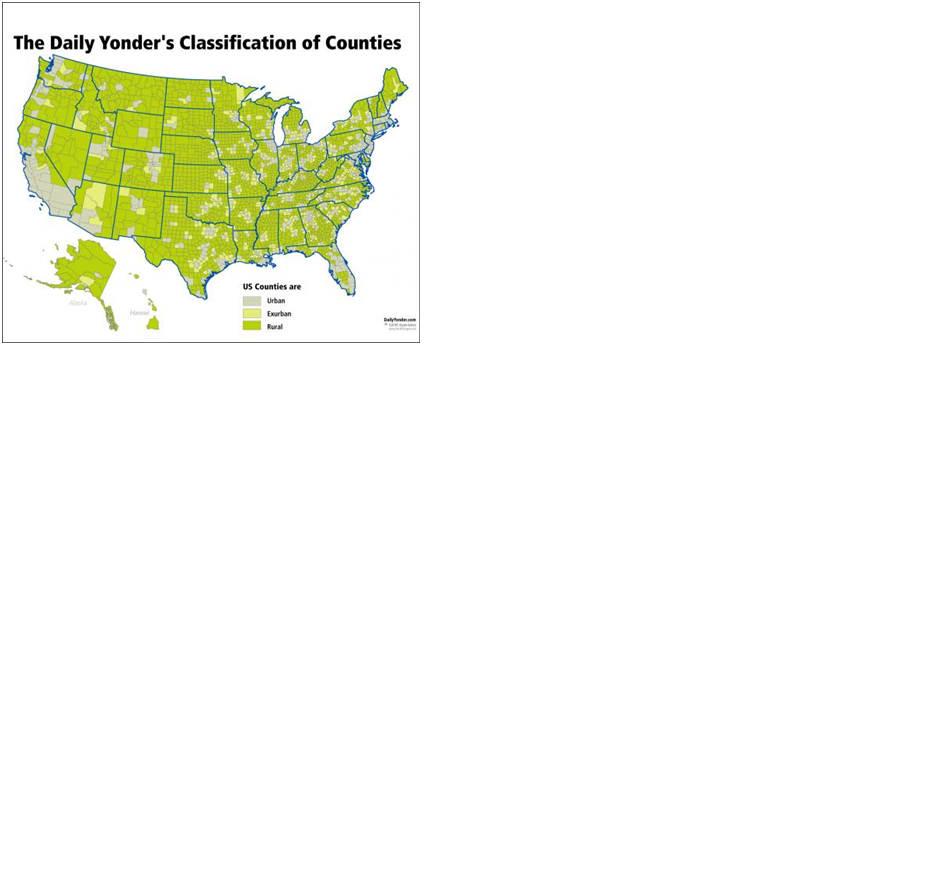
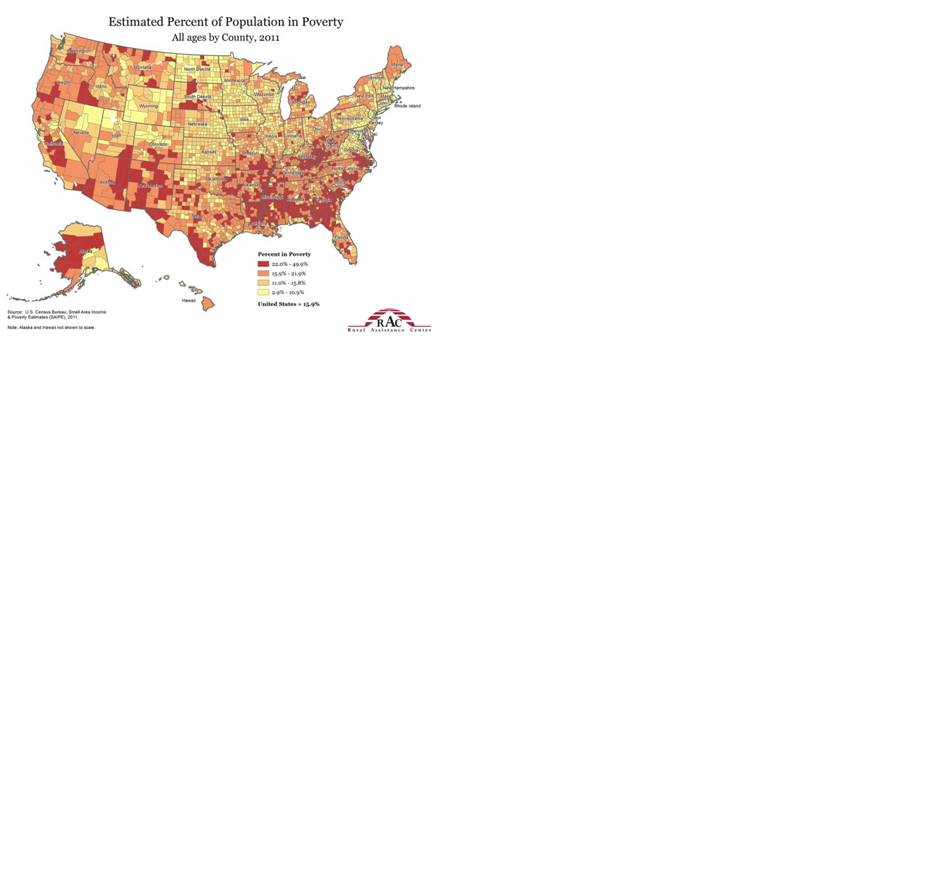
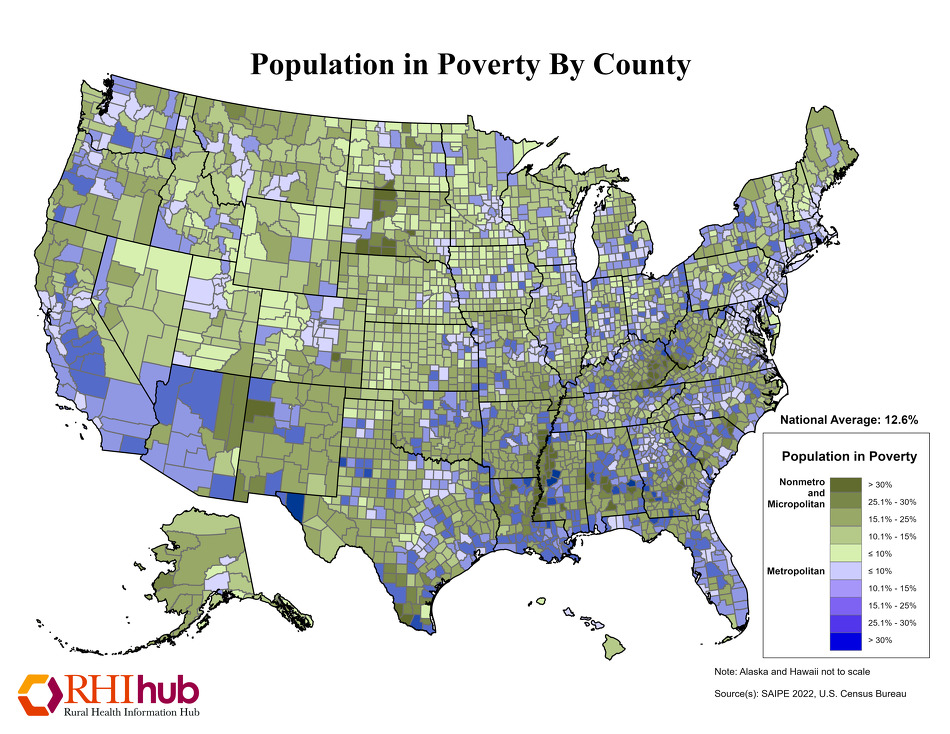
First let’s look at where these rural counties are.  Figure 1 is a map from www.dailyyonder.com  that shows (in green) the rural counties in the US.  Wikipaedia shows the 100 lowest income counties in Figure 2.  For the most part, these counties are rural, with the exceptions being a few areas in south Texas and in the Albuquerque/Santa Fe area of New Mexico. Raceonline.com shows the populations in poverty by county.  The red areas are the highest poverty rates.  The red areas in Figure 3 expand Figure 2 to include much of the rural deep south, Appalachia, more of Texas and New Mexico and part of the central valley in California.

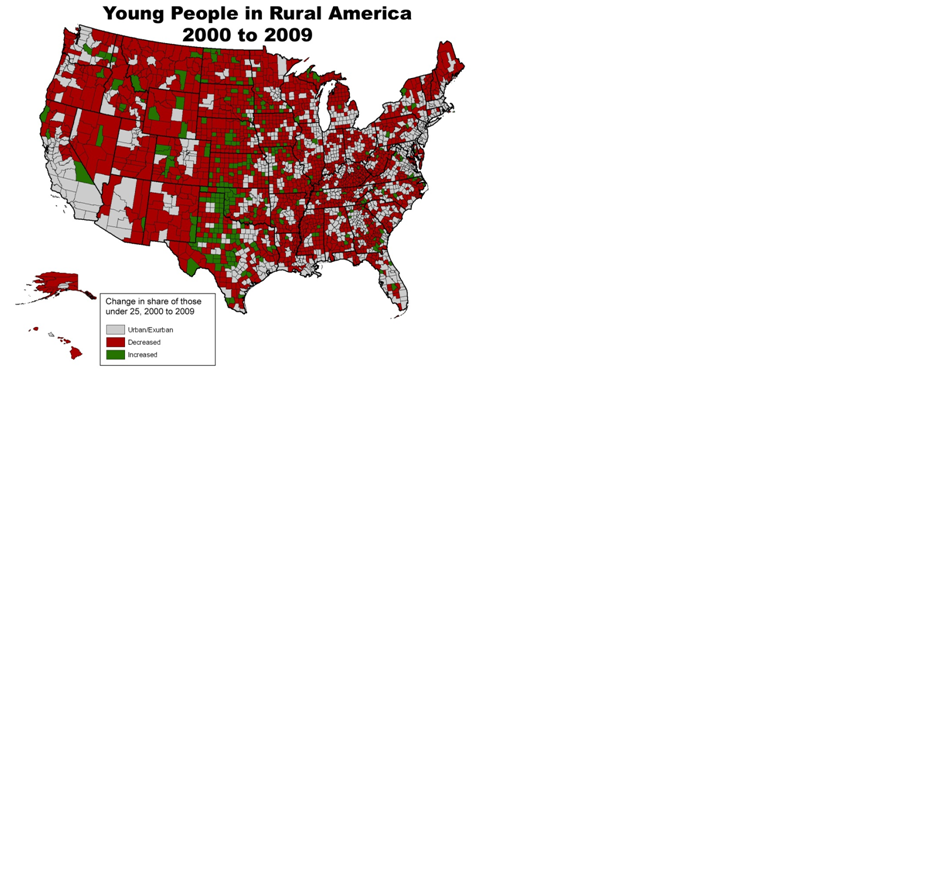
Figure 4 shows how the number of young people has changed between 2000 and 2009 in rural counties (urban counties are white and not included – red means a decrease).  Figure 5 shows population growth (or not) by county. What you see in these two maps is that the young people are moving to the rocky mountain states and vacating the high poverty counties in Figure 3.  Yong people do not see jobs in the rural area – unemployment is 20% higher in rural America and the jobs that are there pay less.  Figures 6 and 7 show unemployment by County in 2008 after the start of the Great Recession and in 2013.  What these figures show is that with exception of the Plains states and Rockies, is that many of the areas with high poverty also had high unemployment, and that the unemployment has remains stubbornly high in many rural areas in the Deep South, Appalachia and New Mexico, plus high unemployment in parts to  the Great Lakes, but the poverty rates are still lower.  Education may by a factor in why the Plains states and Rocky Mountains have less unemployment – despite being rural their students are far more likely to graduate from high school than those in the deep South, Appalachia where unemployment remains high and incomes low. 

So what does this possibly have to do with utilities?  Utilities need to understand this problem as is demands some real, on-the-ground leadership.  Small and rural utilities are more costly to operate per thousand gallons than larger utilities.  A 1997 study by the author showed that economy-of-scale manifested itself to a great extent with water and wastewater operations.  The differences were not close – it is a lot less costly to operate large utilities vs small ones.  Rural utilities complicate the issue further because not only is the number of customers limited, but the pipe per customer is less so the capital investment per customer is far higher than in urban areas.  The impact is that utilities are under pressure to reduce rates to customers, or create a set of lower cost rates for those in poverty, while at the same time their costs are increasing and infrastructure demands are incrementally higher than their larger neighbors.  The scenario cannot be sustained, especially when large portions of rural infrastructure was installed with FHA grants, meaning the customers never paid for the capital cost in the first place.  There was no or lower debt, than what larger utility customers have.  The rural rates since these investments have been set artificially lower than they should as a result. But with Congress talking about reducing SRF and FHA programs, FHA is unlikely to step in to replace their initial investment, meaning that the billions of rural investment dollars that will be needed in the coming years will need to be locally derived, and rate shock will become a major source of controversy in areas that are largely very conservative politically and tend to vote against projects that will increase costs to them.

The good news is that much of the rural infrastructure may be newer when compared to much of the urban infrastructure.  So there is time to build the argument that local investment is needed.  The community needs to be engaged in this discussion sooner as opposed to when problems occur.  Saving for the infrastructure may be the best course since rural utilities will have limited access to the borrowing market because of their size, but that means raising rates now and keeping those saved funds as opposed to using them to deer rate increases.  If ongoing efforts in the House deplete federal funding further, the pinch will be felt sooner by rural customers who will lose the federal dollars from SRF and FHA programs. 


Image

Figures 1 – Rural Counties

The United States: By Rural, Urban and Exurban Counties


Image


Figure 2.  100 lowest income Counties in the US


http://en.wikipedia.org/wiki/List_of_lowest-income_counties_in_the_United_States


Image

Figure 3.  Estimated population in poverty

http://www.raconline.org/racmaps/mapfiles/poverty.jpg


Image

Figure 4.  Where the Young People Are

http://www.raconline.org/maps/topic_details.php?topic=55


Image


Figure 5.  Where people are moving to http://www.raconline.org/maps

Image


Figure 6  Unemployment 2008

http://en.wikipedia.org/wiki/Unemployment

Image

Figure 7  Unemployment 2013 http://www.huduser.org/portal/pdredge/pdr_edge_featd_article_040


A recent article in the South Florida SunSentinel newspaper raised an interesting question.  What they did was line up all the cities in the county and identify the total fees paid to the City by residents.  They took the tax rates, plus water, sewer, storm water, fire, garbage and any other fees.  The article raised an interesting question.  For example, Hollywood, West Park and Lauderdale Lakes had the highest cost per household – in excess of $3500/year.  The other end of the spectrum was Hillsboro Beach, Sea Ranch Lakes and Southwest Ranches, each under $2000/household.  Of note is that Southwest Ranches provides no water or sewer service (all wells and septic tanks on large lots), so a direct comparison is not really appropriate.  Property taxes were low, but fire fees were really high.  Sea Ranch Lakes is a tiny community with no sewer, so again, not really a good comparison.  Hillsboro Beach is among the wealthiest communities, but also tiny. 

 Most communities had total fees between $2100 and 3200/resident.  Why the difference? First, the value of property varies widely.  West Park and Lauderdale lakes have among the lowest values per household, so their taxes must be higher to provide the same level of service.  Hollywood, and Dania Beach (#4 on the list) had higher water, sewer and storm water costs.  While both have recent, ongoing infrastructure programs, both have large transfers from the water and sewer fund to the general fund, and in both cases the water and sewer customer base does not match the property tax base.  In Dania Beach’s case, the service area is half the City, so those residents are supporting the property tax funded services at a higher rate than their neighbors.  Hollywood struggled with major budget issues to used water and sewer funds to balance the budget.

The problem that this article did not address, but should have was that where water, sewer and storm water costs were high, what was driving this? Was in infrastructure investments that others simply have yet to make?  That’s ok and the fact that these utilities invested now may be more timing.  If the result is due to transfers to the general fund, that is an entirely different, and somewhat disconcerting problem.  First since the service areas are not the same. There is a fairness issue.  Some residents pay more for the same services.  It means the water and sewer system is not really an enterprise, with rates based on service costs.  Instead it is being used as a tax source.


Why are health care costs increasing so fast?  Did you ever wonder about that?  We keep hearing about how health care costs, Medicare, Medicare, Obamacare are going to bankrupt us, but why is that?  Why are the cots going up so fast?  It is an important challenge for local officials and utilities who generally pay the health insurance costs for their workers.  There is more to the story that we are not being told.

One problem that get identified quickly is that only 80% of the population is included in the health care system.  Many who are not are “healthy” young people who don’t demand the services.  The concept of the health care bill was to solve this problem by spreading the costs of health care across the entire population using private and public providers.  First, I think there are way more unhealthy  people included in the 20% than we realize because the political dialogue keeps focusing on the few that want to live off the grid – I feel great so I don’t need insurance.  That guy is part of the problem.  That guy gets into a car accident, gets taken to a public hospital, gets treated, gets a bill for $26,000 to fix his broken leg, refuses to pay anything, and the taxpayers get stuck with the bill.  My solution to that guy is if you don’t want to pay for health insurance, bring cash.  Otherwise, “no soup for you!” to paraphrase a famous Seinfeld episode.  Of course my doctor, nurse and therapy friends think that’s a little cold hearted. 

The next argument is the cost of doctors, therapists and nurses.  Okay, I know a bunch of them, and that’s not where the money goes.  These people have lost money in the past 10 years.  Many are going form full-time to part-time employments as Medicare, Medicaid and health insurance bureaucrats decide services are no longer needed.  They will tell you the major change in their lives is paperwork….hold that thought for a moment.

The cost of drugs comes up.  Medicare and Medicare are the largest purchasers of pharmaceuticals in the world.  So in other works, they set the lowest price by supposedly bidding the “contracts” for services. Only there is often only one provider, so exactly how does that work?   Sounds like we don’t get a good deal there, which is why the arguments for importing Canadian drugs or drugs from Mexico keeps popping up.  They get a better deal than we do and most of these are supposedly AMERICAN companies.  No home town discount (I guess I know where free agent baseball players get the idea).   And my medical friends confirm this as an issue.  Check out the comments from Mr. Falloon at Life Extension (www.lef.org) for discussion. 

So let’s go back to the paperwork discussion.  Once upon a time doctors simply sent a little paperwork to the health insurance company or the federal government and said you needed some service.  And the insurance company processed the bill for the services.  The cost was paid by insurance premiums collected by the insurance company.  Everyone was happy.  But then someone at an insurance company said, “wait we could make more money if we asked more questions and paid less for these services.  It would help our bottom line.”  So you hear the complaint that the folks at the insurance companies are deciding whether you need that procedure or not.  And contractors decide if someone needs Medicare or Medicaid services, not the government, not your doctor, your nurse or your therapist.  Not any person that knows you, but some unseen, private sector bureaucrat who’s goal is to minimize the amount of your premium spent on services so they can enhance their bottom line.  And apparently they are very effective because the health insurance industry is very lucrative.  So maybe we have stumbled onto something here.  Maybe the cost of medical coverage is more related to drugs and bureaucracy (and it is not government bureaucracy!!) than the actual cost of services.  Maybe the old system, even if there was some fraud in it, wasn’t nearly as bad as it was made out to be.  It reminds me of one of the 4 laws of City management I developed years ago:  Never give elected officials a bad alternative – it becomes a magnet.  It always worked (hence a law).  I didn’t learn why until years later when I realized, that the worst option was the one all the lobbyists lobbied for even at the local level.  It was the option where they could make the most money “fixing