Archive

Tag Archives: water and sewer


We all know that our infrastructure is deteriorating.  Deferred maintenance increases the risk of system failure. The need for capital reinvestment within the utility industry has historically been very low. As a result, in its “2013 Report Card for America’s Infrastructure,” the American Society of Civil Engineers assigned a grade of “D” to America’s drinking water systems, citing billions of dollars of annual funding shortfalls to replace aging facilities near the end of their useful lives and to comply with existing future federal water regulations (ASCE, 2013).  AWWA estimates that investments of at least $1 trillion are needed over the next 25 years.

While a pay-as-you-go capital funding seems like the best way to go, that is difficult to accomplish with the large outlays needed to upgrade the infrastructure system and the controls on rates often exercised by local officials.  As a result, borrowing is required and the condition of infrastructure and the lack of reserves are a part of how the utility is viewed by those who lend monies.   Utility managers need to understand how the lending agencies evaluate risk. 

Lenders use many tests.  Among them are: whether the utility’s annual depreciation expense is used of accumulated as reinvestment in the system, whether adequate reserves are present, whether  annual capital spending that is below the amount of annual depreciation and the amount of revenues in excess of projected debt (debt service coverage).  The target debt service coverage may depend upon the requirements of the underwriter, the rating agencies and the investors.  Debt service coverage could be as low as 15% or as high as 50%.  In 2012, the median all-in annual debt service coverage excluding connection fees for utilities rated “AAA” by Fitch Ratings was 220%, while the median for AA-rated and A-rated utilities was 180% and 140%, respectively. (Fitch, 2012).  

A working capital target of 90 days of rate revenue is a minimum, but since 2008, more is likely to be required depending on the size of the system and the history of revenues.  Where the revenues were stable despite 2008, less may be required.  For those utilities that suffered major decreases, reserves should be far larger – perhaps a year or more.  Other criteria that could be used to evaluate the projects when borrowing money include public health and safety, regulatory compliance, system reliability, the risk and consequences of asset failure, redundancy, community/customer benefit  and sustainability. At the same time, the expectation is that  the utility systems that retain all monies in the system to be utilized to improve the system and pay for debt service, except those used  for the purchase of indirect services from the General Fund that are justified with indirect cost studies. 


Despite the above, rate are an issue.  Fitch Ratings has indicated that it considers rates for combined water and wastewater service that are higher than 2% of the median household income – or 1% for an individual water or wastewater utility – to be financially burdensome (Fitch, 2012).  The Environmental Protection Agency (EPA) considers that rates for an individual water or wastewater utility that are greater than 2% of median household income may have a high financial impact on customers. (EPA, 1997). Utilities with a stronger financial profile might have residential charges for combined water and wastewater service that are less than or equal to 1.2% of median household income, or less than or equal to 0.6% for an individual water or wastewater utility. All revenues generated through system operations generally must remain within the system and can only be used for lawful purposes of the system.

Canadian utilities employ more formal polices to establish fiscal policies to provide reserves to insure stability in the event of unforeseen circumstances. Reserve targets focus on ensuring liquidity in the event there is an interruption in funding, increased capital costs due to new regulatory requirements or a short term funding emergency – all the issues evaluated by the bankers.  Reserve targets are policy decisions. Benchmarking is an evolving practice within Canadian public sector utilities particularly as it relates to financial planning and capital financing. The benchmarking exercise provides valuable information to help assess fiscal performance, the needs of customers, and provide the tools to help support optimum performance. 


We have spent some time talking about the need to fund and maintain reserves.  I think most people reading this concur but how do you track reserves?  Every public sector utility gets audited annually.  How many people have actually looked at that audit?  Or attend the discussion with the elected officials with the auditors.  Or know how to read it?  This is an important part of our job.  We need to defend the utility and knowing the financial position is part of the defense. 

The annual audit is commonly called the Comprehensive Annual Financial Report of CAFR.  The finance director normally controls the process.  The CAFR is many, many pages long and include information on revenues and expenses, but also a bunch of other things like assets, depreciated assets, transfers to other funds, outstanding long and short term debt, fund balance and reserves.   The CAFR is designed to be a management tool to help with tracking performance of the entity with time.  CAFRs were redesigned by the Governmental Accounting Standards Board (GASB) about 15 years ago to provide more useful information to lenders and oversight agencies.  It was redesigned to help with management, discussion and analysis of the financial position.  The utility director should be a part of this management, discussion and analysis team and should fully understand its contents as it affects the utility. The CAFR should not be viewed simply as a compliance tool to submit and forget about. 

For example, the assets should include the value of all installed infrastructure (fixed) and all mobile equipment (non-fixed) as assets.  The depreciation is the total amount of depreciation, assigned as a straight line, since the acquisition of the assets.  You should always have more than 50% of the asset value remaining.  You should understand outstanding debt and debt plus depreciation should be less than your asset values, otherwise you are underwater with your assets.  You should understand the transfers to other funds and the justification for same.

But the reserves are key.  Some of these reserves may be restricted, which means they are likely impact fees, reserves to cover debt coverage requirements or covenants for repair and replacement of other purposes.  Most utilities do not have a separate repair and replacement reserve, but this would be useful for those capital expenses,  Likewise, operating reserves, for use to balance the budget in lean periods should be identified.  The reporting reserves for rate stabilization should be separate from the operating reserves (usually 1.5 to 3 months) to cover the day-to-day expenses.  An understanding of the value and tracking of these reserves is useful to long and short term decision making by utility managers.  Unfortunately most auditors and most finance director do not make separate reserves and tracking becomes a challenge.  But the utility is an operating entity.  Finance, like purchasing and human resources and support agencies designed to provide service to help accomplish the mission of the operating elements of the utility.  You need the support agencies to provide the necessary information to help your decision-making.  Doubtful your finance director wants to hear this, but really, does the utility operate because the finance department does the work or because the utility does?  Just food for though.

As water and sewer utilities, the public health and safety of our customers is our priority – it is both a legal and moral responsibility. The economic stability and growth of our community depends on reliable services or high quality. The priority is not the same with private business. Private businesses have a fiduciary responsibility to their stockholders, so cutting services will always be preferred to cutting profits. Therein lies the difference and yet the approach is different. Many corporations retain reserves for stability and investment and to protect profits. Many governments retain inadequate reserves which compromises their ability to be stable and protect the public health and safety. Unlike corporations, for government and utilities, expenses are more difficult to change without impacting services that someone is using or expects to use or endangering public health. Our recent economic backdrop indicates that we cannot assume income will increase so we need to reconsider options in dealing with income (revenue) fluctuations. If there are no reserves, when times are lean or economic disruptions occur (and they do regularly), finding funds to make up the difference is a problem. The credit market for governments is not nearly as “easy” to access as it is for people in part because the exposure is much greater. If they can borrow, the rates may be high, meaning greater costs to repay. Reserves are one option, but reserves are a one-time expense and cannot be repeated indefinitely. So if your reserves are not very large, the subsequent years require either raising taxes/rates or cutting costs. An example of the problem is illustrated in Figure 1. In this example the revenues took a big hit in 2009 as a result of the downturn in the economy. Note it has yet to fully return to prior levels as in many utilities. This system had accumulated $5.2 million in reserves form 2000-2008, but has a $5.5 million deficit there after. Reserves only go so far. Eventually the revenues will need to be raised, but the rate shock is far less if you have prudently planned with reserves. You don’t get elected raising rates, but you have a moral responsibility to do so to insure system stability and protection of the public health. So home much is enough for healthy reserves? That is a far more difficult question. In the past 1.5 months of operating reserves was a minimum, and 3 or more months was more common. However, the 2008-2011 economic times should change the model significantly. Many local governments and utilities saw significant revenue drops. Property tax decreases of 50% were not uncommon. It might take 5 to 10 years for those property values to rebound so a ten year need might be required. Sales taxes dropped 30 percent, but those typically bounce back more quickly - 3-5 years. Water and sewer utilities saw decreases of 10-30%, or perhaps more in some tourist destinations. Those revenues may take 3-5 years to rebound as well. Moving money from the utility to the general fund, hampers the situation further. Analysis of the situation, while utility (government) specific, indicates that appropriate reserves to help weather the economic downturns could be years as opposed to months. The conclusion is that governments and utilities should follow the model of trying to stabilize their expenses. Collect reserves. Use them in lean times. Develop a tool to determine the appropriate amounts. Educate local decision-makers and the public. Develop a financial plan that accounts for uncertainty and extreme events that might impact their long-term stability. Take advantage of opportunities and most of all be ready for next time. In other words, plan for that rainy day.


A number of years ago I had the pleasure of speaking with archeaologist Bryan Fagan for an hour or so before a presentation he gave at a conference.   Dr. Fagan is a modern-day Indiana Jones, who has been all over the world studying ancient ruins.  Dr. Fagan expressed his career as “50 years of studying drainage ditches,” but with studying drainage ditches he could provide you with the rise and fall of civilizations through history.  His book Elixir outlines a number of these civilizations:  Egyptian, Babylonia, Southeast Asia, and even the American West.  His findings were that the civilization expended as far as infrastructure could be constructed to allow water to flow to where it was needed, whether that was Alexandria or Ur.  Later civilizations expanded and developed as technology allowed water to flow further.  Rome demonstrated that water could be moved with more than ditches, which would have been a severe limitation for Rome and other civilizations based in dry areas with topography.  The Romans constructed extensive tunnels and aqueducts to supply Rome with water from mountains to the east and north. A recent article noted that we probably know about 20% of the Roman tunnel system as we keep discovering more of it each year – tunnels lost in the Dark Ages after the fall of Rome.  Dr. Fagan notes that it was access to water that allowed human civilizations to develop and evolve.  It is why a number of engineering organizations like Water for People and Engineers Without Borders focus their efforts on providing access to clean water to people in Third World countries.  It is their only way to get to the modern world.  All other infrastructure:  roads, major buildings, etc., result from the access to clean water that allows people to be healthy and productive.

So if civilization rises and falls with access to water, why is it so hard to get public officials to fund water supply and rehabilitation projects?  We talk of an infrastructure crisis in the United States because our average water and sewer infrastructure systems are working on 50 years old and deterioration is evident.  We have many mid-western communities with water, but no customers to pay for deteriorating infrastructure (Detroit), and southeastern utilities that have lost factories that supported the bulk of their utility, and insufficient growth in the customer base to deal with operations and maintenance.  As a result, outages and breaks occur more frequently, costing more money to repair, but under the auspices of maintaining rates, the revenues do not increase to support the needed repairs. 

At least the southeast has surface supplies, albeit perhaps limited, which constrains growth (Atlanta), but our fastest growth often occurs in areas we know have limited precipitation, like a lot of the American West.  Yet somehow we expect groundwater sources that do not recharge locally, to sustain the community indefinitely without disruption – ignoring the fact that history tells us communities cease to function when water supplies are exhausted.  USGS identified many areas that have long-term permanent declines in aquifers as a result of pumpage for agricultural and community uses.  No one raises the question about the aquifer levels – permits get issued, but little data is gathered and very limited plans are available in most places to deal with the declines.  And no one raises a question about aquifer levels because stopping growth to deal with water supplies is not in conformance with the desire to grow, which is required to support additional services demanded by the community. 

No one questions how to secure the water either, much of which has been “created” by federal tax dollars spend over 50 years ago during the era of great dam building (1920-1960).  However, as these systems and populations age, the concern about costs will continue to engender discussion.  And hand wringing.  Water costs money.  Water creates civilization and sustains it.  When we take it for granted, it becomes all too easy to fall behind the proverbial “eight-ball,” and the system crashes.  It is a testament to the utility personnel – the managers, engineers and operators – that these systems continue to operate as they do.  But bailing wire and duct tape only go so far.  We need to develop a frank discussion about the need to infuse funds – local, federal, state and private – into addressing our infrastructure needs.  The dialog needs to commence sooner, as opposed to after failure. 


We get to start the new semester this week.  The economy is looking up in Florida.  Unemployment is down, although the job growth appears to be mostly minimum wage jobs.  So it is useful to look at last semester’s graduates and see how they are doing.  The good news is they are getting jobs.  In fact our seniors mostly have jobs or internships and none of them are minimum wage jobs.  Excellent news, but let’s look at the new graduates and the workplace. 

A lot of our assumptions about the workplace will change in the 21st century.  The workplace at the “office” is less necessary and younger workers are more comfortable working outside the office environment.  They may be more productive than 20th century managers think they will be because of the side benefits that flex hours allow.  Their entry into the workforce places four generations at work at once:  Traditionalists, Baby Boomers, Gen X, and Gen Y or Millennials.  The latter are the fastest growing segment of the workforce, and are already a larger percent of the workforce than Gen X or Traditionists.  The Traditionalists are retiring and are expected to be under 8 % in 2015.  Gen X and Gen Y will encompass about a third of the workforce going forward.

All of these groups have different perspectives.  Recent studies indicate the following.  Baby Boomers grew up post-WWII in a time of change and reform.  Some believe they are instruments of change.  They are optimistic, hard-working and motivated by position.  Gen X grew up in an era of both parents working, so are resourceful and hardworking, but not as motivated by position.  They are independent, and prefer to work on their own.  And many are contributing to the way government operates throughout the world. They accept technology as a way to involve others.  The use of online means to solicit feedback in government is particularly a Gen X phenomenon.  Public participation, traditionally are arena where limited public involvement actually occurs except with highly unpopular issues.

Gen Y was born in an era when both parents worked, but in their off-time, the parents spent more focus on the kids.  Think of no winners or losers in sports, but at the same time they have had unprecedented access to technology and are often well ahead of their work mates with respect to the use of tools in the workplace.  But, they are resourceful and can easily overcome technology barriers in the workplace. They care about their image and the world around them.  We can use that to implement change.

However, Gen Y is facing a workplace that clearly has winners as well as some skepticism about technology.  While we can expect some difficulties, it is up to the Gen X and Baby Boomers to help Gen Y make the transition. They have fresh viewpoints as they have had to be creative to get ahead.  Just doing things “the same old way,” doesn’t cut it.  I actually find this refreshing and a positive challenge to me because I use these challenges to go back of evaluate what my thinking was (or is).  We need to embrace this perspective and channel their energy and independence to solving today’s problems. 

We need to help them acclimate to the business world, while understanding that their motivations are not the same as Dan Pink notes in his book “Drive.”  We need new ideas and perspectives while welcoming them to the workplace.  That is how we improve productivity, product new ways to work, and develop new tools.  We need all of these in the utility industry as we need better ways to upgrade infrastructure and deliver our services.

There is a lot of talk about the difficulties that Gen Y is having getting jobs.  They often lack experience, but how do you get experience if no one hires you.  It is circular logic and we have all been there. 

We need to give the kids a chance.  I see a lot of potential in our graduates, nearly all of whom are Gen Y.  I see many who are hard working and know how to find answers to their questions.   They are far better prepared than many think.  We get comments all the time about how good our students are.  That is good, because the truth is, especially in the engineering and utility world, the Gen Y workforce does not understand why things were done a certain way in the past, nor why they should remain that way.  I actually find this refreshing and a positive challenge to me because I use these challenges to go back of evaluate what my thinking was (or is).  We need to embrace this perspective and channel their energy and independence to solving today’s problems.  They offer fresh ideas – and don’t necessary understand why.  That’s ok.  Long-term engineering graduates will make contributions to our water, sewer and other infrastructure. 


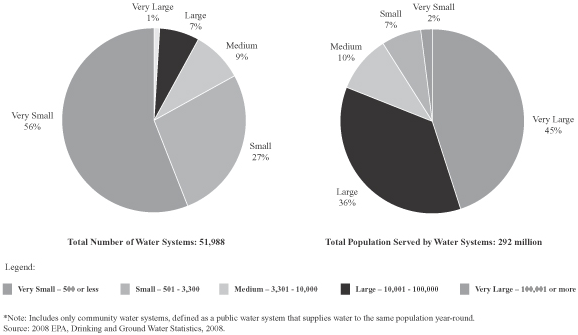
In the last blog I talked about the challenge to rural utilities, many of which serve relatively few people and have used federal monies to pay for a lot of their infrastructure.  In this blog we will take a look at the trends for community water systems which are defined as systems that serve at least 15 service connections or serve an average of at least 25 people for at least 60 days a year. EPA breaks the size of systems down as follows:

  • Very Small water systems serve 25-500 people
  • Small water systems serve 501-3,300 people
  • Medium water systems serve 3,301-10,000 people
  • Large water systems serve 10,001-100,000 people
  • Very Large water systems serve 100,001+ people

Now let’s take a look at the breakdown (from NRC 1997).  In 1960, there were about 19,000 community water utilities in the US according to a National Research Council report published in 1997.  80% of the US population was served.  in 1963 there were approximately 16,700 water systems serving communities with populations of fewer than 10,000; by 1993 this number had more than tripled—to 54,200 such systems. Approximately 1,000 new small community water systems are formed each year (EPA, 1995). In 2007 there were over 52,000 community water systems according to EPA, and by 2010 the number was 54,000.  85% of the population is served. So the growth is in those small systems with incidental increases in the total number of people served (although the full numbers are more significant). 


TABLE 1 – U.S. Community Water Systems: Size Distribution and Population Served


Number of Community Systems Serving This Size Community a

Total Number of U.S. Residents Served by Systems This Size b>

Population Served

1963

1993

1963

1993

Under 500

5,433 (28%)

35,598 (62%)

1,725,000 (1%)

5,534,000 (2%)

501-10,000

11,308 (59%)

18,573 (32%)

27,322,000 (18%)

44,579,000 (19%)

More than 10,000

2,495 (13%)

3,390 (6%)

121,555,000 (81%)

192,566,000 (79%)

Total

19,236

57,561

150,602,000

242,679,000

a Percentage indicates the fraction of total U.S. community water supply systems in this category.

b Percentage is relative to the total population served by community water systems, which is less than the size of the U.S. population as a whole.

SOURCES: EPA, 1994; Public Health Service, 1965.


Updating these numbers, there are over 54,000 systems in the US, and growth is almost exclusively in the very small sector.  93% are considered to be small or very small systems—serving fewer than 10,000 people. Even though these small systems are numerous, they serve only a small fraction of the population. Very small systems, those that serve 3,300 people or fewer make up 84 percent of systems, yet serve 10 percent of the population.  Most critical is the 30,000 new very small systems that serve only 5 million people (averaging 170 per system).  In contrast, the very large systems currently serve 45% of the population.  Large plus very large make it 80%.  The 800 largest systems (1.6%) serve more than 56 percent of the population. 900 new systems were added, but large systems served an additional 90 million people.

What this information suggests if that the large and very large sector has the ability to raise funds to deal with infrastructure needs (as they have historically), but that there may be a significant issue for smaller, rural system that have grown up with federal funds over the past 50 years.  As these system start to come to the end of their useful life, rural customers are in for a significant rate shock. Pipeline average $100 per foot to install.  In and urban area with say, 60 ft lots, that is $3000/household.  In rural communities, the residents may be far more spread out.  As an example, a system I am familiar with in the Carolinas, a two mile loop served 100 houses.  That is a $1.05 million pipeline for 100 hours or $10,500 per house.  With dwindling federal funds, rural customers, who are already making 20% less than their urban counterparts, and who are used to very low rates, that generally do not account for replacement funding, will find major sticker shock. 

This large number of relatively small utilities may not have the operating expertise, financial and technological capability or economies of scale to provide services or raise capital to upgrade or maintain their infrastructure.  Keep in mind that small systems have less resources and less available expertise.  In contrast the record of large and very large utilities, EPA reports that 3.5 percent of all U.S. community water systems violated Safe Drinking Water Act microbiological standards one or more times between October 1992 and January 1995, and 1.3 percent violated chemical standards, according to data from the U.S. Environmental Protection Agency (EPA).. 

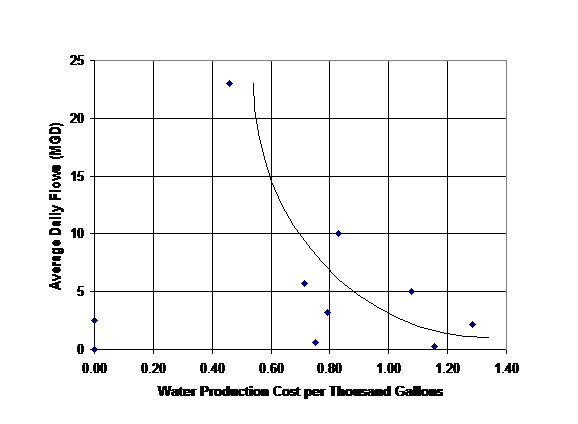
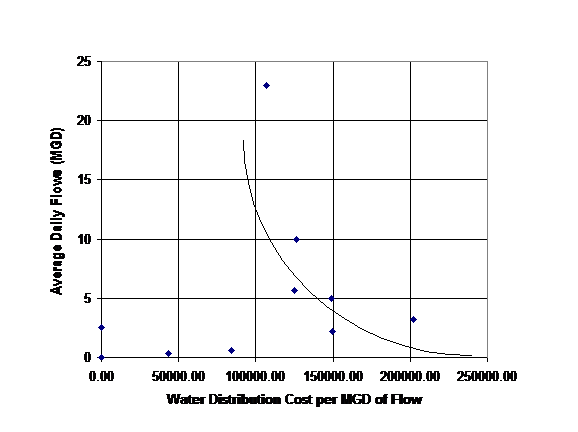
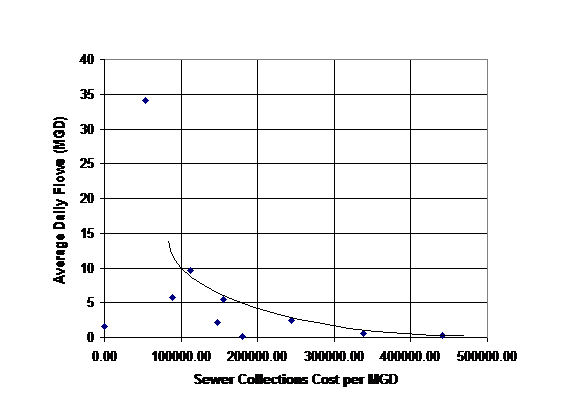
EPA and professionals have long argued that centralized infrastructure for water and sewer utilities makes sense form an economy of scale perspective.  Centralized drinking water supply infrastructure in the United States consists dams, wells, treatment plants, reservoirs, tanks, pumps and 2 million miles of pipe and appurtenances.   In total this infrastructure asset value is in the multi-trillion dollar range.  Likewise centralized sanitation infrastructure in the U.S. consists of 1.2 million miles of sewers and 22 million manholes, along with pump stations, treatment plants and disposal solutions in 16,024 systems.  It is difficult to build small reservoirs, dams, and treatment plants as they each cast far more per gallon to construct than larger systems.  Likewise operations, despite the allowance to have less on-site supervision, is far less per thousand gallons for large utilities when compared to small ones.  The following data shows that the economy-of-scale argument is true:

  • For water treatment, water distribution, sewer collection and wastewater treatment, the graphics clearly demonstrated the economy-of-scale of the larger utility operations versus small scale operations (see Figures 2-5). 
  • The administrative costs as a percentage of the.total budget parameter also demonstrated the economy-of-scale argument that larger utilities can perform tasks at a lesser cost per unit than the smaller utilities (see Figure 6).

Having reviewed the operations costs, the next step was to review the existing rates.  Given the economy-of-scale apparent in Figures 2 to 6, it was expected that there would be a tendency for smaller system to have higher rates.  Figures 2-6 demonstrate this phenomena. 

So what to do?  This is the challenge.  Rate hikes are the first issue, a tough sell in areas generally opposed to increases in taxes, rates and charges and who use voting to impose their desires.  Consolidation is anothe5r answer, but this is on contrast to the independent nature of many rural communities.  Onslow County, NC  figured out this was the only way to serve people efficiently 10 years ago, but it is a rougher sell in many, more rural communities.  Infrastructure banks might help, the question is who will create them and will the small system be able to afford to access them.  Commercial financing will be difficult because there is simply not enough income to offset the risk.  The key is to start planning now for the coming issue and realize that water is more valuable than your iPhone, internet, and cable tv.  In most cases we pay more for each of them than water (see Figure 7).  There is something wrong with that…

 Image


Figure 1  Breakdown of Size of Systems

Image


Fig 2 Cost of Water Treatment

Image


Fig 3 Cost of Water Distribution

Image


Fig 4 Cost of Sewer Collection

Image


Fig 5 Cost of Sewer Treatment

Image

Fig 6 Cost of Administration as a percent of total budget


Image

FIgure 7 Water vs other utilities


Several weeks ago we looked at the phenomenon of population, income, education and unemployment.  The impact to from the combination of these factors in certain communities can be difficult.  Let’s explore a little further as there is more, interesting data every day.  The US Department of Agriculture is releasing its report of rural America.  The findings are interesting and counter-intuitive to the understanding of voters in many of those communities.  Their findings include:

  • The rural areas grew 0.5 % vs 1.6% in urban areas from mid-2011-mid 2012
  • Rural incomes are 17% lower than urban incomes.
  • The highest income rural works (95th percentile) earn 27% less than their urban counterparts
  • 17.7% of rural constituents live in poverty vs 14.5% in urban areas
  • 80% of the high poverty rate counties were rural
  • All the high income counties are urban.

Wow!  So the ghetto has move to the country? According to these statistics there is truth in that statement.  Let’s look a little further using some on-line mapping. 

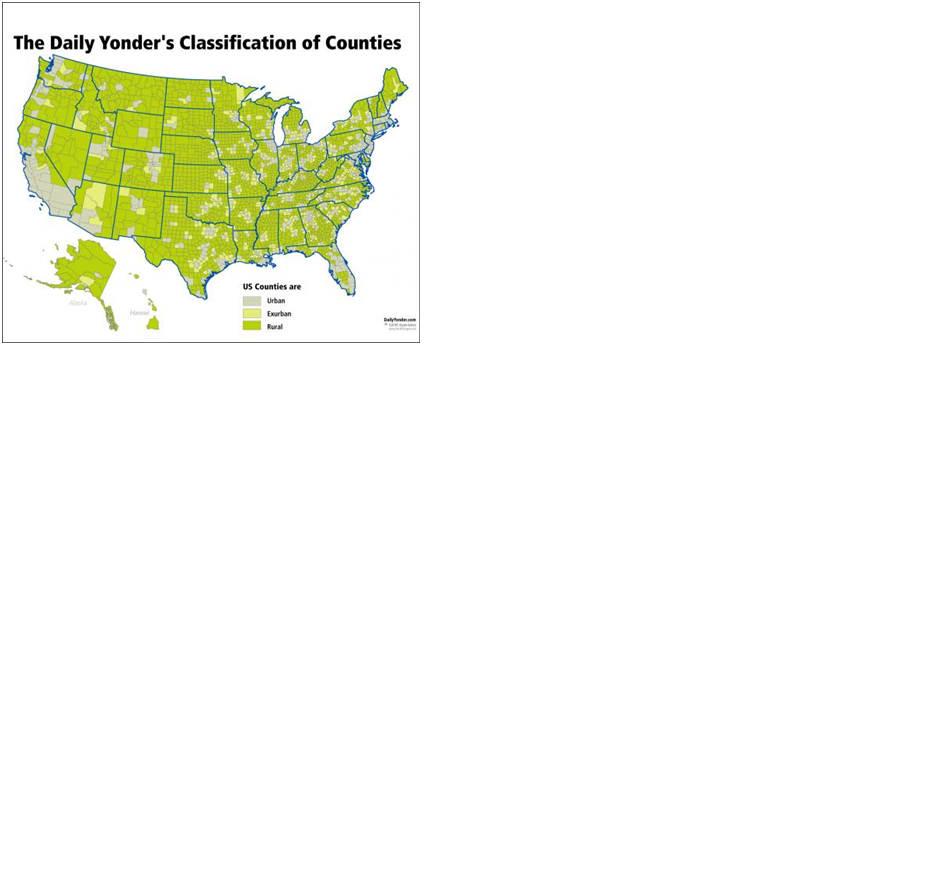
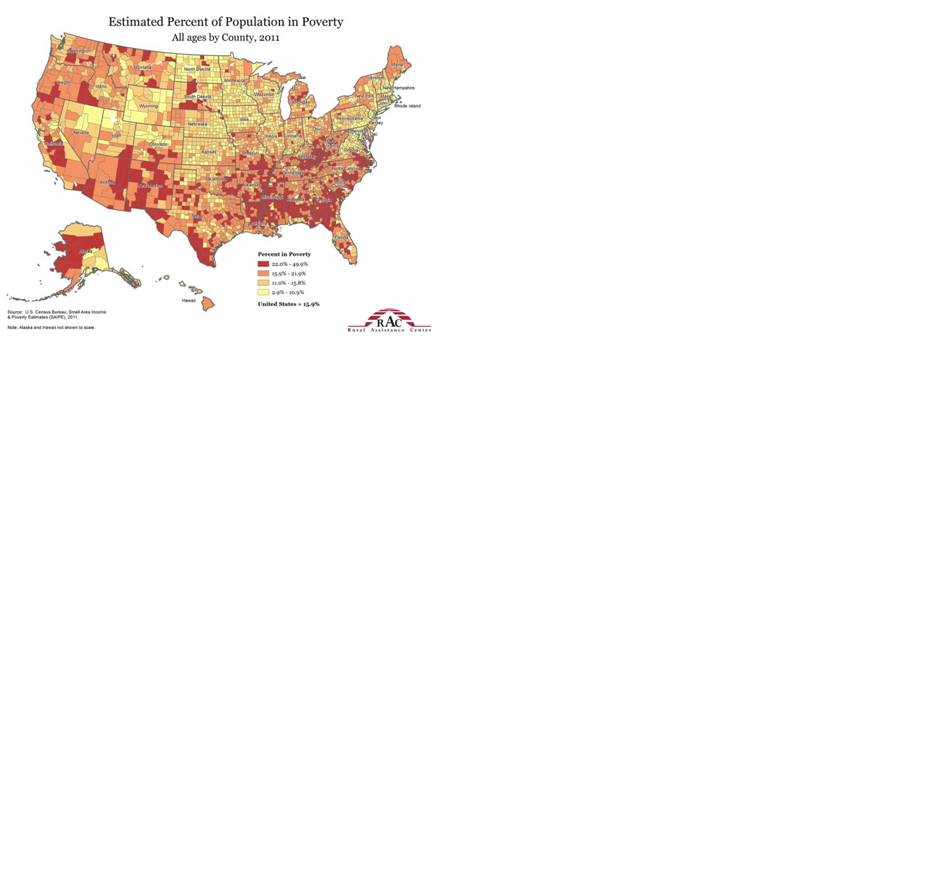
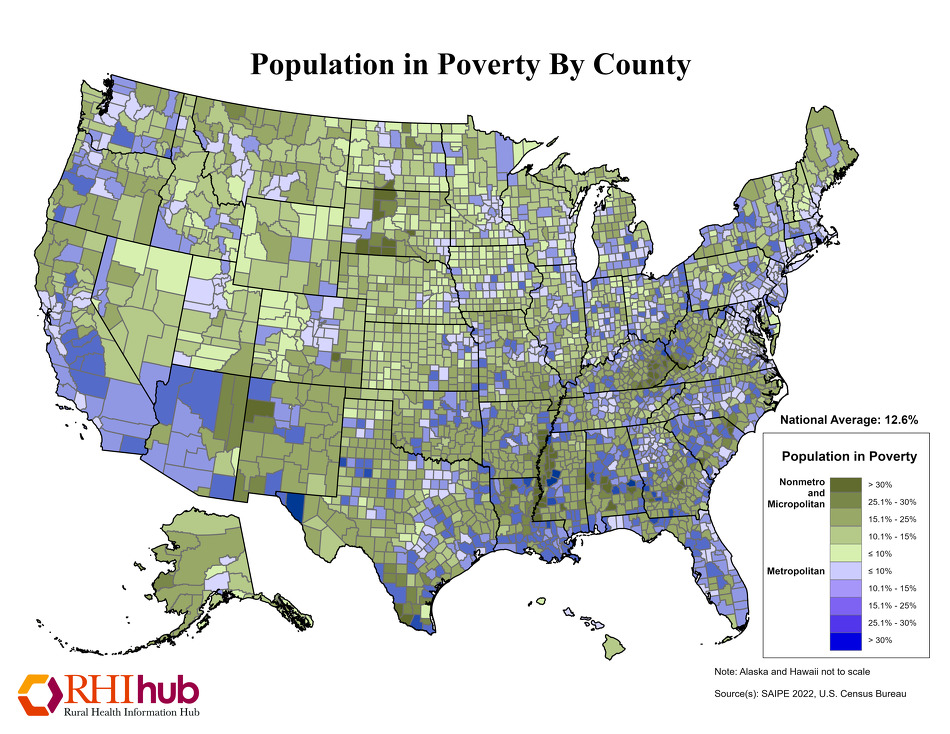
First let’s look at where these rural counties are.  Figure 1 is a map from www.dailyyonder.com  that shows (in green) the rural counties in the US.  Wikipaedia shows the 100 lowest income counties in Figure 2.  For the most part, these counties are rural, with the exceptions being a few areas in south Texas and in the Albuquerque/Santa Fe area of New Mexico. Raceonline.com shows the populations in poverty by county.  The red areas are the highest poverty rates.  The red areas in Figure 3 expand Figure 2 to include much of the rural deep south, Appalachia, more of Texas and New Mexico and part of the central valley in California.

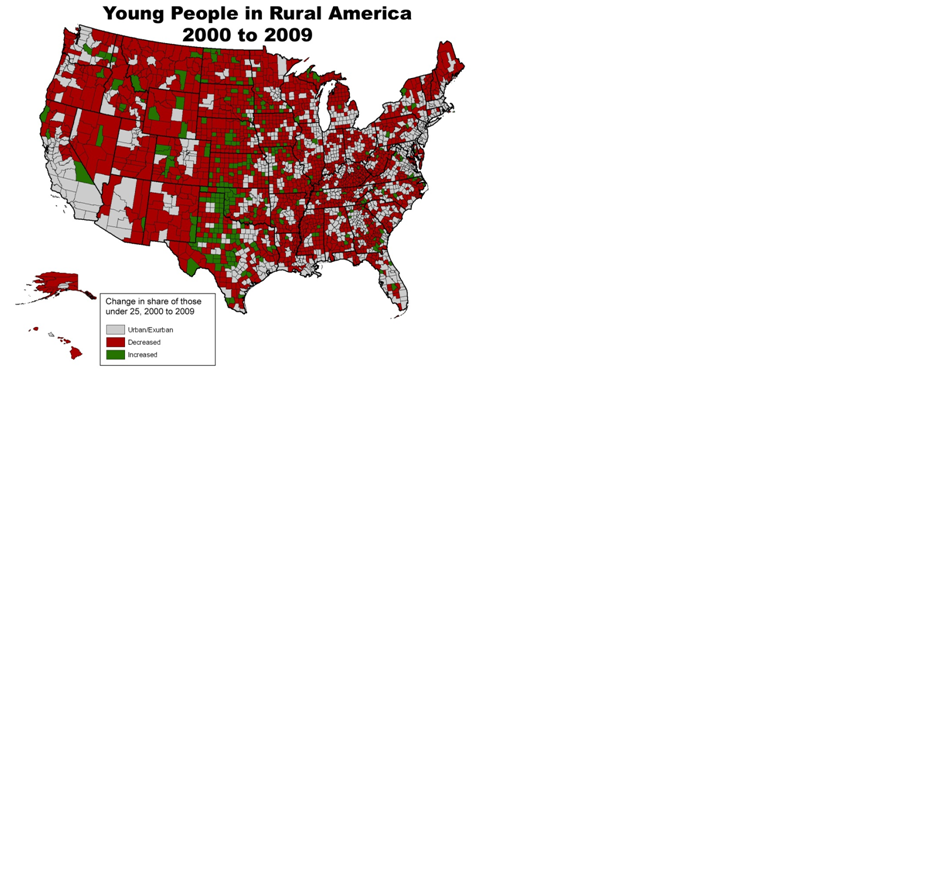
Figure 4 shows how the number of young people has changed between 2000 and 2009 in rural counties (urban counties are white and not included – red means a decrease).  Figure 5 shows population growth (or not) by county. What you see in these two maps is that the young people are moving to the rocky mountain states and vacating the high poverty counties in Figure 3.  Yong people do not see jobs in the rural area – unemployment is 20% higher in rural America and the jobs that are there pay less.  Figures 6 and 7 show unemployment by County in 2008 after the start of the Great Recession and in 2013.  What these figures show is that with exception of the Plains states and Rockies, is that many of the areas with high poverty also had high unemployment, and that the unemployment has remains stubbornly high in many rural areas in the Deep South, Appalachia and New Mexico, plus high unemployment in parts to  the Great Lakes, but the poverty rates are still lower.  Education may by a factor in why the Plains states and Rocky Mountains have less unemployment – despite being rural their students are far more likely to graduate from high school than those in the deep South, Appalachia where unemployment remains high and incomes low. 

So what does this possibly have to do with utilities?  Utilities need to understand this problem as is demands some real, on-the-ground leadership.  Small and rural utilities are more costly to operate per thousand gallons than larger utilities.  A 1997 study by the author showed that economy-of-scale manifested itself to a great extent with water and wastewater operations.  The differences were not close – it is a lot less costly to operate large utilities vs small ones.  Rural utilities complicate the issue further because not only is the number of customers limited, but the pipe per customer is less so the capital investment per customer is far higher than in urban areas.  The impact is that utilities are under pressure to reduce rates to customers, or create a set of lower cost rates for those in poverty, while at the same time their costs are increasing and infrastructure demands are incrementally higher than their larger neighbors.  The scenario cannot be sustained, especially when large portions of rural infrastructure was installed with FHA grants, meaning the customers never paid for the capital cost in the first place.  There was no or lower debt, than what larger utility customers have.  The rural rates since these investments have been set artificially lower than they should as a result. But with Congress talking about reducing SRF and FHA programs, FHA is unlikely to step in to replace their initial investment, meaning that the billions of rural investment dollars that will be needed in the coming years will need to be locally derived, and rate shock will become a major source of controversy in areas that are largely very conservative politically and tend to vote against projects that will increase costs to them.

The good news is that much of the rural infrastructure may be newer when compared to much of the urban infrastructure.  So there is time to build the argument that local investment is needed.  The community needs to be engaged in this discussion sooner as opposed to when problems occur.  Saving for the infrastructure may be the best course since rural utilities will have limited access to the borrowing market because of their size, but that means raising rates now and keeping those saved funds as opposed to using them to deer rate increases.  If ongoing efforts in the House deplete federal funding further, the pinch will be felt sooner by rural customers who will lose the federal dollars from SRF and FHA programs. 


Image

Figures 1 – Rural Counties

The United States: By Rural, Urban and Exurban Counties


Image


Figure 2.  100 lowest income Counties in the US


http://en.wikipedia.org/wiki/List_of_lowest-income_counties_in_the_United_States


Image

Figure 3.  Estimated population in poverty

http://www.raconline.org/racmaps/mapfiles/poverty.jpg


Image

Figure 4.  Where the Young People Are

http://www.raconline.org/maps/topic_details.php?topic=55


Image


Figure 5.  Where people are moving to http://www.raconline.org/maps

Image


Figure 6  Unemployment 2008

http://en.wikipedia.org/wiki/Unemployment

Image

Figure 7  Unemployment 2013 http://www.huduser.org/portal/pdredge/pdr_edge_featd_article_040


Graduation is two weeks away for students in the Fall semester.  The good news is that unemployment is down which means more students may find jobs.  We see my students, civil engineers, nearly fully employed for the second straight semester.  That is a good sign that economy is bouncing back. 

Many are being hired by utilities and contractors.  The utilities are starting to spend money after several years of lean revenues.  Unfortunately many of these utilities were lean because their local governments have increased general fund contributions to reduce tax burdens of residents.  Reducing tax burdens by moving more money from utilities to general funds hits the utility twice – infrastructure improvements get delayed and catchup on deferred maintenance mean the hit is double the pay as you go policy.  It is no surprise that our infrastructure condition continues to deteriorate when funds are diverted for other purposes.  Hopefully the trend will reverse, but I am not optimistic. 

Contractor hiring is more interesting.  It seems that contractors are having many of the same issues as utilities have talked about for a number of years:  an aging workforce in the upper levels of the organization.  However the contractors are seeing that young engineers have a skill set not currently existing in many contractor organizations.  Contracting in lean times is a limited profit margin business.  Competing for low bid contracts further limits profits.  However when 40% of the cost for construction is often associated with materials, and 20-25% of materials may be wasted, finding a way to be more efficient can save a lot of money.  Engineers know software and some schools, like FAU, have their students use 3 dimensional (3D) BIM software for their design projects.  The BIM software allows contractors to merge drawings into 3 dimensions, finding conflicts, solving them early and identifying means to reduce materials.  For example, many pieces could be cut out of gypsum board, but often only one is cut.  The rest is tossed.  Saving big on materials creates added profits at the same price.  The benefit is seen as being well worth the cost to contractors.  As more contractors move this direction, more engineers will the hired; a good trend.

The engineering profession should benefit from this change.  As contractors hire engineers, there is the potential for better communication between engineers on contractor teams and design engineers.  The only question is getting the engineering community to adopt the same kind of attitude toward the new software tools like 3D software.  At present, far too many engineers do not believe the risks are reduced sufficiently by the costs of the software.  But adopting new methods for design will help communication with contractors and other engineers.  That communication has a benefit in saving dollars and limiting the potential for claims against design firms when conflicts are found in the design drawings.  We find that establishing a partnering mentality on projects fosters a better working relationship.  Great things can be accomplished. 


I recent Wall Street Journal article outlined where growth is likely to be coming.  Of no surprise, Arizona, Las Vegas, Central Valley, San Antonio, Dallas, Houston, Denver, Albuquerque, Boise, Pensacola, Tallahassee, Raleigh, Atlanta, and the Washington DC area.  Only one of those areas is has water much water availability.  It means that all of these communities are in areas that are water limited.  We already know that Texas, Las Vegas and Arizona have lots of water problems.  Most of these areas have had issues in the past as well, and will have more in the future. 

Low growth areas:  Detroit, Cleveland, Chicago, Buffalo, Cincinnati, Omaha, and a variety of areas with plenty of water, but old infrastructure and limited funding.  So the big questions is how do we redirect development to areas with plenty of water as opposed to allowing development in areas where we know that there will be serious water supply consequences in the future?  It’s a leadership issue, but local officials and states are so in need to the growth we have discussed in prior blogs, that the long-term realities of water supply limits overrides the short term need to show growth in the communities to delay tax increases, water increases and the like.  But is delays the inevitable, with potentially serious future impacts.


SUSTAINABILITY OF UTILITIES – PART 2

Let’s take a look at some scenarios. Let’s assume you are a utility that serves 20,000 people (8000 customers), with 60 miles of water pipe, 60 miles of sewer pipe, 17 lift stations, and a water and wastewater plant.  Replacing this infrastructure might be valued at $90 million for pipe, $35 million for treatment plants, water supply and pumping equipment (current day dollars).  Let’s also assume that their annual budget is $11 million and the typical demands are 3 MGD yielding a monthly bill of $115/mo (water and sewer).

Let’s make some general assumptions like that the pipe infrastructure might last 100 years, but clearly the treatment and mechanical parts would mot.  They would need ongoing maintenance and replacement.  50 years is probably too long, but let’s go with it.  If the overall costs increase at 3% per year and money is set aside for repair and replacement. The utility will see fairly steady rates if the customer base grows 2-3% per year.  Ten years out, the budget will be $16 million.  Now for the scenarios.

If the customer base has grown at 3% per year, the customers will increase to almost 27,000.  More of an issue is what happens if that increase in demand (from 3 to over 3.4 MGD) needs to come from a new water source and requires new capacity.  Many utilities will use impact fees to offset this cost to current customers so as not to adversely impact current customers too severely .That’s the current assumption.  The result looks like this at 10 and 20 years:


Component


Value today

10 years

20 years

Customers


20000

26878

36122


Accounts


8000

10751

14449


Water  Pipe

60 mi

 $   45,000,000

 $     98,509,418

 $215,646,786

Sewer Pipe

60 mi

 $   45,000,000

 $     98,509,418

 $215,646,786

Treatment Plants and Pumping

3 MGD

 $   35,000,000

 $     76,618,436

 $167,725,278

Operations budget


 $     9,000,000

 $     16,255,001

 $  29,358,340

Capital Budget


 $     1,600,000

 $       3,502,557

 $    7,667,441

Debt


 $        400,000

 $         400,000

 $      400,000

Monthly Amount


 $              115

 $                156

 $             216

Increase per year


5%

5%


Assume 1% of pipe Replacement Costs +2% Plant


Assume operating budget inc 3%/yr but construction increases 5%/yr


But what if the new treatment and supply are 50% more costly and impact fees assume the lower investment (typical)?  The cost for the budget and for the infrastructure replacement increases (with the delta from debt).  Cost are 50% higher:


Component


Value today

10 years

20 years

Customers


20000

26878

36122

Accounts


8000

10751

14449

Water  Pipe

60 mi

 $   45,000,000

 $     98,509,418

 $215,646,786

Sewer Pipe

60 mi

 $   45,000,000

 $     98,509,418

 $215,646,786

Treatment Plants and Pumping

3 MGD

 $   35,000,000

 $     92,289,117

 $202,029,937

Operations budget


 $     9,000,000

 $     23,731,487

 $  42,861,706

Capital Budget


 $     1,600,000

 $       3,815,971

 $    8,353,534

Debt


 $        400,000

 $       1,325,000

 $    2,825,000

Monthly Amount


 $              115

 $                224

 $             312

Increase per year


8%

7%


The normal assumptions are that growth will continue, but what if it does not?


What can be gleaned as a result of a non-growth or net decrease scenario?  How does sustainability get affected?  Let’s look at the no growth scenario.  In this light, rates will need to increase at least 5% per year to insure that the utility remains rate neutral.  If there is significant deferred maintenance, which is typical of may utilities, that cost will be added to the bill.  There are examples of utilities in Florida who finally caught up with deferred obligations which doubled their customers’ bill.  This scenario is doable, but the only real assumption changes that can be made are related to the lack of growth.  Deferring maintenance will once exacerbate the problem as there is not guarantee that growth will return.  Rate neutrality becomes a public relations issue, but not insurmountable.


Component


Value today

10 years

20 years


Customers


20000

20000

20000

Accounts


8000

8000

8000

Water  Pipe

60 mi

 $   45,000,000

 $     73,300,258

 $119,398,397

Sewer Pipe

60 mi

 $   45,000,000

 $     73,300,258

 $119,398,397

Treatment Plants and Pumping

3 MGD

 $   35,000,000

 $     57,011,312

 $  92,865,420

Operations budget


 $     9,000,000

 $     12,095,247

 $  16,255,001

Capital Budget


 $     1,600,000

 $       2,606,231

 $    4,245,276

Debt


 $        400,000

 $         400,000

 $      400,000

Monthly Amount


 $              115

 $                157

 $             218

Increase per year


5%

5%


Now let’s look at the decline issue.  If the population decreases by 25% over the ten year horizon, what does this say?  The costs will remain relatively constant, but the number of customers and demands for water will drive the rates up significantly. In ten years the rates could double in a community that is likely economically disadvantaged.  The higher rates may begin to discourage economic development, rate neutrality exacerbate the problem and may increase in costs for regulatory or deferred maintenance obligation becomes a significant issue:


Component


Value today

10 years

20 years

Customers


20000

16341

13352


Accounts


8000

6537

5341


Water  Pipe

60 mi

 $   45,000,000

 $     73,300,258

 $119,398,397


Sewer Pipe

60 mi

 $   45,000,000

 $     73,300,258

 $119,398,397


Treatment Plants and Pumping

3 MGD

 $   35,000,000

 $     57,011,312

 $  92,865,420


Operations budget


 $     9,000,000

 $     12,095,247

 $  16,255,001


Capital Budget


 $     1,600,000

 $       2,606,231

 $    4,245,276


Debt


 $        400,000

 $         400,000

 $      400,000


Monthly Amount


 $              115

 $                193

 $             326


7%

7%


Assume 1% of pipe Replacement Costs +2% Plant


Assume operating budget inc 3%/yr but construction increases 5%/yr


 What can we glean from this?  Interestingly the failure to accumulate costs for growth, and the declining rate base end up with similar monthly costs.  Only by the no growth and collecting appropriate impact fees will costs be controlled, and even in that case, costs will double every 20 years or less.  The reality is that the failure to follow proper revenue collection protocols will severely limit the utility in future years.  High capital costs impact rates significantly.  Leaving it to some future commissioner to raise the rates is unfair to both the future decision-makers and customers.  It does not make you a leader either.