Archive

Tag Archives: Water supplies


In the last blog we discussed 10 planning steps for sea level rises.  When planning 50-100 years other factors can come into play as well.  As a result, to allow flexibility in the analysis due to the range of increases within the different time periods, an approach that uses incremental increases of 1, 2, and 3 feet of SLR is suggested.  Hence infrastructure is built to meet milestones, not arbitrary dates lessening the potential for stranded assets.. The increments can work as threshold values in planning considerations in terms of allowing planners the ability to know ahead of time where the next set of vulnerable areas will be to allow a for proactive response approach that can be matched to the observed future sea levels.

But prior to developing infrastructure plans, the local community needs to define an acceptable level of service (LOS) for the community. A level service would indicate how often it is acceptable for flooding to occur in a community on an annual basis.  1% is 4 days per years and for a place like Miami Beach, this is nearly 2 ft NAVD88, well above the mean high tide.  The failure to establish an acceptable LOS is often the cause of failure or loss of confidence in a plan at a later point in time.  The effects of SLR of the level of service should be used to update the mapping to demonstrate how the level of service changes, so that a long-term LOS can be defined and used for near-term planning.

With the LOS known, the vulnerability assessment is developed using a GIS based map of topography and the groundwater levels associated with wet and dry season water levels.  LiDAR is a useful tool that may be available at very high resolution in coastal areas.  Topographic maps must be “ground-truthed” by tying it to local benchmarks and transportation plans.  USGS groundwater and NOAA tidal data from local monitoring stations to correlate with the groundwater information. Based on the results of these efforts, the GIS-based mapping will provide areas of likely flooding.

GIS map should be updated with layers of information for water mains, sewer mains, canals, catch basins, weirs and stormwater facilities.  Updating with critical infrastructure will provide a view of vulnerability of critical infrastructure that will be funded by the public sector. Ultimately policy makers will need more information to prioritize the needed improvements.  For example, a major goal may be to reduce Economic Vulnerability.  This means identifying where economic activity occurs and potential jobs.  At-risk populations, valuable property (tax base) and emergency response may be drivers, which means data from other sources should be added.

The next step is to analyze vulnerability spatially, by overlaying development priorities with expected climate change on GIS maps to identify hotspots where adaptation activities should be focused. This effort includes identification of the critical data gaps which, when filled, will enable more precise identification of at risk infrastructure and predictions of impacts on physical infrastructure and on communities. The final deliverable will include descriptions of the recommended concepts including schematics, cost estimates, and implementation plan.

So why go through all this.  Let’s go back to the beginning.  It has to do with community confidence in its leaders.  Resident look at whether their property will be protected.  Businesses look at long-term viability when making decisions about relocating enterprises.  The insurance industry, which has traditionally been focused on a one year vision of risk, is beginning to discuss long-term risks and not insuring property rebuild is risk-prone areas.  That will affect how bankers look at lending practices, which likely will decrease property values.  Hence it is in the community’s interests to develop a planning framework to adapt to sea level rise and protect vulnerable infrastructure through a long-term plan.  Plan or….

So I am reading an article in OneEarth, which is a publication of one of the environmental groups.  The pretext is the issues with the movement of hog farm operations into Iowa and the problems it is causing.  They note that the state has cut the regulatory enforcement budget and the number of inspectors while more incidents of contaminated water are found.  The contamination threatens the raw water supply of  downstream water utilities which must do more treatment and monitoring.  Sorry, I had to giggle because I have heard this story before. 

Going back about decade many will recall the “pfiesteria hysteria” as it was called in North Carolina.  The issue was that the Department of Environmental Management had found fish kills where the fish had these weird sores on their bodies, and then a number of people were diagnosed as being infected with the same condition, some of whom died.  The cause was this pfiesteria, which is a flesh-eating organism that enters the nervous system.  Crazy is one of the side effects but it mostly leads to death.  DEM determined that the organism thrived in waters with significant loading from nutrients that they could trace to…..  wait for it…. hog farms!! 

That was not the first time hog farms were implicated in water quality issues, but due to the significant, political influence of the industry, the transgressions were largely ignored due to a lack of enforcement personnel.  Actually when I was in North Carolina we had a hog farm upstream of our wastewater plant.  Periodically the DEM would test the waters downstream of our plant and find bacteria counts to high and they would want to tag us for the violation.  But we never had any indication of violations at our plant (which we tested daily and reported).  You can’t “make” nutrients appear out of thin air – they come from somewhere.  We told DEM that it was a hog farm that periodically dumped the manure pit n the river when it got full.  No treatment was going on.  Then hog farms exploded in North Carolina which led the pfiesteria event.  Finally the State decided enough was enough and imposed a lot of regulations on hog farms which magically …. moved to Iowa where there are no regulations in place.  I guess there is nothing like a good crisis that kills a few people to get past the political influence of the lobbyists (unless you are the NRA).

But here’s the problem for Iowa, which is what North Carolina found.  The regulations actually are in place.  The Clean Water Act prohibits the contribution of pollutants that will impair the quality of water bodies.  Clearly hog farm effluent clearly falls into this category, but the historical focus of the Clean water Act has been on wastewater treatment plants, and lately stormwater, but not agriculture, which is largely exempted in many, rural states.  Yet agriculture is and has always been a major contributor to water quality degradation in watershed for two reasons.  First they disturb the earth by plowing and planting, so rainfall leads to runoff of material (silt) into streams.  With that runoff is herbicides, pesticides, fertilizer (nutrients), and of course in animal husbandry or CAFO operations, bacteria and other pathogens.  Do not forget that the two most significant examples of water quality impacts on water utilities, Milwaukee and Walkerton, were both agricultural runoff problems.

Agricultural runoff impacts the downstream users which are typically developed areas which use the streams for water supply.  So agricultural practices move land based contaminants to the utility intake, which means more treatment cost to customers.  Sometimes these contaminants are a significant health risk.  It took a significant incident for North Carolina to act. The question is what will it take for Iowa to act, and once they do where do the hog farms go next? 

What needs to happen is that the hog farms develop the treatment systems needed to clean up their act.  It would be great for them to pay the cost but history says they won’t.  So maybe the political leadership needs to participate in that solution to maintain the employment base, and maybe utilities and other source water protection agencies, and there are many of them like the US Water Endowment, can help as well.  Politicians want jobs, while ratepayers do not want to pay all the costs.  A collaborative solution seems reasonable, so we will see what Iowa comes up with.  


We have talked about reserves, the need for them, reasons why they are neglected and how to establish appropriate numbers (an area where more research is needed).  Reserves are an issue when the economy tanks.  We all recall the problem in 2008, but this is where utilities need to look beyond just their system to see what might be coming.  2008 was a problem that we should have seen coming, or at least planned for, but did not.  But it means that we need to look at the national and local economic picture and understand a little about events beyond our reach that can affect us.  Utilities and governments generally do not do this well. 

In 2005-2007, it was very clear we had a property bubble going on.  There was discussion on the news, financial channels, Wall Street Journal and even columns by economist like Paul Krugman.  A few of us may have taken advantage of the bubble through prudent real estate sales, but many did not.  Likewise, few utilities or governments planned for its inevitable fall.  After the crunch hit, those who owed the least amount of money, had savings and had stable incomes fared better than those who did not.  Same for governments.  Unfortunately most Americans and most governments fell into the “did not” category. 

So let’s look at a couple issues.  First, we knew there was a bubble and should know that all bubbles pop.  We had the tech stock bubble in the late 1990s.  People on Wall Street knew that the investments had turned to real estate and bankers where busy loaning money out with no interest for two years, no money down, adjustable rate mortgages and the like.  If you owned a computer you were inundated with Countryside and various other folks trying to loan you money.  Or buy your house and pay you an annuity if you were older. 

The reason that these “opportunities” were so prevalent was to help speculators who expected to own the property for short periods of time, or help those who might not have the means to buy time to get the means to support the payments.  All the subsequent financial instruments discussed in books like “Too Big to Fail” come from tools used by bankers to disperse the risk associated with speculators and the risky.  It made money for bankers and investment houses (remember they are private businesses beholden to their private stockholders). 

Like all bubbles, we get caught up in the money being made by speculators (and yes if you invest in the stock market you are speculating).  We try to grab onto the rising instruments to get ahead, but we forget that especially with real estate, the growth overall rate across the nation could only grow at the rate of population growth.  It is basic supply and demand. 

For governments, revenues rise, especially during real estate bubbles.  Some bubbles last for years, which creates a distorted view of the future.  In south Florida, there was a lot of buzz concerning water supply projections and arguments between regulatory staff and utilities over water supplies that were projected 20 years in the future, based on demand projections from 2000-2005.  When the dust settled in 22011, most of those issued disappeared because virtually all projections were substantially revised downward.  And most revenue growth projections were likewise revised downward and capacity needs delayed.  Planning 20 years out is historically inaccurate because the global economy can impact local growth.

Of course these new projections are incorrect as well.  Because the test period was 2005-2010 or 2000- 2010, the growth is stunted.  So they are likely underestimating demand and revenues.  Uncertainty with time means that the accuracy of projection decreases with time.  As a result, simply relying on past projection methods increases risk that of significant deviations.

I do an exercise n class where I give students three sets of projections.  10 years apart, for 50 years.  I tell them nothing else.  The examples are The State of Nevada, Cleveland, and Collier County, FL.  All are in the past (Cleveland is 1910-1950) There is absolutely no easy method that can project the growth in either Collier County or the State of Nevada, or that Cleveland’s population will drop in half. We could do the same with Detroit and never project that decrease either.  But when you tell them where the population are and what year, the wheels start to turn.  They realize that economics is a major issue.  While Nevada and Collier grew from 1960-2000, the rate of change is likely to be very different in 2010 to 2020 due to the 2008 recession. 

Tracking economic activity is a utility responsibility.  We need to know what is really happening, and understand bubbles.  We need to recognize that when property values and housing number increase fast, it will be short term.  Plan for savings and reserves.  Figure out what your recovery period might be.  We need to understand our economic base.  For example try this out and see what your conclusion is.  Florida’s economy is based on three major industries: agriculture, tourism and housing.  What could possibly go wrong with that model?  Well if we have an economic problem nationally, 2 of 3 take major hits because people outside the state do not travel to Florida and retirements get put off.  The economy gets hit hard and recovery is slow.  We have experienced that exact phenomenon from 2009 to date.  And many of those jobs are low wage positions which means the people who struggle most get hit hardest.  Storm events can impact the state.  Bit hits to all three, and agriculture is also a low wage industry.  It is a precarious economic model that sets itself up for potential fluctuations.  We need to plan for this.  It is our responsibility, utility staff and decision-makers to plan and prepare for the next big event.  


My last blog was a discussion about surpluses.  The State of Florida will have a $1.3 billion surplus this year and a host of politically expedient answers for where that money goes (tax cuts, pork projects, projects to help election results), but little mention of replenishing trust funds and reserves that were emptied to balance the budget amid tax cuts from 2010 – 2012.  But perhaps it is not the legislators or their constituents that we should blame for not understanding the need for reserves because the truth is that most people are not used to saving.  A recent article I read noted that 72 percent of Americans live paycheck to paycheck and would have difficulty putting $2000 together if needed.  $2000 is not a lot of money these days – it won’t buy you a transmission for example or a new engine for your car.  It won’t cover first, last and a deposit on a rental.  And it won’t cover the down payment on a house or most cars.  There are people who do not receive enough income to achieve some degree of savings, but not 72% of us.  We have come to perceive that having little savings is normal, but it wasn’t always this way and it is not this way everywhere in the world.  Back in the day, American saved more than they do now.  The reason is not that they had more money (they didn’t) or that they had less to spend money on (as things cost more proportionately).  But it was that “rainy day” they all knew would come and when they would need money.  They had been through depressions, recession and losses of industries (remember those Concord coachmakers did not get a federal bailout in trying to compete with Henry Ford).  They knew that there would be times when they needed to rely on themselves to survive and savings was the key.

There are two major differences from the past.  The most important is the fact is that credit was a lot harder to come by back in the day, so you needed cash for those big purchases.  That has changed dramatically in 50 years.  Today we get advertisements for credit cards – in the mail, instant credit at stores, easy credit for cars, and in the early 2000s, no-money-down-no-income-verification loans on real estate.  The need to save evaporated.  The access to easy credit has eliminated much of the need to save for those big expenses.  We can borrow to acquire them.  If we have a job problem, we borrow against the house or life insurance policy.  These are good backstops that help us maintain our way of life.

At the same time as we are being extended opportunities to secure funds to spend, we are barraged by advertisements and flyers and pitches to spend that money on products and services, many of which we probably don’t need, but are “cool” to have.  We are encouraged to compete to have better “stuff” than the other guy, and make sure we have the newest technology.  We all do it.  Just look at all phones can do, while keeping in mind that the old Bell phone I bought in college still works regardless of the situation and still sounds good.  No cool ringtones however, nor photo capability.  All that means we spend less on “needs” and more on “stuff.” 

Given this backdrop it is no surprise the attitude of decision-makers in government toward revenues and expenses.  Re-education of the public is needed as opposed to rhetoric.  We need to move the public discussion away from the concept of a balanced budget being expenses equal revenues to the correct concept of revenues + reserve expenses = expenses plus savings.  At times you use reserves (and savings =0) while other times reserve expenses are 0, while savings are positive. When big expenses come, borrow, but recurring expenses should not be funded through borrowing (credit).  We should seek to avoid is the desire to cut taxes (akin to cutting our salaries) to bring the budget back into balance that if we run a surplus, or spend it on “stuff.”  Such a system leaves room for those lean times when revenues may fluctuate but expenses do not (or increase).  


A number of years ago I had the pleasure of speaking with archeaologist Bryan Fagan for an hour or so before a presentation he gave at a conference.   Dr. Fagan is a modern-day Indiana Jones, who has been all over the world studying ancient ruins.  Dr. Fagan expressed his career as “50 years of studying drainage ditches,” but with studying drainage ditches he could provide you with the rise and fall of civilizations through history.  His book Elixir outlines a number of these civilizations:  Egyptian, Babylonia, Southeast Asia, and even the American West.  His findings were that the civilization expended as far as infrastructure could be constructed to allow water to flow to where it was needed, whether that was Alexandria or Ur.  Later civilizations expanded and developed as technology allowed water to flow further.  Rome demonstrated that water could be moved with more than ditches, which would have been a severe limitation for Rome and other civilizations based in dry areas with topography.  The Romans constructed extensive tunnels and aqueducts to supply Rome with water from mountains to the east and north. A recent article noted that we probably know about 20% of the Roman tunnel system as we keep discovering more of it each year – tunnels lost in the Dark Ages after the fall of Rome.  Dr. Fagan notes that it was access to water that allowed human civilizations to develop and evolve.  It is why a number of engineering organizations like Water for People and Engineers Without Borders focus their efforts on providing access to clean water to people in Third World countries.  It is their only way to get to the modern world.  All other infrastructure:  roads, major buildings, etc., result from the access to clean water that allows people to be healthy and productive.

So if civilization rises and falls with access to water, why is it so hard to get public officials to fund water supply and rehabilitation projects?  We talk of an infrastructure crisis in the United States because our average water and sewer infrastructure systems are working on 50 years old and deterioration is evident.  We have many mid-western communities with water, but no customers to pay for deteriorating infrastructure (Detroit), and southeastern utilities that have lost factories that supported the bulk of their utility, and insufficient growth in the customer base to deal with operations and maintenance.  As a result, outages and breaks occur more frequently, costing more money to repair, but under the auspices of maintaining rates, the revenues do not increase to support the needed repairs. 

At least the southeast has surface supplies, albeit perhaps limited, which constrains growth (Atlanta), but our fastest growth often occurs in areas we know have limited precipitation, like a lot of the American West.  Yet somehow we expect groundwater sources that do not recharge locally, to sustain the community indefinitely without disruption – ignoring the fact that history tells us communities cease to function when water supplies are exhausted.  USGS identified many areas that have long-term permanent declines in aquifers as a result of pumpage for agricultural and community uses.  No one raises the question about the aquifer levels – permits get issued, but little data is gathered and very limited plans are available in most places to deal with the declines.  And no one raises a question about aquifer levels because stopping growth to deal with water supplies is not in conformance with the desire to grow, which is required to support additional services demanded by the community. 

No one questions how to secure the water either, much of which has been “created” by federal tax dollars spend over 50 years ago during the era of great dam building (1920-1960).  However, as these systems and populations age, the concern about costs will continue to engender discussion.  And hand wringing.  Water costs money.  Water creates civilization and sustains it.  When we take it for granted, it becomes all too easy to fall behind the proverbial “eight-ball,” and the system crashes.  It is a testament to the utility personnel – the managers, engineers and operators – that these systems continue to operate as they do.  But bailing wire and duct tape only go so far.  We need to develop a frank discussion about the need to infuse funds – local, federal, state and private – into addressing our infrastructure needs.  The dialog needs to commence sooner, as opposed to after failure. 


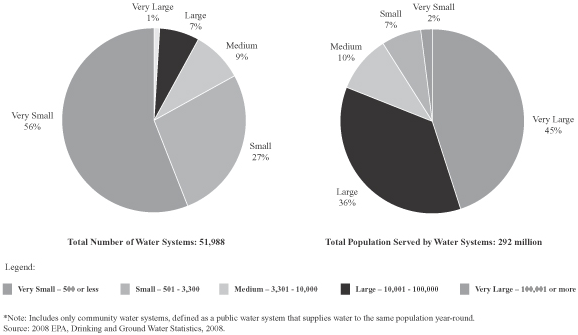
In the last blog I talked about the challenge to rural utilities, many of which serve relatively few people and have used federal monies to pay for a lot of their infrastructure.  In this blog we will take a look at the trends for community water systems which are defined as systems that serve at least 15 service connections or serve an average of at least 25 people for at least 60 days a year. EPA breaks the size of systems down as follows:

  • Very Small water systems serve 25-500 people
  • Small water systems serve 501-3,300 people
  • Medium water systems serve 3,301-10,000 people
  • Large water systems serve 10,001-100,000 people
  • Very Large water systems serve 100,001+ people

Now let’s take a look at the breakdown (from NRC 1997).  In 1960, there were about 19,000 community water utilities in the US according to a National Research Council report published in 1997.  80% of the US population was served.  in 1963 there were approximately 16,700 water systems serving communities with populations of fewer than 10,000; by 1993 this number had more than tripled—to 54,200 such systems. Approximately 1,000 new small community water systems are formed each year (EPA, 1995). In 2007 there were over 52,000 community water systems according to EPA, and by 2010 the number was 54,000.  85% of the population is served. So the growth is in those small systems with incidental increases in the total number of people served (although the full numbers are more significant). 


TABLE 1 – U.S. Community Water Systems: Size Distribution and Population Served


Number of Community Systems Serving This Size Community a

Total Number of U.S. Residents Served by Systems This Size b>

Population Served

1963

1993

1963

1993

Under 500

5,433 (28%)

35,598 (62%)

1,725,000 (1%)

5,534,000 (2%)

501-10,000

11,308 (59%)

18,573 (32%)

27,322,000 (18%)

44,579,000 (19%)

More than 10,000

2,495 (13%)

3,390 (6%)

121,555,000 (81%)

192,566,000 (79%)

Total

19,236

57,561

150,602,000

242,679,000

a Percentage indicates the fraction of total U.S. community water supply systems in this category.

b Percentage is relative to the total population served by community water systems, which is less than the size of the U.S. population as a whole.

SOURCES: EPA, 1994; Public Health Service, 1965.


Updating these numbers, there are over 54,000 systems in the US, and growth is almost exclusively in the very small sector.  93% are considered to be small or very small systems—serving fewer than 10,000 people. Even though these small systems are numerous, they serve only a small fraction of the population. Very small systems, those that serve 3,300 people or fewer make up 84 percent of systems, yet serve 10 percent of the population.  Most critical is the 30,000 new very small systems that serve only 5 million people (averaging 170 per system).  In contrast, the very large systems currently serve 45% of the population.  Large plus very large make it 80%.  The 800 largest systems (1.6%) serve more than 56 percent of the population. 900 new systems were added, but large systems served an additional 90 million people.

What this information suggests if that the large and very large sector has the ability to raise funds to deal with infrastructure needs (as they have historically), but that there may be a significant issue for smaller, rural system that have grown up with federal funds over the past 50 years.  As these system start to come to the end of their useful life, rural customers are in for a significant rate shock. Pipeline average $100 per foot to install.  In and urban area with say, 60 ft lots, that is $3000/household.  In rural communities, the residents may be far more spread out.  As an example, a system I am familiar with in the Carolinas, a two mile loop served 100 houses.  That is a $1.05 million pipeline for 100 hours or $10,500 per house.  With dwindling federal funds, rural customers, who are already making 20% less than their urban counterparts, and who are used to very low rates, that generally do not account for replacement funding, will find major sticker shock. 

This large number of relatively small utilities may not have the operating expertise, financial and technological capability or economies of scale to provide services or raise capital to upgrade or maintain their infrastructure.  Keep in mind that small systems have less resources and less available expertise.  In contrast the record of large and very large utilities, EPA reports that 3.5 percent of all U.S. community water systems violated Safe Drinking Water Act microbiological standards one or more times between October 1992 and January 1995, and 1.3 percent violated chemical standards, according to data from the U.S. Environmental Protection Agency (EPA).. 

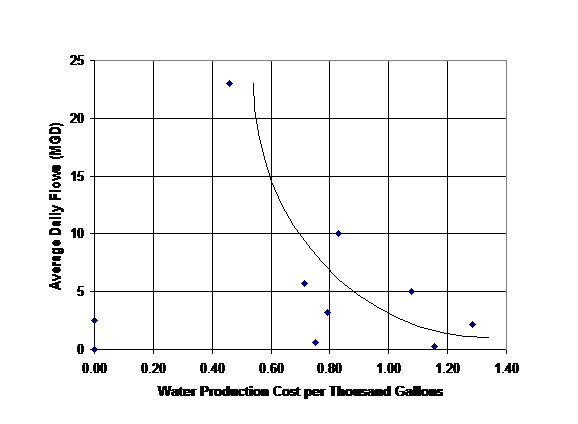
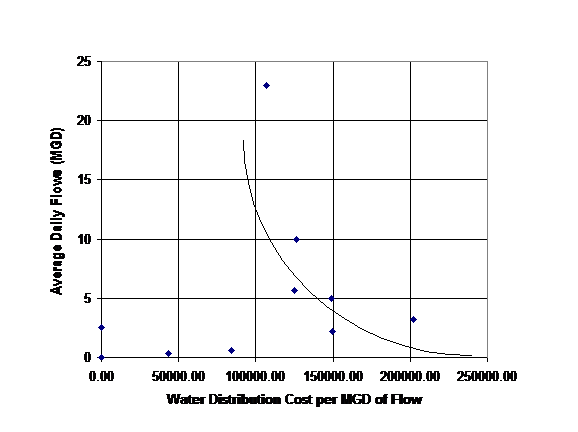
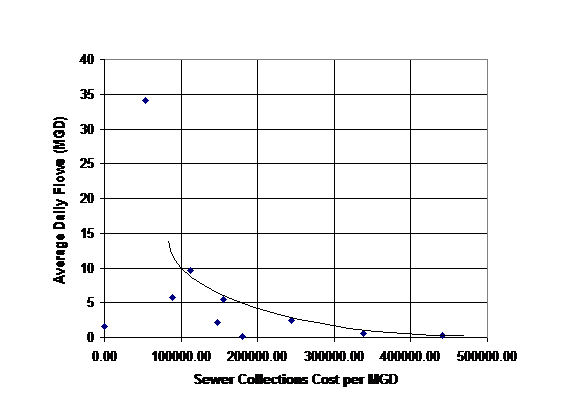
EPA and professionals have long argued that centralized infrastructure for water and sewer utilities makes sense form an economy of scale perspective.  Centralized drinking water supply infrastructure in the United States consists dams, wells, treatment plants, reservoirs, tanks, pumps and 2 million miles of pipe and appurtenances.   In total this infrastructure asset value is in the multi-trillion dollar range.  Likewise centralized sanitation infrastructure in the U.S. consists of 1.2 million miles of sewers and 22 million manholes, along with pump stations, treatment plants and disposal solutions in 16,024 systems.  It is difficult to build small reservoirs, dams, and treatment plants as they each cast far more per gallon to construct than larger systems.  Likewise operations, despite the allowance to have less on-site supervision, is far less per thousand gallons for large utilities when compared to small ones.  The following data shows that the economy-of-scale argument is true:

  • For water treatment, water distribution, sewer collection and wastewater treatment, the graphics clearly demonstrated the economy-of-scale of the larger utility operations versus small scale operations (see Figures 2-5). 
  • The administrative costs as a percentage of the.total budget parameter also demonstrated the economy-of-scale argument that larger utilities can perform tasks at a lesser cost per unit than the smaller utilities (see Figure 6).

Having reviewed the operations costs, the next step was to review the existing rates.  Given the economy-of-scale apparent in Figures 2 to 6, it was expected that there would be a tendency for smaller system to have higher rates.  Figures 2-6 demonstrate this phenomena. 

So what to do?  This is the challenge.  Rate hikes are the first issue, a tough sell in areas generally opposed to increases in taxes, rates and charges and who use voting to impose their desires.  Consolidation is anothe5r answer, but this is on contrast to the independent nature of many rural communities.  Onslow County, NC  figured out this was the only way to serve people efficiently 10 years ago, but it is a rougher sell in many, more rural communities.  Infrastructure banks might help, the question is who will create them and will the small system be able to afford to access them.  Commercial financing will be difficult because there is simply not enough income to offset the risk.  The key is to start planning now for the coming issue and realize that water is more valuable than your iPhone, internet, and cable tv.  In most cases we pay more for each of them than water (see Figure 7).  There is something wrong with that…

 Image


Figure 1  Breakdown of Size of Systems

Image


Fig 2 Cost of Water Treatment

Image


Fig 3 Cost of Water Distribution

Image


Fig 4 Cost of Sewer Collection

Image


Fig 5 Cost of Sewer Treatment

Image

Fig 6 Cost of Administration as a percent of total budget


Image

FIgure 7 Water vs other utilities


Happy 91st Pop! It’s been 2.5 years since you were last with us, but it’s funny how many things popped (no pun intended) up today that connect to you. Clearly you are still watching what goes on. We had a family summer cottage located 8 miles east of Grayling Michigan. So today I came across an old book entitled the Old AuSable written in 1963 by Hazen Miller, a U of M doctor (you were a U of M aerospace engineer) who wrote about the area back in the day (1870s to 1920s), just before your father purchased property along the AuSable River. It mentions the great grandfather of my dad’s summer playmates, one of whom just died last summer - his obit came up in my email today. Reminded me of many places I went as a kid. Funny it also reminded me of some of the old “names” that are now being lost to time, but created what exists today. It also helped with some perspective on a proposal I have been working on regarding water supplies and quality. The grayling fish disappeared by 1912 as a result of hanged on water quality (warming and silt), human impacts of logging on the fish and the introduction of other species. My proposal looks at impacts of human activity on SE Florida, especially as it relates to sea level rise and the need to capture additional soil storage capacity through infiltration trenches. The water cannot be discharged to tide due to Human-induced nutrient and roadway pollutants of the potential exists to impact fish populations. So we are looking at moving the infiltrated water to water plants in the future. We can treat the water there, cost effectively while solving another problem – diminishing water supplies for urban populations. This would diminish our need to deal with desalination and the disposal of concentrate, another proposal. Funny how sometimes it all comes together….Good times back then and up there. Making progress today. Thanks and keep on watching out for us!!


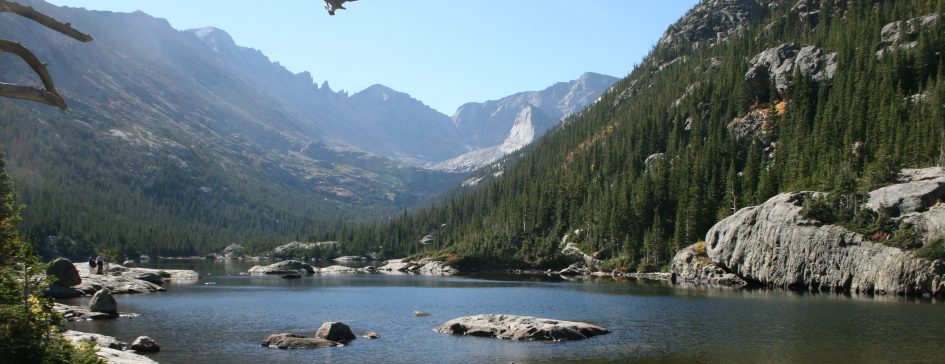
I went to Colorado in July, and it was bone dry like I noted in a prior blog.  The trend was expected to continue, but then something happened.  It rained.  A lot. It’s been raining for almost a month.  Last week it was wet out there, really wet, devastatingly wet on the east side of Rocky Mountain National Park (Boulder, Estes Park, Longmont, Lyons). The rain has not really let up so mountain streams are over-running their banks, flooding streets, washing away bridges, damaging property and businesses.  Helicopter evaluation of the damage indicates that miles of roadways are badly damaged. Route 34/36, the primary eastern entrance to Rocky Mountain National Park may have 17 miles (of 20) damage pavement and foundation needing immediate repair.  Estes Park is cut off from the world and there was mud in the streets.  Rocky Mountain National Park is closed to allow access from Grand Lake for emergency vehicles, residents and supplies.  And eastern emergency route from Nederland is also available.  Tourism has halted in the peak of Fall tourist season.

How fortunes have changed, and continue to change.  Three years ago it was the west side of Colorado with 300 inches of snow that flooded downstream communities.  Three months ago was drought. Are these changes part of a larger issue, or a continuation of the status quo?  Hard to know, but certainly both events were far above any prior events experienced in the area.  The local infrastructure was not constructed to meet these conditions, so either the climate is changing, our models are wrong, or both.  We see the same issue playing out regularly around the world when the 100 year or 500 year storm event occurs and wreaks havoc on a community which does not have infrastructure planned for events like this.

 Expect NE Colorado to be a federal disaster area.  Expect billions to be spent on reconstruction of roadways.   But the larger question is whether the new, replacement infrastructure will survive a similar, or larger climate event in the future.  Will our infrastructure planning be short sighted or will it be adjusted accordingly?  The potential for us to protect infrastructure, and property is completely related to our ability to adjust to infrastructure needs and to minimize exposure to weather events.  Keep in mind our economy and way of life is directly related to our infrastructure condition.  But people want to live near rivers and streams, but rarely consider the real risk and consequences. 

How do we address these risks?  FEMA evaluates the probability of flooding to set flood insurance, but FEMA does not prevent construction in flood zones.  Where construction can occur is a state or local issue.  Of course, few local entities want to limit development in any way, so we keep putting people at risk.  Local officials, like those in Florida, keep pushing FEMA officials to reduce flood risks, despite evidence of increasing rainfall intensity that would increase flooding.  Florida is not alone.  No doubt Colorado officials have the same views.  We need to impress upon local officials the risks and encourage them to reduce risks to citizens.  It’s our tax money and insurance premiums they are raising.  But they are rarely held accountable.  Nor are non-elected officials.  Somehow, this needs to change.  We need leaders to stand up and draw the  line in the sand.


School is back in session.  It is a great opportunity to see what kind of great things we can learn this year.  We can learn from the students as much as they learn from us.  Working with college students, in bridging that connection between my real world clients and my students keeps me engaged and allows me to act as a conduit of information between the two sectors.  That conduit potentially includes jobs for students and technology for clients.  It is remarkable how much the skills sets of the students have changes and increased in certain areas in five years, let alone 10.  I remind them that 5 years after they graduate, the skill set of the next group will be far ahead of theirs. Get your license and keep learning and staying up to date with technology.  It is far too easy to get behind and it is surprising how many graduates figure they are done with learning when the graduate.  Far from it.  The advances and changes in the industry move so quickly.  All my students are doing 3 dimensional projects versus cad drawings 5 years ago.  And those cad drawings were so far above the cad drawings of ten years ago.  All three groups are ahead of a lot of engineering firms with respect to technology.  And there accompanying utilities as well.  My students make great interns for GIS – it comes naturally to them.  My older friends?  Well, let’s say there is a bit of a learning curve.  As we try to be more efficient, training and skill development become continuous exercises.  It is obvious when you compare skill sets of recent, current or older graduates.  Of course skill sets may not translate to knowledge, for there is no substitute for field experience, especially in the water and engineering fields.  The reality is often much different than you expect, for a variety of reasons.  How you adapt means experience.  It is why the older crowd and the younger crowd need each other and need those communication avenues.  I find that my teaching keeps you engaged in the changes in technology, viewpoints and the new generation while maintaining the relationships with the real world


A new GAO report suggests that the short and long-term future for state and local revenues may be more difficult that currently anticipated, despite the economy recovering in many places.  My last blog outlined a number of the problems including that many public entities chose to reduce tax rates to balance the budget as opposed to restocking reserve funds.  When property values plummented and tourism and consumer buying diminished, the taxes related to all three plummented as well.  None have yet returned to their pre-2008 levels.  The failure to stockpile reserves caused many governments to spend down what limited reserves they had in the past 5 years as a means to avoid the hard and unpopular decision – raising taxes to collect the same revenues as before the mid-2000s cuts.  Now the lack of reserves creates an issue going forward – as costs increase faster than revenues, there are no reserves to tap into.  It is a problem that just keeps on giving. –

As I noted, I never like Chicken Little, because he never had a solution for the problem. There are solutions for local governments, some good and some bad.  Clearly local governments need to revisit the revenue production tools.  Taxes and fees will go up.  Taking more money from the utility, an all too popular decision in the past 5 or more years IS NOT THE ANSWER!  That just transfers the problem to the utility system and we already know that there are huge amounts of deferred maintenance and capital projects with utilities – $300 billion and counting at last count. The utility should be run as an enterprise, not as a cash cow to avoid hard political decisions.  Solutions for replacing those ARRA funds and federal grants for police are needed.  Just saying “We ran out of money so lay those people off” is not a solution.  What that is, is poor leadership and planning – a failure to develop the investment made by the feds to better the fiscal position of the community.  A lost opportunity.

There are many options.  And we can lay blame at the feet of elected officials, but it does not all belong there.  The citizens who elect those officials, are to blame.  Most elected officials react to citizenry, not the other way around.  And don’t forget the managers who bring bottom line business practice to local government management who recommend options. We’ve lost a generation of good government managers who understood the service aspect of government who have been banished in favor of the bottom line approach.  We need to change this as well. 

A more entrepreneurial spirit is needed.  I recall a prior entity I worked for where we proposed doing lab work in our certified water lab for other utilities.  That got shot down because it was “unfair to compete with the private sector for this work.”  Really?  That sounds like a private sector red herring.  They know they will lose business, and they can’t compete.  How is that in the spirit of capitalism? It cost less for other entities to have us do it?  A huge missed opportunity.  There are many.  If we want government to operate more like a business, we need accept the opportunities that come with it, not quash them. 

We need to market the community.  Not just give money away hoping to attract businesses that will locate for a short while.  That certainly has been a fiasco in Florida.  Other places as well I am sure.  No, we need to “sell ourselves.”  We need to marketing program to distinguish the community, its assets, its water and sewer reliability and quality, its people, education and opportunities.  It means spending money to invest in the community, not just spending money to fix a few roads and install some pavers, although they are good.  It’s also not just fixing up the distressed neighborhoods, but investing in the better ones as well. The most distressed City in America is quietly encouraging new artists and startup businesses to relocate to Detroit to take advantage of the availability of warehouses, cheap rents and a talented workforce.

We need to avoid the pitfalls of falling victim to reinforcing the past.  Florida’s economy is based on tourism, agriculture and building housing to attract retirees.  Weird business model.  Two of the three are highly susceptible to economic disruptions.  We are still recovering from 2008.  The economy also produces mostly minimum wage jobs, not the way to build a better tax base of encourage investment in education.  The state manufactures nothing, yet fails to take full advantage of what assets it might have to create industry.  As Sun-Sentinel writer Stephen Goldstein noted recently, why is it that south Florida has yet to take advantage of the private sector interest in investing in understanding age –related diseases?  Much of the local economy and the two local public universities are not positioned to take a leadership role?  Yet it is an easily marketed issue given the current population, assuming funds can be secured.  Public investment is needed, and of course that’s the rub.

We can market ourselves.  May communities have.  And most deserve better than their current lot in life.  Alexis de Tocqueville,” you get the government you deserve.”  I think we deserve better, and I think we can do better.  I think we can develop a better future and I think we can overcome challenges.  So maybe it is time for to us to change the perspective!