Archive

Climate


In the last blog we discussed 10 planning steps for sea level rises.  When planning 50-100 years other factors can come into play as well.  As a result, to allow flexibility in the analysis due to the range of increases within the different time periods, an approach that uses incremental increases of 1, 2, and 3 feet of SLR is suggested.  Hence infrastructure is built to meet milestones, not arbitrary dates lessening the potential for stranded assets.. The increments can work as threshold values in planning considerations in terms of allowing planners the ability to know ahead of time where the next set of vulnerable areas will be to allow a for proactive response approach that can be matched to the observed future sea levels.

But prior to developing infrastructure plans, the local community needs to define an acceptable level of service (LOS) for the community. A level service would indicate how often it is acceptable for flooding to occur in a community on an annual basis.  1% is 4 days per years and for a place like Miami Beach, this is nearly 2 ft NAVD88, well above the mean high tide.  The failure to establish an acceptable LOS is often the cause of failure or loss of confidence in a plan at a later point in time.  The effects of SLR of the level of service should be used to update the mapping to demonstrate how the level of service changes, so that a long-term LOS can be defined and used for near-term planning.

With the LOS known, the vulnerability assessment is developed using a GIS based map of topography and the groundwater levels associated with wet and dry season water levels.  LiDAR is a useful tool that may be available at very high resolution in coastal areas.  Topographic maps must be “ground-truthed” by tying it to local benchmarks and transportation plans.  USGS groundwater and NOAA tidal data from local monitoring stations to correlate with the groundwater information. Based on the results of these efforts, the GIS-based mapping will provide areas of likely flooding.

GIS map should be updated with layers of information for water mains, sewer mains, canals, catch basins, weirs and stormwater facilities.  Updating with critical infrastructure will provide a view of vulnerability of critical infrastructure that will be funded by the public sector. Ultimately policy makers will need more information to prioritize the needed improvements.  For example, a major goal may be to reduce Economic Vulnerability.  This means identifying where economic activity occurs and potential jobs.  At-risk populations, valuable property (tax base) and emergency response may be drivers, which means data from other sources should be added.

The next step is to analyze vulnerability spatially, by overlaying development priorities with expected climate change on GIS maps to identify hotspots where adaptation activities should be focused. This effort includes identification of the critical data gaps which, when filled, will enable more precise identification of at risk infrastructure and predictions of impacts on physical infrastructure and on communities. The final deliverable will include descriptions of the recommended concepts including schematics, cost estimates, and implementation plan.

So why go through all this.  Let’s go back to the beginning.  It has to do with community confidence in its leaders.  Resident look at whether their property will be protected.  Businesses look at long-term viability when making decisions about relocating enterprises.  The insurance industry, which has traditionally been focused on a one year vision of risk, is beginning to discuss long-term risks and not insuring property rebuild is risk-prone areas.  That will affect how bankers look at lending practices, which likely will decrease property values.  Hence it is in the community’s interests to develop a planning framework to adapt to sea level rise and protect vulnerable infrastructure through a long-term plan.  Plan or….


The rainy season has sort-of started in south Florida and with it comes flooding and discussions of the falls end of season and concurrent high, high tides for the year, flooding and the impact of sea level rise on low-lying areas.  Much focus has been spent on the causes of sea level rise and the potential flooding caused by same.  However the flooding can be used as a surrogate to impacts to the social and economic base of the community.  By performing vulnerability assessments, coastal areas can begin planning for the impacts of climate change in order to safeguard their community’s social, cultural, environmental and economic resources. Policies need to focus on both mitigation and adaptation strategies, essentially, the causes and effects of climate change. Policy formulation should be based on sound science, realizing that policy decisions will be made and administered at the local level to better engage the community and formulate local decisions.

Making long-term decisions will be important.  Businesses look at long-term viability when making decisions about relocating enterprises.  The insurance industry, which has traditionally been focused on a one year vision of risk, is beginning to discuss long-term risks and not insuring property rebuild is risk-prone areas.  That will affect how bankers look at lending practices, which likely will decrease property values.  Hence it is in the community’s interests to develop a planning framework to adapt to sea level rise and protect vulnerable infrastructure through a long-term plan.

While uncertainties in the scale, timing and location of climate change impacts can make decision-making difficult, response strategies can be effective if planning is initiated early on. Because vulnerability can never be estimated with great accuracy due to uncertainty in the rate of warming, deglaciation and other factors, the conventional anticipation approach should be replaced or supplemented with one that recognizes the importance of building resiliency.  The objectives of the research were to develop a method for planning for sea level rise, and providing a means to prioritize improvements at the appropriate time.  In addition the goals were to provide guidance in developing a means to prioritize infrastructure to maximize benefit to the community by prioritizing economic and social impacts.

Adaptation planning must merge scientific understanding with political and intuitional capacity on an appropriate scale and horizon.  According to Mukheibir and Ziervogel (2007), there are 10 steps to consider when creating an adaptation strategy on the municipal level.  To summarize, these are as follows:

  1. Assess current climate trends and future projections for the region (defining the science).
  2. Undertake a preliminary vulnerability assessment of the community and communicate results through vulnerability maps (using GIS and other tools).
  3. Analyze vulnerability spatially, by overlaying development priorities with expected climate change on GIS maps to identify hotspots where adaptation activities should be focused.
  4. Survey current strategic plans and development priorities to reduce redundancy and understand institutional capacity.
  5. Develop an adaptation strategy that focuses on highly vulnerable areas. Make sure the strategy offers a range of adaptation actions that are appropriate to the local context.
  6. Prioritize adaptation actions using tools such as multi-criteria analysis (MCA), cost-benefit analysis (CBA) and/or social accounting matrices (SAM).
  7. Develop a document which covers the scope, design and budget of such actions (what they call a Municipal Adaptation Plan (MAP)).
  8. Engage stakeholders and decision-makers to build political support. Implement the interventions prioritized in the MAP.
  9. Monitor and evaluate the interventions on an ongoing basis.
  10. Regularly review and modify the plans at predefined intervals.


The strengths of this framework are the initial focus on location-specific science, the use of both economic and social evaluation criteria, and the notion that the plan is not a fixed document, but rather a process that evolves in harmony with a changing environment.  The final two steps occur at regular intervals by the community with associated adjustments made.  The next question is how to develop the data and priorities.


A week ago the new National Climate Assessment came out.  It basically says things we already expected – temperatures are warmer, there will be more droughts, less rainfall, less available water, more intense storms and sea level rise.  What the study did in its 800+ pages was outline examples of climate change phenomena that are already occurring including flooded streets in coastal areas, severe weather (Colorado, New Jersey), and changes in the arctic air currents that may be affecting northeastern and Midwestern winter storm frequency.  All things that those who have been around for a while and have been even minimally observant have already noticed for themselves.  What was also not surprising was the vitriol on the internet about how this assessment was a “fascist plot” perpetrated by a variety of people to impose some yet undetermined regulations on “patriotic Americans.”  And then Senator Marco Rubio comes out this week and says he does not believe it is possible for people to cause climate change.  No facts, just belief.  In Florida.  In Miami.  Wow…

Those who live in coastal areas, earn their living in agriculture, manage water utilities relying on water supplies, and drought planners know the truth.  Denying that the climate is changing simply ignores reality and delays the ability to respond to its impacts.  I realize that those impacts might be 20 or 40 or more years out, but planning is needed because we expect our infrastructure, factories, hoses and economies to last longer than that.  Science says change is occurring.  We can argue why and how fast, but the reality is that there is change and there are many people that will confront he need to adapt to the situation sooner than later (like us the Fort Lauderdale/Miami area!).  So why deny climate change?

As we noted in a prior blog, there are several reasons, but many involved business issues.  So follow the money. Let’s start with the Koch brothers.  The Koch brothers manage Koch Industries, the second largest privately owned company in the United States revenues exceeding $100 billion/year.  Many Americans have no idea who they are but they are billionaires who have made their living in the oil business – their father Fred C. Koch developed a new the method for the refining of heavy oil into gasoline.  They rely on oil to maintain their wealth and are politically active with conservative organizations including the Heritage Foundation and the Cato Institute, FreedomWorks and Americans for Prosperity, all organizations the dismiss any impact of man on climate change.  Why?  Well one of the tenets of dealing with climate change is to reduce carbon dioxide emissions which means less reliance on fossil fuels – oil.  Whoops – that would be a problem for the Koch brothers because if they say “sure climate change is a problem,” well then that would mean that their entire business model and their wealth is a contributor to climate change, which means they are the “bad guys.”  Can’t have that.  So following the money tells you that we can’t make our money with oil and support climate change.

Let’s look at the other side.  Those acknowledging climate change are fully supportive of renewables, which in theory will help climate change by reducing carbon dioxide.  But the concept of renewables though is fraught with the problem that few of these technologies are ripe for wide-scale implementation.  For example natural gas vehicles or natural gas/hybrids are doable, but where do you buy the natural gas for the vehicle?  The technology and distribution networks is 10 or more years out at best and of course if you are in the oil business, why would you be interested in installing the natural gas fuel pumps?  So technology and need do not match when you follow the money.

How about the Keystone pipeline that would bring oil and gas from these remote areas to refineries in Texas and the Gulf of Mexico states.  You can guess the Koch brothers are in favor of the pipeline as they will benefit.  So are most oil and gas entities.  There are many environmentalists and other opposed to the pipeline because of impacts on water supplies (and other issues).  But the railroads are making money by hailing oil and gas from Canada and the Dakotas.  Guess which side the railroads are on?  The pipeline would take business away from the railroads.  Follow the money. 

Let’s look at our industry.  In the utility business, there is a lot of money with the telephone, power, cable and other utilities.  These private entities, although regulated, make huge sums of money for their investors.  You can follow that money. 

So who supports water and sewer utilities?  We do!  We supply over 85% of Americans.  But why do we have so much trouble getting funding when 85% of people would benefit.  One would think that given how many people we support, we have the money, but we are primarily not-for-profit entities, so we don’t make money for anyone.  You can’t follow that money because there is no money.  That tells us more about the difficulties we have in securing funding that anything.    

Fixing it is a little bigger challenge because our representatives and constituents do not understand the financial investment they have in our industry.  Their public health and economies are linked to water and sewer.  Our services make these other enterprises doable but there is no direct monetary connection to facilitate lobbying on our behalf.  I am not sure how to fix this, but we need a better marketing strategy for our services.  That’s one thing we know.


There has been significant discussion about the potential impacts of climate change on the world:  more intense rainfall events, more severe thunderstorms and tropical cyclones, droughts, loss of glacial ice and storage, increased demand for crop irrigation.  However for much of the State of Florida, and for much of the coastal United States east of the Rio Grande River, the climate issue that is most likely to create significant risk to health and economic activity is sea-level rise.  Data gathered by NOAA from multiple sites indicates that sea level rise is occurring, and has been for over 100 years. About 8 inches since 1930.

The impact of climate change on Florida is two-fold – Florida often is water-supply limited as topography limits the ability to store excess precipitation for water use during the dry periods and sea level rise will exacerbate local flooding.  The highly engineered stormwater drainage system of canals and control structures has effectively enabled management of water tables and saltwater intrusion by gravity. The advent of sea-level rise will present new challenges, because the water table is currently maintained at the highest possible levels to counter saltwater intrusion, while limiting flood risk in southeast Florida’s low-lying terrain and providing for water supplies.  As sea level rises, the water will not flow by gravity, which disrupts that balance struck between flood risk and water supply availability in the canal system.

Occasional flooding is not new to Florida, but the increasing frequency we currently experience is related to sea level rise, not just along the coast, but for large expanses of developed property inland due to topography and groundwater levels.  As a result, the challenge for water managers in the state, especially in southeast Florida, is to control the groundwater table, because control of the water table is essential to prevent flooding of the low terrain.

The issue is not lost on local governments in south Florida nor on the educational institutions in the area.  Florida Universities are studying the impacts to the region to identify ways in which we can mitigate, respond to and adapt to these changes. My university, Florida Atlantic University, is located in this vulnerable part of the State has been proactive in partnership with the Four County Compact in addressing these issues and we have now joined with other Universities in the State to form the Florida Climate Institute, a consortium working with state and federal agencies to address the multiple challenges and opportunities facing this State. FAU in particular, has been proactive in developing tools to evaluate risk and identify adaptation strategies to protect local and regional infrastructure and property. 

Our efforts have included using high resolution NOAA data to map topography at the +/- 6 inch level, combined that topography with mapping of infrastructure and groundwater, to identify vulnerable areas throughout Broward, Miami-Dade and Monroe Counties, as well as initiated projects in Palm Beach County and other coastal regions throughout the state.  By identifying vulnerability based on sea level changes, the timing and tools for adaptation can be designed and funded to insure a “no-regrets” strategy that neither accelerates nor delays infrastructure beyond its need. 

While we have all heard the discussion of an estimated two to three feet if sea level rise is anticipated by 2100; sea level rise is a slow, albeit permanent change to our environment.  The slow part allows us to make informed decisions about adaptation strategies that may prove useful in the long term as well as the short term.  Of prime importance is the need to plan for these needs 50 or more years out so that we do not increase our exposure to risk.  Keeping development out of low lying areas, redeveloping pumping and piping systems with change in mind and reserving areas where major efforts will need to be undertaken, is important to the public interest and will affect private business, tourism and homeowners.  Sea level rise is already a problem for many low lying areas such as Miami Beach, Fort Lauderdale, Hollywood, and other coastal communities. It will be an incremental problem creeping up on us for the rest of the century and beyond.

The lowest lying areas are the roadways, which are also the location of electrical, water, sewer, phone and drainage infrastructure.  Fortunately given the current Federally funded special imagery and NOAA data systems we are able to predict pretty accurately where flooding will occur.  Linking that information with detailed projections of sea level rise impacts we can  map vulnerable areas and build adaptive measures into every action and plan we undertake.  But the impacts are not only on the coast. Sea level affects ground water table levels and with our intense rainfall areas far inland can be flooded, even subject to long term inundation.  Water levels are rising and will continue to rise as groundwater rises concurrently with sea level. Add the impact summer rains and dealing with water becomes a major priority. Figures 1 and 2 outline the roadway network degradation at present, 1, 2, and 3 ft of sea level rise.  The figures demonstrate that a major, underestimated amount of property is vulnerable on the western edge of the developed areas because the elevations are decreasing as one moves west from I95. 

Image

While time will impact our environment, there are three options to address the change:


  • Protect infrastructure from the impacts of climate change
  • Adapt to the changes, and
  • In the worst case retreat from the change.

 Retreat does not need to be considered in the short or medium term.  South Florida has developed in the last 100 years and there will be well over 100 years of life left.  As a result, the best option is adaptation.  Adaptation takes different forms depending on location.  I have developed a toolbox of options that can be applied to address these adaptation demands, resulting in an approach that will need a more managed integrated water system, more operations and inevitably more dollars.  For example we can install more coastal salinity structures, raise road beds, abandon some local roads, increase storm water pumping, add storm water retention etc. to address many of the problems.  The technology is available today.

Much of the actual needs are local, but the problem is regional and requires a concerted effort of federal, state and local agencies and the private sector to address the scales of the problem.  A community can address the local problems, but the regional canals, barriers, etc., are beyond the scope of individual agencies.  Collaboration and discussion are needed. 

The needs will be large – in the tens of billions.  But there are two things in south Florida’s favor – time and money.  The expenditures are over many, many years.  Most important in the near term need is the early planning and identification of critical components of infrastructure and policy needs and timing for same.  That is what FAU does best.  At risk are nearly 6 million of Floridians their economy and lifestyle, $3.7 trillion in property (2012) in south east Florida alone and a $260 billion annual economy.  All of these are expected to continue to increase assuming the appropriate plans are made to adapt to the changing sea level.  Protection of the area for the next 100-150 years is achievable as long as we have the science, the understanding and the will to do it.  Plan now, and over the rest of this century starting now we can raise those billions of dollars needed.


I had to share this, from a nonscientific survey of people adamantly opposed to any consideration of changes to our climate:

1. I can’t do anything about it so I don’t care about it
2. People can’t alter what is happening with the earth because it is too big
3. It’s natural, so we can’t do anything about it
4. It’s not an issue now, so it’s somebody else’s future problem
5. The science is inconclusive so why do anything yet. Let’s see what happens
6. Trying to address it will cut jobs
7. We won’t be competitive (i.e our profits will drop)
8. It requires changing our business model (energy)
9. If we talk about it no one will develop in our community
10. Costs too much

I had to post this as many of you will have comments. But before you do, these about this a minute……

The first five are based on no facts, but a desire to ignore the issue entirely. The second five are more poignant because aren’t these pretty much the same arguments to deny the need to correct water pollution concerns in the 1930s? Or 1950s? Or even 1970s? Or even today with hog farms, frack water, acid mine waste, coal dust slurries, etc.? Or actually pretty much every regulation? I seem to recall Tom Delay making this argument when he was in Congress before he was indicted.

Now think about the Clean Water Act, Clean Air Act, Safe Drinking Water Act, and others. These regulations are designed to correct ills of the past that were simply ignored due to the first five arguments above, ignoring the fact that prevention is always less costly than cleanup afterward. To we pass regulations to clean up problems and protect the public health going forward. Otherwise why have a regulation?

So let’s talk about that jobs impact. The reason is that after the passage of these regulations, didn’t the number of professional jobs (like civil and environmental engineers, environmental and other scientists – STEM jobs) increase? Isn’t increasing STEM jobs a priority? So won’t dealing with climate issue perhaps create a similar increase in STEM jobs? Yes, costs for water increased and the cost for the effects of climate changes will cost money, but don’t these challenges create opportunities? Isn’t this akin to dealing with problems with development from the past? Just asking…..


I read a recent article in Roads and Bridges on the reconstruction of the roadways to Estes Park.  An excellent effort by state officials and private contractors to rebuild over 20 miles of roads that were wiped away in mid-September when unprecedented rainstorms cut Estes Park off from the front range.  I actually had reservations in Estes Park as part of a plan to go hiking at Lawn Lake, among others.  Lawn Lake was one the harder hit areas in the park.  Went to Leadville.  If you have never been, go.  The early money in Colorado came out of Leadville – silver was the money-maker.   I did a 12 mile hike thought the mining district as it snowed – note it is the 2 mile high City.  Great hike in the am – the photos were fantastic as well.  

But the point is that people expect government to solve problems like the roadways in Colorado.  They expect we will solve water, sewer and storm water problems.  We have done a great job of it because people take these services for granted.  What we don’t want is to have a catastrophic failure, natural or otherwise.. ..


Several weeks ago we looked at the phenomenon of population, income, education and unemployment.  The impact to from the combination of these factors in certain communities can be difficult.  Let’s explore a little further as there is more, interesting data every day.  The US Department of Agriculture is releasing its report of rural America.  The findings are interesting and counter-intuitive to the understanding of voters in many of those communities.  Their findings include:

  • The rural areas grew 0.5 % vs 1.6% in urban areas from mid-2011-mid 2012
  • Rural incomes are 17% lower than urban incomes.
  • The highest income rural works (95th percentile) earn 27% less than their urban counterparts
  • 17.7% of rural constituents live in poverty vs 14.5% in urban areas
  • 80% of the high poverty rate counties were rural
  • All the high income counties are urban.

Wow!  So the ghetto has move to the country? According to these statistics there is truth in that statement.  Let’s look a little further using some on-line mapping. 

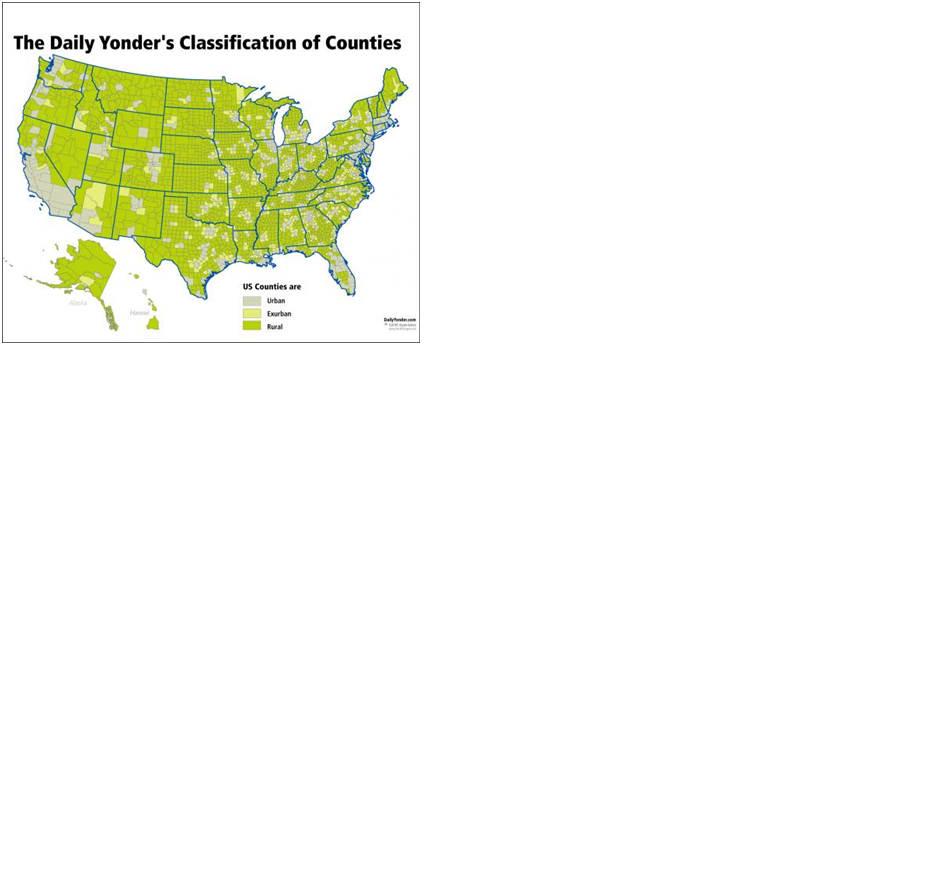
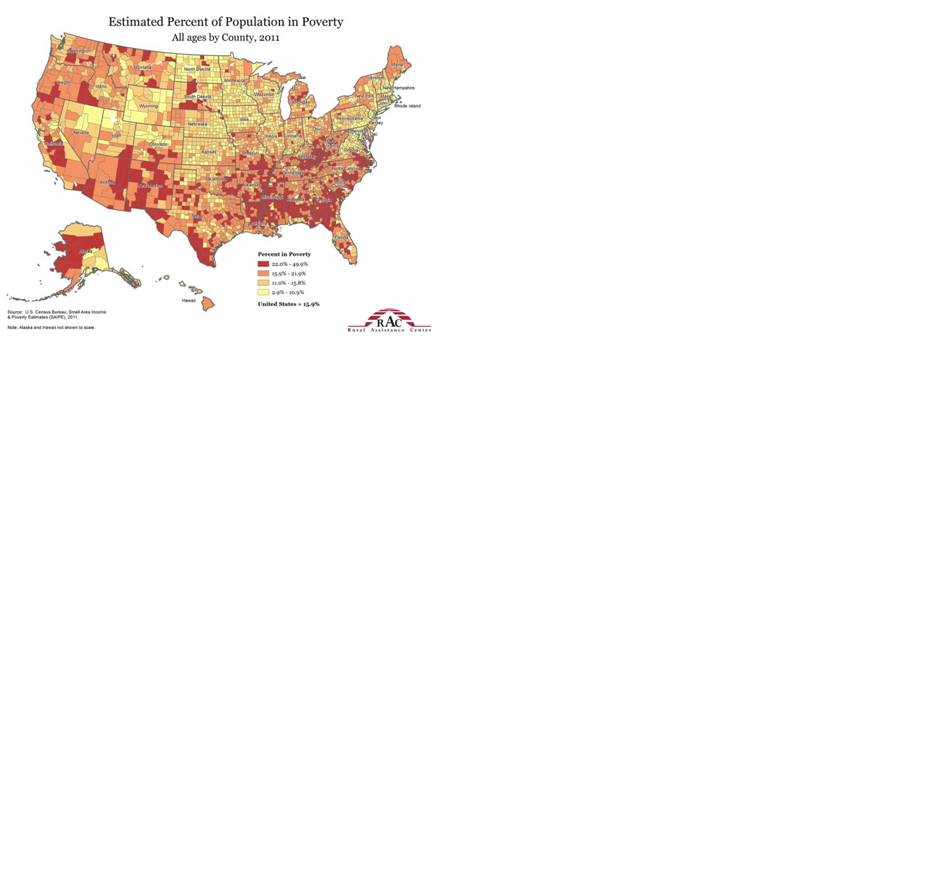
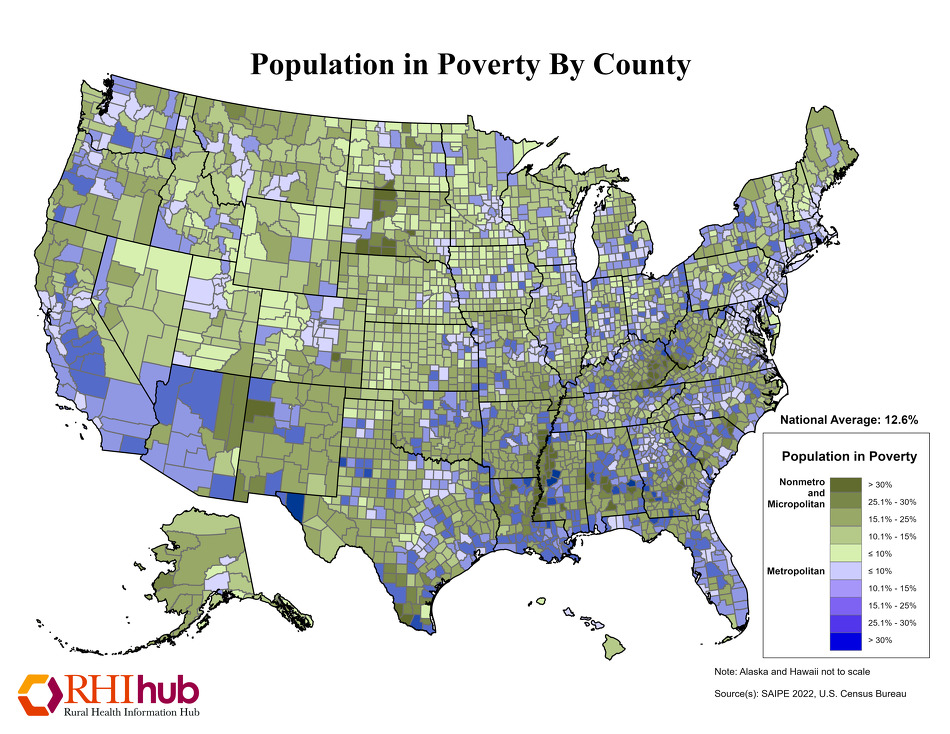
First let’s look at where these rural counties are.  Figure 1 is a map from www.dailyyonder.com  that shows (in green) the rural counties in the US.  Wikipaedia shows the 100 lowest income counties in Figure 2.  For the most part, these counties are rural, with the exceptions being a few areas in south Texas and in the Albuquerque/Santa Fe area of New Mexico. Raceonline.com shows the populations in poverty by county.  The red areas are the highest poverty rates.  The red areas in Figure 3 expand Figure 2 to include much of the rural deep south, Appalachia, more of Texas and New Mexico and part of the central valley in California.

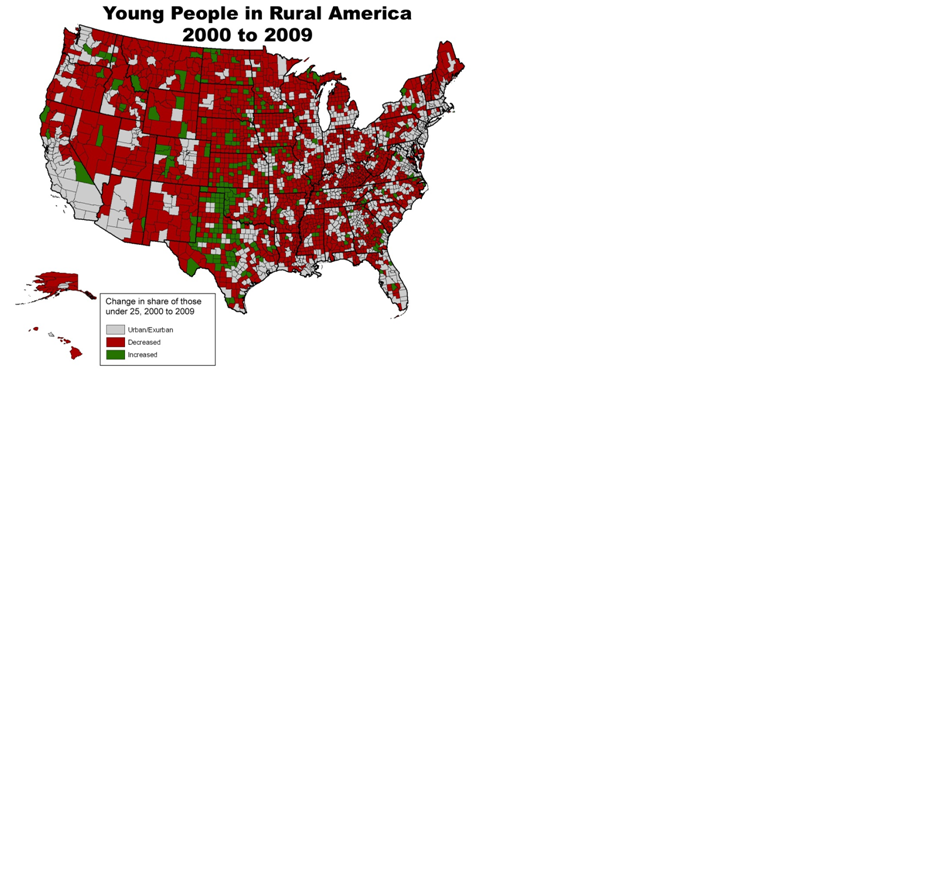
Figure 4 shows how the number of young people has changed between 2000 and 2009 in rural counties (urban counties are white and not included – red means a decrease).  Figure 5 shows population growth (or not) by county. What you see in these two maps is that the young people are moving to the rocky mountain states and vacating the high poverty counties in Figure 3.  Yong people do not see jobs in the rural area – unemployment is 20% higher in rural America and the jobs that are there pay less.  Figures 6 and 7 show unemployment by County in 2008 after the start of the Great Recession and in 2013.  What these figures show is that with exception of the Plains states and Rockies, is that many of the areas with high poverty also had high unemployment, and that the unemployment has remains stubbornly high in many rural areas in the Deep South, Appalachia and New Mexico, plus high unemployment in parts to  the Great Lakes, but the poverty rates are still lower.  Education may by a factor in why the Plains states and Rocky Mountains have less unemployment – despite being rural their students are far more likely to graduate from high school than those in the deep South, Appalachia where unemployment remains high and incomes low. 

So what does this possibly have to do with utilities?  Utilities need to understand this problem as is demands some real, on-the-ground leadership.  Small and rural utilities are more costly to operate per thousand gallons than larger utilities.  A 1997 study by the author showed that economy-of-scale manifested itself to a great extent with water and wastewater operations.  The differences were not close – it is a lot less costly to operate large utilities vs small ones.  Rural utilities complicate the issue further because not only is the number of customers limited, but the pipe per customer is less so the capital investment per customer is far higher than in urban areas.  The impact is that utilities are under pressure to reduce rates to customers, or create a set of lower cost rates for those in poverty, while at the same time their costs are increasing and infrastructure demands are incrementally higher than their larger neighbors.  The scenario cannot be sustained, especially when large portions of rural infrastructure was installed with FHA grants, meaning the customers never paid for the capital cost in the first place.  There was no or lower debt, than what larger utility customers have.  The rural rates since these investments have been set artificially lower than they should as a result. But with Congress talking about reducing SRF and FHA programs, FHA is unlikely to step in to replace their initial investment, meaning that the billions of rural investment dollars that will be needed in the coming years will need to be locally derived, and rate shock will become a major source of controversy in areas that are largely very conservative politically and tend to vote against projects that will increase costs to them.

The good news is that much of the rural infrastructure may be newer when compared to much of the urban infrastructure.  So there is time to build the argument that local investment is needed.  The community needs to be engaged in this discussion sooner as opposed to when problems occur.  Saving for the infrastructure may be the best course since rural utilities will have limited access to the borrowing market because of their size, but that means raising rates now and keeping those saved funds as opposed to using them to deer rate increases.  If ongoing efforts in the House deplete federal funding further, the pinch will be felt sooner by rural customers who will lose the federal dollars from SRF and FHA programs. 


Image

Figures 1 – Rural Counties

The United States: By Rural, Urban and Exurban Counties


Image


Figure 2.  100 lowest income Counties in the US


http://en.wikipedia.org/wiki/List_of_lowest-income_counties_in_the_United_States


Image

Figure 3.  Estimated population in poverty

http://www.raconline.org/racmaps/mapfiles/poverty.jpg


Image

Figure 4.  Where the Young People Are

http://www.raconline.org/maps/topic_details.php?topic=55


Image


Figure 5.  Where people are moving to http://www.raconline.org/maps

Image


Figure 6  Unemployment 2008

http://en.wikipedia.org/wiki/Unemployment

Image

Figure 7  Unemployment 2013 http://www.huduser.org/portal/pdredge/pdr_edge_featd_article_040


Happy 91st Pop! It’s been 2.5 years since you were last with us, but it’s funny how many things popped (no pun intended) up today that connect to you. Clearly you are still watching what goes on. We had a family summer cottage located 8 miles east of Grayling Michigan. So today I came across an old book entitled the Old AuSable written in 1963 by Hazen Miller, a U of M doctor (you were a U of M aerospace engineer) who wrote about the area back in the day (1870s to 1920s), just before your father purchased property along the AuSable River. It mentions the great grandfather of my dad’s summer playmates, one of whom just died last summer - his obit came up in my email today. Reminded me of many places I went as a kid. Funny it also reminded me of some of the old “names” that are now being lost to time, but created what exists today. It also helped with some perspective on a proposal I have been working on regarding water supplies and quality. The grayling fish disappeared by 1912 as a result of hanged on water quality (warming and silt), human impacts of logging on the fish and the introduction of other species. My proposal looks at impacts of human activity on SE Florida, especially as it relates to sea level rise and the need to capture additional soil storage capacity through infiltration trenches. The water cannot be discharged to tide due to Human-induced nutrient and roadway pollutants of the potential exists to impact fish populations. So we are looking at moving the infiltrated water to water plants in the future. We can treat the water there, cost effectively while solving another problem – diminishing water supplies for urban populations. This would diminish our need to deal with desalination and the disposal of concentrate, another proposal. Funny how sometimes it all comes together….Good times back then and up there. Making progress today. Thanks and keep on watching out for us!!


In June, President Obama made a speech about the increase in renewable power that the United States had created in the last 4 years, and announced goals to double this amount in the next four.  Virtually all of this power was solar and wind power.  Little mention was made of hydroelectric or onsite sources.  But the latter have been around much longer than the former sources and there may be options to increase their contributions under the right circumstances. 


Hydroelectric power has been in use in the US for over 100 years.  By the 1930s, 40 percent of the nation’s power came from hydroelectric dams, including some fantastic accomplishments of the time like the Hoover Dam.  Today we have over 100,000 dams in the US, most of which provide power.  Today hydroelectric is only 6 percent of our total.   The reluctance to continue with hydroelectric power involved fisheries, land acquisition costs and legal issues.  Some hydropower options are excellent.  Hurting fisheries (which disrupt local economies dependent on those fisheries) may not be, and therein lies part of the dilemma.


But water and wastewater utilities are actively looking for means to reduce power costs.  Depending on the utility, pumping water can account for 80-90 percent of total power consumption, especially with high service pumps on water systems that require high pressures.  More efficient pumps is one obvious answer, but of fairly limited use unless your pumps are really old.  Variable speed drives can increase efficiency, and the cost is dropping.  But note that with all that high pressure, how do utilities recapture the energy?  We often don’t and the question is whether there is a means to do so that can benefit up.  The first step is looking at plant hydraulics.  Is there a way to recapture energy in the form a pressure.  For example of reverse osmosis systems, we can install a turbine to recapture the pressure on the concentrate side.  They are not very efficient at present, but the potential is there.  On long gravity pipe runs for water supply, a means to recapture pressure might also be available. 


Of course on-site generation of power is a potential solution. Water and sewer utilities have land, and on the wastewater side, methane, so producing power is possible.  This solution, however, may not be embraced by power utilities due to the potential revenue reduction potential and loss of embedded reserve capacity at water and wastewater plants.  As the water facility takes on on-site generation, their load profile may shift significantly placing them in under a different rate structure. This may greatly reduce the benefit to the facility.  There are, however, approaches to permit win-win solutions. The goal is to put willing power and water utilities together to permit local generation that will benefit both power and water utility systems to encourage public – private partnerships.  A medium to large wastewater plant can generate at least a third of its power needs.  Some even more if they take in grease, oils and other substances that should not be put into the sewer system.  The potential there is significant.  EBMUD has a plant that is a net seller of power.  We should look for opportunities.  But don’t forget, water utilities can create hydropower without impacting fish populations. We just need to seek out the right opportunities.


I went back to Colorado last week and it’s dry again out there.  Ok, maybe not this past week when it rained a bit, but despite late snow (March to May), the forests are dry.  The bark beetle problem has not made things easier, so lightning from thunderstorms can easily create fires, like the fire down in Colorado Springs or the Big Meadows fire that is ongoing in Rocky Mountain National Park.  The latter has been ongoing (although fortunately mostly out) for over a month, and has closed some trails in the park.  I hiked through the Fern Lake fire remnants (although virtually all the fire was around Cub Lake). That fire burned for a couple months last fall, only finally burned out in the winter after snowfall. 


The west is dry and “drier than in the past” is the new normal it seems in Colorado.  So now water managers are faced with three new challenges:  less water, faster runoff and more difficult water to treat.  The fires cause the loss of protective vegetation, which means less water is kept in the forest.  As a result, the tiny, light ash particles easily run off in the rain.  Ash is hard to remove without activated carbon or other advanced processes.  The loss of vegetation increases runoff, which means larger sediment content in otherwise pristine water supplies.  That can make a major impact on downstream water plants that may not have planned for such events.  The cost of fire suppression for the last 60 years confounds the current water supply and quality problems.  There are also ecological effects that may impact local economies. 


All this said, I am unsure what the solution is.  Clearly the climate in Colorado is changing.  It is unlikely we can alter the current course any time soon.  Instead we must adapt to the changes and attempt to mitigate the impacts on water supplies.  Creativity, innovation and likely more infrastructure will be required. Concepts like aquifer storage and recovery are coming back to the fore as a result of the current condition. It will be interesting to see how this all plays out.