Archive

engineering


Collaboration between students, faculty and the real world is an excellent means to integrate students into real world situation and provide them valuable experience.  I have done this with several communities to date.  Below are the installed OASIS street improvements in Dania Beach.  Students did the drafting.  Also a stormwater pipe in Boynton Beach.  Excellent learning experience.  The campus mapping project is one that our Facilities Management Department needed.  Very cool 3D map.  We did stormwater assessments in Davie, plus flood mapping.  Of course the Dania Beach nanofiltration plant, the first LEED Gold water plant in the world.  Still.  Here is the cool thing with working with students – they have all kinds of ideas and have all kinds of tools that they can access – they just need guidance.   They will create tools (our app for asset management). to make the job easier.  Most collaborate well.  And most want to learn about the profession.  As an industry we should promote this more.  Go to the local universities, talk with faculty.  Find the right faculty mentor who is interested in local outreach.  Work with them.  But students should not work free.  Pay or pay in grades.  It’s only fair.


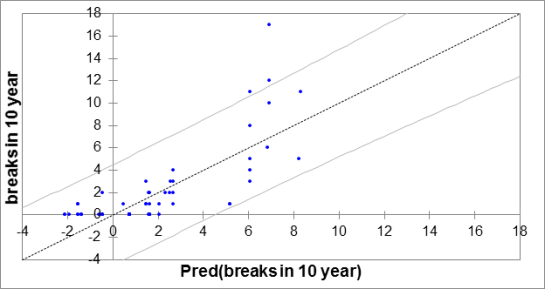
Here is an example of getting to a condition assessment with limited data using power point slides.  Note that where there are categorical variables (type of pipe for example), these need to be converted to separate yes/no questions as mixing.  Categorical and numerical variable do not provide appropriate comparisons = hence the need to alter.  Take a look – but the concept is to predict how well this model explains the break history on this distribution system.  Call me and we can try it on yours….

Step 1  Create a table of assets (this is a small piece of a much larger table).

Asset Dia
water main 2
water main 2
water main 2
water main 2
water main 4
water main 6
water main 6
water main 6
water main 6


Step 2  Create columns for the variables for which you have data (age, material, soil type, groundwater level, depth, traffic, trees, etc.)


Asset breaks in 10 year Dia Age soil traffic Trees depth pressure material Filed estimate of cond.ition
water main 17 2 45 1 1 2 1 55 4 3
water main 11 2 45 2 1 2 1 55 4 3
water main 12 2 45 1 1 2 1 55 4 3
water main 10 2 45 1 1 2 1 55 4 3
water main 2 4 50 1 1 2 1 55 1 2
water main 3 6 60 2 2 2 1 55 1 2
water main 1 6 60 2 2 2 1 55 1 2
water main 0 6 20 1 1 2 1 55 3 1


Step 3  All variables should be numeric.  So descriptive variables like pipe material need to be converted to binary form – i.e. create a column for each material and insert a 1 or 0 for “yes” and “no.”

Step 4 Run Linear regression to determine factors associated with each and the amount of influence that each exerts.  The result will give you a series of coefficientcoefs:

Step 5 – Use this to predict where your breaks will likely be in the next 5-10 years.

Pred breaks

The process is time consuming but provides useful information on the system.  It needs to be kept up as things change, but exact data is not really needed.  And none of this requires destructive testing.  Not bad for having no information.


An asset management program should be developed accordingly to the client’s goals and objectives. It consists of determining the selected area of study, type of system and the quality of data used for evaluation. Before a condition assessment can be determined, an inventory of assets needs to be established – maps, etc. are helpful.  So now you have a map of your water and sewer system and you want to develop a useful system for asset management.  Depending on the accuracy wanted, the data can be gathered in many ways ranging from onsite field investigation which could take a lot of time, to using existing maps, using maps while verifying the structures using aerial photography and video, or field investigations. But most local governments still lack data.  You cannot dig up pipe, or do a lot of destructive testing on buried infrastructure.  So what to do?

The reality is that you have a lot more data than one thinks.  For one thing, most utilities have a pretty good idea about the pipe materials.  Worker memory can be very useful, even if not completely accurate.  In most cases the depth of pipe is fairly similar – the deviations may be known. Soil conditions may be useful – there is an indication that that aggressive soil causes more corrosion in ductile iron pipe, and most soil information is readily available.  Likewise tree roots will wrap around water and sewer pipes, so their presence is detrimental.  Trees are easily noted from aerials.  Likewise road with truck traffic create more vibrations on roads, causing rocks to move toward the pipe and joints to flex.  So with a little research there are at least 5 variables known.  If the break history or sewer pipe condition is known, the impact of these factors can be developed via a linear regression program.  That can then be used as a predictive tool to help identify assets that are mostly likely to become a problem.   We are working on such an example now, but suspect that it will be slightly different for each utility.  Also, in smaller communities, many variables (ductile iron pipe, pvc pipe, soil condition…) may be so similar that differentiating would be unproductive.  That also remains to be seen, which brings up another possible variable- the field perception – what do the field crews recall about breaks?  Are there work orders?  If so do they contain the data needed to piece together missing variables that would be useful to add to the puzzle?

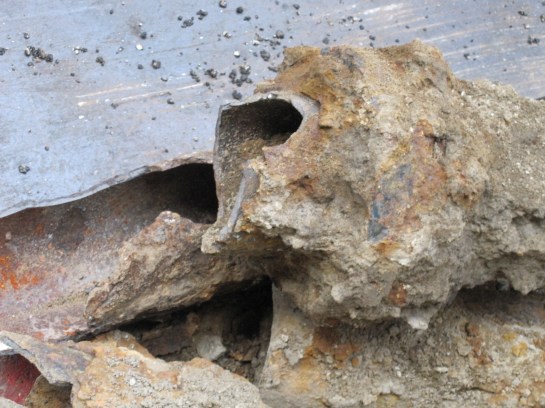
After all we want to avoid this before it happens….

IMG_5040


Asset management plays a vital role to help minimize unnecessary or misplaced spending while meeting the health and environmental needs of a community. The goal is to provide strategic continuous maintenance to the infrastructure before total failure occurs.  Costs should be well distributed over the life of the asset to help avoid emergency repairs. Emergency repairs can cost up to multiple times the cost of a planned repair. Therefore the ultimate goal of asset management is to provide quality, economical infrastructure by identifying the system’s needs and addressing the needs appropriately.  At some point repairs cost more than replacement, or technology may make repairs obsolete.

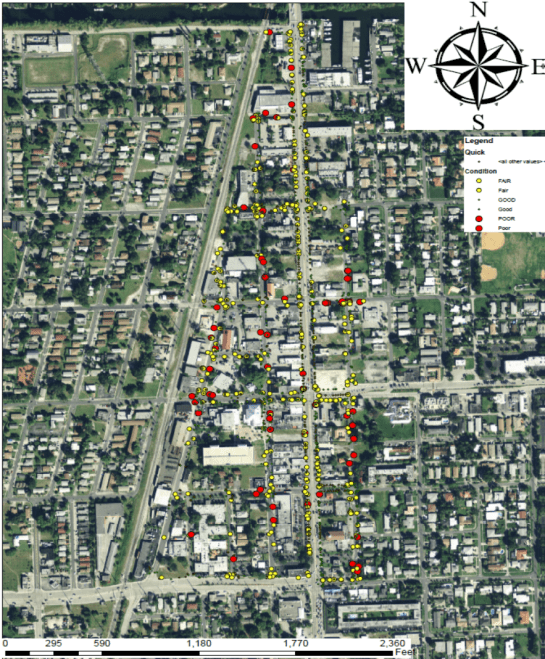
An asset management program should be developed accordingly to the client’s goals and objectives. It consists of determining the selected area of study, type of system and the quality of data used for evaluation (see Figure 1).  Before a condition assessment can be determined, an inventory of assets needs to be established. Depending on the accuracy wanted, the data can be gathered in many ways ranging from onsite field investigation which could take a lot of time, to using existing maps, using maps while verifying the structures using aerial photography and video, or field investigations. Not doing destructive testing is important to reduce costs.  The question is how you do it.  One project we did was the downtown area of Dania Beach.  You can see the areas that are a problem.

Untitled


Figure 1

Asset Dania

FIgure 2


Public infrastructure has been poorly rated by the American Society of Civil Engineers and most public officials acknowledge the deterioration of the infrastructure we rely on daily.  However, many jurisdictions have limited information about their systems, and little data to use to justify spending.  The resistance to impose fees or taxes to upgrade infrastructure also remains high.  Hence the infrastructure tends to deteriorate further each year.  At present the United States spends about 1.6% of its GNP of infrastructure, as compared to 3.1 % prior to 1980.  Half as much money, and a large portion of that was for growth as opposed to repair and replacement.  Hence the need for better tools for asset management.

Utilities that utilize asset management programs experience prolonged asset life by aiding in rehabilitation and repair decisions while meeting customer demands, service expectation and regulatory requirements. The general framework of asset management programs involves collecting and organizing the physical components of a system and evaluating the condition of these components. The importance and the potential consequences associated with the failure of the individual assets are determined by this evaluation. Managers and operators can then prioritize which infrastructure are most critical to the operation of the system and furthermore which infrastructure to consider for repair, rehabilitation or replacement. It is a continuously reviewed and revised strategy that implements the acquisition, use and disposal of assets to optimize service and minimize costs over the life of the assets. An asset management plan (AMP) considers financial, economic and engineering goals in an effort to balance risk and benefits as they relate to potential improvement to the overall operation of the system.

Over the last 2 years, we have been working to develop a means to quickly, effectively and in a cost efficient manner to collect data and assess public infrastructure using simple, readily available means, without the need for significant training and expertise.  The idea was to use student efforts to coalesce a common evaluation without the need for destructive testing.  There are three successive projects used to improve the collection of data for ultimate use in an asset management program.   Students were provided with Leica and Trimble units to gather data.  For the first project, an app was created by FAU students that included photographic tools and entries to document the asset condition and location and permit offsite QA/QC from the cloud.  This app was initially developed for stormwater, but was updated to include all public assets for the second community. Data retrieval was created to be able to log data directly onto a smart phone or tablet in the field to save time and the information is instantly downloaded to the internet for quality assurance. The collection system also was programmed with a condition index to help with organization A session was held in the field with student groups to normalize the assessment process.  The approach began with an inventory and location of each asset. The assets were field inspected and assessed for condition.  A numbering system and photographic tools was used to document the asset condition.  This was accomplished by physically locating each asset in the field and marking it with a global position system (GPS) coordinate which allowed the data to be populated in a geographic information system (GIS) and organized with the other assets of the system

The results include this senior design project by our geomatics students. It is a 3-dimensional map of all infrastructure from the ground down on FAU’s Boca Raton campus. 800 acres and over 5000 points, many of which must be stitched together.  They also created building extrusions for a future project.  Very cool and useful from a tablet.  So the question is – do you have a 3D map of your utility?

Geomatics Engineering Senior Design Project 2016 (2)


June was a tough month and looking back I realize I really didn’t post.  I was in Chicago, spent 2 weeks with middle schoolers, prepared my promotion package, god the doors completed on the house, etc. and suddenly it was the 4th of July.  Yikes time flies.  But it was interesting.  Here I want to talk a little about Chicago.

I went to Chicago to do a 3 day, 12 hour class with elected officials.  Most are board members for their local utility, but they went from a small South Carolina system to San Antonio and St. Paul.  A huge variety.  And we learned a lot.  Obviously the Flint crisis was on their minds.  But I thought the most interesting thing was that these folks understood what happened.  I asked what they thought the real issue was in Flint and the resounding answer was – politics.  Bad decision-making.  Poor preparation.  Notably, not lead service lines.  These people got it.  They read behind the headlines.  Of course these are the officials that wanted to learn more about their water and sewer systems, as opposed to the many that do not take the time to, but interesting nonetheless.

Another issue was talked about was finances.  I ask them to bring their budget, water use, pipelines, etc.  The goal is to do a quick comparison between systems and then discuss what it means (if anything).  I have started doing the exercise each year and we find the same thing – smaller systems cost more per thousand gallons to run than larger systems, so hence their rates must be higher or they are not doing repairs and replacements on a timely basis. This group got that as well and understood that comparisons of their system to others needed to be carefully vetted.  No two system are alike, but size, treatment, terrain can all affect costs to the customer.

We also talked about leadership.  I am applying for an AWWA project on leadership, but when asked, these folks had some great answers. They see leadership as a personal trait (inspiration, vision) as well as being driven by event (negotiating crisis or change), and having the ability to bring people along through the rough patches.  Leadership is an issue that needs more exploration, but I thought this was a good start to preface the larger survey I hope to do for AWWA’s members.

In the meantime, I learned a lot about the Chicago River bridges, enjoyed the planetarium, a Cubs night game, Millenium Park and a walk along the waterfront.  Very cool.
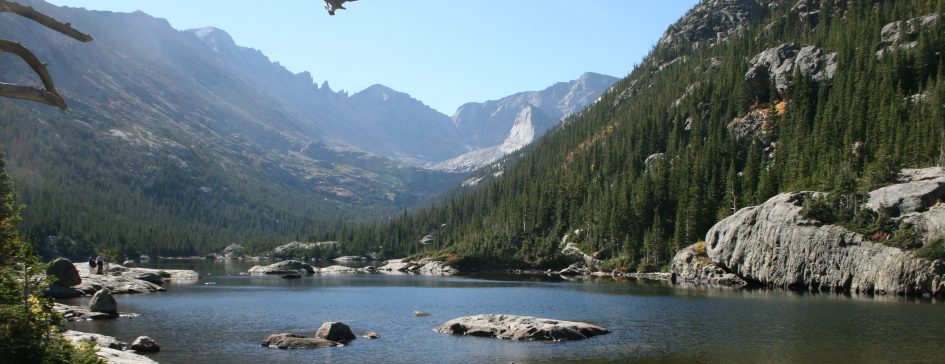

IMG_2660Florida Atlantic University is hosting the first Arctic-Florida Symposium next week (May 3-5).   This is a big event and should prove interesting  I will be speaking. The idea is to evaluate the arctic and Florida and open some dialogue.   Florida and Alaska would seem to be opposites when it comes to many things.  Alaska is cold; Florida is the land of eternal summer.  Alaska has snow and blizzards; Florida has tropical storms with pounding rain.  Sea Level rise is a critical concern to much of Florida’s coast, but much of Alaska’s coast is mountains.  Temperatures affect the permafrost in Alaska, but heat is not new in Florida, where permafrost has not existed in millions of years, if ever.  So how are these two states, located over 5000 miles apart, similar?  That was the question posed before the Arctic-Florida conference in 2016.  The result was that Alaska and Florida share many commonalities, and there is much to learn from each other.  For example, population migration is at hand in Alaska.  It is in Florida’s future.  Likewise diseases have impacted at risk areas in Alaska, portending a potential future condition for southeast Florida.  Adaptation strategies are underway in Florida, which can help in Alaska.  Roads, water supplies, water storage, wastewater and storm water are all issues that pose challenges to both states, so there are answers in infrastructure adaptation  strategies.  Many common problems can be solved by sharing information.  The Florida–Alaska connection is an example of looking outside the box to find ideas that can be useful to those deemed to be far different.  More to come on this….


DSCF0032Curtailed water use and conservation are common topics of conversation in areas with water supplies limitations.  As drought conditions worsen, the need for action increases, so when creating a regulatory framework, or when trying to measure water use efficiency, water supply managers often look for easily applied metrics to determine where water use can be curtailed.  Unfortunately, the one-size-fits-all mentality comes with a potential price of failing to fully grasp the consequences decision-making based on such metrics.

One of the issues that water supply regulator like to use is per capita water use.  Per capital water use is often used to show where there is “wasted” water use, such as excessive irrigation.  However such a metric may not be truly applicable depending on other economic factors, and may even penalize successful communities with diverse economic bases.  A heavy industrial area or dense downtown commercial center may add to apparent per capita use, but is actually the result of vibrant economic activity. Large employment centers tend to have higher per capital use than their neighbors as a result of attracting employees to downtown, which are not included in the population.

In south Florida, a recent project I was involved with with one of my students showed that while there was significant variability among utilities, but the general trend of increased economic activity was related to increased per capita use.  Among the significant actors were health care, retail trade, food service and scientific and technical services.  It appears to be these sectors that drive water use upward.  As a result when evaluating the efficiency of a utility, an analysis should be conducted on the economic sectors to insure that water regulations do not stifle economic growth and jobs in a community.   And conversely if you do not have these sectors, you water use should be lower.  Something to think about when projecting or regulating water use.  Limited water use may in fact be limiting economic activity in the area. Of course if you are water limited, limited new withdrawals may be perfectly acceptable if you want to encourage other options, like direct or indirect potable reuse, irrigation, etc.  

It would be interesting to expand this study across the country to see what the national trends look like and how different tourism oriented South Florida might actually be.


photo 2A week or so ago, on a Sunday afternoon, I flew across Middle America to Colorado for a meeting and was again struck by the crop circles that dominate the landscape west of the Mississippi River.  They are everywhere and are a clear sign of unsustainable groundwater use.  I recently participated in a fly in event for National Groundwater Association in Washington DC, where several speakers, including myself, talked about dwindling groundwater levels and the impact of agriculture, power and economies.  The impact is significant. Dr. Leonard Konikow, a recently retired USGS scientist, noted that he thinks a portion of sea level rise is caused by groundwater running off agriculture and from utilities and making its way to the ocean. He indicated that 5% of SLR each year was caused by groundwater runoff, and has upped his estimates in the past 10 years to 13%.  This is because it is far easier for water to runoff the land than seep into rocks, especially deep formations that may take many years to reach the aquifer.  And since ET can reach 4 ft below the surface, many of the western, dry, hot areas lose most of this water during the summer months.  Hence the impact to agriculture, and the accompanying local communities and their economies will be significant.

It should be noted that the US is a major exported of food to much of the world, including China, so the impact on our long-term economic trade may be significant.  Fortunately the power industry has historically preferred surface waters, but must as power demands increase, they have begun to explore groundwater in rural areas without access to surface waters.  Keep in mind that air-cooled power plants are 25% or more less efficient than water cooled systems and many of these communities lack sufficient reusable water supplied to substitute for cooling.  Hence the projection is a long term negative impact on all of us.

So the question is why isn’t the federal government talking more about this problem?  Is it fear of riling up local political officials that see growth at all costs as necessary?  It is private rights arguments that may spawn lawsuits?  Is it a lack of interest in long-term?  Or the idea that “we have always found a way”. Or is it just buried heads in the sand, leaving the next generation to deal with the problem?  A big issue, yet we do not talk enough about it.  Maybe this is not a surprise since we have not gotten very far with the discussion of limited oil, precious metals, phosphorous or other materials, and unlike them, water appears to be renewable globally.  But water is location specific.  If you have it, great.  If you lose it, a problem.  There are several recent journal articles that make the argument that much of the strife in the Middle East and Africa is water depletion related: water depletion kills local economies.  So we need to ask –what happens if we ignore the looming crisis?  Do we create more “Bundy-type” actions in the rural, dry west because they already lack water?  I suggest it is a cause for concern.


Congratulations FAU owls for placing 7th overall at the Southeastern ASCE student Competition. (28 schools)  In under 15 years we moved into the top 10 in a region with SEC schools like Alabama, Auburn, and Vanderbilt (that we finished ahead of), Tennessee and Florida (#2 and 3).  It’s FAU’s first time in the top 10.  It is a good launching point for next year when FAU hosts the competition – Civil Goes Green in 2017 (for St. Patty’s day).  And you all should be there!  Sponsorships available. 🙂

civil goes green

http://public.eng.fau.edu/design/asce2017/index.html