Archive

infrastructure


The election and post-election discussions have included some concepts about funding for infrastructure.  While this may have been more focused had Clinton been elected, it remains a discussion topic in the Trump White House.  How it would be manifested is a question, with Trump’s faction discussion private cash influxes to make this happen.  The Senate seems to view infrastructure as DOA, which means nothing might occur.  However, in any instances, there needs to be a definition of the word infrastructure and what would qualify for funding.  There are three basic types of infrastructure – public, private and regulated private.  Most SRF programs limit recipients of funding to public entities.

The infrastructure in the public arena falls into three categories which have vastly different types of infrastructures:

Local – water, sewer, stormwater/drainage, local roads, limited bridges.  In larger communities, rail and airports might be included, but the latter is mostly federal subsidies.  Much of water and sewer infrastructure is over 50 years old and is showing signs of weakening.  Buried pipelines are the most at risk.  This would include the 6 million lead services lines in place.  Sewer lines are primarily vitrified clay, also 50+ years old and likely cracked.  Stormwater is corrugated metal and concrete.  Roadway bases in most communities are historical and do not meet today’s standards.  Hence ASCE rates these a D or D-.  Municipal buildings in older communities may also have lead services, asbestos, wood and galvanized pipelines, and other issues to address. The majority of infrastructure under this definition is under local control.

State – highways and bridges – much of America’s commerce depends on these roadways.  25% of bridges need work, 10% are deficient.  Funding for rail and airports is a need from a state perspective.  States may spend more money on transportation that all other infrastructure combined.

Federal – these are very large scale projects like dikes, dams, reservoirs and water transmission systems.  It also includes national parks ($11 billion deficiency), and federal buildings.  The dikes in New Orleans are an example.  However a lot of the funds for these projects are disseminated to locals (like New Orleans), so the actual use may be unclear.

The literature suggests that public investments in infrastructure create at least a 4:1 return.  Good infrastructure is necessary for a vibrant economy.  Deteriorating infrastructure leads to …. Flint, New Orleans after Katrina, and a host of obvious failures.  The impact of climate on communities, particularly sea level rise, can be partially addressed with infrastructure improvements.  Large scale construction can secure jobs both immediately and for the foreseeable future.  The question then is how to secure finding that will lead to jobs, lead to economic development and return on those investments, and will make notable improvements.  That is the challenge at all three levels.  The easiest to address from a sill perspective is state roads and local infrastructure.  From a state perspective the work is focused on highways and transportation.  Locally, the benefit is the local labor force that requires no travel or added overhead.  Just training.  So the question is whether an infrastructure bill can/should have a jobs component built in?


Happy Halloween.  It is time for trick or treat.  Unfortunately the Sunday SunSentinel headline was a trick, not a treat.  “We’re Going to make them suffer,” was the headline – attributed to former Dania Beach Mayor and Commissioner, and now Broward Planning Council chair Anne Castro.  Oooops.  Now anyone driving in Broward County knows that the signals are not timed, which creates traffic issues during rush hours.  Everyone I talk to has the same complaint and similar stories.  I recall driving home late at night from my Dad’s condo realizing one street with a posted 45 mph sign, required people to go 52 to make the lights.  Wrong message.  Closer to my house, a main road required me to stop at every traffic light at midnight, for reasons still unclear to me.  No cross traffic.  No commercial activity.  Engineers with the County say there is too much traffic to fix it in Mondays paper despite the computers to simulate and controllers to adjust timing by cycle.  But my Dad pointed out that Detroit figured it out in the 1930s on Woodward Avenue, by hand.  I95 is being widened to add express lanes and improve traffic flow.

But the trick did not stop there.  The front page story followed with this nugget:  “Until you make it so painful that people want to come out of their cars, they’re not going to come out of their cars.”  Um, ok, but I think we have a penny sales tax referendum going on to help fund transit and transportation, but this is not helping.  Having worked for a transit company, people do not ride unless the buses come frequently enough that they don’t have to wait long.  It is a double edged sword which is why heavy investments (and losses) are required to get transit started.  Once people get used to using it, and it is convenient, they keep using it.  The bus or train ride length is less important, it is the wait that matters.  People will ride an hour if they only wait 10 minutes to get picked up.  And don’t have to walk far on either end because heat & rain matter.  I recall going to a Miami Heat game a number of years ago.  Taking TriRail and the MetroRail worked great, until I realized that there was no train back.  Not convenient.  Had to drive.  In rush hour.  Haven’t gone back.  It was so irritating I decided not to go. Not the solution business wants so I think maybe we need to rethink that statement.  Transit would help, but is needs to be convenient.  That’s what we should be selling.


This is an interesting article from the Union of Concerned Scientists.  Should we be designing for climate change within our infrastructure systems?  The obvious answer, and the one that the ASCE code of ethics suggests for engineers, is yes.  If you live in a coastal area like me, and where sea level rise is your enemy, the solutions are somewhat clearer.  But what if you are in one of those areas where the future is far less certain?  How do you plan for uncertain, uncertainty?  A new area to study and maybe find a means to address things by thinking outside the proverbial box?


Designing Infrastructure with Climate Change in Mind: Assembly Bill 2800 Becomes Law


Every water body will be different but in southeast Florida there are a couple options for Lake Okeechobee’s waters.  One option has been in discussion for years – buy back the EAA lands and restore the Everglades flow.  That has two benefits – improved water quality, and less potential for east-west releases.  The downside is cost.  But the sugar industry knows that the muck layer is decreasing and there are plans to develop the EAA into hundreds of thousands of housing units.  That was not the intention in the 1940s when the EAA was created, but trying to stop someone from developing land, especially when the lake communities are challenged economically, is difficult.  Buying the land would remove it from production, but decrease tax revenues.  And it would need to be managed with no guarantee that it would cleaned up quickly.

The alternative?  The South Florida Sun-Sentinel had a front page article that is a little scary.  The figure below is reproduced from that article.  The discussion was if there is no conservation/public purchase of land, Florida may look very different.  The impact of not buying the land is development.  More people.  More taxes.  More stormwater.  The fertilizer does not go away – it now fertilizes lawns and golf courses.  Add wastewater, and human activities.  We find that urban living and farming can have similar impacts from a nutrient perspective.  So development may exacerbate the problem and given that our modeling indicates that sea level rise imperils inland communities from groundwater, this is not a solution to coastal risk.  Given limitations with local governments inland, it may create a larger crisis.  All there things need discussion, but the question is – will the algal issues on the coast improve?

graphic-of-development

http://www.pressreader.com/usa/sun-sentinel-palm-beach-edition/20160916/281479275879132/textviewer worse?


The reliability of the assets within the area of interest starts with the design process in the asset management plan. Decision-making dictates how the assets will be maintained and effective means to assure the maximum return on investments. Through condition assessment, the probability of failure can be estimated. Assets can also fail due to a growing area that may contribute to exceeding its maximum capacity. Operation and maintenance of the assets are important in reassuring a longer life span as well as getting the most out of the money to be spent. Prioritizing the assets by a defined system will allow for the community to see what areas are most susceptible to vulnerability/failure, which assets need the most attention due to their condition, and where the critical assets are located in relation to major public areas (hospitals, schools, etc.) with a high population.

So what happens when conditions change?  Let’s say sea levels are rising and your land is low.  What would the potential costs be to address this?  Better yet, what happens if it rains? We looked at one south Florida community and the flood stage for each based on 3 storm events: the 1:10 used by FDOT (Assumes 2.75 inches in 24 hours), the Florida Building Code event that includes a 5 in in one hour event (7 in in 24 hrs), and the 3 day 25 year event (9.5-11 inches).

Of no surprise is that the flooding increases as rainfall increases.  Subsequent runs assumed revisions based on sea level rise. The current condition, 1, 2 and 3 ft sea level rise scenarios were run at the 99 percentile groundwater and tidal dates and levels.  Tables 2-5 depict the flood stage results for each scenarios.  The final task was designed to involve the development of scenarios whereby a toolbox options are utilized to address flooding in the community.  Scenarios were to be developed to identify vulnerabilities and cost effectiveness as discussed previously.

The modeling results were then evaluated based of the accompanying infrastructure that is typically associated with same.  A summary of the timelines and expected risk reductions were noted in the tables associated with storm and SLR scenarios.  This task was to create the costs for the recommended improvements and a schedule for upgrading infrastructure will be developed in conjunction with staff.  Two issues arise.  First, the community needs to define which event they are planning to address and the timelines as the costs vary form an initial need of $30 million to over $300 million long-term.  Figure 1 shows how these costs rise with respect to time.  The long-term needs of $5 million per 100 acres matches with a prior effort in Palm Beach County.

SLR costs

Figure 1  Summary of Costs over the 3 ft of potential sea level Rise by 2011, under the 3 storm planning concepts.


scan063

“Or is running a local government like s business killing it?”

I had an interesting conversation at a conference recently.  The people I was talking to were advanced in their careers and the discussion moved toward the outlook on management in public settings. Once upon a time, most public works and utility managers were civil engineers, but often they were criticized because they were focused on the engineering aspects as opposed to the people aspects of the community.  Their focus was public health and making sure things operated correctly.  Most did whatever was needed to accomplish that.

This led to schools of public administration, which actually started educating some of those same engineers about management of large public organizations, organizational theory, human resource, accounting and planning  I did all that myself at UNC-Chapel Hill.  The goal was to understand finances, people, community outreach, the need to engage citizens and as well as public service.  The outcomes were providing good service.  That however tends to cost a little more than operations although there are opportunities to be a bit entrepreneurial.

So back to the people in the conversation.  They noted that sometime in the 1980s or early 1990s the MPAs were being replaced by MBAs as politicians were focusing on operating “like a business.”  Looking at the MBAs out there, the comment was that business schools do not focus on service, but profits to shareholders, and the training is to cut unproductive pieces that detract from the bottom line.   Hence investments do not get made if the payback is not immediate.  Service is not a priority unless it helps the bottom line.  In a monopoly (like a local government), there are no other option, so service becomes a lessor priority.

So it brought up an interesting, but unanswerable question for now: has the move to more business trained people in government created some of the ills we see?  The discussion included the following questions/observations (summarized here):

  1. Many water and sewer utilities are putting a lot of time and effort into customer service and outreach now after years of criticism for failing to communicate with customers. That appears symptomatic of the monopoly business model.
  2. Our investments in infrastructure decreased significantly after 1980, and many business people focus on payback – so if the investment does not payback quickly, they do not pursue them. How does that impact infrastructure investments which rarely pay back quickly (Note that I have heard this argument from several utility directors with business backgrounds in very recent years, so the comments are not unfounded).  It does beg the questions of whether the business focus compounds our current infrastructure problems.
  3. Likewise maintenance often gets cut as budgets are matched to revenues as opposed to revenues matched to costs, another business principle. Run to failure is a business model, not a public sector model. Utilities can increase rates and we note that phones, cable television, and computer access have all increased in costs at a far faster rate that water and sewer utilities.

Interestingly though was the one business piece that was missing:  Marketing the value of the product (which is different than customer service).  Marketing water seems foreign to the business manager in the public sector.  The question arising there is whether that is a political pressure as opposed to a forgotten part of the education.

I would love to hear some thoughts…


The average is 4% of visible infrastructure is in poor condition.  Actually 4-6% depending on the municipality.  And this was visible infrastructure, not buried, but there is not particular reason to believe the below ground infrastructure is somehow far worse off.  Or better.   That 4-6% is infrastructure that needs to be fixed immediately, which means that as system  deteriorate, there is catch –up to do.  The good news is many of the visible problems were broken meter boxes, damaged valve boxes, broken curbs and broken cleanouts- minor appearing issues, but ones that likely require more ongoing maintenance that a water main.  And the appearance may be somewhat symptomatic – people perceive that the system is rundown, unreliable or poorly maintained when they see these problems.  It raises a “Tipping Point” type discussion.  “Tipping Points” Is a book written by Malcolm Gladwell that I read last year (great book – my wife found it in a book exchange for free in Estes Park last summer).  It was along a similar vein of thought as the Freakanomics books – the consequences of certain situations may be less clear than one thinks.  The Tipping point that is most relevant is crime in New York in the early 1990s after Bernard Goetz shot several assailants in the subway.  The problem was significant and the subways were thought to be among the higher risk areas.  The new police chief and Mayor decided that rather that ignore the petty crimes (like many large cities do), they would pursue those vigorously.  So fare hopping on the train and the like were challenged immediately.  They decided that no graffiti would be visible on the subways and cleaned cars every night to insure this remained the case.  Cars with graffiti were immediately removed from service.  New subway cars were ordered.  Pride and public confidence improved.  Crime dropped.  The impact of their efforts was that people recognized that criminal behavior would not be tolerated and fairly quickly criminal activity decreased.  It was a big success story, but the underlying reasons were less discussed, but easily transferrable to our infrastructure.  If we have broken valve boxes, meters, cleanouts, storm drains etc., the same perceptions of a rundown community rise.  Rundown communities lead to a loss of public confidence and trust and pride.   And none of those help our mission or our efforts to increase infrastructure spending.  4% might not look like much, but it can drastically change the perception of the community.  So let’s start to fix those easy things; and document that we did in our asset management programs.

IMG_4677


You asked for more figures – so here you  go   Very cool stuff.  All done by students.

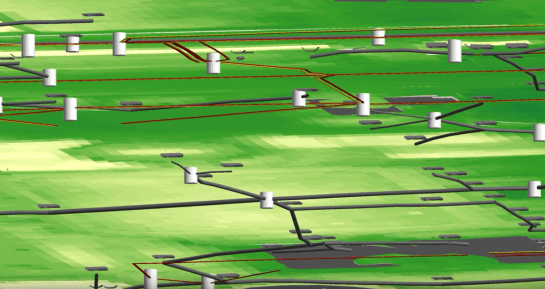
Capture2FAU 3D 23D FAU


How many utilities have a 3D map of their infrastructure?  Not many I bet.  But FAU does.  Here is a recently completed project we did with students and the Facilities Maintenance staff at FAU (costs involved).  They needed better mapping and will tie this to their work order system.  It was an excellent opportunity for two groups within one organization that otherwise seem to have little in common wot work toward a great project.  We will be inputting this data into an online asset management system this summer along with some data for Dania Beach so they will have a portion of their utility system in 3D also.  This is part of a tiny project we did for their downtown area.

GIS is a powerful tool and one utilities should embrace wholeheartedly.  There is so much more than mapping to do.  Data gathering in critical, but with Leica and Trimble units, a lot of data can be gathered easily.  LiDAR can be expensive, but the value is tremendous.  You can see that the FAU system is laid on a 3D LiDAR topographic map (6 in vertical accuracy).  Asset condition assessments were also done concurrently, which adds a lot of information to the system (all assets were also photographed and linked).  Drawing files can be downloaded and extruded from 2D to 3D. Engineers know GIS or can learn it, which makes a fully expanded GIS system for the utility easy to derive if the time is spent.  This is a valuable tool when linked to work orders and asset management programs.

So is your utility in 3D?  Capture