Archive

innovation


Fred+Bloetscher+Senate+Committee+Holds+Hearing+cQCSwINqgm3l

Water and wastewater utilities spend a lot of time dealing with current issues =- putting out “fires.”  But there are larger trends that will affect the industry.  Here are a couple recent topics that we should consider in our industry:

Will robots be doing all our repetitive jobs?  If so what does that mean for all the people doing those jobs now.  Most do not require a lot of skills, and many of those in the jobs that will be lost, do not have the skills for other jobs?  Does the $15 per hour minimum wage accelerate this transition?  How does this affect the water industry?  Meter readers might be replaced with AMR systems.  Customer service is already migrating to direct banking.  There is a change coming.

What does the driverless car mean for us?  I am thinking about an old Arnold Schwartzenegger movie.  For utilities the issue may be how we interact with unmanned vehicles, especially when what we do can be disruptive to traffic.  What happens if those cars get into an accident?  And Warren Buffett is thinking about the impact of this on the insurance industry.  He owns a lot of GEICO stock.  It is doubtful many utility vehicles will be unmanned, in the near-term, but do our manned vehicles and the potential disruption leave us open to greater risk of loss?

Speaking of Warren Buffett says the economy is far better than certain candidates suggest.  I tend to trust Mr. Buffett.  He’s been doing this a long time and has been fabulously successful.  But he notes structural changes to the economy like those noted above, are ongoing.  That will create conflict for certain professions that migrate to automation, much as manufacturing did in the 1970s.  He raises concern about what happens to those workers and suggests that we have not planned enough for those workers who get displaced as the economy undergoes continuing transitions.  In the late 1970s we had CETA and other jobs training programs as we moved from manufacturing to other jobs.  He does not see that in place now.  The at-risk – the poor, minorities, the less educated, rural citizens…. in other words, the usual groups will be hit harder than the rest of the population.  I don’t hear that discussion on the campaign trail but utilities may want to follow these trends is the hope that we can acquire some of the skillsets that we need.  Or provide that training.

Florida’s flood protection plan received a C- from a study called States at Risk.  It said Florida lacks a long term plan for rising seas, despite being vulnerable.  On an unrelated note, the state is expecting insurance premiums to increase 25% or more for flood insurance for homeowners.  And local officials are working busily on FEMA maps to exclude as many properties as possible from flood insurance requirements.  Maybe those things are all related, just at opposite purposes, but who is going to get the calls when flooding occurs?  Storm water utilities, and sewer systems where the manholes are opened to “facilitate drainage.”  The question is what the ratings are for other states as Florida was not the least prepared nor is it the only state with exposure.

A final current trend to think about is this:  Current sea level rise projections have increase the high end, but remained steady for the 50 percentile case.  By 2200 we may see seas at 10 ft higher. That would be a major problem for south Florida.  But the world population will be over 15 billion, which exceeds the carrying capacity of agriculture (at present projections and techniques).  It also places over half the world in water limited areas.  So sea level rise is going to be huge in south Florida, but will concern be localized because of more pressing issues?   Is the number of people going to be our biggest issue in 2200?  Note both will be critical for a large portion of those 15 billion people, but the solution to either is…..?


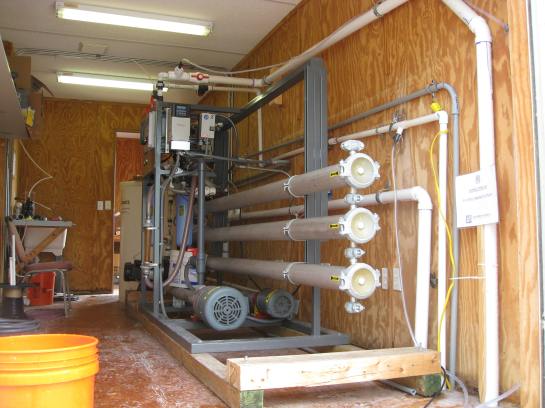
In the last blog I showed what reclaimed wastewater could do for an ecosystem.  Very cool.  But what about for drinking water.  I actually was involved in an indirect potable reuse project several years ago.  The concept was to take wastewater, filter it with sand filters, filter it with microfiltration, reverse osmosis and then hydrogen peroxide and ultraviolet light.  This is what they do in Orange County California when they recharge groundwater, and have been for over 30 years.  Epidemiological studies in the 1990s indicated no increased incidence of disease when that water was withdrawn from the aquifer, and then treated in a drinking water plant before distribution.  So our project was similar – recharge to the Biscayne aquifer in south Florida.   It worked for us.  Total phosphorous was below 10 ppb, TDS was less than 3 mg/L (<1 after RO), and we were able to show 3 log removal of endocrine disruption compounds an d pharmaceuticals.  It worked well.  This is a concept in practice in California.  And will be at some point in south Florida since only the Biscayne aquifer provides sustainable water supplies.  Here is what our system looked like.

IMG_3100

sand filters

IMG_3106

microfiltration

IMG_3085

Reverse osmosis

IMG_3152

ultraviolet/peroxide

This is also the same basic concept Big Springs Texas uses for their direct potable program, demonstrating that the technology is present to treat the water.  A means for continuous monitoring is lacking, but Orange County demonstrates that for indirect potable reuse projects, a well operated plant will not risk the public health.  This is how we do it safely.


photo 2Over the holidays there were a couple articles that came out about groundwater issues in the US, mostly from the declining water level perspective.  I also read a paper that suggested that rising sea level had a contribution from groundwater extraction, and of course USGS has maps of areas where the aquifer have collapsed as a result of overpumping.  In 2009 USGS published a report that showed a large areas across the country with this issue.  The problem is that of the 50,000 community water systems in the US, 500 serve over 50% of the population, and most of them are surface water plants.  There are over 40,000 groundwater systems, but most are under 500 customers.  Hence, groundwater is under represented at with the larger water associations because the large utilities are primarily surface water, while the small systems are groundwater. AWWA has difficulty reaching the small systems while RWA and NGWA reach out to them specifically.  But the small utility seems more oriented to finding and producing water and operating/maintaining/drilling wells than the bigger impact of groundwater use.  It is simply a matter of resources.  I ran a system like that in North Carolina, and just getting things done is a huge issue.  A couple of my medium size utility clients have the same problem.

The bigger picture may contain the largest risk.  Changing water supplies is a high cost item.  We have seen a couple examples (surface water) as a result of drought.  We saw Wichita Falls and Big Springs TX go the potable reuse route due to drought.  California is looking at lots of options. Both have had rain lately (Wichita Falls discontinued the potable reuse when the reservoir got to 4% of capacity).  Great, but someone is next.  Droughts come and go, and the questions is how to deal with them.

Groundwater supposedly is a drought-proof problem, but is it?  Groundwater has been a small utility solution, as it has been for agriculture.  But aquifer require recharge and water limited areas do not have recharge.  The result is a bigger problem – overpumping.  Throughout the west/southwest, Plains states, upper Midwest (WI, MN, IA), southeast (SC, NC), we see this issue.  Most of these areas have limited surface water so never developed much historically.  Rural electrification changes that because it made is easy to put in an electric pump to pull water out of the ground in areas that never had a lot of water on the surface, and hence were not farmed much. Pumps made is easier to farm productively, which led to towns. However, our means to assess recharge are not very good, especially for confined aquifers. The lowering water levels USGS and state agencies see is an indication that recharge is normally over estimated giving a false picture of water availability.  If your aquifer declines year after year, it is not drought – it is mining of the aquifer. You are sucking it dry like the eastern Carolinas did.  But, like many negative things, there is a lack of willingness to confront the overpumping issue in many areas. There are many states with a lack of regulations on groundwater pumping.  And I still think groundwater modeling use is limited to larger utilities, when smaller, rural systems may be most in need of it due to competing interests.

Concurrently, I think there is a tendency to oversell groundwater solutions (ASR, recharge), groundwater quality and the amount of available water (St George, UT).  Easy, cheap, limited treatment should not be the only selling point.  That leads to some curious decisions like some areas of California north of LA the utilities do not treat hard groundwater – then tell residents they cannot use softeners because of the salt in the wastewater prevents it from being used for reuse.  The reason they do not treat – cost, but it makes things difficult for residents.  The fact is we do not wish to confront is the realization that for many places, groundwater should probably be the backup plan only, not the primary source.

That leads to the question – what do we do about it when every politician’s goal is for their community to grow?  For every farmer to grow more crops?  But can they really grow sustainably?  DO we not reach a point where there are no more resources to use?  Or that the costs are too high?  Or that competition become unruly?  The growth and groundwater use ship is sailing, but in to many cases they do not see the rocks ahead.


IMG_8055So as 2016 starts, it is time to look at goals for the coming year.  I have several project in mind that I would like to make progress on this year. The first is interesting.  We have embarked on a project that looks at engineering ethics.  The study have several parts:

  1. Historical context
  2. Engineering societies
  3. Laws and rules by the state
  4. Perceptions
  5. Future directions

One of my reference points is an old publication from ASCE by Murray Mantell, who I got to know about 15 years ago.  He wrote such a book in 1964 when he was char of the University of Miami’s Department of Civil Engineering.  I believe he has since passed on, but I have used his book in some of my courses.

Other references come from contact with the Board of Professional Engineers in each state and various society’s code of ethics, and historical versions of same. However a “hole” in our project is the perceptions piece.  Views change with time and with technology.  Things like competition, lobbying, risk and costs create added pressures on engineers and a need to react to those pressures.  So what we would like to do is create a survey monkey survey for engineers, professional and not to respond to as a means to evaluate perceptions.

I do not have ready access to a database for this purpose.  Gathering data form many states would be difficult as well and duplicative as many engineers have multiple licenses.  However, your organization does not have this constraint.  So I am reaching out to several societies to see if there is a means to collaborate on this endeavor.  The program is as follows:

  1. Complete the questionnaire (I have a draft but if anyone has thoughts on what we should ask, I would love to hear them)
  2. Make any final changes and launch it
  3. Send notices to members.

I am hoping that some of these organizations will find benefit and will agree to participate by emailing the survey link to their members.  I will compile the data and we expect to publish it.  Most of the work so far is being done via email, and thanks to some prior students for gathering information on it.  I have a ways to go here though.  So what are your thoughts?  If anyone can help with ASCE, NSPE, ACEC, etc, I would appreciate it.  And if you get that email with a link, I would appreciate your input and comments.


So everyone is doing their Top 10 questions for 2016 (although with David Letterman off the air, perhaps less so), I figured why not?  So it the vein of looking forward to 2016, let’s ponder these issues that could affect utilities and local governments:

  1. How wild, or weird will the Presidential election get? And part b, what will that do to America’s status in the world?  Thinking it won’t help us.  Probably won’t help local governments either.
  2. Will the economic recovery keep chugging along? Last time we had an election the economy tanked.  Thinking a major change in direction might create economic uncertainty.  Uncertainty (or panic) would trickle down.  Status quo, probably keeps things moving along.  .
  3. What will the “big” issue be in the election cycle and who will it trickle down to local governments and utilities? In 2008 it was the lack of health care for millions of Americans and the need for a solution. Right after the election we got the Great Recession so most people forgot about the health care crisis until the Affordable are Act was signed into law.  And then ISIS arose from a broken Iraq and Arab summer.  None helped local governments.
  4. What are we going to hear about the 20 richest Americans having more assets than the bottom 150 million residents? 20 vs 150,000,000.  And while we are at it, the top 0.1% have more assets than the bottom 90%, the biggest disparity since the 1920s.  While we will decide that that while hard work should be rewarded, the disparity is in part helped by tax laws, tax shelters, lobbying of politicians, etc. as Warren Buffett points out, indicate a discussion about tax laws will be heard.  Part b – if we do adjust the tax laws, how will we measure how much this helps the bottom 99.9%?
  5. What will be the new technology that changes the way we live? Computers will get faster and smaller.  Phones are getting larger.  Great, but what is the next “Facebook”?  By the way the insurance folks are wondering how the self driving car will affect the insurance industry.  So reportedly is Warren Buffett.  Watch Mr. Buffett’s moves.
  6. Along a similar vein, will the insurance industry start rethinking their current risk policies to look at longer term as opposed to annual risk? If so what does that mean for areas where sea levels are rising?  The North Carolina coast, where sea level rise acceleration is not permitted as a discussion item could get tricky.
  7. Will unemployment (now 5%) continue to fall with associated increases in wages? Will that help our constituents/customers?  Will people use more water as a result?
  8. Where is the next drought? Or flood?  And will the extremes keep on coming?  Already we have record flooding in the Mississippi River in December – not March/April?  Expect February to be a cold, snowy month. IT is upper 80s here.  Snowing in the Colorado Rockies.
  9. Will we continue to break down the silos between water “types” for a more holistic view of water resources? We have heard a bunch on potable reuse systems.  More to come there, especially with sensors and regulations.  But in the same vein, will we develop a better understanding of the link between ecosystems and good water supplies, and encourage lawmakers to protect the wild areas that will keep drinking water cleaner?
  10. Will we get water, sewer, storm water, etc. customers to better understand the true value of water, and therefore get their elected official on board with funding infrastructure neglect? And will that come as a result of better education, a better economy, breaking down those silos, drought (or floods), more extreme event, more breaks or something else?

Happy New Year everyone.  Best to all my friends and followers in 2016!


The number of people that recall the Dust Bowl of the 1930s is dwindling and that may portend poorly for society (likewise the loss of Depression memories and two world wars).  The Dust Bowl was aptly names for the regular storms of windblown dust that pummeled farm fields and blew away valuable topsoil needed by farmers.  Why it occurred was more interesting and foretelling.

The amount of farming had exploded in the late 1920s as a result of  record wheat price, motorized tractors and government programs encouraging farmers to plow up the prairie and plant.  The crops replacing the native plants did not have the same root structure and were less drought tolerant as a result.  When wheat prices collapsed, the fields were left fallow exposing the topsoil to the elements.  Since the topsoil was no longer anchored to the soil by plants, the wind and lack of rain caused much of the topsoil to migrate with the wind as dust.  Topsoil was lost, rain ran off, transpiration decreased, and the cycle just go worse.   Up to 75% of he topsoil was lost.

Rains returned in the 1940s but much of the dry farming (no irrigation) practice was immediately converted to wet framing using deep wells to capture water from aquifers.  The result was healthier crops, more consistent yields and protection of the remaining topsoil as a result.  Or is it?

Visit California today.  They are in the midst of severe drought conditions. Farmers have attempted to protect themselves by drilling more wells – deeper wells which diminish water supplies to the shallower neighboring wells.  Water levels decline, land subsides, the aquifer collapses, and there is little recharge.  Some areas of the central valley have sunk over 8 feet in the past 100 years.  But we have up until this point, had healthier crops and more productive yields, which protects the valley until the rains return.  Or does it?

While the lack of rainfall is a natural cycle, there is an argument to be made that man-made impacts have exacerbated the situation.  In the Dust Bowl states, the initial error was plowing up the native grasses without understanding how they had adapted to the mostly dry conditions on the prairie.  Many of the prairie states receive under 20 inches or rain each year, and scarcely any during the summer, which limited evapotranspiration, which limits thunderstorm and regional rainfall activity.  Less ET = drier conditions.  So growing crops is not what one would immediately identify and a “normal” land use for the prairie.  We altered the environment, but the Midwestern farming thought process doesn’t work in the dry prairie.  Irrigation was needed, but the lack of surface water limited irrigation unless wells are used.  Wells were drilled which returned and improved crop yields, but the well use has caused massive decreases in aquifer levels in the prairie states. The amount of water is finite, so as long as withdrawal exceed recharge, and with only 20 inches of rain that mostly runs off the land, there is a point in time when the well runs dry.  As the well runs drier, productivity will fall.  The interim fix is drill deeper, but the bottom of the aquifer is in sight.  Then, fields will be fallow, agriculture will be impacted dramatically, and it is not inconceivable the Dust Bowl type conditions could reoccur. Policies by man exacerbate the problem because the prairie productivity is accelerated will above its natural condition.

Likewise much of the land subsidence problem in California is irrigation driven – water is pulled through wells in an ever increasing competition to maintain one’s crop yield.  Water wars and fights with one’s neighbors over wells drying up is increasing more common as irrigation needs increase and recharge to the aquifer is diminished.  Much of California is even drier than the Dust Bowl states, and more reliant or wells and irrigation.  Less water also means less ET which means less local rainfall.  So while California has done much to protect itself over the years from drought, the current experience says that declining aquifer levels means we have exceeded the productivity of that state as well.  So is the California Dust Bowl coming?

Man is an ingenious creature.  We overcome much that the Earth throws at us.  But at the same time, we rarely consider the consequences of our actions in overcoming the challenges Earth poses.  These two examples show how our efforts to solve one problem, may actually damage the long term sustainability of these areas.  Short term gain, long term problem.


Interesting that while we all love low gas prices and the low cost of energy is fueling an expansion of our economy, including the first gains in middle income salaries since 2008, the states reliant on oil and gas may be facing real problems financially.  A year ago I read an article that noted the reluctance of North Dakota residents and politicians to invest in roads and other infrastructure despite the influx of oil money.  Keep taxes low was the mantra.  SO they did.  A recent Governing magazine article notes that a dollar drop in oil means $7.5 million decrease in revenues for the State of New Mexico.  Since oil has lost about $30 a barrel in the past year – that is $200 million loss.  Louisiana sees a $12 million cost/dollar drop so they have $171 billion less to work with.  Alaska, perhaps the most oil dependent budget (90 percent) has a $3.4 billion shortfall, but $14.7 billion in revenues.  Texas, North Dakota, Oklahoma and Kansas are other states facing losses.  Fast growing states like North Dakota and Wyoming now have hard decisions to make.  Growth in Texas, Oklahoma, Louisiana and Arkansas may be cut by 2/3 of prior estimates as a result.  A double hit on anticipated revenues.

The comparison is interesting financial straights experienced by the “property value” states like Florida, Nevada and Arizona before and after the economic collapse in 2008.  Florida politicians couldn’t wait to cut taxes and slow spending during boom years, then got caught badly after the 2008 recession when property values dropped in half and state sales tax revenues (tourism) dropped steeply.  They ran out of reserves and refused to raise taxes (after cutting them), so cut things like education and health care to balance the budget.  Not sure how either helped low and middle class Floridians get back on track since Florida has primarily create low wage jobs since that time, not high paying jobs.  We are paying the price still.  I am guessing Nevada and Arizona are similar.

We clearly have not learned the lessons of the many mill towns in the south or the rust belt cities of the Midwest that encountered difficulties when those economies collapsed. Everyone refused to believe the good times would end.  Now Detroit is half of its former self and Akron has the same population as it did on 1910.

The moral of the story is that booms great, but short term.  Diversity in the economy is a key.  Florida will continue to be subject to economic downturns more severe than other states when it relies primarily on tourism and retirees to fuel the economy.  Detroit relied on automobiles, Akron rubber and chemicals, Cleveland steel, etc.  Some day the Silicon Valley will suffer when the next generation of technology occurs that makes the current works obsolete.  It is what happens when you are a “one economy” town.  It is also what happens when you believe the booms are “normal” and fail to financially plan by putting money aside during the boom to soften the subsequent period.

An argument could be made that if the federal government had not enacted tax cuts in 2000 when the budget was finally balanced and surpluses were presumed to loom ahead, we could have banked that money (or bought down our debts), and the amount of borrowing would have been less in 2008.  Buying down debt when times are good is good business.  So is putting money in reserve.  The question is why the politicians do not understand it.  We can run government like a business financially, but takes leadership to do it.  It takes leadership to explain why reserves are good and tax cuts are a future problem.  It takes leadership to make hard decisions like raising taxes, spending more on infrastructure, requiring people to move out of flood plains, not rebuilding in vulnerable areas, and curtaining water use policies when they damage society.  Leadership is making decisions that help the needs of the many, versus the needs of the few.  Oh wait, I see the issue now.  We need Spock to lead us…


Power costs are stable.  Gas prices decreased markedly in 2014 Oil futures are low compared to 2013 and earlier.  .  Production is constant.  Low energy likely is fueling an economic expansion.  Gas economy in vehicles is at an all-time high.  Fuel efficiency lowers GHGs and cuts oil imports.  America is less reliant on foreign oil.  We have more money in our pockets.  Utility power costs and vehicle costs are lower.  Generator operations are lower.  Life is great.  Or is it?


Well, that depends on who you talk to.  Politicians in states with in oil and gas based economies are scrambling to deal with large deficits in their budgets.  The railroads are not happy over the Keystone pipeline vote.  Green energy manufacturer are unhappy.  Environmentalists are unhappy.    Heck even the Koch brothers are probably not completely happy


The first issue is methane gas.  Pipelines and fracking operations lose about 6% of the gas. A Washington Post article estimates 8 million metric tons of methane is lost each year.  That is where we are trying to capture and transport it.  The Bakken fields lack pipelines for gas, so much if it may be flared.  The amount of fracking will continue (Florida Power and Light has said it will get into the business – but outside of Florida), so more exploration will likely lead to more methane escaping.  Why do we care?  Methane is 22 to 80 times the greenhouse gas that carbon dioxide it (depending on who you talk to).  It accounts for 9% of GHG emission in the US – a third of that from the oil and gas industry.  That gas is concentrated in the western US which makes them ripe for regulation.


Enter cap and trade.  The cap and trade “industry” has been opposed by the oil and gas industry for years.  However there are a number of groups –from Indian tribes to NextEra Energy are posed to benefit from cap and trade (C&T) rules.   They have reduced their carbon footprint enough that they can sell carbon credits.  It is doubtful that this Congress with pass C&T legislation, but much of the regulatory focus could be shifted if C&T was in place.  C&T could accelerate green energy efforts.


Green energy folks want continued subsides or policies that encourage increased green power supplies, improve technology and reduce prices – all at the same time.  Rolling out a major change in the energy picture is a huge investment that will not gain traction without policies to encourage it   At least for now, green energy creates more jobs per KW-hr than conventional oil and gas, primarily in research and development and product manufacturing.  Sewing up the patents would portend positively for America in the 21st century, much as sewing up the car, gas engine, and nuclear patents did for the 20th century.  He who owns the technology should benefit.  Unfortunately that isn’t the Koch brothers who are unhappy with green energy but are happy that lower oil prices might decrease the competition in the future when oil prices inevitably rise.  But America would be better off in a non-oil based economy in 50 years if we developed an energy policy to address these issues with a long-term view.


However, that would take a lot of business and political leadership to overcome some of those who do not want change.  These are people who have more money than the Concord coach makers who could not fight the technology change to automobiles in the early 20th century.  It also takes a vision of what America should look like in 50 years. We might be short on those visionaries.  And how will utilities be a part of it.


ASCE came out with more bad news about infrastructure.  60 Minutes did a piece about deterioration of bridges. The magazine American City and County has published a couple articles about the risks of aging infrastructure.  Asset management is practiced by few governments, and even fewer small ones.  The public doesn’t want to foot the bill and lobbyists want taxes cut further.  Where does it end?

The infrastructure crisis is a political and business leadership crisis.  Or vacuum.  The economy of America and much of the developed world was built on advanced (for their time) infrastructure systems constructed by governments with a vision to the future.  Some of this infrastructure was repurposed (federal interstate system for example), but much of it has addressed critical issues that hampered our development.  For example, the lack of water severely inhibits many third world nations.  Even when they have water, it is unsafe to drink or use.  In America, at the turn of the 20th century 1:100,000 people DIED each summer from typhoid.  Just typhoid, not all the other waterborne disease options.  Many more were sick.  And the population was much smaller.  Talk about reduced productivity.  Now we have advanced water systems, disinfection practices that protect people and pipes, and few event get sick from contaminated water.  Those that do, become headlines.  You don’t want to be a headline.  Productivity is up.  But we expect good water and can’t see the pipes.

Sewer is an even better example.  People just don’t want to know.  Flush and it’s gone.  But the equipment, treatment and materials may be even more complex than the water system.  But few people get sick from sewage because of the systems we have built.  Now think about third world examples.  Or conditions you have seen in documentaries, the news or movies.  Being in sewage is not a great place to be.  Even the manhole thriving cockroaches agree..

Stormwater is probably the laggard here, in part because changes in development patterns have overwhelmed the old systems.  Miami Beach experienced this when redevelopment replaced small houses on permeable lots with large housed with mostly impermeable property.  Oops.  Meanwhile road and bridges have received a lot of funding – with much to do (see bridge that collapsed on I-75 in Cincinnati a few weeks back).  Most states fund transportation at a magnitude more than water and sewer.

What is the problem?  Local officials do not convey an understanding of these complex system to the public very well.  In part this may be because understanding the maintenance needs is difficult and highly variable.  And many do not fully comprehend the assets they have, their condition, life expectancy or technological needs.  No one knows when things will fails, so maintenance or replacement of some equipment or pipeline is always the thing cut in the budget, with no real understanding of the consequences.

The public does not see the asset, assumes it will have a long life, so is unconcerned until they are affected.  Then it is personal.  The public does not understood the impact or value that these assets have to society – they tend to be personal focused, not societal.  That is a leadership issue.  That leadership starts with vision and communication from those that understand the issue to the elected officials that need to advocate for their infrastructure.  Elected officials need to take ownership of infrastructure.  It is like your house – you need to upgrade and protect it constantly.  You do not let that roof leak keep leaking!  Elected officials that do not invest in infrastructure, are letting the roof leak.  Making is someone else’s problem for political expediency is not leadership.

Despite the infrastructure crisis, the good news is that construction of piping is increasing – both new and replacement.  Every so many months, the magazine Utility Contractor will note current trends and pipe seems to be going up.  That’s good but there is a long way to go.  Better news – the construction of buildings is increasing.  That could lead to more revenues.  In Florida, all of a sudden finding experienced construction workers is a problem.  Things are definitely better economically, but are we taking advantage to improve the local infrastructure, or is you economy simply an infrastructure disruption away from another fault?


2014 is almost over.  Hard to believe.  I have been attending or annual Florida Section AWWA conference, meeting up with old friends, making new ones and learning new things.  Conferences and connections allow us to do our jobs more efficiently because as we learn how to solve problems or where we can find a means to solve whatever problem we encounter.  It is a valuable experience that I encourage everyone to get involved with, especially young people who need to make connections to improve their careers.  The technical sessions seemed to be well received and popular.  That means that there are issues that people want to hear about.  Things we focused on were alternative water supplies, water distribution piping issues, disinfection byproducts, ASR and reuse projects.

The reuse projects focused on Florida efforts to deal with 40 years of reuse practice and a movement toward indirect potable reuse. This is the concept where we treat wastewater to a standard whereby it can be put into a waterway upstream of a water supply intake or into the aquifer upstream of wells.  The discussion was extended to a number of discussions about water shortages and solutions for water limited areas.  Florida averages 50-60 inches of rain per year as opposed to the 6-10 inches in areas of the southwest or even 15-20 inches in the Rockies which makes the concept of water limitations seem a bit ludicrous for many, but we rely on groundwater that is recharged by this rainfall for most of our supplies, a lack of topography for storage and definitive wet and dry seasons that do not coincide with use.

The situation is distinctly different in much of the US that relies on surface waters or is just plain water limited.  We have a severe multi-year drought going on in California and huge amounts of groundwater being used for irrigation in many rain-challenged areas.  That is what all those crop-circles are as you fly over the Plains states and the wet.  Where you see crop circles, think unsustainable water supplies.  They are unsustainable because there is no surface water and the recharge for these aquifers is very limited.  Most leakance factors in aquifers is over estimated and hence water levels decline year after year.   Water limited places need answers because agriculture often out-competes water utilities, so in the worst of those areas, there are discussions about direct potable reuse (which occurs in Texas).

Direct and indirect potable reuse are offered as answers which is why this topic was popular at our conference.  A recent 60 Minutes presentation included a tour and discussion of the Orange County Groundwater Replenishment program, where wastewater is treated and injected into the ground for recovery by wells nearer to the coast.  They discussed the process (reverse osmosis, ultraviolet light and peroxide) and they took a drink.  “Tastes like water” was Leslie Stahl’s comment – not sure what she expected it to taste like, but it provides a glimpse into the challenge faced by water utilities in expanding water supplies.   Orange County has been injecting water for many years into this indirect potable reuse project.  The West Coast Basin Barrier Project and several others in California have similar projects.  South Florida has tested this concept 5 times, including one by my university, but no projects have yet been installed.

But until recently, there were no direct potable reuse projects where wastewater is directly connected to the water plant.  But now we have two – both in Texas with a number of potential new projects in the pipeline.  Drought, growth, water competition have all aligned to verify that there many are areas that really do not have water, and what water they do have is over allocated.  A 50 year plan to manage an aquifer (i.e.. to drain it) is not a sustainable plan because there may not be other options.  But Texas is not alone.  Arizona, Nevada, New Mexico, Utah, Colorado, The Dakotas, Kansas Oklahoma and I am sure others have verified water limitations and realize that sustainable economic activity is intrinsically linked to sustainable water supplies.  Conservation only goes so far and in many of these places, conservation may be hitting its limits.  Where your rainfall is limited and/or your aquifer is deep, replenishable resource is not always in the quantities necessary for economic sustainability.  Water supplies and economic activity are clearly linked.

So the unimaginable, has become the imaginable, and we now have direct potable reuse of wastewater.  Fortunately we have the technology – it is not cheap, but we have demonstrated that the reverse osmosis/ultraviolet light/advanced oxidation (RO/UV/AOP) process will resolve the critical contaminant issues (for more information we have a paper we published on this). From an operational perspective, RO membranes, UV and chemical feeds for AOP are easy to operate, but there are questions about how we insure that the quality is maintained.  The technical issues for treatment are well established.  Monitoring is a bit more challenging – the question is what to monitor and how often, but even this can be overcome with redundancy and overdosing UV.

But drinking poop-water? The sell to the public is much more difficult.  It is far easier to sell communities without water on the idea, but the reality we need to plan ahead.  There are no rules.  There are no monitoring requirements, but we MUST insure the public that the DPR water they are drinking is safe.  WE are gaining data in Texas.  California and Texas are talking about regulations.  The University of Miami has been working of a project where they have created a portion of a dorm that makes its own water from wastewater.  Results to come, but the endeavor shows promise.