Archive

management


scan063

“Or is running a local government like s business killing it?”

I had an interesting conversation at a conference recently.  The people I was talking to were advanced in their careers and the discussion moved toward the outlook on management in public settings. Once upon a time, most public works and utility managers were civil engineers, but often they were criticized because they were focused on the engineering aspects as opposed to the people aspects of the community.  Their focus was public health and making sure things operated correctly.  Most did whatever was needed to accomplish that.

This led to schools of public administration, which actually started educating some of those same engineers about management of large public organizations, organizational theory, human resource, accounting and planning  I did all that myself at UNC-Chapel Hill.  The goal was to understand finances, people, community outreach, the need to engage citizens and as well as public service.  The outcomes were providing good service.  That however tends to cost a little more than operations although there are opportunities to be a bit entrepreneurial.

So back to the people in the conversation.  They noted that sometime in the 1980s or early 1990s the MPAs were being replaced by MBAs as politicians were focusing on operating “like a business.”  Looking at the MBAs out there, the comment was that business schools do not focus on service, but profits to shareholders, and the training is to cut unproductive pieces that detract from the bottom line.   Hence investments do not get made if the payback is not immediate.  Service is not a priority unless it helps the bottom line.  In a monopoly (like a local government), there are no other option, so service becomes a lessor priority.

So it brought up an interesting, but unanswerable question for now: has the move to more business trained people in government created some of the ills we see?  The discussion included the following questions/observations (summarized here):

  1. Many water and sewer utilities are putting a lot of time and effort into customer service and outreach now after years of criticism for failing to communicate with customers. That appears symptomatic of the monopoly business model.
  2. Our investments in infrastructure decreased significantly after 1980, and many business people focus on payback – so if the investment does not payback quickly, they do not pursue them. How does that impact infrastructure investments which rarely pay back quickly (Note that I have heard this argument from several utility directors with business backgrounds in very recent years, so the comments are not unfounded).  It does beg the questions of whether the business focus compounds our current infrastructure problems.
  3. Likewise maintenance often gets cut as budgets are matched to revenues as opposed to revenues matched to costs, another business principle. Run to failure is a business model, not a public sector model. Utilities can increase rates and we note that phones, cable television, and computer access have all increased in costs at a far faster rate that water and sewer utilities.

Interestingly though was the one business piece that was missing:  Marketing the value of the product (which is different than customer service).  Marketing water seems foreign to the business manager in the public sector.  The question arising there is whether that is a political pressure as opposed to a forgotten part of the education.

I would love to hear some thoughts…


The average is 4% of visible infrastructure is in poor condition.  Actually 4-6% depending on the municipality.  And this was visible infrastructure, not buried, but there is not particular reason to believe the below ground infrastructure is somehow far worse off.  Or better.   That 4-6% is infrastructure that needs to be fixed immediately, which means that as system  deteriorate, there is catch –up to do.  The good news is many of the visible problems were broken meter boxes, damaged valve boxes, broken curbs and broken cleanouts- minor appearing issues, but ones that likely require more ongoing maintenance that a water main.  And the appearance may be somewhat symptomatic – people perceive that the system is rundown, unreliable or poorly maintained when they see these problems.  It raises a “Tipping Point” type discussion.  “Tipping Points” Is a book written by Malcolm Gladwell that I read last year (great book – my wife found it in a book exchange for free in Estes Park last summer).  It was along a similar vein of thought as the Freakanomics books – the consequences of certain situations may be less clear than one thinks.  The Tipping point that is most relevant is crime in New York in the early 1990s after Bernard Goetz shot several assailants in the subway.  The problem was significant and the subways were thought to be among the higher risk areas.  The new police chief and Mayor decided that rather that ignore the petty crimes (like many large cities do), they would pursue those vigorously.  So fare hopping on the train and the like were challenged immediately.  They decided that no graffiti would be visible on the subways and cleaned cars every night to insure this remained the case.  Cars with graffiti were immediately removed from service.  New subway cars were ordered.  Pride and public confidence improved.  Crime dropped.  The impact of their efforts was that people recognized that criminal behavior would not be tolerated and fairly quickly criminal activity decreased.  It was a big success story, but the underlying reasons were less discussed, but easily transferrable to our infrastructure.  If we have broken valve boxes, meters, cleanouts, storm drains etc., the same perceptions of a rundown community rise.  Rundown communities lead to a loss of public confidence and trust and pride.   And none of those help our mission or our efforts to increase infrastructure spending.  4% might not look like much, but it can drastically change the perception of the community.  So let’s start to fix those easy things; and document that we did in our asset management programs.

IMG_4677


You asked for more figures – so here you  go   Very cool stuff.  All done by students.

Capture2FAU 3D 23D FAU


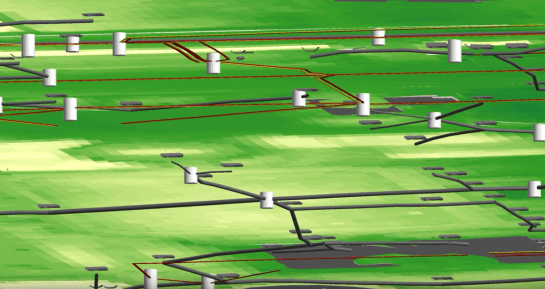
How many utilities have a 3D map of their infrastructure?  Not many I bet.  But FAU does.  Here is a recently completed project we did with students and the Facilities Maintenance staff at FAU (costs involved).  They needed better mapping and will tie this to their work order system.  It was an excellent opportunity for two groups within one organization that otherwise seem to have little in common wot work toward a great project.  We will be inputting this data into an online asset management system this summer along with some data for Dania Beach so they will have a portion of their utility system in 3D also.  This is part of a tiny project we did for their downtown area.

GIS is a powerful tool and one utilities should embrace wholeheartedly.  There is so much more than mapping to do.  Data gathering in critical, but with Leica and Trimble units, a lot of data can be gathered easily.  LiDAR can be expensive, but the value is tremendous.  You can see that the FAU system is laid on a 3D LiDAR topographic map (6 in vertical accuracy).  Asset condition assessments were also done concurrently, which adds a lot of information to the system (all assets were also photographed and linked).  Drawing files can be downloaded and extruded from 2D to 3D. Engineers know GIS or can learn it, which makes a fully expanded GIS system for the utility easy to derive if the time is spent.  This is a valuable tool when linked to work orders and asset management programs.

So is your utility in 3D?  Capture


My grandmother lost here summer cabin outside of Grayling, Michigan in the Great Crawford County fire on 1990.  My grandfather had hauled the cabin and out buildings up to Grayling by rail from Detroit in the 1920s (some old houses my Great Grandmother had owned).  It was one of many fires that year, but an early one caused by significantly less snow over the prior winter, high winds, and carelessness.   The cabin was gone before anyone could react as it appears to have been in the dead center of the moving flames.  I recall the story on CNN, but no one realized exactly where it was.  My grandmother never recovered.  She wasn’t the only one.  20 year later there are trees.

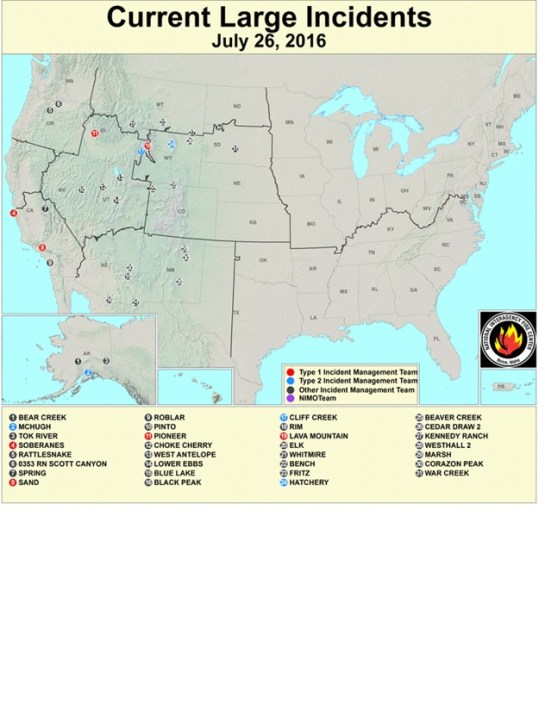
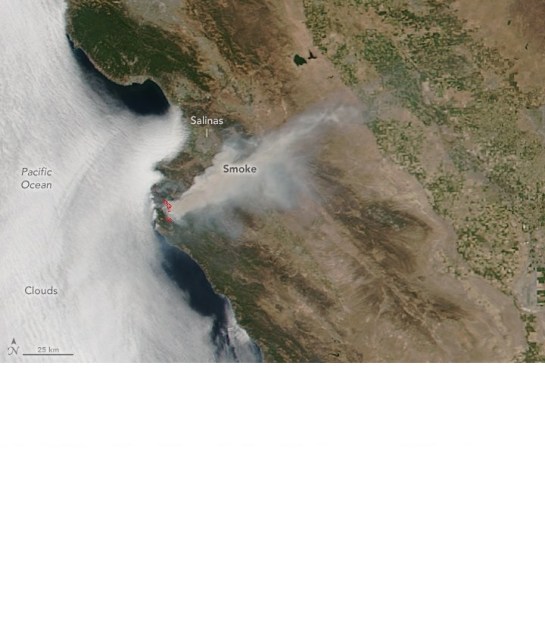
Forest fires happen with increasing frequency. Today in Southern California, the Sand Fire has set more than 35,000 acres of the Santa Clarita Valley ablaze.  Difficulties fighting it are not limited to temperatures hitting 101 degrees in the area and dried brush from 5 years of drought conditions.  The Soberanes Fire in Monterey County has burned 16,100 acres along the California coast between Carmel and Big Sur. The fire is bigger than the size of Manhattan.  The 778 acre McHugh Fire located on the steep terrain south of Anchorage, Alaska.  Looking at the map, it seems the west is on fire.  A larger and larger portion of the US Forest Services’ budget gets spent on fire-fighting each year – 67% in 2016.  Yet fires on Forest Service property account for only 20% of the total fire nationally (1.9 million acres or a total of over 10 million acres in 2015), but this total amount is increasing.  Warmer weather in the west has increased the length of fire season, drought has increased the risk, budgets are stagnant so means to prevent fire intensity have been reduced, The only good news is that a University of Vermont study suggests that areas where pine beetle has killed trees is actually thinner and less at risk that heathier forests, if that is a “good” thing.

My friend Dr. Chi Ho Sham did some work on forest fires on watersheds a few year back.  He found that forest fires have obvious impacts on people and our customers, but also our water supplies and our water supplies.  The ash runs off into streams and is difficult to remove at water plants because it is so fine.  Areas burned are far more subject to erosion after rain of snow melt thereby creating a need for more treatment at water plants.  This will go on for some time after the rain until groundcover can re-establish itself.  Fire retardant and water drops combat some fires although the retardant shows up in streams and water supplies with adverse impacts.  Dams and reservoirs will need more frequent dredging due to buildup, and wildlife equilibrium will be disrupted.  Forest fires make for interesting news, when they are far away, but few utilities think too much about what would happen if their watershed were impacts.  No groundwater utility has thought about impacts on surficial groundwater although that might be an interesting study.  But we should all have plans, should watch our watershed, and be cognizant that far away fires might give us the opportunity to study what could possibly go wrong at our utilities.  Meanwhile, our thoughts are with those in the realm of the conflagrations.  Be Safe!!


July FIRes 2016

Current Fire map – July 2016 Sources; http://activefiremaps.fs.fed.us/

San Fran Fire satteliteSatellite photo of fire outside San Francisco  Source NASA Earth
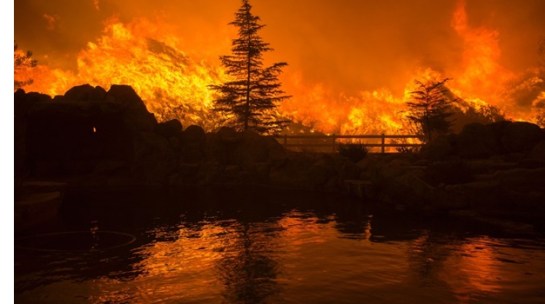
CNN photo forest fire CAFIre outside Santa Clarita CA July 2016Source CNN
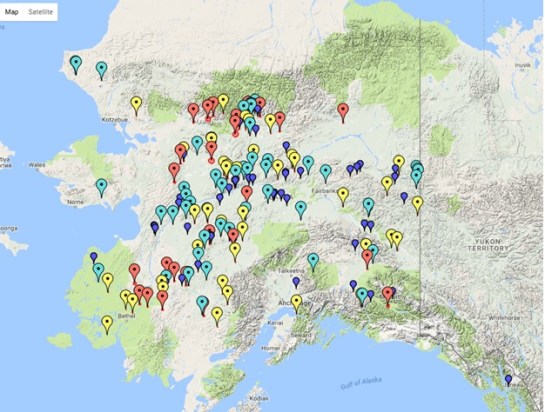
2016 Alaska Fires

Alaska FIres


Collaboration between students, faculty and the real world is an excellent means to integrate students into real world situation and provide them valuable experience.  I have done this with several communities to date.  Below are the installed OASIS street improvements in Dania Beach.  Students did the drafting.  Also a stormwater pipe in Boynton Beach.  Excellent learning experience.  The campus mapping project is one that our Facilities Management Department needed.  Very cool 3D map.  We did stormwater assessments in Davie, plus flood mapping.  Of course the Dania Beach nanofiltration plant, the first LEED Gold water plant in the world.  Still.  Here is the cool thing with working with students – they have all kinds of ideas and have all kinds of tools that they can access – they just need guidance.   They will create tools (our app for asset management). to make the job easier.  Most collaborate well.  And most want to learn about the profession.  As an industry we should promote this more.  Go to the local universities, talk with faculty.  Find the right faculty mentor who is interested in local outreach.  Work with them.  But students should not work free.  Pay or pay in grades.  It’s only fair.


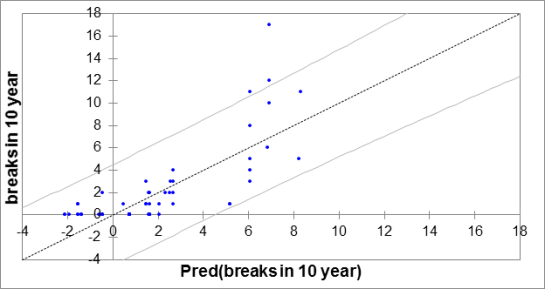
Here is an example of getting to a condition assessment with limited data using power point slides.  Note that where there are categorical variables (type of pipe for example), these need to be converted to separate yes/no questions as mixing.  Categorical and numerical variable do not provide appropriate comparisons = hence the need to alter.  Take a look – but the concept is to predict how well this model explains the break history on this distribution system.  Call me and we can try it on yours….

Step 1  Create a table of assets (this is a small piece of a much larger table).

Asset Dia
water main 2
water main 2
water main 2
water main 2
water main 4
water main 6
water main 6
water main 6
water main 6


Step 2  Create columns for the variables for which you have data (age, material, soil type, groundwater level, depth, traffic, trees, etc.)


Asset breaks in 10 year Dia Age soil traffic Trees depth pressure material Filed estimate of cond.ition
water main 17 2 45 1 1 2 1 55 4 3
water main 11 2 45 2 1 2 1 55 4 3
water main 12 2 45 1 1 2 1 55 4 3
water main 10 2 45 1 1 2 1 55 4 3
water main 2 4 50 1 1 2 1 55 1 2
water main 3 6 60 2 2 2 1 55 1 2
water main 1 6 60 2 2 2 1 55 1 2
water main 0 6 20 1 1 2 1 55 3 1


Step 3  All variables should be numeric.  So descriptive variables like pipe material need to be converted to binary form – i.e. create a column for each material and insert a 1 or 0 for “yes” and “no.”

Step 4 Run Linear regression to determine factors associated with each and the amount of influence that each exerts.  The result will give you a series of coefficientcoefs:

Step 5 – Use this to predict where your breaks will likely be in the next 5-10 years.

Pred breaks

The process is time consuming but provides useful information on the system.  It needs to be kept up as things change, but exact data is not really needed.  And none of this requires destructive testing.  Not bad for having no information.


An asset management program should be developed accordingly to the client’s goals and objectives. It consists of determining the selected area of study, type of system and the quality of data used for evaluation. Before a condition assessment can be determined, an inventory of assets needs to be established – maps, etc. are helpful.  So now you have a map of your water and sewer system and you want to develop a useful system for asset management.  Depending on the accuracy wanted, the data can be gathered in many ways ranging from onsite field investigation which could take a lot of time, to using existing maps, using maps while verifying the structures using aerial photography and video, or field investigations. But most local governments still lack data.  You cannot dig up pipe, or do a lot of destructive testing on buried infrastructure.  So what to do?

The reality is that you have a lot more data than one thinks.  For one thing, most utilities have a pretty good idea about the pipe materials.  Worker memory can be very useful, even if not completely accurate.  In most cases the depth of pipe is fairly similar – the deviations may be known. Soil conditions may be useful – there is an indication that that aggressive soil causes more corrosion in ductile iron pipe, and most soil information is readily available.  Likewise tree roots will wrap around water and sewer pipes, so their presence is detrimental.  Trees are easily noted from aerials.  Likewise road with truck traffic create more vibrations on roads, causing rocks to move toward the pipe and joints to flex.  So with a little research there are at least 5 variables known.  If the break history or sewer pipe condition is known, the impact of these factors can be developed via a linear regression program.  That can then be used as a predictive tool to help identify assets that are mostly likely to become a problem.   We are working on such an example now, but suspect that it will be slightly different for each utility.  Also, in smaller communities, many variables (ductile iron pipe, pvc pipe, soil condition…) may be so similar that differentiating would be unproductive.  That also remains to be seen, which brings up another possible variable- the field perception – what do the field crews recall about breaks?  Are there work orders?  If so do they contain the data needed to piece together missing variables that would be useful to add to the puzzle?

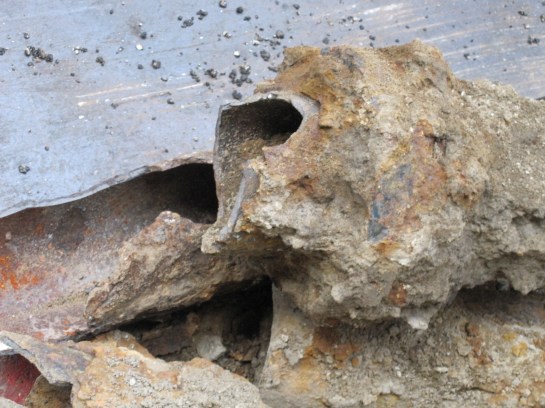
After all we want to avoid this before it happens….

IMG_5040


Asset management plays a vital role to help minimize unnecessary or misplaced spending while meeting the health and environmental needs of a community. The goal is to provide strategic continuous maintenance to the infrastructure before total failure occurs.  Costs should be well distributed over the life of the asset to help avoid emergency repairs. Emergency repairs can cost up to multiple times the cost of a planned repair. Therefore the ultimate goal of asset management is to provide quality, economical infrastructure by identifying the system’s needs and addressing the needs appropriately.  At some point repairs cost more than replacement, or technology may make repairs obsolete.

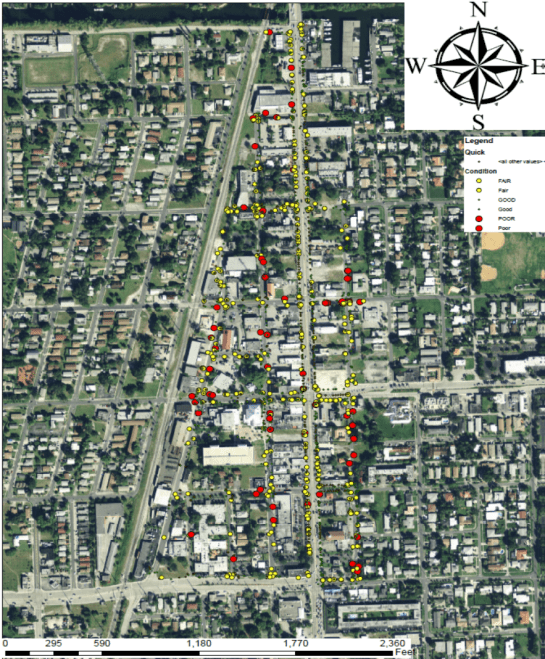
An asset management program should be developed accordingly to the client’s goals and objectives. It consists of determining the selected area of study, type of system and the quality of data used for evaluation (see Figure 1).  Before a condition assessment can be determined, an inventory of assets needs to be established. Depending on the accuracy wanted, the data can be gathered in many ways ranging from onsite field investigation which could take a lot of time, to using existing maps, using maps while verifying the structures using aerial photography and video, or field investigations. Not doing destructive testing is important to reduce costs.  The question is how you do it.  One project we did was the downtown area of Dania Beach.  You can see the areas that are a problem.

Untitled


Figure 1

Asset Dania

FIgure 2


Public infrastructure has been poorly rated by the American Society of Civil Engineers and most public officials acknowledge the deterioration of the infrastructure we rely on daily.  However, many jurisdictions have limited information about their systems, and little data to use to justify spending.  The resistance to impose fees or taxes to upgrade infrastructure also remains high.  Hence the infrastructure tends to deteriorate further each year.  At present the United States spends about 1.6% of its GNP of infrastructure, as compared to 3.1 % prior to 1980.  Half as much money, and a large portion of that was for growth as opposed to repair and replacement.  Hence the need for better tools for asset management.

Utilities that utilize asset management programs experience prolonged asset life by aiding in rehabilitation and repair decisions while meeting customer demands, service expectation and regulatory requirements. The general framework of asset management programs involves collecting and organizing the physical components of a system and evaluating the condition of these components. The importance and the potential consequences associated with the failure of the individual assets are determined by this evaluation. Managers and operators can then prioritize which infrastructure are most critical to the operation of the system and furthermore which infrastructure to consider for repair, rehabilitation or replacement. It is a continuously reviewed and revised strategy that implements the acquisition, use and disposal of assets to optimize service and minimize costs over the life of the assets. An asset management plan (AMP) considers financial, economic and engineering goals in an effort to balance risk and benefits as they relate to potential improvement to the overall operation of the system.

Over the last 2 years, we have been working to develop a means to quickly, effectively and in a cost efficient manner to collect data and assess public infrastructure using simple, readily available means, without the need for significant training and expertise.  The idea was to use student efforts to coalesce a common evaluation without the need for destructive testing.  There are three successive projects used to improve the collection of data for ultimate use in an asset management program.   Students were provided with Leica and Trimble units to gather data.  For the first project, an app was created by FAU students that included photographic tools and entries to document the asset condition and location and permit offsite QA/QC from the cloud.  This app was initially developed for stormwater, but was updated to include all public assets for the second community. Data retrieval was created to be able to log data directly onto a smart phone or tablet in the field to save time and the information is instantly downloaded to the internet for quality assurance. The collection system also was programmed with a condition index to help with organization A session was held in the field with student groups to normalize the assessment process.  The approach began with an inventory and location of each asset. The assets were field inspected and assessed for condition.  A numbering system and photographic tools was used to document the asset condition.  This was accomplished by physically locating each asset in the field and marking it with a global position system (GPS) coordinate which allowed the data to be populated in a geographic information system (GIS) and organized with the other assets of the system

The results include this senior design project by our geomatics students. It is a 3-dimensional map of all infrastructure from the ground down on FAU’s Boca Raton campus. 800 acres and over 5000 points, many of which must be stitched together.  They also created building extrusions for a future project.  Very cool and useful from a tablet.  So the question is – do you have a 3D map of your utility?

Geomatics Engineering Senior Design Project 2016 (2)