Archive

Responsibility


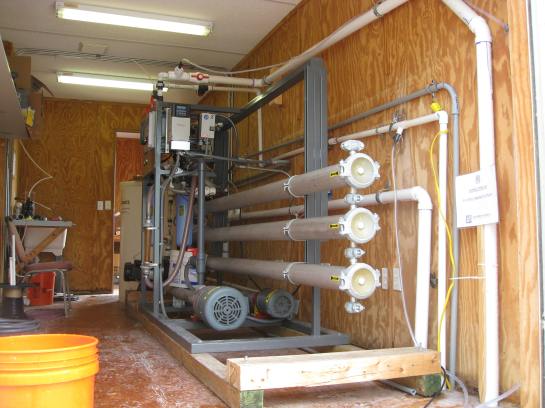
In the last blog I showed what reclaimed wastewater could do for an ecosystem.  Very cool.  But what about for drinking water.  I actually was involved in an indirect potable reuse project several years ago.  The concept was to take wastewater, filter it with sand filters, filter it with microfiltration, reverse osmosis and then hydrogen peroxide and ultraviolet light.  This is what they do in Orange County California when they recharge groundwater, and have been for over 30 years.  Epidemiological studies in the 1990s indicated no increased incidence of disease when that water was withdrawn from the aquifer, and then treated in a drinking water plant before distribution.  So our project was similar – recharge to the Biscayne aquifer in south Florida.   It worked for us.  Total phosphorous was below 10 ppb, TDS was less than 3 mg/L (<1 after RO), and we were able to show 3 log removal of endocrine disruption compounds an d pharmaceuticals.  It worked well.  This is a concept in practice in California.  And will be at some point in south Florida since only the Biscayne aquifer provides sustainable water supplies.  Here is what our system looked like.

IMG_3100

sand filters

IMG_3106

microfiltration

IMG_3085

Reverse osmosis

IMG_3152

ultraviolet/peroxide

This is also the same basic concept Big Springs Texas uses for their direct potable program, demonstrating that the technology is present to treat the water.  A means for continuous monitoring is lacking, but Orange County demonstrates that for indirect potable reuse projects, a well operated plant will not risk the public health.  This is how we do it safely.


IMG_7871

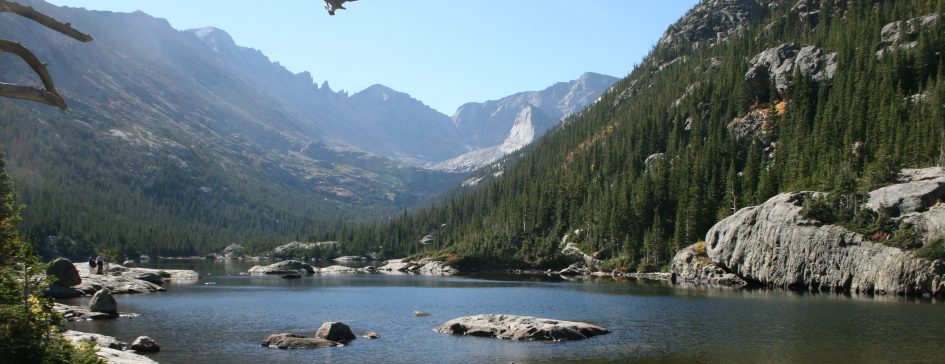
Most water suppliers realize that the more natural their land is upstream of their water supplies, the less risk there likely is for their customers.  Under the source water protection programs that state, local officials and water utilities implement, the concept is to keep people related activities out, and let the natural forests and landscapes remain.   For the most part the natural areas support only a limited amount of wildlife (sustainable) and thereby there natural systems are attuned to compensate for the natural pollutant loads, sediment runoff, ash, detrital matter, etc., that might be created through natural processes.  For thousands of years these systems operated sustainably.  When people decide there needs to be changes, it seems like the unanticipated consequences of these actions create more problems.  Now many of these same ecosystems do not work sustainably and water quality has diminished, increasing the need for treatment and the risks of contamination to the public.  It would be better, but decidedly less popular on certain fronts, to provide more protection to natural systems that extend into watersheds (which is most of them), not less.

So this leads to a series of questions that go to the greater questions about natural environments:

Is it really necessary to cull the small Yellowstone bison herd by 1000?  What do bison have to do with watersheds?  Well, the bison create much less damage to grasslands and underlying soil than cattle due to the size of their hooves.  An argument is that we need to cull the herd because they transmit disease to cattle, but Brucellosis has never been demonstrated to move from bison to cattle, so disease is not an answer.  What is really happening is that there is competition between buffalo and cattle for grazing.  Competition with cattle means that the cattle are on public property, not private ranch lands, and the cattle trample the public lands which creates the potential for soil erosion and sediment runoff.  So I am thinking water folks should be siding with the bison. Of course without wolves, there is no natural predator for bison, which raises a different sustainability problem, so maybe instead of killing them, we move them to more of their native ranges – maybe some of those Indian reservation might want to restart the herds on their lands?  That might be good for everyone, water folks included.

Part 2 – is it necessary to continue to protect wolves or should we continue to hunt them in their native ranges?  Keep in mind wolf re-introduction efforts are responsible for most of the wolf populations in the US, specifically in the Yellowstone area.  Without wolves, there is no control of large grazing animal populations (see bison above, but also elk and deer), and there is a loss of wetland habitat because the elk eat the small shoots used by beavers to build dams and trap sediment.  Eliminating wolves has been proven to create imbalance.  Wolves = sediment traps = better water quality downstream.  Sounds like a win for everyone. (BTW there is a program in Oregon to protect wolves and help ranchers avoid periodic predation of calves by wolves so they win too).

Part 3 – Is it really necessary to kill off coyotes in droves?  The federal government kills thousands of coyotes and hunters and others kill even more.  This is a far more interesting question because it leads to one of those unintended consequences.  !100+ years ago people decided wolves were bad (we still have this issue ongoing – see above).  So we eradicated wolves.  No wolves means more rodents, deer, elk, etc. which mean less grass, less aspens and less beavers, which means more runoff which does not help water suppliers.  It also means more coyotes, because there is more food for the coyotes.  Interesting that coyotes have pretty much covered the entire US, when their ranges were far more limited in the past.  Coyotes are attracted to the rodents and rabbits.  But the systems are generally not sustainable for coyotes because there is not enough prey and there is no natural control of the coyotes – again, see wolves above.  A Recent Predator defense report indicates that culling coyotes actually increases coyote birth rate and pushes them toward developed areas where they find cats and small dogs, unnatural prey.  Not the best solution – unintended consequences of hunting them on more distant land pushes them into your neighborhood.  Not the consequence intended.  So maybe we keep the small dogs and cat inside at daybreak and nightfall when the coyotes are out and let them eat the rats and mice that the cats chase and once consumed they go away.   Coyotes need to eat grazers and rodents but you need the right mix or the grazers overgraze, which leads to sediment runoff issues – which is bad for us.  That also seems like a win.

Everglades restoration is a big south Florida issue.  The recharge area for the Biscayne aquifer is the Everglades.  So water there seems like a win for water suppliers?  So why aren’t we the biggest Everglades advocates out there?  Still searching for that answer, but Everglades restoration is a win for us and a win for a lot of critters.  Federal dollars and more federal leadership on restoration is needed.  Which leads to ….

Do we need more, not less management of federal lands?  Consider that the largest water manager in the west is the federal government, which has built entire irrigation systems to provide water to farmers who grow crops in places that are water deficient.  Those farms then attract people to small towns that consume more of the deficient water.  Then people lobby to let cattle graze on those public lands (see bison above), timber removal – which increases sediment erosion, or mining (what could possible go wrong there?).  So since the federal government manages these lands, wouldn’t better regulations and control to keep the federal properties more protected benefit water users and suppliers?  Contrary to the wishes of folks like the guys holed up in a federal monument in Oregon, or the people who have physically attacked federal employees in Utah and Nevada, more regulations and less freedom is probably better in this situation for the public good.  If we are going to lease public lands (and most lands leased are leased to private parties for free or almost free), and there should be controls on the activities monitoring for compliance and requirements for damage control caused by those activities.  There should be limits on grazing, timber and mining, and monitoring of same.  Lots of monitoring.  It is one of the things government really should do.  And we need it to protect water users downstream.  Again a win for water suppliers.

So as we look at this side issue, ecosystems, bison, wolves, coyotes and the Everglades seem very distant from our day-to-day water jobs.  But in reality they are not.  We should consider the impacts they might have on water supply, keeping in mind natural system decisions are often significantly linked to our outcomes, albeit the linkage is not always obvious.

My cousin  once asked me what I thought about deciding on who to vote for for President might be best done when evaluating how well your 401K or investments did.  Kind of an amusing thought.  In that vein the decisions might be very different than they were.  Clearly your 401k did with with Clinton.  The economy was flat for George W. Bush, and the end of his term was the Great Recession.  Reagan’s first term was flat.  We all know about George H.W. Bush.  Interesting thoughts.  Not so good.  So what about the last 8 years?   But is raises a more interesting issue.  So don’t get me wrong, this blog is not intended to lobby for any candidate (and Obama can’t run), but it is interesting to look at the last 8 years.  They have been difficult.   The economy responded slowly.  Wages did not rebound quickly.  But in comparison to 2008 are we better off?

The question has relevance for utilities because if our customers are better off, that gives us more latitude to do the things we need – build reserves (so we have funds for the next recession), repair/replace infrastructure (because unlike fine wine, it is not improving with age), improve technology (the 1990s are long gone), etc., all things that politicians have suppressed to comport with the challenges faced by constituents who have been un- or under-employed since 2008.

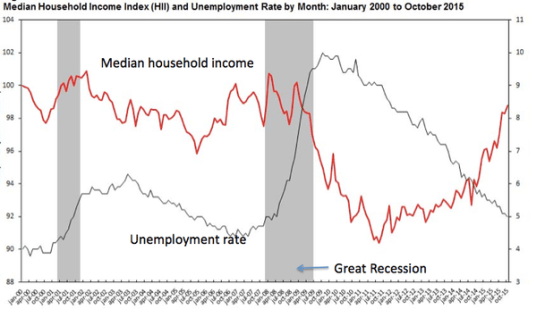
Economist Paul Krugman makes an interesting case in a recent op-ed in the New York times:  (http://krugman.blogs.nytimes.com/2016/01/13/yes-he-did/?module=BlogPost-Title&version=Blog%20Main&contentCollection=Opinion&action=Click&pgtype=Blogs&region=Body).  Basically he summarizes the figure below which shows that unemployment is back to pre-2008 levels, and income is back to that point.  Some income increase would have been good, but this basically tracks with the Bush and Reagan years for income growth – flat.  So the question now is in comparison to 2008 are we worse off that we were?  And if not, can we convince leaders to move forward to meet our needs?  Can we start funding some of the infrastructure backlog?  Can we modernize?  Can we create “smarter networks?”  Can we adjust incomes to prevent more losses of good employees?  Can we improve/update equipment?  All issues we should contemplate in the coming budget.

Krugman Income percent


photo 2Over the holidays there were a couple articles that came out about groundwater issues in the US, mostly from the declining water level perspective.  I also read a paper that suggested that rising sea level had a contribution from groundwater extraction, and of course USGS has maps of areas where the aquifer have collapsed as a result of overpumping.  In 2009 USGS published a report that showed a large areas across the country with this issue.  The problem is that of the 50,000 community water systems in the US, 500 serve over 50% of the population, and most of them are surface water plants.  There are over 40,000 groundwater systems, but most are under 500 customers.  Hence, groundwater is under represented at with the larger water associations because the large utilities are primarily surface water, while the small systems are groundwater. AWWA has difficulty reaching the small systems while RWA and NGWA reach out to them specifically.  But the small utility seems more oriented to finding and producing water and operating/maintaining/drilling wells than the bigger impact of groundwater use.  It is simply a matter of resources.  I ran a system like that in North Carolina, and just getting things done is a huge issue.  A couple of my medium size utility clients have the same problem.

The bigger picture may contain the largest risk.  Changing water supplies is a high cost item.  We have seen a couple examples (surface water) as a result of drought.  We saw Wichita Falls and Big Springs TX go the potable reuse route due to drought.  California is looking at lots of options. Both have had rain lately (Wichita Falls discontinued the potable reuse when the reservoir got to 4% of capacity).  Great, but someone is next.  Droughts come and go, and the questions is how to deal with them.

Groundwater supposedly is a drought-proof problem, but is it?  Groundwater has been a small utility solution, as it has been for agriculture.  But aquifer require recharge and water limited areas do not have recharge.  The result is a bigger problem – overpumping.  Throughout the west/southwest, Plains states, upper Midwest (WI, MN, IA), southeast (SC, NC), we see this issue.  Most of these areas have limited surface water so never developed much historically.  Rural electrification changes that because it made is easy to put in an electric pump to pull water out of the ground in areas that never had a lot of water on the surface, and hence were not farmed much. Pumps made is easier to farm productively, which led to towns. However, our means to assess recharge are not very good, especially for confined aquifers. The lowering water levels USGS and state agencies see is an indication that recharge is normally over estimated giving a false picture of water availability.  If your aquifer declines year after year, it is not drought – it is mining of the aquifer. You are sucking it dry like the eastern Carolinas did.  But, like many negative things, there is a lack of willingness to confront the overpumping issue in many areas. There are many states with a lack of regulations on groundwater pumping.  And I still think groundwater modeling use is limited to larger utilities, when smaller, rural systems may be most in need of it due to competing interests.

Concurrently, I think there is a tendency to oversell groundwater solutions (ASR, recharge), groundwater quality and the amount of available water (St George, UT).  Easy, cheap, limited treatment should not be the only selling point.  That leads to some curious decisions like some areas of California north of LA the utilities do not treat hard groundwater – then tell residents they cannot use softeners because of the salt in the wastewater prevents it from being used for reuse.  The reason they do not treat – cost, but it makes things difficult for residents.  The fact is we do not wish to confront is the realization that for many places, groundwater should probably be the backup plan only, not the primary source.

That leads to the question – what do we do about it when every politician’s goal is for their community to grow?  For every farmer to grow more crops?  But can they really grow sustainably?  DO we not reach a point where there are no more resources to use?  Or that the costs are too high?  Or that competition become unruly?  The growth and groundwater use ship is sailing, but in to many cases they do not see the rocks ahead.


Fred+Bloetscher+Senate+Committee+Holds+Hearing+cQCSwINqgm3l

In my last blog I introduced our ethics project we hope to make progress on.  But here is one of the interesting questions, especially in Florida.  I could not find any actual laws or rules issues here, but it is increasingly common for big engineering contracts to have lawyers, lobbyists, etc. get involved in what is intended to be a qualifications based selection process? There is an interesting issue raised in 287.055 FS (CCNA) where the legal intent is that governmental agencies “shall negotiate a contract with the most qualified firm for professional services at compensation which the agency determines is fair, competitive, and reasonable.” Most states use credentials and qualifications for selection as opposed to cost, because the lowest cost may not get you the best job.  You want people doing engineering that have experience with the type of project you are doing.  This has come up to me with storage tanks, membrane plans, deep wells, etc.  You want someone that has done it before, not someone who is cheaper but hasn’t. There is too much at risk.

In addition the statute is fairly specific about contingent fees (as are most states):

Ch 287.055  (6) PROHIBITION AGAINST CONTINGENT FEES.—

(a) Each contract entered into by the agency for professional services must contain a prohibition against contingent fees as follows: “The architect (or registered surveyor and mapper or professional engineer, as applicable) warrants that he or she has not employed or retained any company or person, other than a bona fide employee working solely for the architect (or registered surveyor and mapper, or professional engineer, as applicable) to solicit or secure this agreement and that he or she has not paid or agreed to pay any person, company, corporation, individual, or firm, other than a bona fide employee working solely for the architect (or registered surveyor and mapper or professional engineer, as applicable) any fee, commission, percentage, gift, or other consideration contingent upon or resulting from the award or making of this agreement.” For the breach or violation of this provision, the agency shall have the right to terminate the agreement without liability and, at its discretion, to deduct from the contract price, or otherwise recover, the full amount of such fee, commission, percentage, gift, or consideration.

So here is the question:  As the public becomes more aware of these types of political lobbying activities, does it move the perception of engineers away from a profession and more towards profession toward developers, lawyers and others who are often seen as less ethical than perhaps engineer, doctors, educators, and scientists?  And if so, is this good for either the engineering profession or the local governments (and their utilities) involved in the selection process?  The comment that “that’s how business get done” is not an acceptable argument when the priority purpose of engineers, and utility operators is the protection of the HEALTH, SAFETY AND WELFARE OF THE PUBLIC.  Somehow I think the politicizing of engineering contracts does not help our profession.  Looking forward to your thoughts.


IMG_8055So as 2016 starts, it is time to look at goals for the coming year.  I have several project in mind that I would like to make progress on this year. The first is interesting.  We have embarked on a project that looks at engineering ethics.  The study have several parts:
  1. Historical context
  2. Engineering societies
  3. Laws and rules by the state
  4. Perceptions
  5. Future directions

One of my reference points is an old publication from ASCE by Murray Mantell, who I got to know about 15 years ago.  He wrote such a book in 1964 when he was char of the University of Miami’s Department of Civil Engineering.  I believe he has since passed on, but I have used his book in some of my courses.

Other references come from contact with the Board of Professional Engineers in each state and various society’s code of ethics, and historical versions of same. However a “hole” in our project is the perceptions piece.  Views change with time and with technology.  Things like competition, lobbying, risk and costs create added pressures on engineers and a need to react to those pressures.  So what we would like to do is create a survey monkey survey for engineers, professional and not to respond to as a means to evaluate perceptions.

I do not have ready access to a database for this purpose.  Gathering data form many states would be difficult as well and duplicative as many engineers have multiple licenses.  However, your organization does not have this constraint.  So I am reaching out to several societies to see if there is a means to collaborate on this endeavor.  The program is as follows:

  1. Complete the questionnaire (I have a draft but if anyone has thoughts on what we should ask, I would love to hear them)
  2. Make any final changes and launch it
  3. Send notices to members.

I am hoping that some of these organizations will find benefit and will agree to participate by emailing the survey link to their members.  I will compile the data and we expect to publish it.  Most of the work so far is being done via email, and thanks to some prior students for gathering information on it.  I have a ways to go here though.  So what are your thoughts?  If anyone can help with ASCE, NSPE, ACEC, etc, I would appreciate it.  And if you get that email with a link, I would appreciate your input and comments.


For the new year, my PUMPS website (not this site) will be undergoing reconstruction.  It has been a few years and some things are out of date.  Instead the focus will be more on rate studies, financial planning and asset management as opposed to all the other issues (like publications).  I will have a separate website for me, with all that stuff since some folks have hit the website looking for it.  My main goal is to partner with some folks and try to help smaller utilities with financial and management issues.  I will be adding work products, including the asset management stuff we are doing in Dania Beach and Davie.  My hope is I  energize PUMPS a bit.  At the same time via FAU, we will be developing a study of utility costs and revenues since 2005, with emphasis on the impact of the 2008-2009 Recession.  This will be instructive  – and be an update to the 1997 and 199 studies I did (hard to believe they were so long ago).  We will be looking nationally, as well as at different types of treatment, location and size.  The idea will be to develop some tools to help utilities benchmark where they are in the bigger picture, and to help with identifying trends and potential missing issues.  COnncection rates and asset  is improtant to insure hte timely renewal and repalcement of critical infrastrucutre.  After all, the people who get fired when things go wrong with a utility are not the politicians – its us!.  I will be solicitng (or my studnet will) data from over 300 utilities across the country.  If you are interested, or have clients who might be, let me know.  I have tnatively discussed publication with AWWA – but it won’t jsut be water.  Resue, wastewater etc will be included.  Should be fun!  Look for the results next summer!!


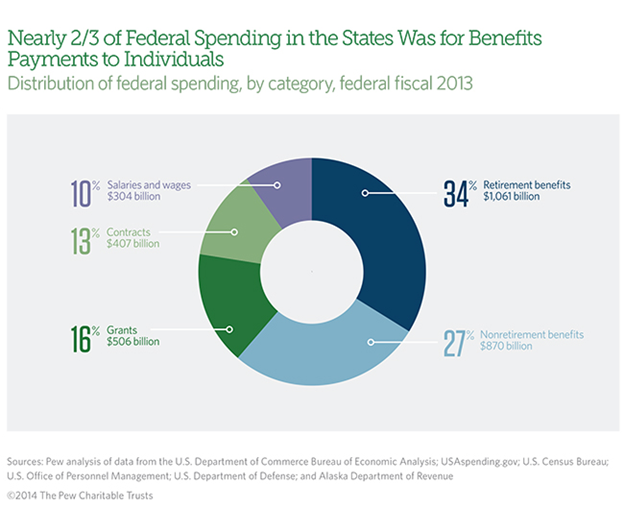
How much money goes to the states from the Federal government? Ever wonder about that? And how do we react? We talk about the need to tighten the federal spending so we keep cutting back on the Superfund cleanup monies ($1 billion/yr), the State Revolving Fund loan system ($2.35 billion/yr), and under $2 billion/yr for clean energy systems. We are concerned about the projected increase of $66 billion/yr for the Affordable Care Act. But these sums are just a tiny component for the federal budget, which is dwarfed by the $3.1 trillion sent to the states during its 2013 fiscal year. So what are these funds? Retirement benefits, including Social Security and disability payments, veteran’s benefits; and other federal retirement and disability payments account for over 34% of these payments. Medicare in another 18%. Food assistance, unemployment insurance payments, student financial aid, and other assistance payments account for another 9%. Another 16% is for grants to state and local governments for a variety of program areas such as health care (half the amount is Medicaid), transportation, education, and housing and research grants. All the SRF and grant monies are in this 16%. Those water programs are barely visible in this picture. Contracts for purchases of goods and services for military and medical equipment account for another 13%, while smallest amount – salaries and wages for federal employees is 10%.  Keep in mind that federal employees have dropped from nearly 7 million to 4.4 million since 1967. No federal employment expansion going on there.

growth in fed payments

fed payments

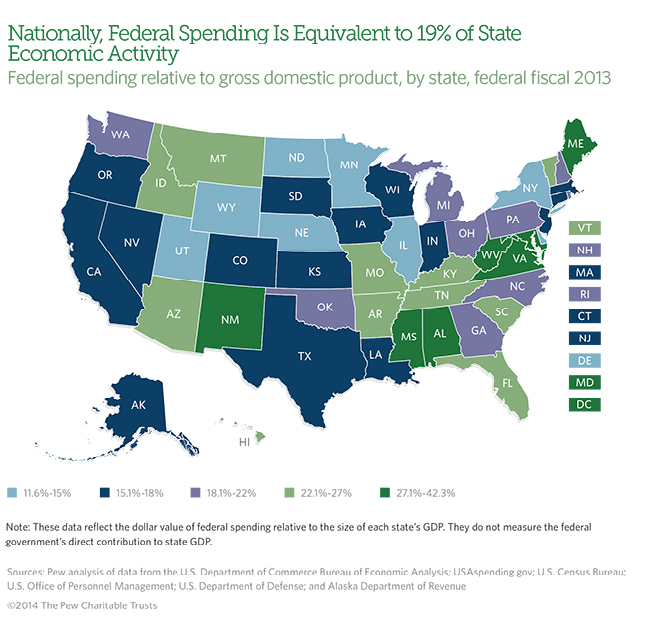
So how much does this affect the states? Federal funds account for about 19 of the total gross domestic product of the US, a number that has been relatively consistent (within a few percentage points) for years. That is below its all-time highs, and about typical over the past 30 years. Figure 1 from a PEW report shows that federal funds are greater than 22% of the GDP in most southern states (which interestingly enough have the people that complain the most about the federal government intrusion), while the Plains states, Midwest, northeast and the west coast are generally below average, and the two coasts, especially complain the least. Mississippi, Virginia and New Mexico all top 30%.

figure nat fed spending by state

So let me see if I have this right – those that pay the least, but get the most, complain the most about their benefactors, and those that pay the most, but collect less, complain less. That is the message! What is WRONG with that picture? And those people? The problem is I see it every day at the local level and it is truly baffling. It means that somehow our politics gotten so out of whack that those in need the most, seem to continue to vote against their best interests? Marketing clearly is a problem but are we fooled that easily. A message that distracts from the reality is obvious, but this continuing trend is just truly weird. No wonder it is so hard to accomplish things.


Most states were doing pretty well before the 2008 recession hit, but that ended in 2009. Most states had to make extremely difficult cuts or raise taxes, which was politically unacceptable. Of course invested pension systems received a lot of attention as their value dropped and long term sufficiency deteriorated, which was fodder for many changes in pensions, albeit not how they were invested. The good news is a lot of them came back in the ensuing 5 years, but 2015 may be different. A number of states have reported low earnings in 2015 and whether this may be the start of another recession. The U.S. economy has averaged a recession every six years since WWII and it has been almost seven years since the last contraction. With China devaluing their currency, this may upset the economic engine. At present there are analysts on Wall Street who suggest that some stocks may be overvalued, just like in 1999. If so, that does not bode well states like Illinois, Kansas, New Jersey, Louisiana, Alaska and Pennsylvania that are dealing with significant imbalances between their expenses and incomes. Alaska has most of its revenue tied to oil, so when oil prices go down (good for most of us), it is a huge problem for Alaska that gives $2200 to every citizen in the state. An economic downturn portends poorly for the no tax, pro-business experiment in Kansas that has been unsuccessful in attracting the large influx of new businesses, or even expansion of current ones. California and next door Missouri, often chided by Kansas lawmakers as how not to do business, outperform Kansas.

Ultimately the issue that lawmakers must face at the state and as a result the local level is that tax rates may not be high enough to generate the funds needed to operate government and protect the states against economic down turns. There is a “sweet spot” where funds are enough, to deal with short and long term needs, but starving government come back to haunt these same policy makers when the economy dips.   It would be a difficult day for a state to declare bankruptcy because lawmakers refuse to raise taxes and fees.