Today is the Day that America remembers those fallen heroes that fought to protect our freedoms.  Memorial Day is supposed to be a time to reflect on those that made the ultimate sacrifice for our country.  These people, and the many veterans that served with them understood that what was important was protecting our country and our way of life.  Sacrifices needed to be made, and they made them.  It was not easy – no one said it would be.  FDR noted that the only thing we have to fear, is fear itself as we navigated the Great Depression, then WW2, both full of sacrifices at home and abroad.  The overarching goal of protecting our country was more important that the needs of individuals.  Sacrifices the Greatest Generation tried to make sure their descendants never faced.  We have not inherited the mantle and duty to protect the greater “us.”  That is patriotism.

Our expectations of our government have been that our government will protect and uplift us in time of need.  Virtually all government legislation notes that the intent is the protection of the public health, safety and welfare, or something akin to that.  The US Constitution addresses this as well in the first paragraph – “promote the general Welfare.”  Laws and rules are made to reinforce that concept of the greater good.  Likewise, we look to governments in the aftermath of natural disasters, terrorist attacks, etc. to protecting the greater good by bringing much needed help for the greater good.

So, let’s remember the sacrifices that those who have fought for this country have made, let’s remember those sacrifices so they are not in vain.  Likewise, let’s resist recognizing false patriots who’s real agenda is their personal desires, something that our forefathers would view as anti-American, and would view with disgust.


In 1980, Miami-Dade County undertook a major regionalization effort that required expansion of the three major wastewater treatment facilities (South District, Central District, and North District), upgrades to new wastewater disposal solutions, and consolidation of many small-sized treatment plants that were replaced by master lift stations, while expanding service to a rapidly increasing population of 1.6 million people.  At the time, the Central District Wastewater Treatment Facility was generating approximately 100 dry tons of raw sludge per day, which was reduced to about 65 dry tons per day after digestion.  In the 1980s, the County created an alternative solids plan that included use of an electron beam prototype unit procured with 95% funding provided by USEPA. Thus, a pilot-scale electron beam system was installed and operated at the Miami-Dade County Central District Wastewater Treatment Plant in Virginia Key, FL. The installation was designed to achieve pathogen reduction and removal of organic priority pollutants in sludge and wastewater. This system was a 1.5 MeV, 75 kW (50 mA) unit capable of delivering 8.3 kGy at 120 gpm, which was only 0.1% of the plant’s capacity. The beam was scanned out to a window with dimensions of approximately 150 cm × 5 cm (60″ × 2″) in a horizontal configuration that passed through a constant flow over a weir. The wastewater fell by gravity through the electron beam with treatment achieved in less than one second exposure. The efficiency of this system was measured to be 66% (Kurucz et al. 1995).

During pilot testing operations, both pathogens and viruses were evaluated. The anaerobic digestion process generated a product with ~10,000 mg/L of ammonia, which is a concentration that is known to inactivate pathogens and viruses. Spiking sludge with viruses to monitor direct treatment performance was not acceptable with the regulatory agency (Florida Department of Heath). The facility achieved a 5-7 log reduction in bacteria, but it could not demonstrate effectiveness on Ascaris ova because of limited analytical capabilities. Likewise, because there were no viruses in the feed sludge, effectiveness on viruses could not be demonstrated. Similarly, with respect to organic priority pollutants, they were detected consistently but the removal efficiency could not be determined because concentrations were near zero initially and spike tests could not be performed (Cooper et al. 1998; Kurucz et al. 1995).

Laboratory and pilot tests were conducted in 1998-2001 using electron beam treatment of sludge collected from multiple sampling points at this facility (Meeroff et al. 2004). Operational improvements were investigated with respect to bulking control, thickening enhancement, anaerobic stabilization, and dewaterability. Electron beam processing caused permanent effects in measured sludge parameters including solids content, chemical oxygen demand, ammonia-nitrogen, zeta potential, specific surface area, resistance to filtration, sludge volume index, pH, organic acid production during anaerobic digestion, and digester gas evolution and methane content. Findings from sludge parameter analyses indicated that treatment should enhance certain flocculation and settling mechanisms by permanently altering electrokinetic sludge properties, rupturing cells, and increasing biodegradability of recalcitrant material.

For doses higher than 10 kGy, pilot testing generally showed a reversal of dose-response trends indicating undesirable effects. At moderate doses (3-4 kGy), pilot testing demonstrated several benefits:

  • Ammonia nitrogen stayed below toxic levels (<1000 mg/L as N)
  • COD solubilization increased slightly (3%)
  • Surface charge became more neutral by 40%
  • Specific surface area decreased by 30%
  • Resistance to filtration was reduced by 50%

Taken together, these results indicated that treatment induced more efficient compaction and improved filterability; however, the rate of water release did not necessarily show a corresponding improvement, and bench scale settling tests were not sensitive enough to detect any differences, such that surface area requirements and loading rates in settling column studies were not affected, indicating no adverse impacts to sludge thickening. With respect to bulking control, feasibility was deduced from relative inactivation kinetics. Since the indicator filament Sphaerotilus natans (D10 = 0.66 kGy) was inactivated at a lower dose than the bulk flora (D10 = 0.94 kGy), selective elimination of bacterial filaments is possible. In summary, pilot testing results suggest that electron beams will enhance operational efficiency of certain processes within an activated sludge wastewater treatment plant with residuals processing. Analysis of beneficial effects from preliminary studies and pilot tests demonstrate that a dose of 2-3 kGy would be potentially successful for bulking control and to a lesser degree, enhanced thickening and improved anaerobic digestion. A cost analysis based on preliminary tests determined that a centralized electron beam accelerator in an integrated approach could potentially pay for itself at an estimated annual savings of $0.2-2.7 million depending upon the application (Meeroff et al. 2004).


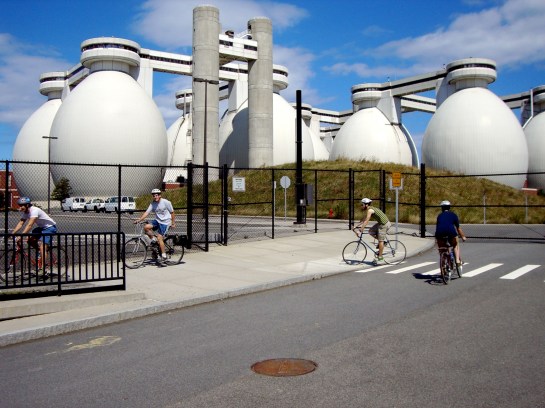
Deerislandeggs

There are over 30,000 accelerators operating worldwide with sales of $3.5 billion/yr and impact of over $500 billion/yr (Henning and Shank 2010). These accelerators are predominantly warm/copper technology. Because there is a need to treat high volumes in the environmental applications, superconducting accelerators are needed. Design commonalities for such accelerators, include an electron generating thermionic gun that creates a high-current electron beam, a cryostat with a Nb3Sn SRF cavity for acceleration, cryocoolers to reduce power demand and a coaxial input power couples for the RF cavity (Thangaraj and Ciovanti 5/10/2018 presentation at Fermilab).

The first foray into municipal water treatment using an electron beam has its origins in a study conducted by Sandia Labs and New Mexico State University that looked at the feasibility of sludge disinfection with electron beams and cesium 137 in 1974. The positive disinfection data obtained (Trump (not that one), 1980) led to the establishment of a large scale pilot facility at the Deer Island Treatment Plant in Boston, Massachusetts that focused on treatment of different sludges from the process at Deer Island (Kurucz, et al, 1995).  That study was funded by the National Science Foundation to investigate high energy electron disinfection of wastewater residuals (Bryan, 1990). The research team was led by MIT.

At the time, the Deer Island facility was operated by the Metropolitan District Commission, and subsequently the Massachusetts Water Resources Authority (MWRA – MWRA, nd).  The Deer Island facility started operations in 1968. At the time of the ebeam test, the plat had a capacity of 343 MGD, but experienced peaks of 850 mgd (MWRA 2020; ND).  Combined sewer overflows plagued the system (60 days per year).  Sludge disinfection was an emerging issue under the Clean Water Act rules.

The electron beam experiment was conducted at 70 gpm or 100,000 gpd, using a 50 kW/850 kvolt electron accelerator supplied by High Voltage Engineering Corp.  The e-beam first started operations in April 1976.  The liquid sludge was presented as a wide thin layer of liquid cascading downward through the electron beam.  All sludge must receive disinfection and therefore the setup requires that all of the sludge be penetrated by the electron beam. A 400 kilorad dosage was used for liquid sludge.  Trump et al (1979) found that the concentrations of salmonella, total coliforms, sand shigella were reduced between 4 and 5 orders of magnitude.  The most resistant parasite was ascaris.

The electron beam had benefits beyond pathogen reduction. Trump et al (1979) reported that trace polychlorinated biphenyls were effectively destroyed by as little as 10 krads in pure water.  Fragments disappeared at 50-100 kilorads.  The studies confirmed that the electron beam was capable of disinfecting raw, digested, waste activated primary and secondary and composted sludge effectively. (Trump et al 1979).


Here is something you probably have never heard of, but maybe you want to.  Electron beams.  They are not radiation, but they do irradiate and thereby disinfect.  We use them all the time (about 20,000) the them to irradiate and disinfect food, post office packages, and more.  But we don’t use them for water or wastewater treatment.  So would they work?  This is a four-part blog to outline electron beams and how we might use them to solve some recalcitrant water treatment problems.  But first, what is an electron beam?  There are two case studies that will be discussed in Parts 2 &3, which the more recent research outlined in part 4.  Sludge was the first area of investigation, but emerging contaminants, pathogens and the like are all subject to destruction by electron beams.

The basic concept of the technology is to accelerate electrons in a vacuum and focus those electrons using a magnetic field to create a concentrated, high-energy beam that can be directed at a target. In 1913, William Coolidge developed a high vacuum, thermionic cathode that he used to produce an prototype of the modern electron beam accelerator at General Electric (Coolidge 1916; Coolidge 1917). In 1925, Coolidge placed a thin foil window at one end of a high vacuum tube and studied the effects of the electron beam on a variety of materials using a 200 keV tube (Coolidge 1926; Coolidge and Moore 1926; Coolidge 1933). In the early 1930s, John Cockcroft and Ernest Walton developed circuitry for increasing the voltage for the particle discharge, which was the basis for many high-current, mid-energy electron accelerators (Berejka and Cleland, 2011). This design was improved by Willem Westendorp, who developed one of the first industrial electron beam accelerators at GE which were the first industrial electron beam processing (Westendorp 1940). In 1937, William Hansen and Sigurd Varian developed the klystron amplifier, which increases the amount of available power levels of microwave linear accelerators (linac), which with one or two milliamps of average beam current at 10 MeV are widely used for medical device sterilization and food treatment, accounting for most of the current industrial applications (Berejka and Cleland 2011). By 1941, technological innovations brought forth the commercialization of the industrial computerized tomography accelerator (Berejka and Cleland 2011).

Since the mid-20th century, electron beam technology has provided the basis for a variety of applications. Among the companies that became active with accelerators were High Voltage Engineering Company, Vivirad-High Voltage, Cryovac division of the Sealed Air Corporation, Nissin-High Voltage (NHV) and Wasik Associates.  Arno Brasch and Wolfgang Huber developed a pulsed accelerator, based on capacitor banks being charged in parallel and discharged in series, made commercially available through the Electronized Chemicals Corporation (Berejka and Cleland 2011).  With their pulsed accelerator, they showed that short pulses of high voltage, high current electron beams could effectively sterilize and preserve food with minimum damage.

Marshall Cleland and Kennard Morganstern founded Radiation Dynamics, Inc. (RDI) in 1958 to sell their Dynamitron which could attain the combination of higher electron energy and higher beam currents that other accelerators (many of which remain in operation -Berejka and Cleland 2011). The Dynamitron can operate at up to 5.0 MeV with total beam power up to 300 kW, thereby forming the basis for the electron transformer-rectifier (ELV) electron beam accelerators produced by the Budker Institute of Nuclear Physics in Novosibirsk, Russia (Berejka and Cleland 2011).  Berejka and Cleland (2011) and Nayak et al. (2016) report that the Budker Institute has accelerators that operate between 400 keV and 2.5 MeV with a maximum beam power of 400 kW at 1.0 MeV. In addition, high current pulsed beams, radiofrequency accelerators which operate between 700 keV and 5.0 MeV with a high current version have been developed, and researchers are working on a 10 MeV at 100 kW accelerator.

The Efremov Research Institute of Electrophysical Apparatus in Saint Petersburg also produces a variety of industrial electron accelerators ranging between 0.5 and 2.5 MeV with electron beam power ratings up to 100 kW (Berejka and Cleland 2011).  Ford Motor Company initially used energy electron beams (400 keV or less) to cure coatings, which generated a host of companies including Radiation Polymer Company (now Broadbeam Equipment part of PCT Engineered Systems), Energy Sciences Incorporated (ESI), Applied Advanced Technologies (now known as Advanced Electron Beams – AEB), and Ion Beam Applications SA (IBA). The IBA design has become better known as the Rhodotron™.  The US Postal Service uses a Rhodotron to sanitize critical US Federal government mail (Berejka and Cleland 2011).  The major competition for particle accelerators is gamma irradiators.  The gamma irradiators have issues with radiation.  As a result, there are 8 times as many particle accelerators in use as gamma irradiators.

New accelerators include changes to the older designs to improve efficiency and reduce operating costs.  The basic unit of acceleration in particle accelerators is the RF cavity. Conventional accelerators are made from copper cavities and referred to as warm accelerating technology. More recently, superconducting materials like niobium, referred to as cold accelerating technology because of the need to operate cryogenic temperatures, have gained favor because of their ability to operate more efficiently. Bulk materials processing applications require multi-MeV energy for penetration and thousands of kW (or even MW) of beam power.  Inherent losses in copper accelerators limit their efficiency (heat vs beam power). Heat removal limits duty factor, gradient and average power.  Superconducting radio frequency (SRF)-based accelerators, found typically only in big science, are huge with complex cryogenic refrigerators, cryomodules, etc.  High wall plug power efficiency of these SRF accelerators (e.g. ~75%) allows a large fraction of the input power to go into the beam and ultimately the target.

Recent efforts at institutions like the DOE’s Fermilab have incorporated several new technologies into superconducting RF accelerators to remove the need for liquid cryogens thus greatly reducing the size and complexity of the accelerator.  This is in part made possible using cryocoolers to remove heat conductively.  Since less heat removal is possible with conduction and the cryocoolers than convection and liquid helium, a bulk of the other technology advances like Nb3Sn thin films, low loss power coupling and accelerator operating parameters are made to reduce heat load which ultimately improves efficiency. The advantages of such an accelerator includes energy efficiency (lower operating cost), smaller foot print (portable and fits into existing operations more easily), less complexity and therefore more robust and higher power allowing for treatment of more mass per unit time.