A public water and sewer utility is created to develop safe, reliable and financially self-supporting potable water and sanitary sewage systems which will meet the water and sewerage needs of the areas served by the utility; to ensure that existing and future utility facilities are constructed, operated and managed at the least possible cost to the users without outside subsidies; and to develop a system that is compatible with the area’s future growth. To gain efficiencies in operation, these new facilities must be developed in accordance with the latest technical and professional standards to protect the health, safety, and welfare of the citizens served now or in the future.


Hence a utility must construct new pipelines, pump stations and other infrastructure, whether that infrastructure is for growth, to improve existing service, or to replace infrastructure that has reached the end of its useful, economic, and/or physical life.  In established or stable communities, the replacement of existing infrastructure, where it is no longer economical to operate, is deteriorated to a point where replacement is more cost effective than repairs due to wear, neglect or environmental conditions, or where the infrastructure no longer serves its intended purpose or meets regulatory standards, must be pursued.  As a result, many established utilities have capital plans that contain many such replacement projects.

One reason we need to invest is to keep the infrastructure up-to-date and operating properly because   numerous studies confirm that infrastructure investment spurs economic growth. Cohen et al (2010) estimated that a dollar spent on infrastructure construction produces roughly double the initial spending in ultimate economic output in the short-term, primarily in the manufacturing and business services sectors.  Economic theory and practice also suggests that public sector spending, primarily in infrastructure, can stimulate of the economy in difficult times.  The most notable examples are the Works Progress Administration (WPA; renamed in 1939 as the Work Projects Administration) projects of the Great Depression and the American Recovery and Reinvestment Act of 2009 (ARRA) legislation of the Great Recession.  Both are credited with putting people to work, and preventing further economic hardship on the country (Krugman, 2014; Kavoussi, 2011).  By putting people to work, there was more income that could be spent, and therefore the greater potential for economic growth (Krugman, 2014).  Similarly, Eberts, (1991) and Munnell and Cook (1990) suggest underinvestment in public capital may ultimately retard our economic growth.


So the question is: Do local utilities invest enough? We should ask that question given that ASCE claimed that additional spending of $1.6 trillion, in 2010 dollars, is needed by 2020 to bring the quality of the country’s infrastructure up from “poor” to “good” and that the US could lose $18 trillion in GDP in the next 10 years due to infrastructure deficiencies.  The American Water Works Association (2012) estimated $1 trillion in for just water systems and the USEPA estimated a $500 billion need for infrastructure investment by 2025.

Underinvestment leads to public health risk in addition to economic risk.  Much of the recent news is about the lead and legionella issues associated with potable water with the Flint, Michigan water system.  There have been at least six indictments, a Congressional hearing and numerous lawsuits filed.  The fallout will continue as all utilities will be re-evaluating water quality issues associated with piping.  One of the major discussions was the issues with lead service lines in Flint. Many utilities are now fielding questions about and dealing with lead in their services lines, research that will come for lead, and regulatory requirements for upgrades.  Money drives decisions.  There is a utility system in Florida that contracted its operations to save money (and pension costs).  Flint’s decision to change water sources was driven by money, not public health.  Other risks come from increasing incidents to failure – there are utilities all over the country have increasing incidents of breaks, and age-related problems, and impacts of the 2008 financial crisis likely delayed capital improvements and diverted water and sewer revenues to hemorrhaging general funds.  So not enough funds are being spent on infrastructure it would seem.  But can we see this at the utility level?  Stay tuned for Part 2.


I hope 2017 was good to you. I personally have no complaints. Unfortunately, for a few of my friends, they are glad to see 2017 go.  Either way, 2017 is now in the past.  Let us all look forward to a fantastic 2018, where progress gets made toward peace, prosperity and happiness.


I just finished a midnight run of the sewer system in one of our local communities, part of a larger project I am working on.  The concept behind the midnight run is to look into the sewer system between midnight and 5 am, when flows should be at their minimum to see if we can find where groundwater is entering the system.  This should occur AFTER the surface has been sealed via smoke testing, manhole chimney seals and dishes.  That way standing water cannot get into the system.   These tasks were completed just after Thanksgiving.  The question is what we will find.  It also rained Saturday so the groundwater table was higher (I prefer October when the groundwater is highest, but you can’t always get that).  And a cold front went through with that rain, so the temperatures were in the mid-40s and the skies were clear.  So over two nights, under clear skies and shining stars, and a crescent moon, what did we find?

  1. 4 rats – one ran across the pavement and jumped into the manhole when we opened it. Going home I guess.  All were fairly small
  2. Lots of cockroaches, but not as many as expected – and you wonder from where they get into your house?
  3. Fatbergs caused by way to much grease going down the drain, mostly from cooking – you do NOT put grease down the sink people!
  4. Paper towels – also – these do not go down the toilet!
  5. More grease – see above except this was different cooking grease – yes we can tell who lives where the sewers are by the grease
  6. Handi-wipes and diapers – exactly how these flush is unclear
  7. Clothing – this was a commercial laundry. So I guess the sock elves really do live in your washer
  8. A gold watch or bracelet – we didn’t try to figure out which. Even after our accompanying police officer asked if we could have gotten it out.
  9. More grease – only this time is was more like auto grease mixed with paint
  10. The usual feminine hygiene products – none of them should go down the toilet regardless what the box says, esp. applicators which are plastic, not paper! Plastic does not degrade in a sewer plant.  In fact it floats. Somebody has to scoop them all off the top of the clarifier.  Ditto anything with strings that get wound around pumps
  11. Adult diapers? Bad enough, and inappropriate with babies, but seriously?

This community is not alone.  Most wastewater collection systems (and plants) see these kinds of issues.  Paper towels, handi-wipes, and cloth will congeal with the grease and cause blockages.  We saw manholes where we could not really see the bottom because of the fatbergs or heavy grease on the bottom (some grease was black and some tan/white).  There were rings of grease buildup around manholes and lift stations.  Blockages will occur.

Cloth that manages to get through the piping will get caught in the pumps at the lift stations, binding them up and burning them out.  One city I work with had an issue where the pumps got bound up every three days because of fancy paper towels (with cloth fibers to make them soft) being flushed down the toilets.  Thousands of dollars each time.  Finally the restaurant was told they would be getting the bill once we figured out the culprit.  They changes the paper towels.

Cloth and too much fat are not biodegradable so must be skimmed off the clarifier at the wastewater plant along with floating objects.  That is a fun job.  Or I have an example of an equalization basin with floating grease lands, complete with plants.   Grease creates issues everywhere it goes – and it goes everywhere.

Clearly education is needed, but many public officials and members of the public do not want to talk about waste, wastewater and personal habits.  But we need to have a conversation about the sewer system, and an ongoing one.  These problems cost money.  Rats and roaches will be ever present, but the populations can be controlled (they like the grease, but not too much).  Grease, fibers, plastic and such are not good for operation of the sewer system – it will cost money to remove the clogs and fix the pumps.

Now about that gold watch/bracelet…..

No….


Today is the day we should thank all of those who served our country to preserve our freedom.  My Dad and his brother and my mother’s brother served during WW2.  My grandfather in WW1.  Many before that.  So today I have the distinct honor and pleasure to bring 20 FAU ASCE members (mostly seniors), to Dania Beach to participate in Project Rebuild, a project designed to help communities improve their neighborhoods by painting houses, cleanup and landscaping.

However today, rather than paint a house, we have the pleasure and honor to paint the American Legion Hall in Dania Beach.  We got there about 830 and had the building painted by 1130.  20+ kids and other volunteers makes short work of painting the exterior of a large building.  Their ceremony was at noon.  So the building looked great.

SO to honor our vets, thank  you for your service and thank you for the opportunity to do this service.  And thanks to all the students, plus Frank Schnidman, who had been providing significant help with senior design over the past year and a half, and his wife, for coming out to participate this morning!

Photos: including with commissioners and the Mayor in Dania Beach and lots of painting.

https://drive.google.com/open?id=1XNjzWTFH41nb5qeZJvbghRjwF-AgUNjf

https://drive.google.com/open?id=1AtlmNcYL3j-8sLLaW8TWkkGsYhga5RuV

https://drive.google.com/open?id=1NY9baispTeI9lswzupNeKwUrkLFMVn5Q

https://drive.google.com/open?id=1dj_g9f8rWVhWoxxIa16E8hgbpL1U0jzS

https://drive.google.com/open?id=1dutX83bZh1jG-r4tUXCiB5w3vyHxNWdp

https://drive.google.com/open?id=1e0zKvLKASIdUExY1gJLKzE4SdFCUJi-J

https://drive.google.com/open?id=17zHejNYNJb781Wymip2KFyisiACJ3G7U

https://drive.google.com/open?id=1y3KB4WnmWoJ9nXoOkJnWfIijXlDsEL_L

https://drive.google.com/open?id=1aZrP7oJBDbK3VpdleGzHrPCzhxWjqJ4l

https://drive.google.com/open?id=1OWWi3z6QGjUYzb4IslfQXddQCeEaABsw

https://drive.google.com/open?id=1pIeDM3lURqlJUSa6z1e5IuKIYZv5Cyp9

https://drive.google.com/open?id=1T61VO7zKToCZmt2VIOfiJMxlXrNRlxhe

https://drive.google.com/open?id=1CKmjyTpg30BGYxRZGMXt03yP2a2DBMZl


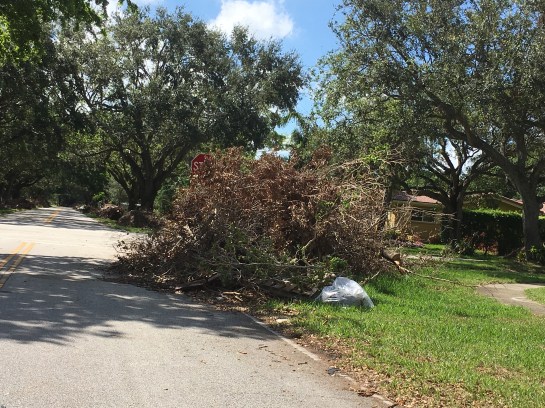
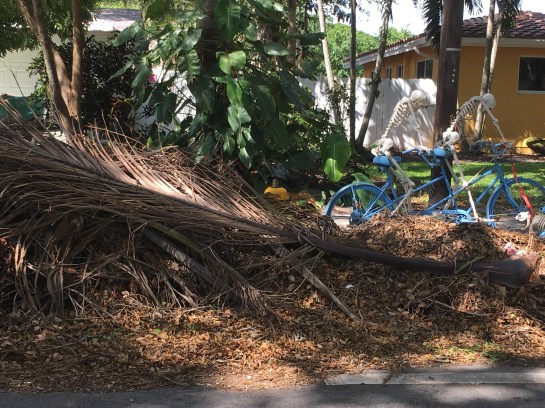
A month after Irma, and several rounds of City, FPL and homeowner tree trimming, cleanup and more, the piles are not picked up.  So besides rats, cockroaches, palmetto bug, composted breakdown( smells) and other ills, take a look closely at these photos.

IMG_1280

There is a stop sign there

IMG_1278 (1)

There is a fire hydrant in there

IMG_1281 (1)

There might be a car coming down the road.

Now when  the inevitable problem occurs – is the City going to be responsible for this?  I stopped smoke testing in Hallandale Beach until the piles were gone (they are making huge progress), but in the City with these pipes, how do the fire department staff access the hydrant?  Accidents?  This is why communities need to have their guys to do work.  The contractors and subcontractors are looking for the highest dollar.  you aren’t it, you fall down the list.  Right?  no.  Do they have contract?  Sure.  Are they following them?  No.  Recourse?  Sue them.  The courts might get to it next summer.  Meanwhile the piles survive.  Maybe privatization was not the answer here.