Archive

Tag Archives: finance


For those wondering what the big report was going yo say, interesting reading, and a lot like Walkerton – plenty of blame to go around.

Click to access FWATF_FINAL_REPORT_21March2016_517805_7.pdf

And some related articles:

http://www.fox2detroit.com/news/flint-water-crisis/112311306-story


How to Predict the next Flint?

IMG_4803In the last blog we talked about Flint’s water quality problem being brought on by a political/financial decision, not a public health decision.  Well, the news get worse.  Flint’s deteriorated water system is a money thing as well – the community has a lot of poverty and high water bills, so they can’t pay for improvements.  They are not alone.  Utilities all over the country have increasing incidents of breaks, and age related problems. So the real question then is who are the at risk utilities?  Who is the next Flint?  It would be an interesting exercise to see if a means could be developed to identify those utilities at risk for future crises, so we can monitor them in more detail as a means to avoid such crises.

So what would be the measures that might identify the future “Flint?”  These could be things like age of the system, materials used, economic activity trends, income, poverty rate, unemployment rate, utility size, reserves, utility rates, history of rate increases, etc.?  Could these be developed into a means to evaluate risk?  If so, who would use it and how would we address the high risk cases?  I suggest that lenders have means to evaluate this using many of these same measures, but from a risk of events, this method has not been applied.  So I think this would be a useful research project.  So if anyone has some ideas, time or ideas for funding, let me know.  Let’s get rolling!


I was at a recent AWWA technical and Education Council meeting in Denver. One of the major discussions was the issues with lead service lines as highlighted by the current problem in Flint, and how many utilities are now fielding questions about and dealing with lead in their services lines, research that will come for lead, and regulatory requirements for upgrades. One issue that remains unanswered is what happens on the customer’s side of the meter, which may also be lead piping. So removing the utility’s lead service would not solve the lead issue completely, but it will help. But why has lead not been an issue in 25 years? Did it suddenly arise?
While the lead has arisen again as a public health topic, the lead and copper rule has been in effect for nearly 30 years and much of the lead and copper testing was conducted in the early 1990s. Most utilities made water treatment upgrades based the findings from the testing, and utilities have been required to continue to monitor their system ever since. Normally lead levels, even when present, were not a health issue because the zinc orthophosphates and other treatment methods kept the pipe
encapsulated. Others like Cincinnati, Lansing, Madison, Boston and others had ongoing programs to replace lead pipes. 30 years ago in North Carolina we changed out lead goosenecks and galvanized lines rather than replace them – it was just easier.
Most of the folks in the room agreed most utilities have or have such programs and that the number of lead service lines and lead goosenecks on the utility side is
limited. So I suggested that maybe the lesson we should learn from Flint is not about lead service lines, but instead the risks we incur with decision-makers who only look at money when making decisions. Flint’s decision to change water sources was driven by money, not public health.
In fact the report just published indicates that public health was not a real consideration at all. But decisions based on money impacted not only Flint, but Alamosa, CO in 2008, where disinfection was not practiced, and Walkerton,
ONT in 2001 where a Flint like set of decisions cascaded into contamination that killed people. There are utiity systems who contract operations and their contract operator makes decisions based on money, and now there is a distribution system problem. This is a repetitive pattern that has less to do with personnel operating these systems, than decision-makers, who tend to look more at the business case or money as opposed to public health. The lesson we need to learn is that money cannot be the
deciding factor when operating public water and sewer system. And to reduce the chance it happens in the future, perhaps there should be penalties if it does.

IMG_7385One of the issues I always include in rate studies is a comparison of water rates with other basic services.  Water always comes in at the bottom.  But that works when everyone has access and uses those services.  Several years ago a study indicated that cable tv was in 87-91 % of home.  At the time I was one of the missing percentage, so I thought it was interesting.  However, post the 2008 recession, and in certain communities, this may be a misplace comparison.  A recent study by Emmanuel Saez and Gabriel Zucman notes that the top 0.1% have assets that are worth the same as the bottom 90% of the population!  Yes, you read that correctly.  Occupy Wall Street had it wrong.  It’s not the 1% it is the 0.1%.  This is what things were like in the 1920s, just before the Great Depression.  The picture improved after the implementation of tax policies (the top tax rate until 1964 was 90% – yes you read that right – 90%).  Then the tax rate was slowly reduced to deal with inflation.  The picture continued to improve until supply side economics was introduced in the early 1980s when the disparity started to rise again (see their figure below), tripling since the late 1970s (you recall the idea was give wealthy people more money and they would invest it in jobs that would increase employment opportunities and good jobs for all, or something like that).  Supply side economics did not/does not work (jobs went overseas), and easy credit borrowing and education costs have contributed to the loss of asset value for the middle class as they strove to meet job skills requirements for better jobs.  In addition wages have stagnated or fallen while the 0.1% has seen their incomes rise.  The problem has been exacerbated since 2008 as they report no recovery in the wealth of the middle class and the poor.  So going back to my first observation – what gets cut from their budget, especially the poor and those of fixed pensions?  Food?  Medicine?  Health care?  My buddy Mario (86 year old), still works because he can’t pay his bills on social security.  And he does not live extravagantly.  So do they forego cable and cell phones?  If so the comparison to these costs in rate studies does not comport any longer.  It places at risk people more at risk.  And since, rural communities have a lower income and education rate than urban areas, how much more at risk are they?  This is sure to prove more interesting in the coming years.  Hopefully with some tools we are developing, these smaller communities can be helped toward financial and asset sustainability.  But it may require some tough decisions today.

Income percent


My cousin  once asked me what I thought about deciding on who to vote for for President might be best done when evaluating how well your 401K or investments did.  Kind of an amusing thought.  In that vein the decisions might be very different than they were.  Clearly your 401k did with with Clinton.  The economy was flat for George W. Bush, and the end of his term was the Great Recession.  Reagan’s first term was flat.  We all know about George H.W. Bush.  Interesting thoughts.  Not so good.  So what about the last 8 years?   But is raises a more interesting issue.  So don’t get me wrong, this blog is not intended to lobby for any candidate (and Obama can’t run), but it is interesting to look at the last 8 years.  They have been difficult.   The economy responded slowly.  Wages did not rebound quickly.  But in comparison to 2008 are we better off?

The question has relevance for utilities because if our customers are better off, that gives us more latitude to do the things we need – build reserves (so we have funds for the next recession), repair/replace infrastructure (because unlike fine wine, it is not improving with age), improve technology (the 1990s are long gone), etc., all things that politicians have suppressed to comport with the challenges faced by constituents who have been un- or under-employed since 2008.

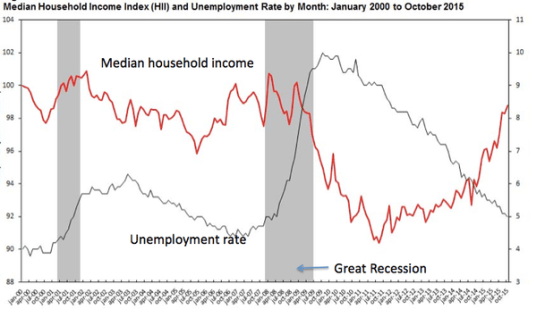
Economist Paul Krugman makes an interesting case in a recent op-ed in the New York times:  (http://krugman.blogs.nytimes.com/2016/01/13/yes-he-did/?module=BlogPost-Title&version=Blog%20Main&contentCollection=Opinion&action=Click&pgtype=Blogs&region=Body).  Basically he summarizes the figure below which shows that unemployment is back to pre-2008 levels, and income is back to that point.  Some income increase would have been good, but this basically tracks with the Bush and Reagan years for income growth – flat.  So the question now is in comparison to 2008 are we worse off that we were?  And if not, can we convince leaders to move forward to meet our needs?  Can we start funding some of the infrastructure backlog?  Can we modernize?  Can we create “smarter networks?”  Can we adjust incomes to prevent more losses of good employees?  Can we improve/update equipment?  All issues we should contemplate in the coming budget.

Krugman Income percent


photo 2Over the holidays there were a couple articles that came out about groundwater issues in the US, mostly from the declining water level perspective.  I also read a paper that suggested that rising sea level had a contribution from groundwater extraction, and of course USGS has maps of areas where the aquifer have collapsed as a result of overpumping.  In 2009 USGS published a report that showed a large areas across the country with this issue.  The problem is that of the 50,000 community water systems in the US, 500 serve over 50% of the population, and most of them are surface water plants.  There are over 40,000 groundwater systems, but most are under 500 customers.  Hence, groundwater is under represented at with the larger water associations because the large utilities are primarily surface water, while the small systems are groundwater. AWWA has difficulty reaching the small systems while RWA and NGWA reach out to them specifically.  But the small utility seems more oriented to finding and producing water and operating/maintaining/drilling wells than the bigger impact of groundwater use.  It is simply a matter of resources.  I ran a system like that in North Carolina, and just getting things done is a huge issue.  A couple of my medium size utility clients have the same problem.

The bigger picture may contain the largest risk.  Changing water supplies is a high cost item.  We have seen a couple examples (surface water) as a result of drought.  We saw Wichita Falls and Big Springs TX go the potable reuse route due to drought.  California is looking at lots of options. Both have had rain lately (Wichita Falls discontinued the potable reuse when the reservoir got to 4% of capacity).  Great, but someone is next.  Droughts come and go, and the questions is how to deal with them.

Groundwater supposedly is a drought-proof problem, but is it?  Groundwater has been a small utility solution, as it has been for agriculture.  But aquifer require recharge and water limited areas do not have recharge.  The result is a bigger problem – overpumping.  Throughout the west/southwest, Plains states, upper Midwest (WI, MN, IA), southeast (SC, NC), we see this issue.  Most of these areas have limited surface water so never developed much historically.  Rural electrification changes that because it made is easy to put in an electric pump to pull water out of the ground in areas that never had a lot of water on the surface, and hence were not farmed much. Pumps made is easier to farm productively, which led to towns. However, our means to assess recharge are not very good, especially for confined aquifers. The lowering water levels USGS and state agencies see is an indication that recharge is normally over estimated giving a false picture of water availability.  If your aquifer declines year after year, it is not drought – it is mining of the aquifer. You are sucking it dry like the eastern Carolinas did.  But, like many negative things, there is a lack of willingness to confront the overpumping issue in many areas. There are many states with a lack of regulations on groundwater pumping.  And I still think groundwater modeling use is limited to larger utilities, when smaller, rural systems may be most in need of it due to competing interests.

Concurrently, I think there is a tendency to oversell groundwater solutions (ASR, recharge), groundwater quality and the amount of available water (St George, UT).  Easy, cheap, limited treatment should not be the only selling point.  That leads to some curious decisions like some areas of California north of LA the utilities do not treat hard groundwater – then tell residents they cannot use softeners because of the salt in the wastewater prevents it from being used for reuse.  The reason they do not treat – cost, but it makes things difficult for residents.  The fact is we do not wish to confront is the realization that for many places, groundwater should probably be the backup plan only, not the primary source.

That leads to the question – what do we do about it when every politician’s goal is for their community to grow?  For every farmer to grow more crops?  But can they really grow sustainably?  DO we not reach a point where there are no more resources to use?  Or that the costs are too high?  Or that competition become unruly?  The growth and groundwater use ship is sailing, but in to many cases they do not see the rocks ahead.
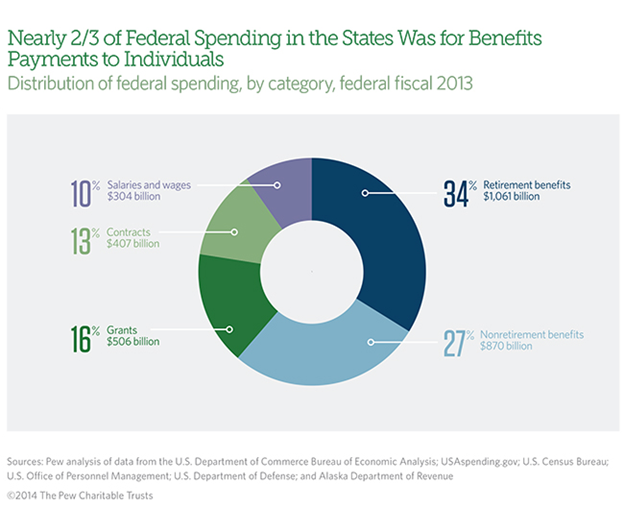
How much money goes to the states from the Federal government? Ever wonder about that? And how do we react? We talk about the need to tighten the federal spending so we keep cutting back on the Superfund cleanup monies ($1 billion/yr), the State Revolving Fund loan system ($2.35 billion/yr), and under $2 billion/yr for clean energy systems. We are concerned about the projected increase of $66 billion/yr for the Affordable Care Act. But these sums are just a tiny component for the federal budget, which is dwarfed by the $3.1 trillion sent to the states during its 2013 fiscal year. So what are these funds? Retirement benefits, including Social Security and disability payments, veteran’s benefits; and other federal retirement and disability payments account for over 34% of these payments. Medicare in another 18%. Food assistance, unemployment insurance payments, student financial aid, and other assistance payments account for another 9%. Another 16% is for grants to state and local governments for a variety of program areas such as health care (half the amount is Medicaid), transportation, education, and housing and research grants. All the SRF and grant monies are in this 16%. Those water programs are barely visible in this picture. Contracts for purchases of goods and services for military and medical equipment account for another 13%, while smallest amount – salaries and wages for federal employees is 10%.  Keep in mind that federal employees have dropped from nearly 7 million to 4.4 million since 1967. No federal employment expansion going on there.

growth in fed payments

fed payments

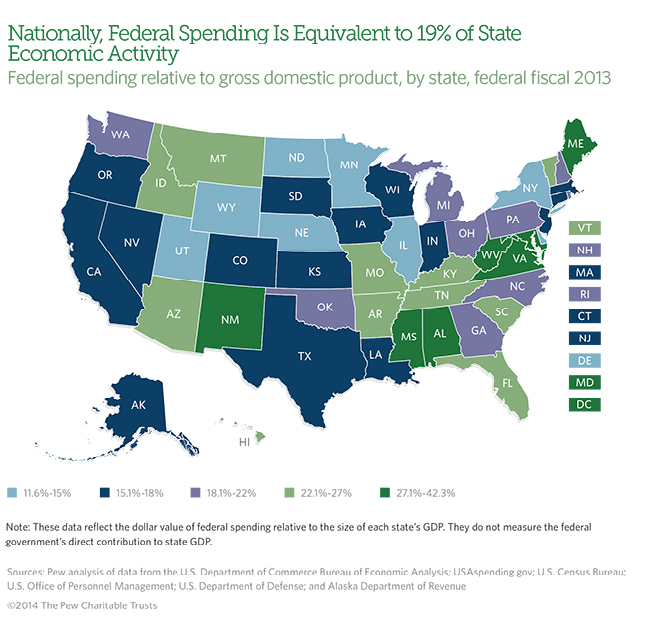
So how much does this affect the states? Federal funds account for about 19 of the total gross domestic product of the US, a number that has been relatively consistent (within a few percentage points) for years. That is below its all-time highs, and about typical over the past 30 years. Figure 1 from a PEW report shows that federal funds are greater than 22% of the GDP in most southern states (which interestingly enough have the people that complain the most about the federal government intrusion), while the Plains states, Midwest, northeast and the west coast are generally below average, and the two coasts, especially complain the least. Mississippi, Virginia and New Mexico all top 30%.

figure nat fed spending by state

So let me see if I have this right – those that pay the least, but get the most, complain the most about their benefactors, and those that pay the most, but collect less, complain less. That is the message! What is WRONG with that picture? And those people? The problem is I see it every day at the local level and it is truly baffling. It means that somehow our politics gotten so out of whack that those in need the most, seem to continue to vote against their best interests? Marketing clearly is a problem but are we fooled that easily. A message that distracts from the reality is obvious, but this continuing trend is just truly weird. No wonder it is so hard to accomplish things.


Your grandma always told you to save money for a rainy day.  She wasn’t really talking about rainy days, but days when you had less or no income.  The press talks about the huge percentage of Americans that have little or no savings, and how compared to other countries, we are at a disadvantage during economic times.  A huge problem is that the same argument can be translated to governments, which must provide services, and often more services during economic downturns.  But if they have no savings, how are they to accomplish this?  They do not want to raise taxes and fees in down situations, so won’t the loss of services just make things worse?

A recent PEW reports suggests that states “had about half the reserves necessary to address budget gaps during the first year of the Great Recession.  The 50 states had about $60 billion set aside in the summer of 2008, but in fiscal 2009, budget gaps across the country totaled $117 billion, about twice what states had in reserve. The budget gaps continued to grow in 2010 and many states struggled with shortfalls for years afterward.  Bad news, but the news really does not improve.  They report that 37 states have legal caps that prevent them from saving enough to weather recessions or even enough to substantially offset revenue losses, and most of those are based on some percentage of the prior year’s revenues.  Why?  Short-term views?  Most governments figure on keeping enough cash on hand to pay bills during tax seasons. That accounts for 60-90 days of funds.  Far too little for dealing with economic impacts.  Far too few state governments recognize the importance of saving, figuring that cutting taxes during time of plenty and giving back to taxpayers is a better use of funds.  Then it is someone else’s issue when the next economic hiccup occurs – and it will.  Unless you raise your cap now as Minnesota and Virginia have recently done.

But the issue is not just a state issue.  It is a local and a utility issue as well.  Local governments are closer to the ground, have less leeway in their budgets and often have far too little funding as a result of resistance to raising property taxes, user fees and over-dependence on state shared sales tax, which often drops precipitously during a recession.  Same goes for sin and gas tax dependence.  When people slow smoking, or as oil prices drop, so do revenues.  Ask Alaska, Louisiana, Kansas, Texas, North Dakota and others that are oil rich states about their budget this past year.  The legislatures were begging Grover Norquist to let them out of their no tax increase pledges.  He said no of course, because he doesn’t want government to function properly.  So those legislators were stuck in the either “do the right thing” or “get whacked by Grover in the next election” conundrum.  You know what they did because they want to get re-elected  That doesn’t help the citizens of those states.  Standard & Poor’s revised its outlook on Alaska’s general obligation and appropriation-backed debt from stable to negative. That will cost them in the future. St. Louis, Moody’s downgraded the city’s credit rating one step to A1, citing “the city’s weak socioeconomic profile; reliance on earnings taxes which are due for voter reauthorization in 2016.”  Diversity in industry and taxes is beneficial.  Too often this gets lost in the desire to do more with less, but doing more means you need more funding!  And you need to collect those savings as grandma counselled!


The true risk to the community of pipe damage is underestimated and the potential for economic disruption increases.  The question is how do we lead our customers to investing in their/our future?  That is the question as the next 20 years play out. Making useful assumptions about increases in demands, prices, inflation rates etc. are key to useful projections and long-term sustainability. Building too much or too little capacity for example can have disastrous consequences (to the ratepayers on the former, to the local economy for the latter).

Getting funding relies on economic strength, a problem of you are in a depressed area (Detroit) or a boom that could crash at any time (North Dakota).  P3 opportunities are available for cash strapped communities but they come with a cost.  Risk must be allocated fairly – the private community will not take on too much risk without increasing costs significantly. Loss of control is one of those risk conversion issues.  Extensive planning and feasibility analyses should be expected – far more scrutiny than most utilities are used to.  The economic strength of the community is important to private investors.

In a prior blog we talked about the boom towns of North Dakota.  Things were booming in 2013 but the downturn in oil prices may get ugly.  The need for more fracking wells may have decreased (at least temporarily) and the decrease in the oil and gas costs has cut into local revenues, so is this is the time to keep planning for the boom?  South Florida did this in the early 2000s – and well, that real estate boom put quite a dent in the economy and population estimates for 2020 and 2030.  The balloon popped and so did the economy.  South Florida had the resiliency to bounce back because of weather and proximity to South America.  We have seen the result to an industrial economy – where a community relies on industry, well industry can be fickle.  Ask Detroit.  Or Cleveland.  Or any number of other Rust Belt cities.  Now they have infrastructure, but much of it is underused.
So while the Plains states plan for the boom, the boom has settled in some places. Already the oil and gas industry has shed 100,000 jobs (many high salary).  Texas, Kansas, North Dakota and Oklahoma are facing financial challenges in 2015 due to funding losses.  Alaska is dipping into reserves.  But that doesn’t mean the results of the 2010-2014 boom are not continuing, or at least portions of them.  Frack water continues to be discharged to local wastewater systems, but the revenues to pay for the needed upgrades is lacking.  Effluent limits for nitrogen and TOC for some rivers have decreased as a result of constant increased loading to the streams (more flow increases total loads, so if flows remain the same, the concentrations must decrease to maintain total loading).  The costs to reduce ammonia, for example from 10 mg/l to 2 or 3 mg/L can be $1-2/1000 gallon – over 50% or more of the current cost for treatment.

So is it a surprise that some communities fight the boom times?  Booms create disruption and uncertainly, and a need for technology (and costs).  Maybe stability does matter, as it can contain costs and treatment requirements.  However the boom can help communities in financial distress.  Detroit and Flint would love a boom – both have the infrastructure in place to support it as opposed to rural communities in the Plains.  But that’s is a key – they already HAVE the infrastructure in place.  The Plains, well, do not.

There is a lot of older, underutilized infrastructure out there.  Detroit, Flint, Cleveland, Akron, Toledo and Philadelphia are among the older industrial cities that have stable populations – people that live there most of their lives, have a trained and educated workforce, and normally have lots of water and infrastructure, and lots of potential employees, all of which are underutilized and at risk due to economic losses. But the booms rarely go to older cities. How that is?  Is this a leadership issue?  Convenience?  Quick profits?  And how long will the boom last?  Is it a matter of lack of understanding or regulations that creates the boom?  A combination of factors?  A better PR program?

Remember we all play defense.  Industry does not.  Industry plays offense all the time.  The private sector mode is play offense.  Get the message out.  Frame the message.  Win the game.  Is winning the game at any cost the right answer?  For boomers it is.  What about the rest of us?


The US EPA estimates that there is a $500 billion need for infrastructure investment by 2025.  The American Water Works Association estimate $1 trillion.  Congress recently passes the Water infrastructure Finance and Innovation Act (WIFIA) at $40 million/year, rising to $100 million in 5 years, which is a drop in the bucket.  Peanuts.  We have so many issues with infrastructure in the US and Congress tosses a few scheckles at the problem and thinks it is solved.  The reality is that the federal government wants to get out of the water infrastructure funding business and shift all water infrastructure to the local level.  This is a long-standing trend, going back to the conversion of the federal water and sewer grant programs to loan programs.

The reality is that local officials need to make their utility system self-sustaining and operating like a utility business whereby revenues are generated to cover needed maintenance and long-term system reliability.  The adage that “we can’t afford it” simply ignores the fact that most communities cannot afford NOT to maintain their utility system since the economic and social health of the community relies on safe potable water and wastewater systems operating 24/7.  Too often decision are made by elected officials who’s vision is limited by future elections as opposed to long-term viability and reliability of the utility system and community.  This is why boom communities fall precipitously, often never recovering – the boom is simply not sustainable.  Long-term planning is a minimum of 20 years, well beyond the next election and often beyond the reign of current managers.  Decisions today absolutely affect tomorrow’s operators.  Dependency on water rates may be a barrier, but this ignores the fact that power, telephone, cable television, gas, and internet access are generally more expensive hat either water or sewer in virtually all communities.  We need water. Not so sure about cable tv or he internet.  Great to have, but needed to survive?

The growth in costs can lead to mergers where a utility cannot afford to go it alone – as the economy of scale of larger operations continues to play out in communities.  Several small plants cannot operate at the same cost as one larger plant.  As a result larger projects will increase – from 87 to over 336 between 2005 and 2014.

But these costs are generally plant costs – treatment and storage, not piping.  Distribution pipelines remain the least recognized issue for water utilities (collection pipelines for sewer are similarly situated).  The initial Clean Water Act and Safe Drinking Water acts did not focus on piping systems – only treatment and supply.  The national Council on Public Works concluded their first assessment grade for infrastructure in the 1980s – but piping was not discussed.  ACSCE’s first report card in 1998 did not express concern about piping system.  Yet piping continues to age, and expose communities to risk.  In many communities greater than 50% of their assets are buried pipes.  Tools for assessing the condition of buried pipes especially water distribution pipes is limited to breaks and taps.  As a result the true risk to the community of pipe damage is underestimated and the potential for economic disruption increases.  The question is how do we lead our customers to investing in their/our future?  That is the question as the next 20 years play out.  Many risk issues will be exposed.  The fact that there are not more issues is completely related to the excellent work done by the utility employees.  More to come….