Archive

Tag Archives: sustainability


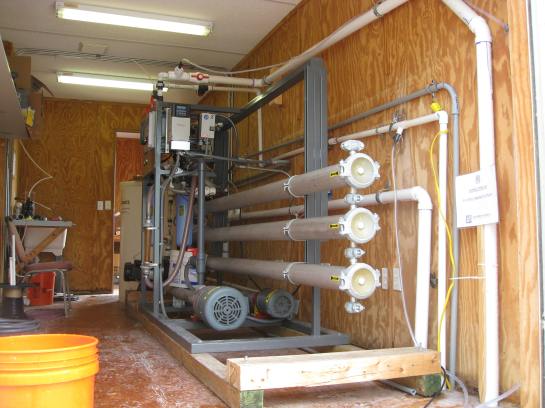
In the last blog I showed what reclaimed wastewater could do for an ecosystem.  Very cool.  But what about for drinking water.  I actually was involved in an indirect potable reuse project several years ago.  The concept was to take wastewater, filter it with sand filters, filter it with microfiltration, reverse osmosis and then hydrogen peroxide and ultraviolet light.  This is what they do in Orange County California when they recharge groundwater, and have been for over 30 years.  Epidemiological studies in the 1990s indicated no increased incidence of disease when that water was withdrawn from the aquifer, and then treated in a drinking water plant before distribution.  So our project was similar – recharge to the Biscayne aquifer in south Florida.   It worked for us.  Total phosphorous was below 10 ppb, TDS was less than 3 mg/L (<1 after RO), and we were able to show 3 log removal of endocrine disruption compounds an d pharmaceuticals.  It worked well.  This is a concept in practice in California.  And will be at some point in south Florida since only the Biscayne aquifer provides sustainable water supplies.  Here is what our system looked like.

IMG_3100

sand filters

IMG_3106

microfiltration

IMG_3085

Reverse osmosis

IMG_3152

ultraviolet/peroxide

This is also the same basic concept Big Springs Texas uses for their direct potable program, demonstrating that the technology is present to treat the water.  A means for continuous monitoring is lacking, but Orange County demonstrates that for indirect potable reuse projects, a well operated plant will not risk the public health.  This is how we do it safely.


before+and+after+animas

In the last blog we talked about a side issue: ecosystems, bison, wolves, coyotes and the Everglades, which seem very distant form our day-to-day water jobs, but really are not.  So let’s ask another, even more relevant issue that strikes close to home.  Why is it that it is a good idea to store coal ash, mine tailings, untreated mine waste, garbage, and other materials next to rivers?  We see this over and over again, so someone must think this is brilliant.   It cost Duke Energy $100 million for the 39,000 tons of coal ash and 24 MG of wastewater spilled into the Dan River near Eden NC in 2014. In West Virginia, Patriot Coal spilled 100,000 gallons of coal slurry into Fields Creek in 2014, blackening the creek and impacting thousands of water supply intakes.  Fines to come.  Being a banner year for spills, again in West Virginia, methylcyclohexamethanol was released from a Freedom Industries facility into the Elk River in 2014, contaminating the water supply for 300,000 residents.   Fines to come, lawsuits filed.  But that’s not all.  In 2008, an ash dike ruptured at an 84-acre solid waste containment area, spilling material into the Emory River in Kingston TN at the TVA Kingston Fossil Plant.  And in 2015, in the Animas River in western Colorado, water tainted with heavy metal gushed from the abandoned Gold King mining site pond into the nearby Animas River, turning it a yellow for dozens of miles crossing state lines.

Five easy-to-find examples that impacted a lot of people, but it does not address the obvious question – WHY are these sites next to rivers?  Why isn’t this material moved to more appropriate locations?  It should never be stored on site, next to water that is someone else’s drinking water supply.  USEPA and state regulators “regulate” these sites but regulation is a form of tacit approval for them to be located there.  Washington politicians are reluctant to take on these interests, to require removal and to pursue the owners of defunct operations (the mine for example), but in failing to turn the regulators loose to address these problems, it puts our customers at risk.  It is popular in some sectors to complain about environmental laws (see the Presidential elections and Congress), but clearly they are putting private interests and industry before the public interest.  I am thinking we need to let the regulators do their job and require these materials to be removed immediately to safe disposal.  That would help all of us.


IMG_7871

Most water suppliers realize that the more natural their land is upstream of their water supplies, the less risk there likely is for their customers.  Under the source water protection programs that state, local officials and water utilities implement, the concept is to keep people related activities out, and let the natural forests and landscapes remain.   For the most part the natural areas support only a limited amount of wildlife (sustainable) and thereby there natural systems are attuned to compensate for the natural pollutant loads, sediment runoff, ash, detrital matter, etc., that might be created through natural processes.  For thousands of years these systems operated sustainably.  When people decide there needs to be changes, it seems like the unanticipated consequences of these actions create more problems.  Now many of these same ecosystems do not work sustainably and water quality has diminished, increasing the need for treatment and the risks of contamination to the public.  It would be better, but decidedly less popular on certain fronts, to provide more protection to natural systems that extend into watersheds (which is most of them), not less.

So this leads to a series of questions that go to the greater questions about natural environments:

Is it really necessary to cull the small Yellowstone bison herd by 1000?  What do bison have to do with watersheds?  Well, the bison create much less damage to grasslands and underlying soil than cattle due to the size of their hooves.  An argument is that we need to cull the herd because they transmit disease to cattle, but Brucellosis has never been demonstrated to move from bison to cattle, so disease is not an answer.  What is really happening is that there is competition between buffalo and cattle for grazing.  Competition with cattle means that the cattle are on public property, not private ranch lands, and the cattle trample the public lands which creates the potential for soil erosion and sediment runoff.  So I am thinking water folks should be siding with the bison. Of course without wolves, there is no natural predator for bison, which raises a different sustainability problem, so maybe instead of killing them, we move them to more of their native ranges – maybe some of those Indian reservation might want to restart the herds on their lands?  That might be good for everyone, water folks included.

Part 2 – is it necessary to continue to protect wolves or should we continue to hunt them in their native ranges?  Keep in mind wolf re-introduction efforts are responsible for most of the wolf populations in the US, specifically in the Yellowstone area.  Without wolves, there is no control of large grazing animal populations (see bison above, but also elk and deer), and there is a loss of wetland habitat because the elk eat the small shoots used by beavers to build dams and trap sediment.  Eliminating wolves has been proven to create imbalance.  Wolves = sediment traps = better water quality downstream.  Sounds like a win for everyone. (BTW there is a program in Oregon to protect wolves and help ranchers avoid periodic predation of calves by wolves so they win too).

Part 3 – Is it really necessary to kill off coyotes in droves?  The federal government kills thousands of coyotes and hunters and others kill even more.  This is a far more interesting question because it leads to one of those unintended consequences.  !100+ years ago people decided wolves were bad (we still have this issue ongoing – see above).  So we eradicated wolves.  No wolves means more rodents, deer, elk, etc. which mean less grass, less aspens and less beavers, which means more runoff which does not help water suppliers.  It also means more coyotes, because there is more food for the coyotes.  Interesting that coyotes have pretty much covered the entire US, when their ranges were far more limited in the past.  Coyotes are attracted to the rodents and rabbits.  But the systems are generally not sustainable for coyotes because there is not enough prey and there is no natural control of the coyotes – again, see wolves above.  A Recent Predator defense report indicates that culling coyotes actually increases coyote birth rate and pushes them toward developed areas where they find cats and small dogs, unnatural prey.  Not the best solution – unintended consequences of hunting them on more distant land pushes them into your neighborhood.  Not the consequence intended.  So maybe we keep the small dogs and cat inside at daybreak and nightfall when the coyotes are out and let them eat the rats and mice that the cats chase and once consumed they go away.   Coyotes need to eat grazers and rodents but you need the right mix or the grazers overgraze, which leads to sediment runoff issues – which is bad for us.  That also seems like a win.

Everglades restoration is a big south Florida issue.  The recharge area for the Biscayne aquifer is the Everglades.  So water there seems like a win for water suppliers?  So why aren’t we the biggest Everglades advocates out there?  Still searching for that answer, but Everglades restoration is a win for us and a win for a lot of critters.  Federal dollars and more federal leadership on restoration is needed.  Which leads to ….

Do we need more, not less management of federal lands?  Consider that the largest water manager in the west is the federal government, which has built entire irrigation systems to provide water to farmers who grow crops in places that are water deficient.  Those farms then attract people to small towns that consume more of the deficient water.  Then people lobby to let cattle graze on those public lands (see bison above), timber removal – which increases sediment erosion, or mining (what could possible go wrong there?).  So since the federal government manages these lands, wouldn’t better regulations and control to keep the federal properties more protected benefit water users and suppliers?  Contrary to the wishes of folks like the guys holed up in a federal monument in Oregon, or the people who have physically attacked federal employees in Utah and Nevada, more regulations and less freedom is probably better in this situation for the public good.  If we are going to lease public lands (and most lands leased are leased to private parties for free or almost free), and there should be controls on the activities monitoring for compliance and requirements for damage control caused by those activities.  There should be limits on grazing, timber and mining, and monitoring of same.  Lots of monitoring.  It is one of the things government really should do.  And we need it to protect water users downstream.  Again a win for water suppliers.

So as we look at this side issue, ecosystems, bison, wolves, coyotes and the Everglades seem very distant from our day-to-day water jobs.  But in reality they are not.  We should consider the impacts they might have on water supply, keeping in mind natural system decisions are often significantly linked to our outcomes, albeit the linkage is not always obvious.

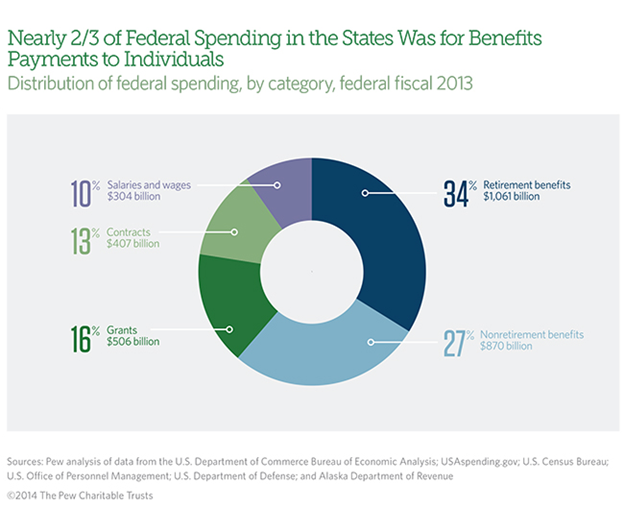
How much money goes to the states from the Federal government? Ever wonder about that? And how do we react? We talk about the need to tighten the federal spending so we keep cutting back on the Superfund cleanup monies ($1 billion/yr), the State Revolving Fund loan system ($2.35 billion/yr), and under $2 billion/yr for clean energy systems. We are concerned about the projected increase of $66 billion/yr for the Affordable Care Act. But these sums are just a tiny component for the federal budget, which is dwarfed by the $3.1 trillion sent to the states during its 2013 fiscal year. So what are these funds? Retirement benefits, including Social Security and disability payments, veteran’s benefits; and other federal retirement and disability payments account for over 34% of these payments. Medicare in another 18%. Food assistance, unemployment insurance payments, student financial aid, and other assistance payments account for another 9%. Another 16% is for grants to state and local governments for a variety of program areas such as health care (half the amount is Medicaid), transportation, education, and housing and research grants. All the SRF and grant monies are in this 16%. Those water programs are barely visible in this picture. Contracts for purchases of goods and services for military and medical equipment account for another 13%, while smallest amount – salaries and wages for federal employees is 10%.  Keep in mind that federal employees have dropped from nearly 7 million to 4.4 million since 1967. No federal employment expansion going on there.

growth in fed payments

fed payments

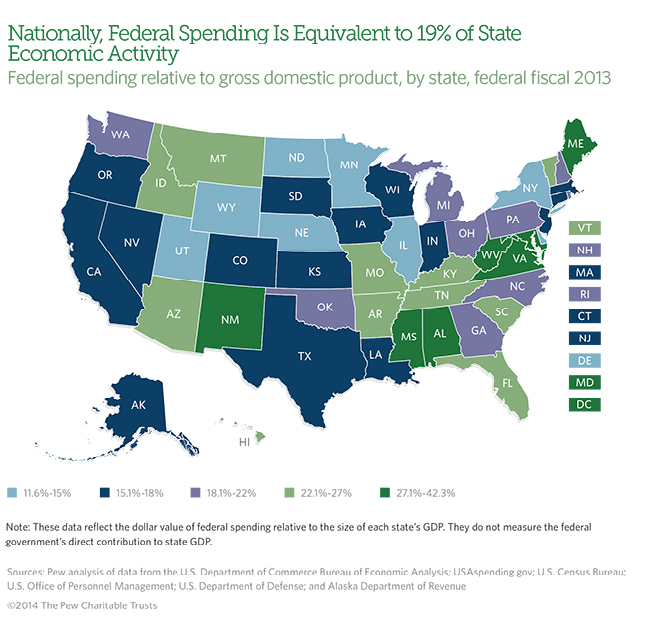
So how much does this affect the states? Federal funds account for about 19 of the total gross domestic product of the US, a number that has been relatively consistent (within a few percentage points) for years. That is below its all-time highs, and about typical over the past 30 years. Figure 1 from a PEW report shows that federal funds are greater than 22% of the GDP in most southern states (which interestingly enough have the people that complain the most about the federal government intrusion), while the Plains states, Midwest, northeast and the west coast are generally below average, and the two coasts, especially complain the least. Mississippi, Virginia and New Mexico all top 30%.

figure nat fed spending by state

So let me see if I have this right – those that pay the least, but get the most, complain the most about their benefactors, and those that pay the most, but collect less, complain less. That is the message! What is WRONG with that picture? And those people? The problem is I see it every day at the local level and it is truly baffling. It means that somehow our politics gotten so out of whack that those in need the most, seem to continue to vote against their best interests? Marketing clearly is a problem but are we fooled that easily. A message that distracts from the reality is obvious, but this continuing trend is just truly weird. No wonder it is so hard to accomplish things.


Most states were doing pretty well before the 2008 recession hit, but that ended in 2009. Most states had to make extremely difficult cuts or raise taxes, which was politically unacceptable. Of course invested pension systems received a lot of attention as their value dropped and long term sufficiency deteriorated, which was fodder for many changes in pensions, albeit not how they were invested. The good news is a lot of them came back in the ensuing 5 years, but 2015 may be different. A number of states have reported low earnings in 2015 and whether this may be the start of another recession. The U.S. economy has averaged a recession every six years since WWII and it has been almost seven years since the last contraction. With China devaluing their currency, this may upset the economic engine. At present there are analysts on Wall Street who suggest that some stocks may be overvalued, just like in 1999. If so, that does not bode well states like Illinois, Kansas, New Jersey, Louisiana, Alaska and Pennsylvania that are dealing with significant imbalances between their expenses and incomes. Alaska has most of its revenue tied to oil, so when oil prices go down (good for most of us), it is a huge problem for Alaska that gives $2200 to every citizen in the state. An economic downturn portends poorly for the no tax, pro-business experiment in Kansas that has been unsuccessful in attracting the large influx of new businesses, or even expansion of current ones. California and next door Missouri, often chided by Kansas lawmakers as how not to do business, outperform Kansas.

Ultimately the issue that lawmakers must face at the state and as a result the local level is that tax rates may not be high enough to generate the funds needed to operate government and protect the states against economic down turns. There is a “sweet spot” where funds are enough, to deal with short and long term needs, but starving government come back to haunt these same policy makers when the economy dips.   It would be a difficult day for a state to declare bankruptcy because lawmakers refuse to raise taxes and fees.


There is an interesting ethical issues that arises in this discussion also. Engineers are entrusted to protect the public health, safety and welfare. When there were few people, projects did not impact many so little thought was given to the “what could possible happen” question. We are still paying for that. When bad things happen, the precedent has unfortunately been set that somehow “the government” will resolve this. An old 1950s BOR director said he thought he was “a hero because he helped create more room for people” in the west with dams and water projects. He did accomplish that, except that while there were more people coming, the resources were never analyzed for sustainability, nor the impact it might have on the existing or potential future economic resources. But once the well runs dry, I think we just assumed that another solution would resolve any issue. But what is if doesn’t?

There are many water supply examples, where we have engineered solutions that have brought water or treated water to allow development. South Florida is a great example – we drained half a state. But no one asked if that development was good or appropriate – we drained off a lot of our water supply in the process and messed up the ecological system that provided a lot of the recharge. No one asked in the 1930 if this was a good idea.

Designing/building cities in the desert, designing systems that pump groundwater that does not recharge, or design systems that cannot be paid for by the community – we know what will happen at some point. Now that there are more people, conflicts become more likely and more frequent. Most times engineers are not asked to evaluate the unintended consequences of the projects they build. Only to build them to protect the public health safety and welfare while doing so, but from a specific vantage point.

So if you know a project will create a long-term consequence, what action should you take? So the question is whether there is a conflict between engineers meeting their obligations to the public and economic interests in such cases?  Or should we just build, build, build, with no consideration of the consequences?


The number of people that recall the Dust Bowl of the 1930s is dwindling and that may portend poorly for society (likewise the loss of Depression memories and two world wars).  The Dust Bowl was aptly names for the regular storms of windblown dust that pummeled farm fields and blew away valuable topsoil needed by farmers.  Why it occurred was more interesting and foretelling.

The amount of farming had exploded in the late 1920s as a result of  record wheat price, motorized tractors and government programs encouraging farmers to plow up the prairie and plant.  The crops replacing the native plants did not have the same root structure and were less drought tolerant as a result.  When wheat prices collapsed, the fields were left fallow exposing the topsoil to the elements.  Since the topsoil was no longer anchored to the soil by plants, the wind and lack of rain caused much of the topsoil to migrate with the wind as dust.  Topsoil was lost, rain ran off, transpiration decreased, and the cycle just go worse.   Up to 75% of he topsoil was lost.

Rains returned in the 1940s but much of the dry farming (no irrigation) practice was immediately converted to wet framing using deep wells to capture water from aquifers.  The result was healthier crops, more consistent yields and protection of the remaining topsoil as a result.  Or is it?

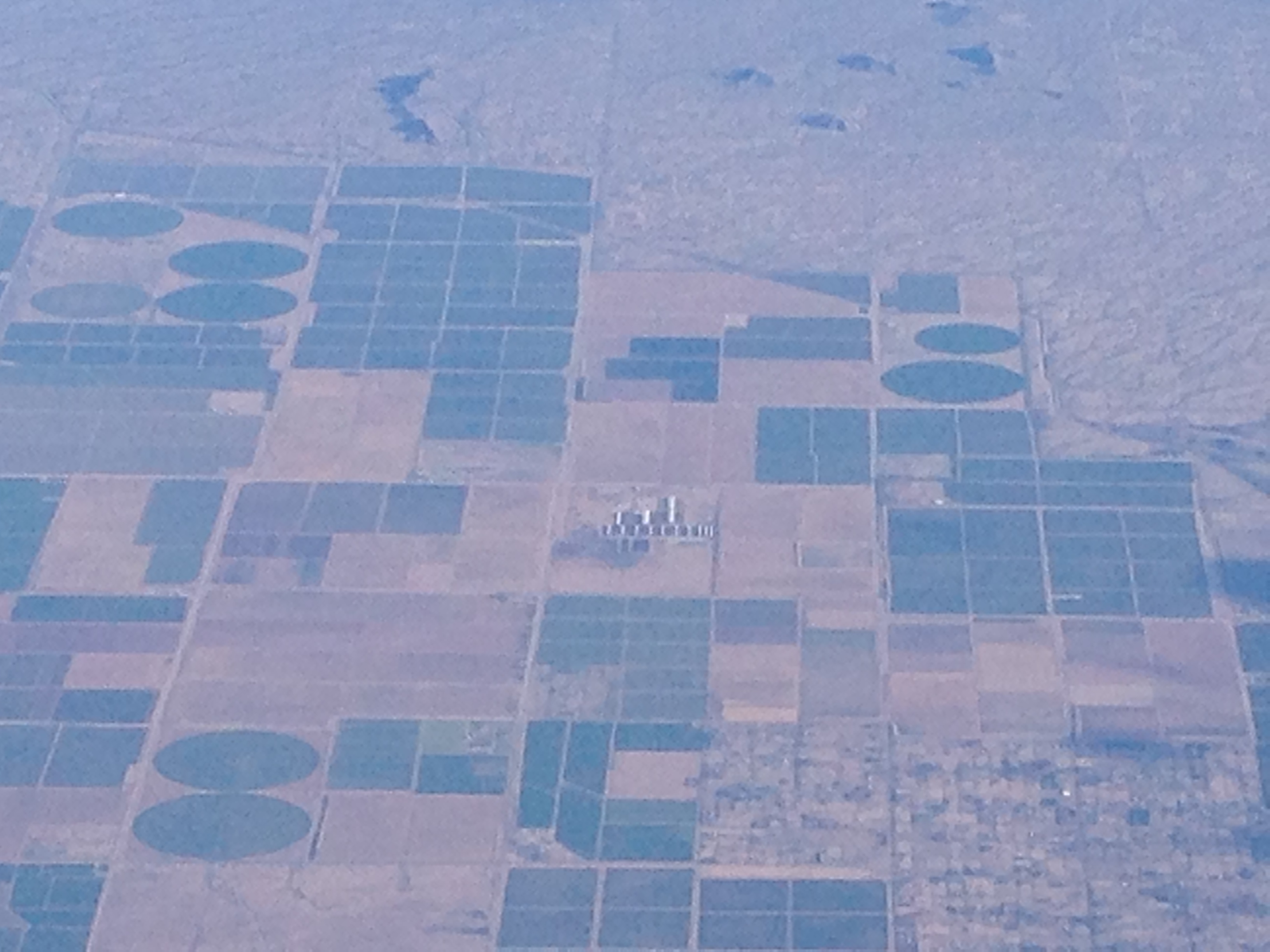
Visit California today.  They are in the midst of severe drought conditions. Farmers have attempted to protect themselves by drilling more wells – deeper wells which diminish water supplies to the shallower neighboring wells.  Water levels decline, land subsides, the aquifer collapses, and there is little recharge.  Some areas of the central valley have sunk over 8 feet in the past 100 years.  But we have up until this point, had healthier crops and more productive yields, which protects the valley until the rains return.  Or does it?

While the lack of rainfall is a natural cycle, there is an argument to be made that man-made impacts have exacerbated the situation.  In the Dust Bowl states, the initial error was plowing up the native grasses without understanding how they had adapted to the mostly dry conditions on the prairie.  Many of the prairie states receive under 20 inches or rain each year, and scarcely any during the summer, which limited evapotranspiration, which limits thunderstorm and regional rainfall activity.  Less ET = drier conditions.  So growing crops is not what one would immediately identify and a “normal” land use for the prairie.  We altered the environment, but the Midwestern farming thought process doesn’t work in the dry prairie.  Irrigation was needed, but the lack of surface water limited irrigation unless wells are used.  Wells were drilled which returned and improved crop yields, but the well use has caused massive decreases in aquifer levels in the prairie states. The amount of water is finite, so as long as withdrawal exceed recharge, and with only 20 inches of rain that mostly runs off the land, there is a point in time when the well runs dry.  As the well runs drier, productivity will fall.  The interim fix is drill deeper, but the bottom of the aquifer is in sight.  Then, fields will be fallow, agriculture will be impacted dramatically, and it is not inconceivable the Dust Bowl type conditions could reoccur. Policies by man exacerbate the problem because the prairie productivity is accelerated will above its natural condition.

Likewise much of the land subsidence problem in California is irrigation driven – water is pulled through wells in an ever increasing competition to maintain one’s crop yield.  Water wars and fights with one’s neighbors over wells drying up is increasing more common as irrigation needs increase and recharge to the aquifer is diminished.  Much of California is even drier than the Dust Bowl states, and more reliant or wells and irrigation.  Less water also means less ET which means less local rainfall.  So while California has done much to protect itself over the years from drought, the current experience says that declining aquifer levels means we have exceeded the productivity of that state as well.  So is the California Dust Bowl coming?

Man is an ingenious creature.  We overcome much that the Earth throws at us.  But at the same time, we rarely consider the consequences of our actions in overcoming the challenges Earth poses.  These two examples show how our efforts to solve one problem, may actually damage the long term sustainability of these areas.  Short term gain, long term problem.


Interesting that while we all love low gas prices and the low cost of energy is fueling an expansion of our economy, including the first gains in middle income salaries since 2008, the states reliant on oil and gas may be facing real problems financially.  A year ago I read an article that noted the reluctance of North Dakota residents and politicians to invest in roads and other infrastructure despite the influx of oil money.  Keep taxes low was the mantra.  SO they did.  A recent Governing magazine article notes that a dollar drop in oil means $7.5 million decrease in revenues for the State of New Mexico.  Since oil has lost about $30 a barrel in the past year – that is $200 million loss.  Louisiana sees a $12 million cost/dollar drop so they have $171 billion less to work with.  Alaska, perhaps the most oil dependent budget (90 percent) has a $3.4 billion shortfall, but $14.7 billion in revenues.  Texas, North Dakota, Oklahoma and Kansas are other states facing losses.  Fast growing states like North Dakota and Wyoming now have hard decisions to make.  Growth in Texas, Oklahoma, Louisiana and Arkansas may be cut by 2/3 of prior estimates as a result.  A double hit on anticipated revenues.

The comparison is interesting financial straights experienced by the “property value” states like Florida, Nevada and Arizona before and after the economic collapse in 2008.  Florida politicians couldn’t wait to cut taxes and slow spending during boom years, then got caught badly after the 2008 recession when property values dropped in half and state sales tax revenues (tourism) dropped steeply.  They ran out of reserves and refused to raise taxes (after cutting them), so cut things like education and health care to balance the budget.  Not sure how either helped low and middle class Floridians get back on track since Florida has primarily create low wage jobs since that time, not high paying jobs.  We are paying the price still.  I am guessing Nevada and Arizona are similar.

We clearly have not learned the lessons of the many mill towns in the south or the rust belt cities of the Midwest that encountered difficulties when those economies collapsed. Everyone refused to believe the good times would end.  Now Detroit is half of its former self and Akron has the same population as it did on 1910.

The moral of the story is that booms great, but short term.  Diversity in the economy is a key.  Florida will continue to be subject to economic downturns more severe than other states when it relies primarily on tourism and retirees to fuel the economy.  Detroit relied on automobiles, Akron rubber and chemicals, Cleveland steel, etc.  Some day the Silicon Valley will suffer when the next generation of technology occurs that makes the current works obsolete.  It is what happens when you are a “one economy” town.  It is also what happens when you believe the booms are “normal” and fail to financially plan by putting money aside during the boom to soften the subsequent period.

An argument could be made that if the federal government had not enacted tax cuts in 2000 when the budget was finally balanced and surpluses were presumed to loom ahead, we could have banked that money (or bought down our debts), and the amount of borrowing would have been less in 2008.  Buying down debt when times are good is good business.  So is putting money in reserve.  The question is why the politicians do not understand it.  We can run government like a business financially, but takes leadership to do it.  It takes leadership to explain why reserves are good and tax cuts are a future problem.  It takes leadership to make hard decisions like raising taxes, spending more on infrastructure, requiring people to move out of flood plains, not rebuilding in vulnerable areas, and curtaining water use policies when they damage society.  Leadership is making decisions that help the needs of the many, versus the needs of the few.  Oh wait, I see the issue now.  We need Spock to lead us…