Archive

communciations


The rainy season has sort-of started in south Florida and with it comes flooding and discussions of the falls end of season and concurrent high, high tides for the year, flooding and the impact of sea level rise on low-lying areas.  Much focus has been spent on the causes of sea level rise and the potential flooding caused by same.  However the flooding can be used as a surrogate to impacts to the social and economic base of the community.  By performing vulnerability assessments, coastal areas can begin planning for the impacts of climate change in order to safeguard their community’s social, cultural, environmental and economic resources. Policies need to focus on both mitigation and adaptation strategies, essentially, the causes and effects of climate change. Policy formulation should be based on sound science, realizing that policy decisions will be made and administered at the local level to better engage the community and formulate local decisions.

Making long-term decisions will be important.  Businesses look at long-term viability when making decisions about relocating enterprises.  The insurance industry, which has traditionally been focused on a one year vision of risk, is beginning to discuss long-term risks and not insuring property rebuild is risk-prone areas.  That will affect how bankers look at lending practices, which likely will decrease property values.  Hence it is in the community’s interests to develop a planning framework to adapt to sea level rise and protect vulnerable infrastructure through a long-term plan.

While uncertainties in the scale, timing and location of climate change impacts can make decision-making difficult, response strategies can be effective if planning is initiated early on. Because vulnerability can never be estimated with great accuracy due to uncertainty in the rate of warming, deglaciation and other factors, the conventional anticipation approach should be replaced or supplemented with one that recognizes the importance of building resiliency.  The objectives of the research were to develop a method for planning for sea level rise, and providing a means to prioritize improvements at the appropriate time.  In addition the goals were to provide guidance in developing a means to prioritize infrastructure to maximize benefit to the community by prioritizing economic and social impacts.

Adaptation planning must merge scientific understanding with political and intuitional capacity on an appropriate scale and horizon.  According to Mukheibir and Ziervogel (2007), there are 10 steps to consider when creating an adaptation strategy on the municipal level.  To summarize, these are as follows:

  1. Assess current climate trends and future projections for the region (defining the science).
  2. Undertake a preliminary vulnerability assessment of the community and communicate results through vulnerability maps (using GIS and other tools).
  3. Analyze vulnerability spatially, by overlaying development priorities with expected climate change on GIS maps to identify hotspots where adaptation activities should be focused.
  4. Survey current strategic plans and development priorities to reduce redundancy and understand institutional capacity.
  5. Develop an adaptation strategy that focuses on highly vulnerable areas. Make sure the strategy offers a range of adaptation actions that are appropriate to the local context.
  6. Prioritize adaptation actions using tools such as multi-criteria analysis (MCA), cost-benefit analysis (CBA) and/or social accounting matrices (SAM).
  7. Develop a document which covers the scope, design and budget of such actions (what they call a Municipal Adaptation Plan (MAP)).
  8. Engage stakeholders and decision-makers to build political support. Implement the interventions prioritized in the MAP.
  9. Monitor and evaluate the interventions on an ongoing basis.
  10. Regularly review and modify the plans at predefined intervals.


The strengths of this framework are the initial focus on location-specific science, the use of both economic and social evaluation criteria, and the notion that the plan is not a fixed document, but rather a process that evolves in harmony with a changing environment.  The final two steps occur at regular intervals by the community with associated adjustments made.  The next question is how to develop the data and priorities.

Last week I went to Boston for the American Water Works Association Annual Conference and Exposition.  It is a gathering of thousands of water industry professionals – from operators to university professors to engineers to manufacturers.  It is a good group of people and most know a number of people each year.  The industry is smaller than one things despite there being over 50,000 community water systems in the United States.  All are there to network, which allows them to discuss their issue, learn new ways to approach things, create new contacts and see new equipment and techniques.  Over 11,000 registered.  Good job to AWWA staff and the folks in New England that local hosts.

At the conference, one of many tasks, beyond meetings and education, was to do a class for public officials on what water and sewer utilities are, how they operate, how to deal with revenues and expenses and regulations.  The idea is to help local officials understand the complex utility issues which are often second fiddle to more “surficial” activities like parks, and economic development.   The officials get a certificate from AWWA for 12 hours of class time, but the fact that these folks come, spend the time, get involved and can then experience the rest of the program is to be commended.  I have been doing these public officials classes since my book came out in 2009.  The first two days are always based on the book, but the third day can vary depending on issues in the news and preferences form the public officials group within AWWA.  This year the focus was operations and revenues. The responses were positive, and the interaction was very good.  And I had a blast as well.

It had been 40 years since AWWA was in Boston for ACE.  I have been twice previously – once when I was 7 and we went to the aquarium and once to catch a baseball game at Fenway, while on a 5 game, 4 city, 3 day baseball trip.  Boston led off.  This time, I was able to spend a day looking at the City.  Thanks to my friend Chi Ho Sham who acted as chauffer and tour guide – I expect to repay the gesture whenever he can spend a couple days in S. Florida.  Boston as many of you know is the cradle of the American revolution, and visits to the old North Church, Paul Revere’s house, the USS Constitution, several cemeteries and Faneuil Hall.  Fascinating.  Another trip to come as there is much more to experience than a day.

The moral to the story is that conferences allow us to accomplish many things.  We meet new people, hear new things, and if we spend a little time, we can experience how others live or have lived.  The history is valuable to us personally.


In a prior blog we talked about the difference between urban and rural counties and the impact of the differences between incomes and how that would affect utilities.  Keep in mind that the 40 largest urban counties in the US contain nearly half the US population as do the 50 largest utilities.  So in a recent article in Governing, the focus was on the few counties where income was higher than average.  In fact, in looking at counties, within the top 20 in per capita income are 10 counties in North and South Dakota.  Interesting until you review why.  All are in areas where fracking is ongoing and corporate farming is prevelant.  It is no surprise that the fracking boom has created wealth in rural areas that have limited populations, limited regulations and state and local officials who are desperate to reduce unemployment and stimulate laggard economies.  We noted before that rural counties are often desperate for jobs, so they often ignore what could possibly go wrong when jobs and development are the only priorities for a community.  Governing used the example of Wells County, ND where the per capita income has doubled since 1997 and is 75% above the national average.  Yet the local governments are looking at which roads they will allow to go back to gravel.  How is this possible? 

The issue is not relegated to just Wells, ND.  Despite the fact that many rural communities in areas with intensive farming or fracking have grown 10-15% since 2007, local officials are finding it difficult to raise taxes to pay for infrastructure.  Roads are the most obvious and pressing issue because of the impact from fracking traffic.  As new wells are constructed, the frackers build new dirt roads and use the existing roadways.  Some believe the need to fix many of the roads is temporary so why bother, but it neglects the need to infrastructure improvements in general.  The same argument could be used for water and sewer infrastructure as well, but these wealthy rural communities do not want to increase governmental spending to improve any infrastructure, so the opportunity to address the community needs is being lost.  

What is more interesting is that the states where these rural counties exist, including the Dakotas, along with Montana, Wyoming, New Mexico, and most of the southeastern states are among the states that rely most heavily on federal funding.  So when incomes increase, the dependency remains.  These are the same states that tax residents the least, spend the least on education, have the poorest health care (and the fewest people signed up for the Affordable Care Act and few have state exchanges) and have the most people in poverty.  The dichotomy between reality and the political perception is interesting in these states, which leads one to wonder if the residents of these states like their situation and keep electing representatives that reflect this desire, or they have fallen victim to political interests that cause them to vote consistently against their better interests, or for the interests of a limited few that deny them access to the education, infrastructure, medical care and other benefits their urban and wealthier neighbors enjoy. 

That is a tough question but the bigger question is how to infrastructure agencies like utilities attempt to overcome either of these perceptions?  Neglecting infrastructure, education, medical and the like does not promote local economies, does not create jobs and more likely causes the migration of the best and brightest young people out of the community in search of better prospects, which further imperils their rural situation.  Keep in mind that most cities are relatively permanent, but fracking, like mining, oil and timber before them, have been booms and busts.  The situation if far more dire after the boomtown than it was before.  After all, what could possibly go wrong when 50,000 miners, or frackers, descend upon a community of 1,500 people?  They will consume all the resources, then leave.  Locally those well paying jobs are imported due to the lack of skills and education, and then they leave with the bust.  This has played out many times in the past.  It is not sustainable.  We need to learn from the past – when the boom hits, make the investments you need in infrastructure, education, medicine, etc. so that the future is better after the bust. 


A week ago the new National Climate Assessment came out.  It basically says things we already expected – temperatures are warmer, there will be more droughts, less rainfall, less available water, more intense storms and sea level rise.  What the study did in its 800+ pages was outline examples of climate change phenomena that are already occurring including flooded streets in coastal areas, severe weather (Colorado, New Jersey), and changes in the arctic air currents that may be affecting northeastern and Midwestern winter storm frequency.  All things that those who have been around for a while and have been even minimally observant have already noticed for themselves.  What was also not surprising was the vitriol on the internet about how this assessment was a “fascist plot” perpetrated by a variety of people to impose some yet undetermined regulations on “patriotic Americans.”  And then Senator Marco Rubio comes out this week and says he does not believe it is possible for people to cause climate change.  No facts, just belief.  In Florida.  In Miami.  Wow…

Those who live in coastal areas, earn their living in agriculture, manage water utilities relying on water supplies, and drought planners know the truth.  Denying that the climate is changing simply ignores reality and delays the ability to respond to its impacts.  I realize that those impacts might be 20 or 40 or more years out, but planning is needed because we expect our infrastructure, factories, hoses and economies to last longer than that.  Science says change is occurring.  We can argue why and how fast, but the reality is that there is change and there are many people that will confront he need to adapt to the situation sooner than later (like us the Fort Lauderdale/Miami area!).  So why deny climate change?

As we noted in a prior blog, there are several reasons, but many involved business issues.  So follow the money. Let’s start with the Koch brothers.  The Koch brothers manage Koch Industries, the second largest privately owned company in the United States revenues exceeding $100 billion/year.  Many Americans have no idea who they are but they are billionaires who have made their living in the oil business – their father Fred C. Koch developed a new the method for the refining of heavy oil into gasoline.  They rely on oil to maintain their wealth and are politically active with conservative organizations including the Heritage Foundation and the Cato Institute, FreedomWorks and Americans for Prosperity, all organizations the dismiss any impact of man on climate change.  Why?  Well one of the tenets of dealing with climate change is to reduce carbon dioxide emissions which means less reliance on fossil fuels – oil.  Whoops – that would be a problem for the Koch brothers because if they say “sure climate change is a problem,” well then that would mean that their entire business model and their wealth is a contributor to climate change, which means they are the “bad guys.”  Can’t have that.  So following the money tells you that we can’t make our money with oil and support climate change.

Let’s look at the other side.  Those acknowledging climate change are fully supportive of renewables, which in theory will help climate change by reducing carbon dioxide.  But the concept of renewables though is fraught with the problem that few of these technologies are ripe for wide-scale implementation.  For example natural gas vehicles or natural gas/hybrids are doable, but where do you buy the natural gas for the vehicle?  The technology and distribution networks is 10 or more years out at best and of course if you are in the oil business, why would you be interested in installing the natural gas fuel pumps?  So technology and need do not match when you follow the money.

How about the Keystone pipeline that would bring oil and gas from these remote areas to refineries in Texas and the Gulf of Mexico states.  You can guess the Koch brothers are in favor of the pipeline as they will benefit.  So are most oil and gas entities.  There are many environmentalists and other opposed to the pipeline because of impacts on water supplies (and other issues).  But the railroads are making money by hailing oil and gas from Canada and the Dakotas.  Guess which side the railroads are on?  The pipeline would take business away from the railroads.  Follow the money. 

Let’s look at our industry.  In the utility business, there is a lot of money with the telephone, power, cable and other utilities.  These private entities, although regulated, make huge sums of money for their investors.  You can follow that money. 

So who supports water and sewer utilities?  We do!  We supply over 85% of Americans.  But why do we have so much trouble getting funding when 85% of people would benefit.  One would think that given how many people we support, we have the money, but we are primarily not-for-profit entities, so we don’t make money for anyone.  You can’t follow that money because there is no money.  That tells us more about the difficulties we have in securing funding that anything.    

Fixing it is a little bigger challenge because our representatives and constituents do not understand the financial investment they have in our industry.  Their public health and economies are linked to water and sewer.  Our services make these other enterprises doable but there is no direct monetary connection to facilitate lobbying on our behalf.  I am not sure how to fix this, but we need a better marketing strategy for our services.  That’s one thing we know.


Last week was one heckuva week for societal problems related to race relations.  Seems like someone turned over a rock and the 1950s crawled out.  We started with Cliven Bundy, the Nevada rancher who has been using federal property (read our land) for grazing his cattle for 20 years without paying for it, said after the armed confrontation with federal officials, that “I wonder if Negros weren’t better off as slaves.”  But he says he is not a racist, but wow.  That’s right up there with Rush Limbaugh’s comments about Native Americans in his book 15 years ago. 

 Then we had newspaper columnist and right-wing wonk, Thomas Sowell, who is black, saying in a recent column that “you are poor because you don’t work.”  And it is your fault you don’t work.  In “higher income families, people work.”  So using that line of racist nonsense, given that minorities are disproportionately un- or under-employed, does Mr. Sowell really believe that it is really the choice of all of these people not to work?!  Could there be any other causal links like the lack of education, decaying infrastructure or the lack of local opportunities in their community that might just come into play? That’s like saying Detroit’s problem is not the lack of job opportunities, but the fact that no one wants to work in Detroit.  I think not.

The we have Donald Sterling, the owner of the Los Angeles Clippers NBA team, who was taped making racists comments, then received a lifetime ban and multi-million dollar fine for his comments about minorities, and then, instead of apologizing, states that he wishes he’d just paid the woman who taped him off.  Huh?   Of course it is not the first time for Mr. Sterling who lost a case several years ago over his practices of renting property in LA, so I guess we should have expected it.

Of course there are those who argue these folks were simply misunderstood.  Maybe Mr. Sowell was just pandering to his fan base, but what does that say about his fan base that he can write a column that purports that “you are poor because you don’t work” because you don’t want to work and no one says anything?  He clearly appears to be besmirching the inner city minority population, but as I noted in a prior blog, rural America is significantly worse off economically than urban America.  Rural America is where health care suffers, the lack of health insurance is pervasive, income are lower and unemployment higher.  There are poor across all races, and in all settings.  And given his fan base is includes a lot of poor, white, rural people who aren’t making a lot of money or who can’t find jobs, he’s talking about you!

The Bundy comments stem from his standoff with federal officials over many years of not paying for grazing (like the rest of us could get away with that!).  He and those that came armed to his defense are more indicative of a larger, far-right, anti-government sentiment around the country that has persisted for years.  The west has a number of these groups (recall Ruby Ridge, Waco, Black Hawk helicopter-ists, etc.) that are basically anarchists that disagree with America as it is today.    All white.  But of course as we have seen in the Sudan, Rwanda, the middle east and throughout history, hate can come from all races and religions. All harboring hatred of others not like them.  Understanding why is more difficult, but the commonality seems to be that they all have the perception that the others are somehow treated differently, which allows them to move up the economic ladder faster or allows them to “game the system.”  The perception, which may be completely false, persists because it somehow justifies the actions of these people.

So given the comments of the past week, are we back in the 1950s?  Or 1870s?  How are we here in 2014?  Prejudice and hate were not wiped away magically by civil rights legislation, integration, communication and education alone, but really, does this type of attitude have a place in today’s world? If so why?  Hate has created trouble in the world for thousands of years.  Hate is a problem because hate is a means to distract people from real problems or to force your problems on others.  But in truth, psychologists will tell you that in most cases, the Haters tend to hate themselves, which is something we all need to remember.  Hate is developed because you cannot control a situation or someone else gets something you want.  Therefore it is that someone else’s fault, not yours.  It is easier when race, sex, sexual orientation, religion or other factors represent the “somebody else,” but the reality is haters hate themselves first, then project their hate onto others.  They need help. Professional help. Counseling.  Many of them. Even whole societies. They need to go get help for themselves and the rest of us. 


My last blog was a discussion about surpluses.  The State of Florida will have a $1.3 billion surplus this year and a host of politically expedient answers for where that money goes (tax cuts, pork projects, projects to help election results), but little mention of replenishing trust funds and reserves that were emptied to balance the budget amid tax cuts from 2010 – 2012.  But perhaps it is not the legislators or their constituents that we should blame for not understanding the need for reserves because the truth is that most people are not used to saving.  A recent article I read noted that 72 percent of Americans live paycheck to paycheck and would have difficulty putting $2000 together if needed.  $2000 is not a lot of money these days – it won’t buy you a transmission for example or a new engine for your car.  It won’t cover first, last and a deposit on a rental.  And it won’t cover the down payment on a house or most cars.  There are people who do not receive enough income to achieve some degree of savings, but not 72% of us.  We have come to perceive that having little savings is normal, but it wasn’t always this way and it is not this way everywhere in the world.  Back in the day, American saved more than they do now.  The reason is not that they had more money (they didn’t) or that they had less to spend money on (as things cost more proportionately).  But it was that “rainy day” they all knew would come and when they would need money.  They had been through depressions, recession and losses of industries (remember those Concord coachmakers did not get a federal bailout in trying to compete with Henry Ford).  They knew that there would be times when they needed to rely on themselves to survive and savings was the key.

There are two major differences from the past.  The most important is the fact is that credit was a lot harder to come by back in the day, so you needed cash for those big purchases.  That has changed dramatically in 50 years.  Today we get advertisements for credit cards – in the mail, instant credit at stores, easy credit for cars, and in the early 2000s, no-money-down-no-income-verification loans on real estate.  The need to save evaporated.  The access to easy credit has eliminated much of the need to save for those big expenses.  We can borrow to acquire them.  If we have a job problem, we borrow against the house or life insurance policy.  These are good backstops that help us maintain our way of life.

At the same time as we are being extended opportunities to secure funds to spend, we are barraged by advertisements and flyers and pitches to spend that money on products and services, many of which we probably don’t need, but are “cool” to have.  We are encouraged to compete to have better “stuff” than the other guy, and make sure we have the newest technology.  We all do it.  Just look at all phones can do, while keeping in mind that the old Bell phone I bought in college still works regardless of the situation and still sounds good.  No cool ringtones however, nor photo capability.  All that means we spend less on “needs” and more on “stuff.” 

Given this backdrop it is no surprise the attitude of decision-makers in government toward revenues and expenses.  Re-education of the public is needed as opposed to rhetoric.  We need to move the public discussion away from the concept of a balanced budget being expenses equal revenues to the correct concept of revenues + reserve expenses = expenses plus savings.  At times you use reserves (and savings =0) while other times reserve expenses are 0, while savings are positive. When big expenses come, borrow, but recurring expenses should not be funded through borrowing (credit).  We should seek to avoid is the desire to cut taxes (akin to cutting our salaries) to bring the budget back into balance that if we run a surplus, or spend it on “stuff.”  Such a system leaves room for those lean times when revenues may fluctuate but expenses do not (or increase).  


Regardless of the causes, southeast Florida, with a population of 5.6 million (one-third of the State’s population), is among the most vulnerable areas in the world for climate change due its coastal proximity and low elevation (OECD, 2008; Murley et al. 2008), so assessing sea level rise (SLR) scenarios is needed to accurately project vulnerable infrastructure (Heimlich and Bloetscher, 2011). Sea level has been rising for over 100 years in Florida (Bloetscher, 2010, 2011; IPCC, 2007).  Various studies (Bindoff et al., 2007; Domingues et al., 2008; Edwards, 2007; Gregory, 2008; Vermeer and Rahmstorf, 2009; Jevrejeva, Moore and Grinsted, 2010; Heimlich, et al. 2009) indicate large uncertainty in projections of sea level rise by 2100. Gregory et al. (2012) note the last two decades, the global rate of SLR has been larger than the 20th-century time-mean, and Church et al. (2011) suggested further that the cause was increased rates of thermal expansion, glacier mass loss, and ice discharge from both ice-sheets. Gregory et al. (2012) suggested that there may also be increasing contributions to global SLR from the effects of groundwater depletion, reservoir impoundment and loss of storage capacity in surface waters due to siltation.

Why is this relevant?  The City of Fort Lauderdale reported last week that $1 billion will need to be spent to deal with the effect of sea level rise in Fort Lauderdale alone.  Fort Lauderdale is a coastal city with canals and ocean property, but it is not so different from much of Miami-Dade County, Hollywood, Hallandale Beach, Dania Beach and host of other coastal cities in southeast Florida.  Their costs may be a harbinger of costs to these other communities. Doing a “back of the napkin”  projection of Fort Lauderdale’s cost for 200,000 people to the additional million people in similar proximity to Fort Lauderdale means that $5 billion could easily be spent over the next 100 years for costal impoundments like flap gates, pumping stations, recharge wells, storm water preserves, exfiltration trenches and as discussed in this blog before, infiltration galleries. Keep in mind that would be the coastal number and we often ignore ancillary issues.  At the same time, an addition $5 to 10 billion may be needed for inland flooding problems due to the rise of groundwater as a result of SLR.

The question raised in conjunction with the announcement was “is it worth it?”  I suggest the answer is yes, and not just because local politicians may be willing to spend money to protect their constituents.  The reality is that $178 billion of the $750 billion economy of Florida, and a quarter of its population, is in the southeast. With nearly $4 trillion property values, raising a few billion for coastal improvements over 100 years is not an insurmountable task.  It is billions in local engineering and construction jobs, while only impacting taxpayers to the tune of less than 1/10 of a mill per year on property taxes. This is still not an insurmountable problem.

I think with good leadership, we can see our way.  However, that leadership will need to overcome a host of potential local community conflicts as some communities will “get more” than others, yet everyone benefits across the region.  New approaches to working together will need to be tried.  But the problem is not insurmountable, for now…


Several weeks ago we looked at the phenomenon of population, income, education and unemployment.  The impact to from the combination of these factors in certain communities can be difficult.  Let’s explore a little further as there is more, interesting data every day.  The US Department of Agriculture is releasing its report of rural America.  The findings are interesting and counter-intuitive to the understanding of voters in many of those communities.  Their findings include:

  • The rural areas grew 0.5 % vs 1.6% in urban areas from mid-2011-mid 2012
  • Rural incomes are 17% lower than urban incomes.
  • The highest income rural works (95th percentile) earn 27% less than their urban counterparts
  • 17.7% of rural constituents live in poverty vs 14.5% in urban areas
  • 80% of the high poverty rate counties were rural
  • All the high income counties are urban.

Wow!  So the ghetto has move to the country? According to these statistics there is truth in that statement.  Let’s look a little further using some on-line mapping. 

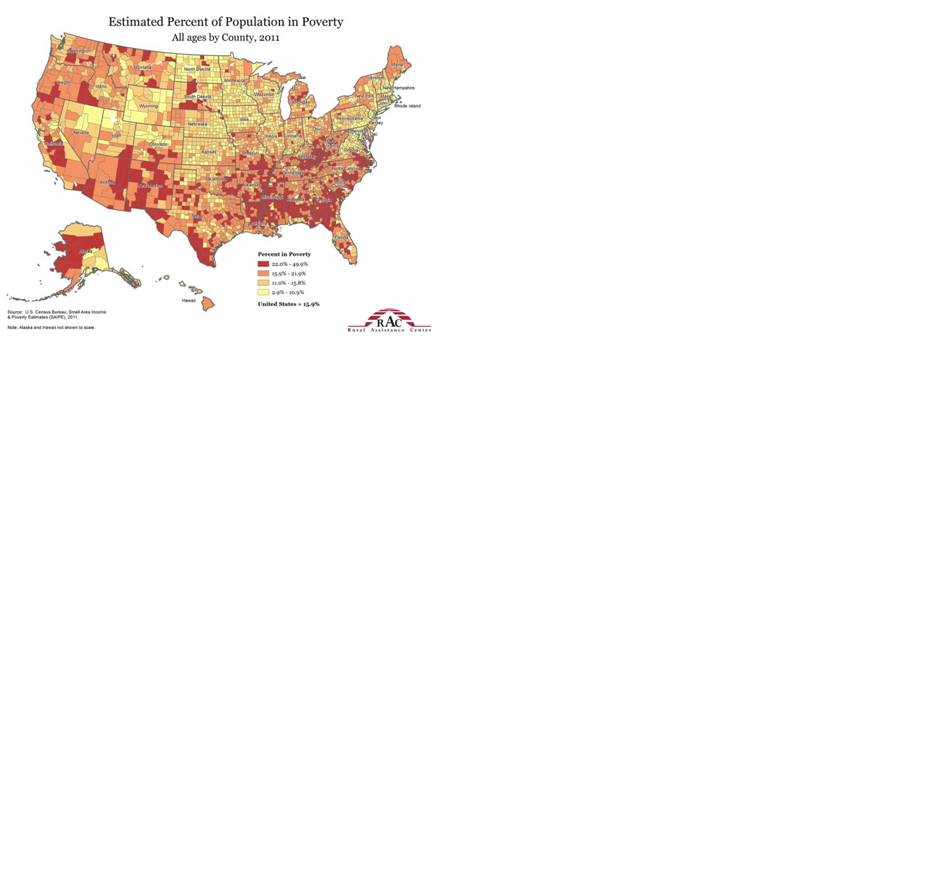
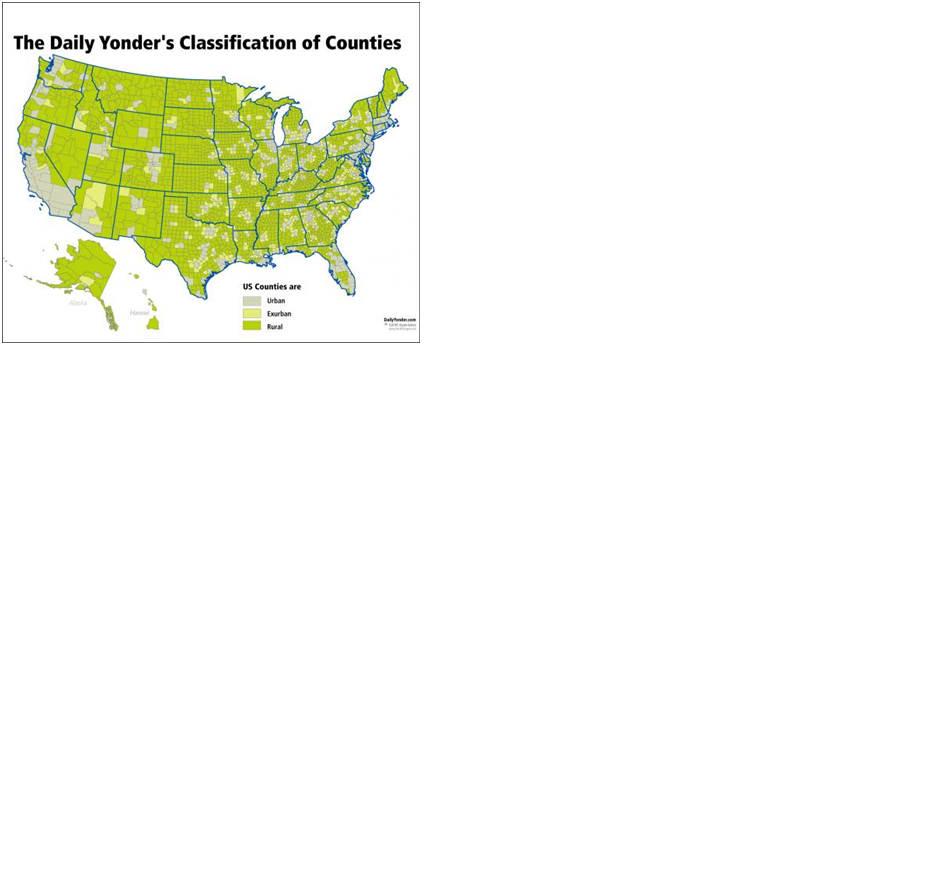
First let’s look at where these rural counties are.  Figure 1 is a map from www.dailyyonder.com  that shows (in green) the rural counties in the US.  Wikipaedia shows the 100 lowest income counties in Figure 2.  For the most part, these counties are rural, with the exceptions being a few areas in south Texas and in the Albuquerque/Santa Fe area of New Mexico. Raceonline.com shows the populations in poverty by county.  The red areas are the highest poverty rates.  The red areas in Figure 3 expand Figure 2 to include much of the rural deep south, Appalachia, more of Texas and New Mexico and part of the central valley in California.

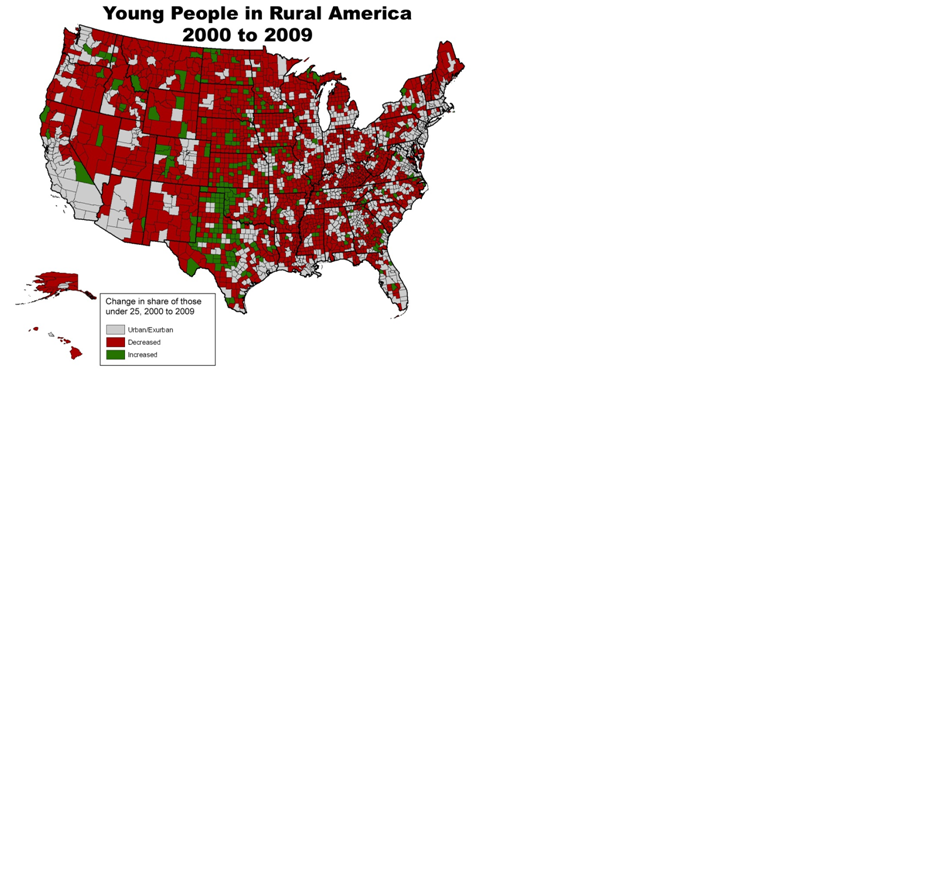
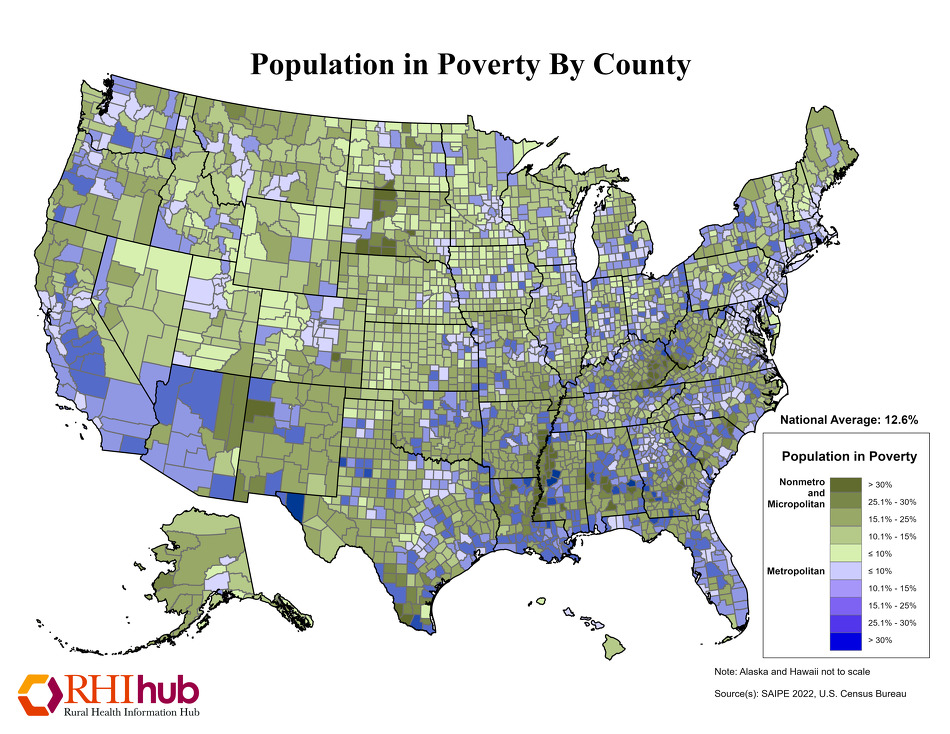
Figure 4 shows how the number of young people has changed between 2000 and 2009 in rural counties (urban counties are white and not included – red means a decrease).  Figure 5 shows population growth (or not) by county. What you see in these two maps is that the young people are moving to the rocky mountain states and vacating the high poverty counties in Figure 3.  Yong people do not see jobs in the rural area – unemployment is 20% higher in rural America and the jobs that are there pay less.  Figures 6 and 7 show unemployment by County in 2008 after the start of the Great Recession and in 2013.  What these figures show is that with exception of the Plains states and Rockies, is that many of the areas with high poverty also had high unemployment, and that the unemployment has remains stubbornly high in many rural areas in the Deep South, Appalachia and New Mexico, plus high unemployment in parts to  the Great Lakes, but the poverty rates are still lower.  Education may by a factor in why the Plains states and Rocky Mountains have less unemployment – despite being rural their students are far more likely to graduate from high school than those in the deep South, Appalachia where unemployment remains high and incomes low. 

So what does this possibly have to do with utilities?  Utilities need to understand this problem as is demands some real, on-the-ground leadership.  Small and rural utilities are more costly to operate per thousand gallons than larger utilities.  A 1997 study by the author showed that economy-of-scale manifested itself to a great extent with water and wastewater operations.  The differences were not close – it is a lot less costly to operate large utilities vs small ones.  Rural utilities complicate the issue further because not only is the number of customers limited, but the pipe per customer is less so the capital investment per customer is far higher than in urban areas.  The impact is that utilities are under pressure to reduce rates to customers, or create a set of lower cost rates for those in poverty, while at the same time their costs are increasing and infrastructure demands are incrementally higher than their larger neighbors.  The scenario cannot be sustained, especially when large portions of rural infrastructure was installed with FHA grants, meaning the customers never paid for the capital cost in the first place.  There was no or lower debt, than what larger utility customers have.  The rural rates since these investments have been set artificially lower than they should as a result. But with Congress talking about reducing SRF and FHA programs, FHA is unlikely to step in to replace their initial investment, meaning that the billions of rural investment dollars that will be needed in the coming years will need to be locally derived, and rate shock will become a major source of controversy in areas that are largely very conservative politically and tend to vote against projects that will increase costs to them.

The good news is that much of the rural infrastructure may be newer when compared to much of the urban infrastructure.  So there is time to build the argument that local investment is needed.  The community needs to be engaged in this discussion sooner as opposed to when problems occur.  Saving for the infrastructure may be the best course since rural utilities will have limited access to the borrowing market because of their size, but that means raising rates now and keeping those saved funds as opposed to using them to deer rate increases.  If ongoing efforts in the House deplete federal funding further, the pinch will be felt sooner by rural customers who will lose the federal dollars from SRF and FHA programs. 


Image

Figures 1 – Rural Counties

The United States: By Rural, Urban and Exurban Counties


Image


Figure 2.  100 lowest income Counties in the US


http://en.wikipedia.org/wiki/List_of_lowest-income_counties_in_the_United_States


Image

Figure 3.  Estimated population in poverty

http://www.raconline.org/racmaps/mapfiles/poverty.jpg


Image

Figure 4.  Where the Young People Are

http://www.raconline.org/maps/topic_details.php?topic=55


Image


Figure 5.  Where people are moving to http://www.raconline.org/maps

Image


Figure 6  Unemployment 2008

http://en.wikipedia.org/wiki/Unemployment

Image

Figure 7  Unemployment 2013 http://www.huduser.org/portal/pdredge/pdr_edge_featd_article_040


Local utilities are among the largest power users in their communities.  This is why power companies make agreements with utilities at reduced cost if the utilities will install backup power supplies.  The peak power generation capacity as well as backup capacity is at the local utilities and other large users.  Power companies can delegate this capital cost to large users without the investment concerns.  It works for both parties.  In addition, power companies spend effort to be more efficient with current power supplies, because recovering the costs for new, large plants is difficult, and in ways, cost prohibitive.  Hence small increment options are attractive, especially when they are within high demand areas (distributed power).  The use of localized wind, solar and on-site energy options like biogas are cost effective investments if sites can be found.  That is where the utilities come in.  Many utilities have sites.  Large water utilities may have large reservoirs and tank sites that might be conducive to wind or solar arrays.  Wind potential exists where there are thermal gradients or topography like mountains.  Plant sites with many buildings and impervious areas could also be candidates for solar arrays and mini-wind turbines.  Wastewater plants are gold mines for digester gas that is usually of high enough quantity to drive turbines directly.  So utilities offer potential to increase distributed power supplies, but many water/wastewater utilities lack the expertise to develop and maintain these new options, and the greatest benefit is really to power companies that may be willing to provide as much money in “rent” to the utilities as they can save.   Power entities obviously have the expertise and embedded experience to run distributed options optimally.  So why don’t we do this?

I would speculate several reasons.  First, the water/wastewater utilities have not really considered the option, and if they do there is the fear of having other folks on secure treatment sites.  That can be overcome.  The power entities have not really looked at this either.  The focus in the power industry is to move from oil-based fuels to natural gas to accumulate carbon credit futures, the potential for lower operating costs and better efficiency of current facilities to reduce the need for capital investments.  Power entities operate in a tight margin just like water/wastewater utilities do so saving where you can is a benefit.  There are limited dollars to invest on both sectors and political and/or public service commission issues to overcome to invest in distributed power options at water/wastewater facilities. 

But a longer-term view is needed.  While fossil fuels have worked for us for the last 100 years, the supply is finite.  We are finding that all that fracking might not give us 200 years, but more like 20-40 years of fuel.  We have not solved the vehicle fuel issue and fossil fuels appear to be the best solution for vehicles for the foreseeable future which means they will compete directly with power demands.  Natural gas can be used for vehicles fairly easily as evidenced by the many transit and local government fleets that have already converted to CNG. 

The long-term future demands a more sustainable green power solution.  We can get to full renewable power in the next 100 years, but the low hanging fruit need to be implemented early on so that the optimization of the equipment and figuring out the variables that impact efficiency can be better understood than they are now.  For example, Leadville, CO has a solar array, but the foot of snow that was on it last September didn’t allow it to work very well.  And solar arrays do use water to clean the panels.  Dirty panels are nowhere near as efficient as clean ones.  We need to understand these variables.

Area that are self sufficient with respect to power will benefit as the 21st century moves forward.  There are opportunities that have largely been ignored with respect to renewable power at water and wastewater facilities, and with wastewater plants there is a renewable fuel that is created constantly.  Wastewater plants are also perfect places to receive sludge, grease, septage, etc which increase the gas productions.  There are examples of this concept at work, but so far the effort is generally led by the wastewater utilities.  An example is East Bay Municipal Utility District (Oakland, CA) which produces 120% of its power needs at its wastewater plant, so sells the excess power back to the power company.  There are many large wastewater plants that use digester gas to create power on-site to heat digesters or operate equipment.  Others burn sludge in on-site incinerators to produce power.  But so far the utilities are only reducing their cost as opposed to increasing total renewable power supplies.  A project is needed to understand the dynamics further.  If you are interested, email me as I have several parties wishing to participate in such a venture. 


As 2014 is only a month away, expect water and sewer infrastructure to become a major issue in Congress.  While Congress has failed to pass budgets on-time for many years, already there are discussions about the fate of federal share of SRF funds.  The President has recommended reduction in SRF funds of $472 million, although there is discussion of an infrastructure fund, while the House has recommended a 70% cut to the SRF program.  Clearly the House sees infrastructure funding as either unimportant (unlikely) or a local issue (more likely).  Past budgets have allocated over $1.4 billion, while the states put up a 20% match to the federal share.  A large cut in federal funds will reverberate through to local utilities, because many small and medium size utilities depend on SRF programs because they lack access to the bond market.  In addition, a delay in the budget passage due to Congressional wrangling affects the timing of SRF funds for states and utilities, potentially delaying infrastructure investments. 

This decrease in funding comes at a time when ASCE rates water and wastewater system condition as a D+ and estimates over $3 trillion in infrastructure investment will be needed by 2020.  USEPA notes that the condition of water and wastewater systems have reached a rehabilitation and replacement stage and that infrastructure funding for water and sewer should be increased by over $500 billion per year versus a decrease of similar amounts or more.  Case Equipment and author Dan McNichol have created a program titled “Dire Straits:  the Drive to Revive America’s Ailing Infrastructure” to educate local officials and the public about the issue with deteriorating infrastructure.  Keep in mind much of what has made the US a major economic force in the middle 20th century is the same infrastructure we are using today. Clearly there is technical momentum to indicate there is greater need to invest in infrastructure while the politicians move the other way.  The public, caught in the middle, hears the two sides and prefers less to pay on their bills, so sides with the politicians as opposed to the data. 

Local utilities need to join the fray as their ability to continue to provide high quality service.  We need to educate our customers on the condition of infrastructure serving them.  For example, the water main in front of my house is a 50 year old asbestos concrete pipe that has broken twice in the past 18 months. The neighborhood has suffered 5 of these breaks in the past 2 months, and the City Commission has delayed replacement of these lines for the last three years fearing reprisals from the public.  Oh and the road in front of my house is caving in next to where the leak was.  But little “marketing” by the City has occurred to show the public the problem.  It is no surprise then that the public does not recognize the concern until service is interrupted.  So far no plans to reinitiate the replacement in front of my house.  The Commission is too worried about rates.

Water and sewer utilities have been run like a business in most local governments for years  They are set up as enterprise funds and people pay for what they use.  Just like the private sector.  Where the process breaks down is when the price is limited while needs and expenses rise.  Utilities are relatively fixed in their operating costs and I have yet to find a utility with a host of excess: workers.  They simply do not operate in this manner.  Utilities need to engage the public in the infrastructure condition discourse, show them the problems, identify the funding needs, and gain public support to operate as any enterprise would – cover your costs and insure you keep the equipment (and pipes) maintained, replacing them when they are worn out.  Public health and our local economies depend on our service. Keep in mind this may become critical quickly given the House commentary.  For years the federal and state governments have suggested future funding may not be forthcoming at some point and that all infrastructure funding should be local.  That will be a major increase in local budgets, so if we are to raise the funds, we need to solicit ratepayer support.  Now!