Archive

local government


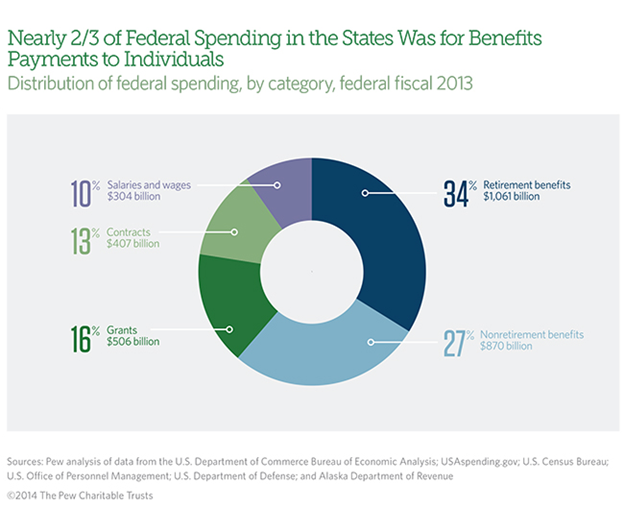
How much money goes to the states from the Federal government? Ever wonder about that? And how do we react? We talk about the need to tighten the federal spending so we keep cutting back on the Superfund cleanup monies ($1 billion/yr), the State Revolving Fund loan system ($2.35 billion/yr), and under $2 billion/yr for clean energy systems. We are concerned about the projected increase of $66 billion/yr for the Affordable Care Act. But these sums are just a tiny component for the federal budget, which is dwarfed by the $3.1 trillion sent to the states during its 2013 fiscal year. So what are these funds? Retirement benefits, including Social Security and disability payments, veteran’s benefits; and other federal retirement and disability payments account for over 34% of these payments. Medicare in another 18%. Food assistance, unemployment insurance payments, student financial aid, and other assistance payments account for another 9%. Another 16% is for grants to state and local governments for a variety of program areas such as health care (half the amount is Medicaid), transportation, education, and housing and research grants. All the SRF and grant monies are in this 16%. Those water programs are barely visible in this picture. Contracts for purchases of goods and services for military and medical equipment account for another 13%, while smallest amount – salaries and wages for federal employees is 10%.  Keep in mind that federal employees have dropped from nearly 7 million to 4.4 million since 1967. No federal employment expansion going on there.

growth in fed payments

fed payments

So how much does this affect the states? Federal funds account for about 19 of the total gross domestic product of the US, a number that has been relatively consistent (within a few percentage points) for years. That is below its all-time highs, and about typical over the past 30 years. Figure 1 from a PEW report shows that federal funds are greater than 22% of the GDP in most southern states (which interestingly enough have the people that complain the most about the federal government intrusion), while the Plains states, Midwest, northeast and the west coast are generally below average, and the two coasts, especially complain the least. Mississippi, Virginia and New Mexico all top 30%.
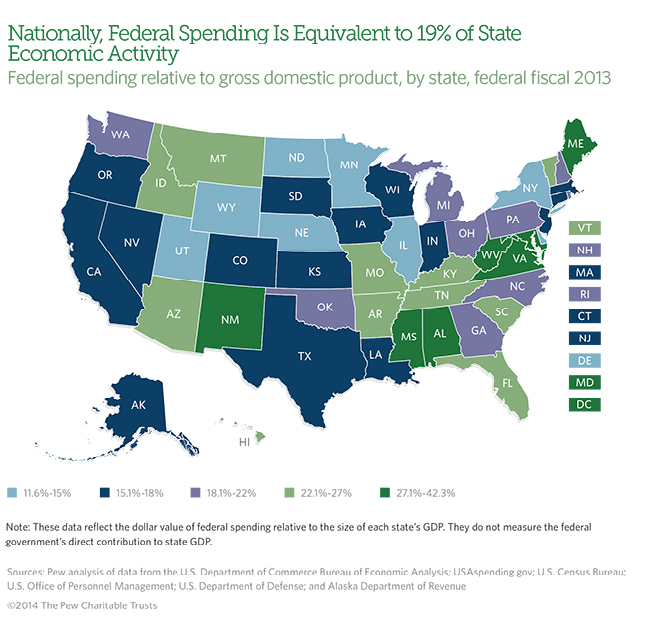
figure nat fed spending by state

So let me see if I have this right – those that pay the least, but get the most, complain the most about their benefactors, and those that pay the most, but collect less, complain less. That is the message! What is WRONG with that picture? And those people? The problem is I see it every day at the local level and it is truly baffling. It means that somehow our politics gotten so out of whack that those in need the most, seem to continue to vote against their best interests? Marketing clearly is a problem but are we fooled that easily. A message that distracts from the reality is obvious, but this continuing trend is just truly weird. No wonder it is so hard to accomplish things.


Most states were doing pretty well before the 2008 recession hit, but that ended in 2009. Most states had to make extremely difficult cuts or raise taxes, which was politically unacceptable. Of course invested pension systems received a lot of attention as their value dropped and long term sufficiency deteriorated, which was fodder for many changes in pensions, albeit not how they were invested. The good news is a lot of them came back in the ensuing 5 years, but 2015 may be different. A number of states have reported low earnings in 2015 and whether this may be the start of another recession. The U.S. economy has averaged a recession every six years since WWII and it has been almost seven years since the last contraction. With China devaluing their currency, this may upset the economic engine. At present there are analysts on Wall Street who suggest that some stocks may be overvalued, just like in 1999. If so, that does not bode well states like Illinois, Kansas, New Jersey, Louisiana, Alaska and Pennsylvania that are dealing with significant imbalances between their expenses and incomes. Alaska has most of its revenue tied to oil, so when oil prices go down (good for most of us), it is a huge problem for Alaska that gives $2200 to every citizen in the state. An economic downturn portends poorly for the no tax, pro-business experiment in Kansas that has been unsuccessful in attracting the large influx of new businesses, or even expansion of current ones. California and next door Missouri, often chided by Kansas lawmakers as how not to do business, outperform Kansas.

Ultimately the issue that lawmakers must face at the state and as a result the local level is that tax rates may not be high enough to generate the funds needed to operate government and protect the states against economic down turns. There is a “sweet spot” where funds are enough, to deal with short and long term needs, but starving government come back to haunt these same policy makers when the economy dips.   It would be a difficult day for a state to declare bankruptcy because lawmakers refuse to raise taxes and fees.


As technology advances I have an observation, and a question that needs to be asked and answered.  And this could be a pretty interesting question.  Back in the day, say 100 or 150 years ago, there were not so many people.  Many activities occurred where there were few people and impacts on others were minimal.  In some cases ecological damage was significant, but we were not so worried about that because few people were impacted by that ecological damage.  In the 20th century, in urban locations, the impact of one’s activities on others became the basis for zoning laws – limiting what you could do with your property because certain activities negatively impacted others.  And we certainly had examples of this – Cuyahoga River burning for one.  Of course this phenomenon of zoning and similar restrictions was mostly an urban issue because there potential to impact others was more relevant in urban areas.  We also know that major advances in technology and human development tend to occur in population centers (think Detroit for cars, Pittsburgh and Cleveland for steel, Silicon Valley, etc.).  People with ideas tend to migrate to urban areas, increasing the number of people and the proximity to each other.  Universities, research institutions, and the like tend to grow up around these industries, further increasing the draw of talent to urban areas.  The observation is that urban areas tend to have more restrictions on what people do than rural areas.  So the question – do people consciously make the migration to urban areas realizing that the migration for the potential financial gain occur with the quid pro quo of curbing certain freedoms to do as you please?  Of does this artifact occur once they locate to the urban areas?  And is there a lack of understanding of the need to adjust certain activities understood by the rural community, or does it become yet another point of philosophical or political contention?  I have blogged previously about the difference between rural and urban populations and how that may affect the approach of utilities, but read a recent article that suggests that maybe urban citizens accept that financial gains potential of urban areas outweighs the need to limit certain abilities to do as you please to better the entire community.  They are motivated by potential financial opportunities that will increase their standing and options in the future.  So does that mean urban dwellers understand the financial tradeoff differently than rural users?  Or is it a preference issue.  And how does this translate to providing services like water to rural customers, who often appear to be more resistant to spending funds for improvements?  While in part their resistance may be that their incomes tend to be lower, but is their community benefit concern less – i.e. they value their ability to do as they please more than financial opportunities or the community good?  I have no answer, but suggest that this needs some further study since the implications may be significant as rural water systems start to approach their life cycle end.


So I am training a group of public officials about utilities. Many have limited experience; others much more so. The interesting question that came up is how these officials should communicate with their customers. Interesting question and one that often receives little thoughts. So I thought their thoughts might be enlightening, keeping in mind that I have abbreviated some of them, and this was a discussion. Here are the thoughts they provided, in no particular order:

“Not the newspaper, most residents do not receive the newspaper anymore”

“Who are our customers and how do they communicate? Until you can answer that, you will not reach them. Ask them.”

“If 37% percent of your customers are direct deposit – should we send them direct mailings?” Response: “Yes! They will not think it is a bill and they might read it.”

“Most people discard bill stuffers without reading them . That wastes a lot of time and money.”

“We have a Facebook page, but we don’t just talk utilities. We talk about things that might interst them like strawberry shortcake recipes and current community events.”

“We use twitter and Facebook”

“We have a website, but we found the website was useless if we did not keep it current constantly. It takes effort and someone with that responsibility to accomplish that.”

“We use Facebook to get people interested, then use it to direct them to our website.”

“Every utility should have a public relations person that deals with media, and can brand your utility to the public.”

“Understand your demographics and then figure out how they communicate – phone, twitter, Facebook, on line, etc. Maybe all of these, interconnected. You can find local people who will do this for your professionally. The results are worth the investment.”

“Radio is useless, just like the paper. Avoid the television because they really only want to report the bad stuff.”

“Blogs tied to websites and Facebook are helpful.”

“Many venues are needed – make the message the same.”

“Ask the young people in your community – they will know how the reach the residents.”

“Don’t focus just on utility issues, add content on topics they might be interested in.”

“Public relations is as important as providing good service.   It is part of your job.”

“worth every dollar spent.”

Interesting isn’t it. I wonder if the mainstream media will take note? And I wonder how many utilities do not have these things and will consider it as a part of the coming budget cycle?


ASCE came out with more bad news about infrastructure.  60 Minutes did a piece about deterioration of bridges. The magazine American City and County has published a couple articles about the risks of aging infrastructure.  Asset management is practiced by few governments, and even fewer small ones.  The public doesn’t want to foot the bill and lobbyists want taxes cut further.  Where does it end?

The infrastructure crisis is a political and business leadership crisis.  Or vacuum.  The economy of America and much of the developed world was built on advanced (for their time) infrastructure systems constructed by governments with a vision to the future.  Some of this infrastructure was repurposed (federal interstate system for example), but much of it has addressed critical issues that hampered our development.  For example, the lack of water severely inhibits many third world nations.  Even when they have water, it is unsafe to drink or use.  In America, at the turn of the 20th century 1:100,000 people DIED each summer from typhoid.  Just typhoid, not all the other waterborne disease options.  Many more were sick.  And the population was much smaller.  Talk about reduced productivity.  Now we have advanced water systems, disinfection practices that protect people and pipes, and few event get sick from contaminated water.  Those that do, become headlines.  You don’t want to be a headline.  Productivity is up.  But we expect good water and can’t see the pipes.

Sewer is an even better example.  People just don’t want to know.  Flush and it’s gone.  But the equipment, treatment and materials may be even more complex than the water system.  But few people get sick from sewage because of the systems we have built.  Now think about third world examples.  Or conditions you have seen in documentaries, the news or movies.  Being in sewage is not a great place to be.  Even the manhole thriving cockroaches agree..

Stormwater is probably the laggard here, in part because changes in development patterns have overwhelmed the old systems.  Miami Beach experienced this when redevelopment replaced small houses on permeable lots with large housed with mostly impermeable property.  Oops.  Meanwhile road and bridges have received a lot of funding – with much to do (see bridge that collapsed on I-75 in Cincinnati a few weeks back).  Most states fund transportation at a magnitude more than water and sewer.

What is the problem?  Local officials do not convey an understanding of these complex system to the public very well.  In part this may be because understanding the maintenance needs is difficult and highly variable.  And many do not fully comprehend the assets they have, their condition, life expectancy or technological needs.  No one knows when things will fails, so maintenance or replacement of some equipment or pipeline is always the thing cut in the budget, with no real understanding of the consequences.

The public does not see the asset, assumes it will have a long life, so is unconcerned until they are affected.  Then it is personal.  The public does not understood the impact or value that these assets have to society – they tend to be personal focused, not societal.  That is a leadership issue.  That leadership starts with vision and communication from those that understand the issue to the elected officials that need to advocate for their infrastructure.  Elected officials need to take ownership of infrastructure.  It is like your house – you need to upgrade and protect it constantly.  You do not let that roof leak keep leaking!  Elected officials that do not invest in infrastructure, are letting the roof leak.  Making is someone else’s problem for political expediency is not leadership.

Despite the infrastructure crisis, the good news is that construction of piping is increasing – both new and replacement.  Every so many months, the magazine Utility Contractor will note current trends and pipe seems to be going up.  That’s good but there is a long way to go.  Better news – the construction of buildings is increasing.  That could lead to more revenues.  In Florida, all of a sudden finding experienced construction workers is a problem.  Things are definitely better economically, but are we taking advantage to improve the local infrastructure, or is you economy simply an infrastructure disruption away from another fault?


The Union of Concerned Scientists reviewed recent wildfires in the west. One of the concerns they raised was that increased forest fires are both a climate change and a man-induced issue.  Wildfires on federal land has increased 75% on federally owned land.  Fire impacted areas are larger and impact more development which encroaches on those federal holdings.  We spend over $1 billion in fire fighting on federal lands each year.  But why?

Because many of the forest are in mountainous areas, fire season starts earlier in year with less mountain snowfall.  And that is  most years as snowfall accumulation decrease.  Temperatures are warmer, earlier with shortens the snow season.   Water runs off faster.  Of course the fact that we altered management philosophies to prevent all forest fires didn’t help because some burning is natural each year. As a result there is a huge reserve of unburned land out west.  The beetles did not help either as they left millions of acres of dead trees on mountain sides from Canada to New Mexico. Beetle infestation is clearly climate change driven.

The solutions are more difficult.  Building up next to federal land needs to be restricted.  Regulations in dealing with trees, bushes and underbrush in fire prone areas need to be enacted and enforced. Early spring fires set as control burns need to happen more frequently. But these are all local responses to a global climate problem.  That response is currently lacking.  These are leadership issues.

From a utility perspective, this issue may be significant.  We like those high, clean mountain streams.  But after a forest fire, those streams are often warmer and less clean.  The soot, ash and runoff from now barren land can create significant impacts on water plant, create major treatment alterations, increase costs, and risk contamination.  A friend some years ago suggested that utilities were instruments of social change.  The fact that we have treated water and sewer creates social change.  We need to protect water supplies and therefore we should be a part of the conversation on land use.  That requires some leadership.


There is a recent iPos MORI study that evaluated the perception and reality of issues in 14 western, industrialized countries to determine how well the perception of the populace matched reality.  The US was one of those surveyed.  No surprise, most Americans’ perception is very different than reality because the news and politics get in the way of the facts.  The study found for example that Americans perceived that teenage birth rates were 24 % of girls vs the real number of 3%, that 32% of the population is immigrants vs 13% actual, and that the majority of people perceiving welfare were black vs. the reality of 39% (38% are white and 15% Hispanic).  The states with the largest number of welfare recipients are in the northeast, which are also the states that received the smallest amount of federal funding per capita.  Talk about misperceptions.

While other countries have similar misperceptions, perpetuating misconceptions is part of the extreme discourse in Congress and among different constituencies. When we perceive the issues incorrectly and our elected officials do nothing to improve that perception?  What does that say about them?  No wonder we cannot get infrastructure to the top of our funding needs?  They perceive if you get water, can drive on it or flush it away, things must be fine?


2014 is almost over.  Hard to believe.  I have been attending or annual Florida Section AWWA conference, meeting up with old friends, making new ones and learning new things.  Conferences and connections allow us to do our jobs more efficiently because as we learn how to solve problems or where we can find a means to solve whatever problem we encounter.  It is a valuable experience that I encourage everyone to get involved with, especially young people who need to make connections to improve their careers.  The technical sessions seemed to be well received and popular.  That means that there are issues that people want to hear about.  Things we focused on were alternative water supplies, water distribution piping issues, disinfection byproducts, ASR and reuse projects.

The reuse projects focused on Florida efforts to deal with 40 years of reuse practice and a movement toward indirect potable reuse. This is the concept where we treat wastewater to a standard whereby it can be put into a waterway upstream of a water supply intake or into the aquifer upstream of wells.  The discussion was extended to a number of discussions about water shortages and solutions for water limited areas.  Florida averages 50-60 inches of rain per year as opposed to the 6-10 inches in areas of the southwest or even 15-20 inches in the Rockies which makes the concept of water limitations seem a bit ludicrous for many, but we rely on groundwater that is recharged by this rainfall for most of our supplies, a lack of topography for storage and definitive wet and dry seasons that do not coincide with use.

The situation is distinctly different in much of the US that relies on surface waters or is just plain water limited.  We have a severe multi-year drought going on in California and huge amounts of groundwater being used for irrigation in many rain-challenged areas.  That is what all those crop-circles are as you fly over the Plains states and the wet.  Where you see crop circles, think unsustainable water supplies.  They are unsustainable because there is no surface water and the recharge for these aquifers is very limited.  Most leakance factors in aquifers is over estimated and hence water levels decline year after year.   Water limited places need answers because agriculture often out-competes water utilities, so in the worst of those areas, there are discussions about direct potable reuse (which occurs in Texas).

Direct and indirect potable reuse are offered as answers which is why this topic was popular at our conference.  A recent 60 Minutes presentation included a tour and discussion of the Orange County Groundwater Replenishment program, where wastewater is treated and injected into the ground for recovery by wells nearer to the coast.  They discussed the process (reverse osmosis, ultraviolet light and peroxide) and they took a drink.  “Tastes like water” was Leslie Stahl’s comment – not sure what she expected it to taste like, but it provides a glimpse into the challenge faced by water utilities in expanding water supplies.   Orange County has been injecting water for many years into this indirect potable reuse project.  The West Coast Basin Barrier Project and several others in California have similar projects.  South Florida has tested this concept 5 times, including one by my university, but no projects have yet been installed.

But until recently, there were no direct potable reuse projects where wastewater is directly connected to the water plant.  But now we have two – both in Texas with a number of potential new projects in the pipeline.  Drought, growth, water competition have all aligned to verify that there many are areas that really do not have water, and what water they do have is over allocated.  A 50 year plan to manage an aquifer (i.e.. to drain it) is not a sustainable plan because there may not be other options.  But Texas is not alone.  Arizona, Nevada, New Mexico, Utah, Colorado, The Dakotas, Kansas Oklahoma and I am sure others have verified water limitations and realize that sustainable economic activity is intrinsically linked to sustainable water supplies.  Conservation only goes so far and in many of these places, conservation may be hitting its limits.  Where your rainfall is limited and/or your aquifer is deep, replenishable resource is not always in the quantities necessary for economic sustainability.  Water supplies and economic activity are clearly linked.

So the unimaginable, has become the imaginable, and we now have direct potable reuse of wastewater.  Fortunately we have the technology – it is not cheap, but we have demonstrated that the reverse osmosis/ultraviolet light/advanced oxidation (RO/UV/AOP) process will resolve the critical contaminant issues (for more information we have a paper we published on this). From an operational perspective, RO membranes, UV and chemical feeds for AOP are easy to operate, but there are questions about how we insure that the quality is maintained.  The technical issues for treatment are well established.  Monitoring is a bit more challenging – the question is what to monitor and how often, but even this can be overcome with redundancy and overdosing UV.

But drinking poop-water? The sell to the public is much more difficult.  It is far easier to sell communities without water on the idea, but the reality we need to plan ahead.  There are no rules.  There are no monitoring requirements, but we MUST insure the public that the DPR water they are drinking is safe.  WE are gaining data in Texas.  California and Texas are talking about regulations.  The University of Miami has been working of a project where they have created a portion of a dorm that makes its own water from wastewater.  Results to come, but the endeavor shows promise.


Ray Rice gets video-taped punching out his wife in an elevator in a casino.  Wes Welker gets videotaped at the Kentucky Derby looking like he has imbibed a bit too much.  We have couple students that, well, let’s just say those photos won’t help them get jobs.  And everyday people are You-tubed doing stupid things they wouldn’t want to get caught doing.  And hackers download photos of celebrities in various states of undress that they thought were secure.  We do not understand the Cloud and we do not understand all the wires that make the internet a useful and productive tool that houses the cloud.  The internet is a great information sharing tool, but almost anything is exchangeable.  To date the internet is open to all, but the wires are owned by corporations.  If you watched the 60 Minutes episode recently with Michael Lewis as he talked about Wall street brokers gaming the stock market by using internet cabling to accelerate their access to your data (his book is Flash Boys), you should not be surprise if corporations won’t want to restrict those tools that help them, including cables and satellites.  Jim Hightower in a recent Lowdown newsletter outlines the reasons we should be watching the mergers of the large entities like Time-Warner who own and therefore control the internet connections.  They can and will impose fees for access of certain types.  Instead of equal access, those who pay can and will receive preferential connections.  They also will get access to data.  Wall Street saw the benefit of using the wiring and cloud and data sharing to their advantage, even when it is your data, so certainly these media giants know all about it.  It makes sense form a business perspective.  It works against you, me and our local water and sewer utilities who do not have the luxury of being able to pay and pay for better access.  Keep it on your radar screens – at home and at work.  Keep in mind deregulation and merger of the airlines didn’t reduce air fares or make service necessarily better.