Archive

Uncategorized


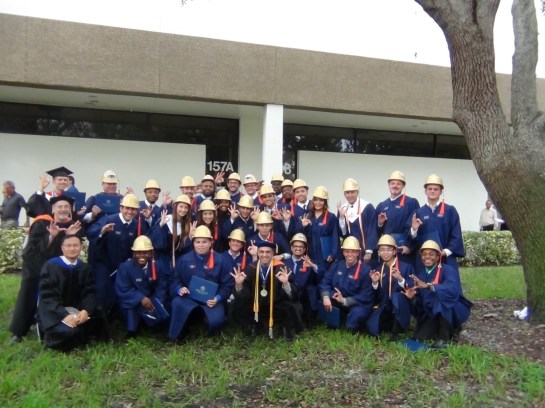
DSC07760I am a little late, but I had the privilege of leading our students into graduation.  We had 4 masters grads and over 30 BS grads  They all did well and should been very proud of their efforts.  Congratulations gang!!  Thanks to Dr. Meeroff for the photo!!


I ended up in the water industry after college. It was kinda by default since jobs were scarce and I just got lucky. But pipes and treatment fascinated me and even after I became a town manager. There I learned everyone wanted my water and sewer skills. So when I moved to Florida, I moved over to water and sewer full-time and continue to do so today.

I joined AWWA in 1986 and came to my first ACE in 1994. I haven’t missed one since. Along the way I have met a lot of great people, written papers, published books and developed training for AWWA and its members. I have chaired several AWWA conferences and technical programs. I am on the committee for WQTC – hence why I am here (and given two papers). The conference combines research, regulations and management into a package. WQTC is the opportunity to and learn about the research in the industry form the researchers and academics performing the work which is the reason to be here.

But I was probably always destined for water. I was born an Aquarius (water bearer). When I was a kid I really looked forward to hanging out along the AuSable River or my favorite place to fish, Kyle Lake. I never really thought about whether it was the water or the fishing that enthused me the both (they both did). Fond memories years later. Then I moved to eastern North Carolina and ended up spending a lot of time on the beach, again, not really asking whether it was fishing or the waves. When I moved to Naples, FL, I was re-energized by the waves, and it was a lot less about fishing as I rarely fished. Same as when I started hiking, I always seem to hike to water. Water falls, calm lakes, roaring oceans, streams, rivers – it doesn’t matter. It’s all water. In my industry – it’s all one water!

#mywaterstory


Please thank a vet for their service.  Without them we would not be as free as we are and we would be a lot less safe.  They have made sacrifices many of us cannot understand – we were not there.  But please understand, vets went to fight because their country, that the rest of us, asked them to.  They didn’t go looking for a fight but they did not back down from one.  Some never came back – the ultimate sacrifice.  But they did it because we asked them to lay down their lives for us.  They fought for freedom (ours in the Revolutionary War and War of 1812), for the freedom of others (Civil War), Freedom from tyranny (WW1, WW2) idealism (Korea, Vietnam) and our defense from the attacks of others (Afghanistan).  We should never put them in harm’s way unless there is a national security reason to do so.  And then, we need to give them  our support and understanding coming back.  Those that give us their true service won’t ask for it, but we need to give it as freely as they risk their lives.  And remember, we cannot relate to what they experienced.  Only they can.  So thank  Vet for all you have!

IMG_6285 FB731 IMG_0234.  IMG_6308


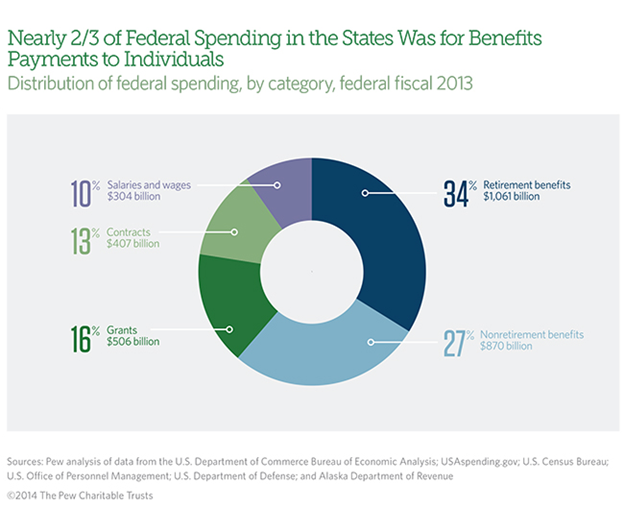
How much money goes to the states from the Federal government? Ever wonder about that? And how do we react? We talk about the need to tighten the federal spending so we keep cutting back on the Superfund cleanup monies ($1 billion/yr), the State Revolving Fund loan system ($2.35 billion/yr), and under $2 billion/yr for clean energy systems. We are concerned about the projected increase of $66 billion/yr for the Affordable Care Act. But these sums are just a tiny component for the federal budget, which is dwarfed by the $3.1 trillion sent to the states during its 2013 fiscal year. So what are these funds? Retirement benefits, including Social Security and disability payments, veteran’s benefits; and other federal retirement and disability payments account for over 34% of these payments. Medicare in another 18%. Food assistance, unemployment insurance payments, student financial aid, and other assistance payments account for another 9%. Another 16% is for grants to state and local governments for a variety of program areas such as health care (half the amount is Medicaid), transportation, education, and housing and research grants. All the SRF and grant monies are in this 16%. Those water programs are barely visible in this picture. Contracts for purchases of goods and services for military and medical equipment account for another 13%, while smallest amount – salaries and wages for federal employees is 10%.  Keep in mind that federal employees have dropped from nearly 7 million to 4.4 million since 1967. No federal employment expansion going on there.
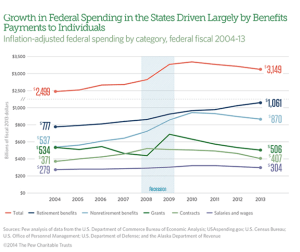
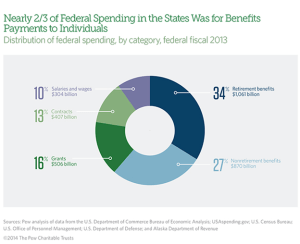
growth in fed payments

fed payments

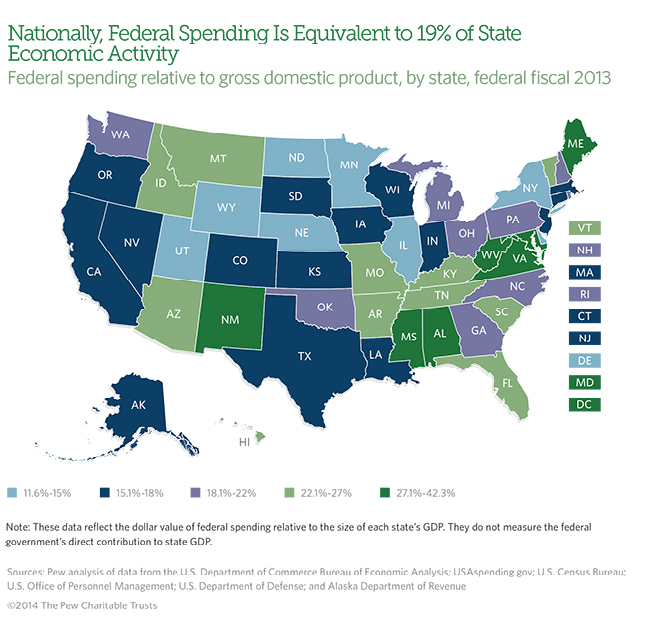
So how much does this affect the states? Federal funds account for about 19 of the total gross domestic product of the US, a number that has been relatively consistent (within a few percentage points) for years. That is below its all-time highs, and about typical over the past 30 years. Figure 1 from a PEW report shows that federal funds are greater than 22% of the GDP in most southern states (which interestingly enough have the people that complain the most about the federal government intrusion), while the Plains states, Midwest, northeast and the west coast are generally below average, and the two coasts, especially complain the least. Mississippi, Virginia and New Mexico all top 30%.
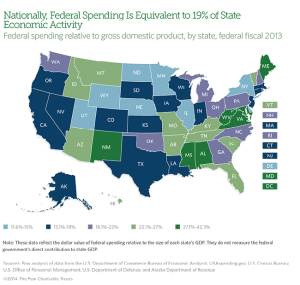
figure nat fed spending by state

So let me see if I have this right – those that pay the least, but get the most, complain the most about their benefactors, and those that pay the most, but collect less, complain less. That is the message! What is WRONG with that picture? And those people? The problem is I see it every day at the local level and it is truly baffling. It means that somehow our politics gotten so out of whack that those in need the most, seem to continue to vote against their best interests? Marketing clearly is a problem but are we fooled that easily. A message that distracts from the reality is obvious, but this continuing trend is just truly weird. No wonder it is so hard to accomplish things.
Most states were doing pretty well before the 2008 recession hit, but that ended in 2009. Most states had to make extremely difficult cuts or raise taxes, which was politically unacceptable. Of course invested pension systems received a lot of attention as their value dropped and long term sufficiency deteriorated, which was fodder for many changes in pensions, albeit not how they were invested. The good news is a lot of them came back in the ensuing 5 years, but 2015 may be different. A number of states have reported low earnings in 2015 and whether this may be the start of another recession. The U.S. economy has averaged a recession every six years since WWII and it has been almost seven years since the last contraction. With China devaluing their currency, this may upset the economic engine. At present there are analysts on Wall Street who suggest that some stocks may be overvalued, just like in 1999. If so, that does not bode well states like Illinois, Kansas, New Jersey, Louisiana, Alaska and Pennsylvania that are dealing with significant imbalances between their expenses and incomes. Alaska has most of its revenue tied to oil, so when oil prices go down (good for most of us), it is a huge problem for Alaska that gives $2200 to every citizen in the state. An economic downturn portends poorly for the no tax, pro-business experiment in Kansas that has been unsuccessful in attracting the large influx of new businesses, or even expansion of current ones. California and next door Missouri, often chided by Kansas lawmakers as how not to do business, outperform Kansas.

Ultimately the issue that lawmakers must face at the state and as a result the local level is that tax rates may not be high enough to generate the funds needed to operate government and protect the states against economic down turns. There is a “sweet spot” where funds are enough, to deal with short and long term needs, but starving government come back to haunt these same policy makers when the economy dips.   It would be a difficult day for a state to declare bankruptcy because lawmakers refuse to raise taxes and fees.


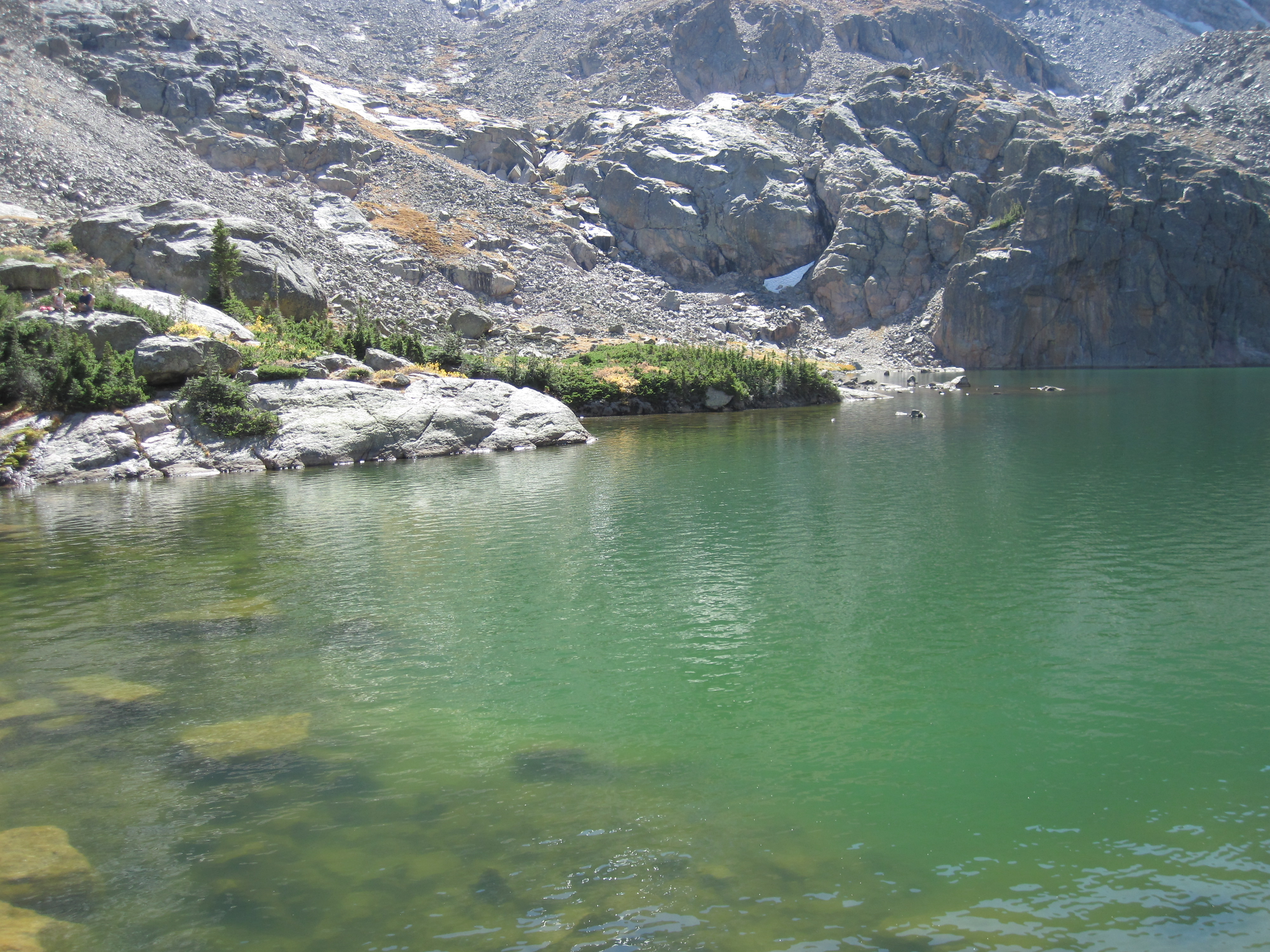
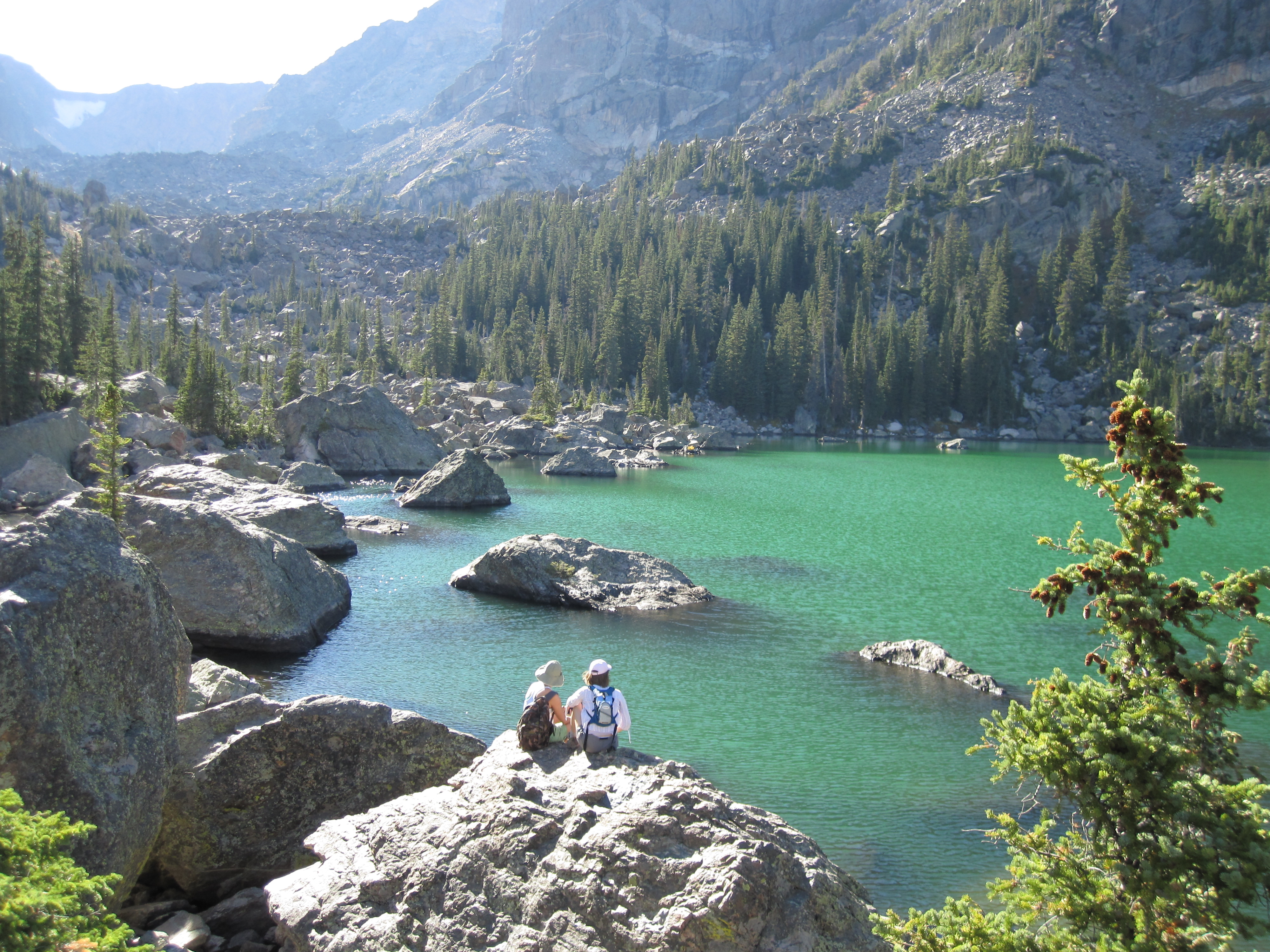
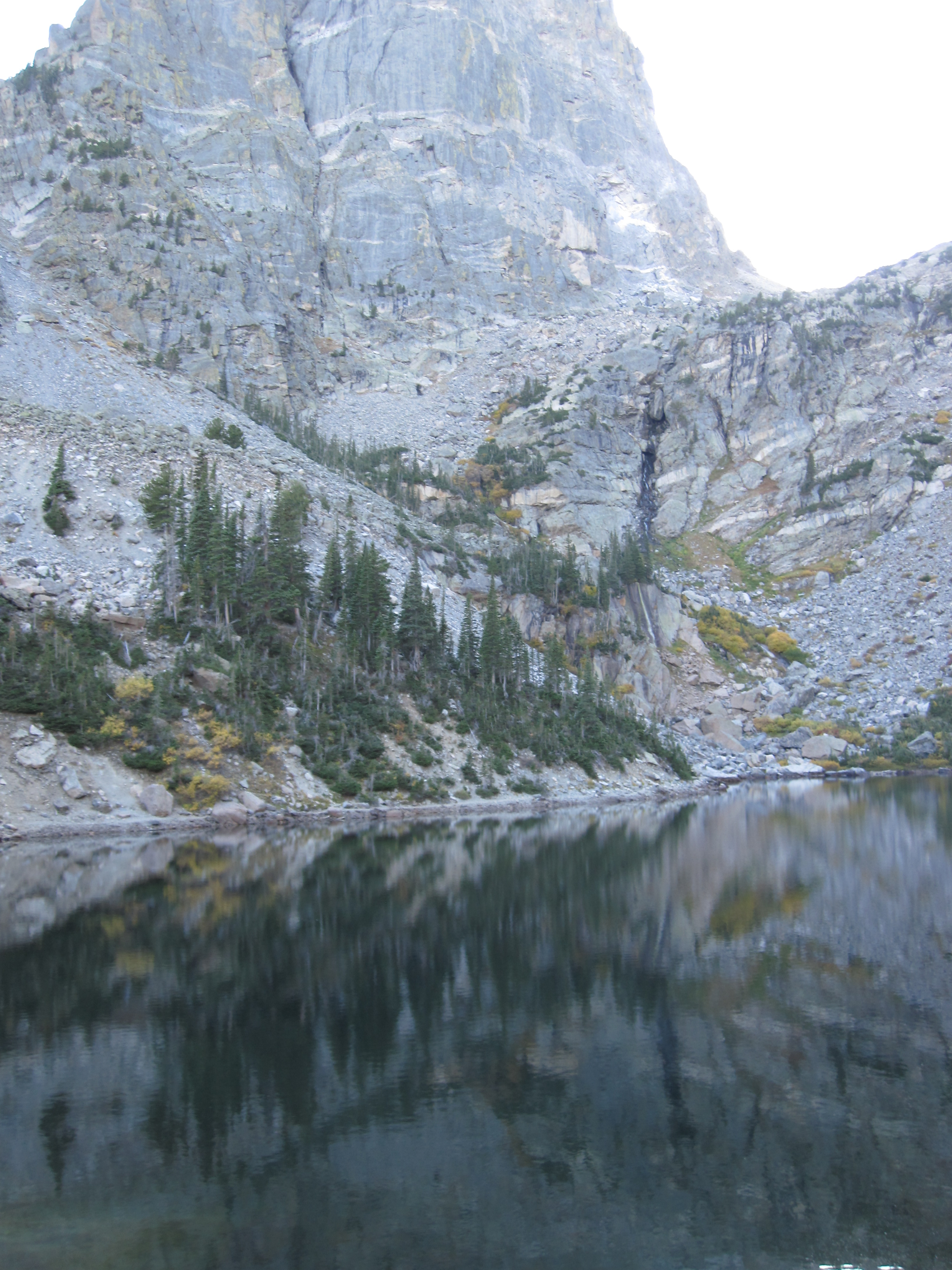
Last weekend I went hiking on Rocky Mountain National Park, on my way to a conference in Oklahoma City. My goal was to hike 35 miles in 2.5 days prior to the conference. Friday afternoon was a solid 7 miles, but not a difficult hike. Saturday was more interesting. I hit 10 lakes in under 10 hours, plus 4 water falls. And still saw 7 deer and a bunch of Elk. And trout. And birds. So here are the 10 lakes in order:

Bear Lake

IMG_7751 Bear Lake

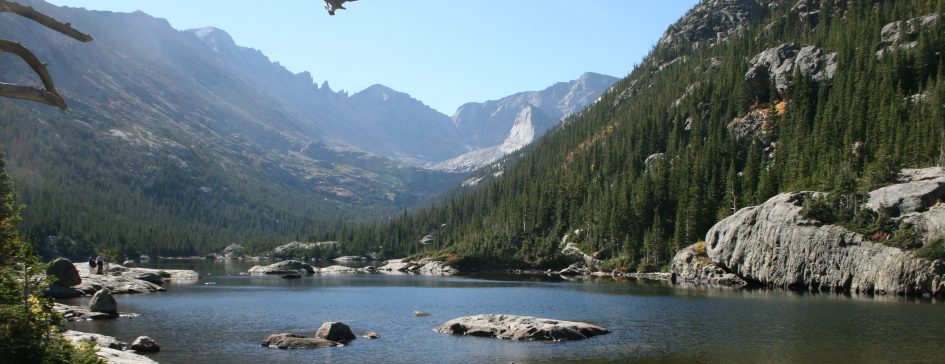
Mills Lake

IMG_7773 Mills Lake

Jewel Lake

IMG_7803 Jewll lake

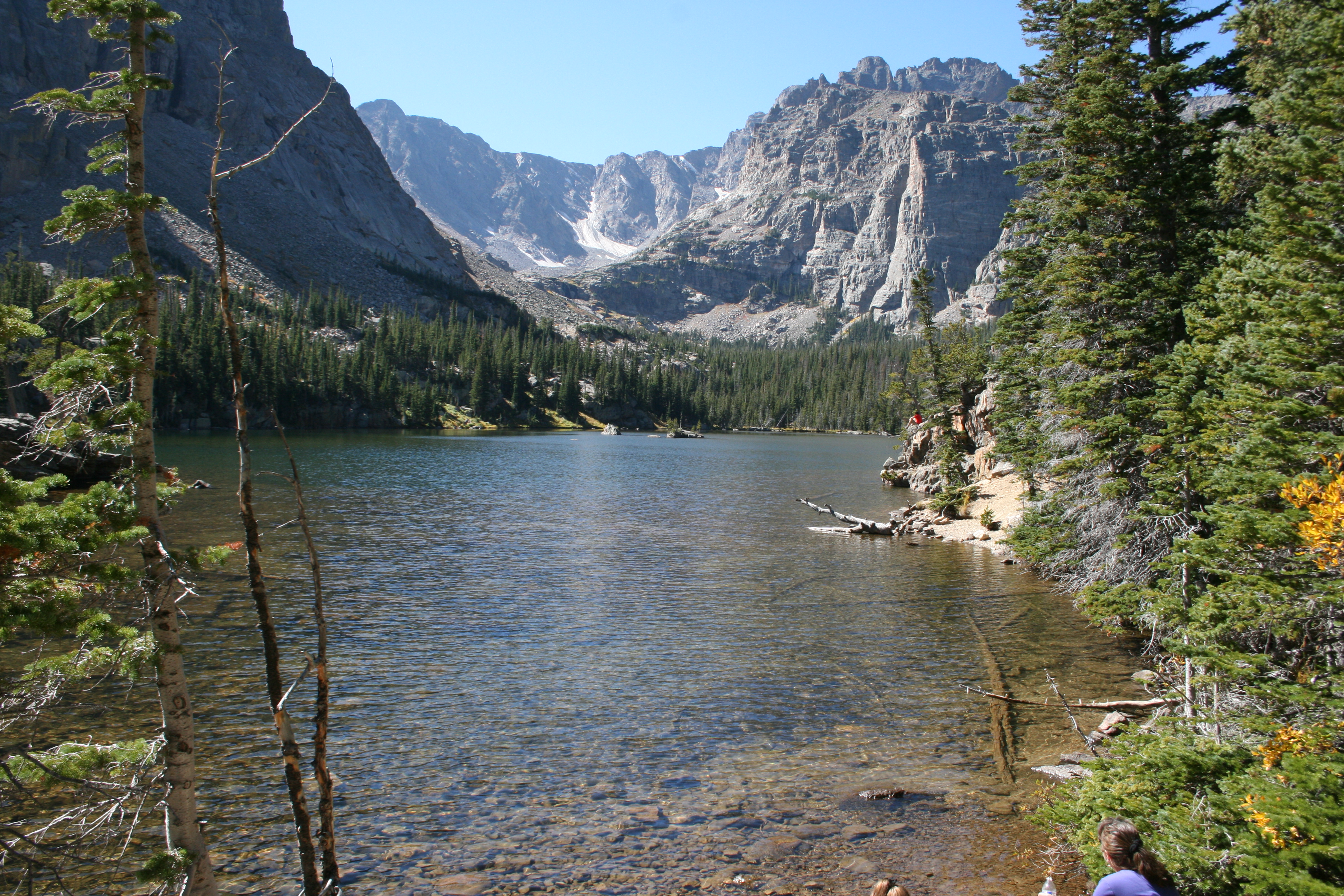
The Loch

IMG_7813 The Loch

Lake of Glass

IMG_3162 Lake of Glass

Sky Pond (after climbing up rocks – highest lake)

IMG_3165 Sky Pond

Lake Haiyaha

IMG_3188 Lake haiyaha

Dream Lake

IMG_3198 Dream Lake

Emerald Lake ( sorry sun was directly ahead so this is washed out a little

IMG_3203 Emerald lake

Nymph Lake

IMG_3214 Nymph Lake

Arrived back at Bear Lake at the end of the trek. I luckily got a parking spot as the lot was basically full at 830 am due to the unseasonal weather.   It was over 80 degrees – which is warmer than the temperatures this past July when we went out. Unseasonable warm weather brought out people by the thousands to enjoy the opportunity to hike this late. And the last two years I was hiking in snow on Sept 22 and Oct 4.


It’s hard to believe it has been 14 years since the twin towers fell!  I vividly remember walking into a conference room for a meeting and seeing the second plane hit.  And work just stopped after that.  It took a while for us to understand what happened.  The why problem still sits out there.    But we should never forget those lost, or the efforts of those who tried to help

WTC_seq_reuters (1)