Archive

Water Funding


Most states were doing pretty well before the 2008 recession hit, but that ended in 2009. Most states had to make extremely difficult cuts or raise taxes, which was politically unacceptable. Of course invested pension systems received a lot of attention as their value dropped and long term sufficiency deteriorated, which was fodder for many changes in pensions, albeit not how they were invested. The good news is a lot of them came back in the ensuing 5 years, but 2015 may be different. A number of states have reported low earnings in 2015 and whether this may be the start of another recession. The U.S. economy has averaged a recession every six years since WWII and it has been almost seven years since the last contraction. With China devaluing their currency, this may upset the economic engine. At present there are analysts on Wall Street who suggest that some stocks may be overvalued, just like in 1999. If so, that does not bode well states like Illinois, Kansas, New Jersey, Louisiana, Alaska and Pennsylvania that are dealing with significant imbalances between their expenses and incomes. Alaska has most of its revenue tied to oil, so when oil prices go down (good for most of us), it is a huge problem for Alaska that gives $2200 to every citizen in the state. An economic downturn portends poorly for the no tax, pro-business experiment in Kansas that has been unsuccessful in attracting the large influx of new businesses, or even expansion of current ones. California and next door Missouri, often chided by Kansas lawmakers as how not to do business, outperform Kansas.

Ultimately the issue that lawmakers must face at the state and as a result the local level is that tax rates may not be high enough to generate the funds needed to operate government and protect the states against economic down turns. There is a “sweet spot” where funds are enough, to deal with short and long term needs, but starving government come back to haunt these same policy makers when the economy dips.   It would be a difficult day for a state to declare bankruptcy because lawmakers refuse to raise taxes and fees.


In the vein of more growth is always better mentality, the following struck me as I was in Colorado last month.  Front Range politics are a big deal in Colorado because virtually all the people in the state live within 60 miles of Denver.  The following table outlines the populations of the Front Range counties and their growth trends over the past three years.  Big growth.  So the local politicians are happy.  Growth is good.

The Front Range Urban Corridor
County 2012 Estimate 2010 Census Change
Larimer County 310,487 299,630 +3.62%
Weld County 263,691 252,825 +4.30%
Boulder County 305,318 294,567 +3.65%
City and County of Denver 634,265 600,158 +5.68%
Arapahoe County 595,546 572,003 +4.12%
Jefferson County 545,358 534,543 +2.02%
Adams County 459,598 441,603 +4.07%
Douglas County 298,215 285,465 +4.47%
City and County of Broomfield 58,298 55,889 +4.31%
Elbert County 23,383 23,086 +1.29%
Park County 16,029 16,206 −1.09%
Clear Creek County 9,026 9,088 −0.68%
Gilpin County 5,491 5,441 +0.92%
El Paso County 644,964 622,263 +3.65%
Teller County 23,389 23,350 +0.17%

Then I read an article by Bruce Finley of the The Denver Post entitled “Colorado shies from big fix as proliferating people seek more water.’  The concept is to continue the state’s tradition of moving water from the wetter west side of the Rockies to the drier east side.  The current fix is to build a huge reservoir by Dinosaur National Monument (in the middle of the west Colorado desert), then divert 97 billion gallons a year from the Yampa River through a 250-mile pipeline across the Continental Divide to the Front Range to defray Colorado’s projected 2050 water shortfall of 163 billion gallons.  The Yampa Pumpback would be the 31st cross divide diversion Colorado has built since the 1930s.

colorado water

Now the plan has hit a snag, whereby the EIS for the project indicates to meet needs, it would be the Front Range that bears the risks of not enough water in dry years as a part of negotiations for water entitlements under the interstate treaty that divvies the Colorado River.  Once that is resolved, the project would cost billions and take years to construct.  Ok, the Front Range is water limited. And we all know it.  The problem is people like Northern Water manager Eric Wilkinson who the article quotes as saying. “With the number of people coming here, we’re going to have to look at all alternatives. Conservation isn’t the silver bullet; it’s also going to take additional infrastructure…. These people need water, and they’re willing to pay for that water.”  In other words, we need more growth!  So in the meantime, development competes with agriculture or replaces agriculture on the semi-arid high plains.  The article suggests that cities and industries seeking more water would absorb hundreds of thousands of acres of agricultural land water rights if unable to divert more across mountains, something the governor is a little concerned about.  They would just buy them out.  So less agriculture when we probably will need that land later.

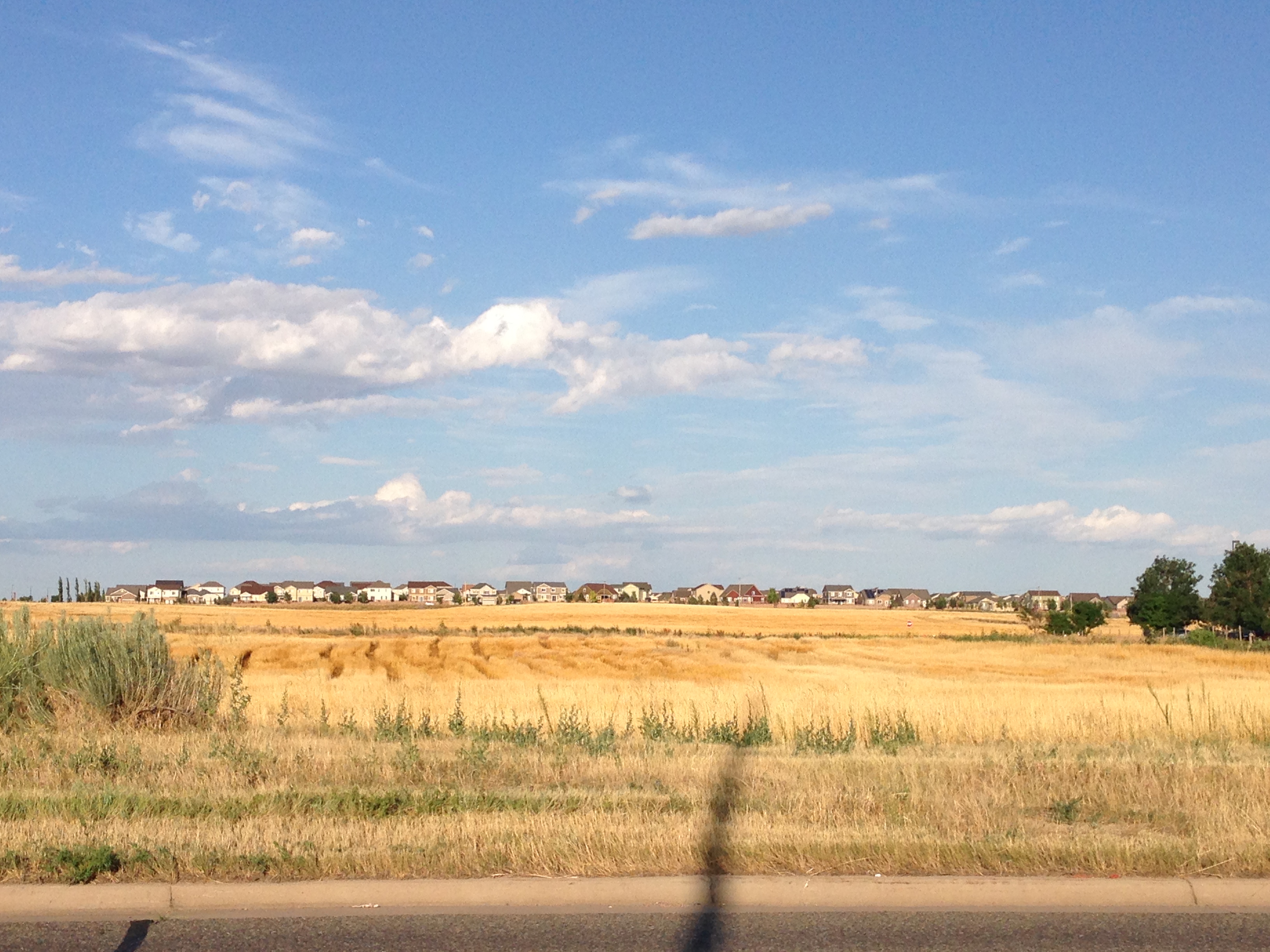
So in that vein, I noted the following at the airport.  One is a nice field of grain. Golden in the summer sun.  Across the street, the golden field is being converted to 300 houses.  You can see the pipe and the equipment.  And my question is – Is this really a good idea?

photo15b

photo15e


Wastewater utilities and water utilities are intrinsically linked.  Wastewater utilities often discharge to water bodies that are water supplies for downstream water plants.  In other cases, wastewater plants provide additional supply options to reduce water demands in the form of reclaimed water.  However as a wastewater utility, costs are often associated with power- pumping and aeration, which can be 30% or more of the utility’s costs in the worst cases.  However, substantial savings in operations can be achieved by reducing the amount of wastewater that must be pumped and treated and in some cases that reduction also is associated with water quality benefits for the reuse of reclaimed water.  Utilities have long dealt with the infiltration and inflow (I and I) issues in their system by televising their pipes and identifying leak points, but this primarily addresses only the infiltration part of I and I.  Inflow and infiltration are not the same thing – they are very different and must be addressed differently.  Inflow causes hydraulic issues during rain events – like sanitary sewer overflows and basement flooding.  Both subject the utility liability from lawsuits and/or regulatory fines.  Inflow is the risk issue that must be addressed to protect the utility.  A cost effective solution to inflow involves low tech, low cost methods can identify the problems that can corrected easily.  Removing the inflow portion from I and I, often leads to a more focused plan for infiltration correction.  What are those tools?  Smoke testing, cleanout repairs, sealing manholes and manhole dishes.  But each of these needs to be carefully selected.  Because these solutions, pipe that leak can be seen through another low tech solution – a midnight monitoring event.  Recent efforts here in south Florida indicate that only 15-20% of the pipes in a sewer system need to be televised and within those, about half the leaky pipes are actually not leaking – they are broke laterals.  Laterals are one of the most ignored parts of the sewer system – often they are small pipes and much of the piping is on private property so the utility does not address those pipes.  And in many utilities these are the pipes in the worst condition.

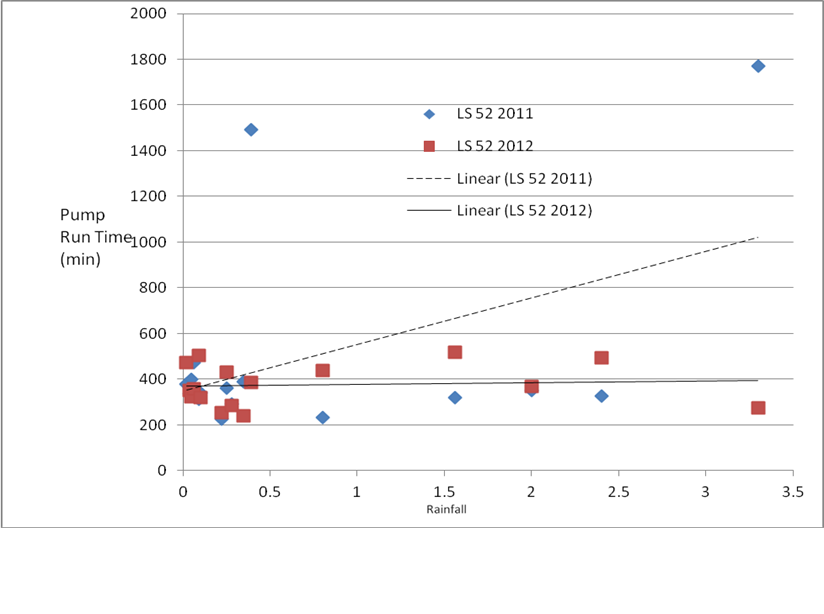
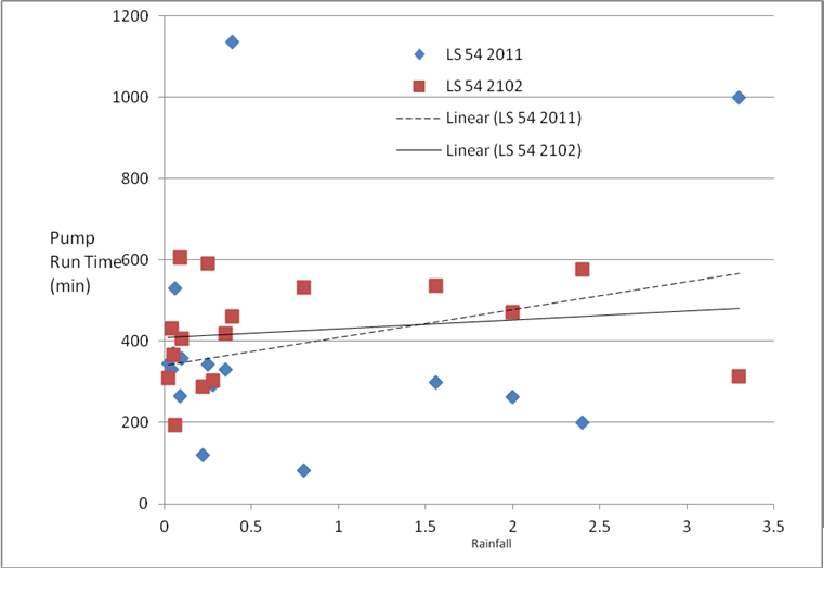
Other things that our efforts have shown are that new pipe can leak, just like old pipe, clay is not the only pipe that leaks and that the inflow solutions can be very helpful.  Figures 1-4  show how the solutions affected three lift stations and one community.  The graphs show rainfall vs flow.  Before these efforts, the flows increased with rainfall events.  After, they did not.  Hence this utility was able to resolve its risk for overflows at a cost of under $500/manhole.  That is relatively inexpensive.

LS 52 db LS 54 LS 53


As technology advances I have an observation, and a question that needs to be asked and answered.  And this could be a pretty interesting question.  Back in the day, say 100 or 150 years ago, there were not so many people.  Many activities occurred where there were few people and impacts on others were minimal.  In some cases ecological damage was significant, but we were not so worried about that because few people were impacted by that ecological damage.  In the 20th century, in urban locations, the impact of one’s activities on others became the basis for zoning laws – limiting what you could do with your property because certain activities negatively impacted others.  And we certainly had examples of this – Cuyahoga River burning for one.  Of course this phenomenon of zoning and similar restrictions was mostly an urban issue because there potential to impact others was more relevant in urban areas.  We also know that major advances in technology and human development tend to occur in population centers (think Detroit for cars, Pittsburgh and Cleveland for steel, Silicon Valley, etc.).  People with ideas tend to migrate to urban areas, increasing the number of people and the proximity to each other.  Universities, research institutions, and the like tend to grow up around these industries, further increasing the draw of talent to urban areas.  The observation is that urban areas tend to have more restrictions on what people do than rural areas.  So the question – do people consciously make the migration to urban areas realizing that the migration for the potential financial gain occur with the quid pro quo of curbing certain freedoms to do as you please?  Of does this artifact occur once they locate to the urban areas?  And is there a lack of understanding of the need to adjust certain activities understood by the rural community, or does it become yet another point of philosophical or political contention?  I have blogged previously about the difference between rural and urban populations and how that may affect the approach of utilities, but read a recent article that suggests that maybe urban citizens accept that financial gains potential of urban areas outweighs the need to limit certain abilities to do as you please to better the entire community.  They are motivated by potential financial opportunities that will increase their standing and options in the future.  So does that mean urban dwellers understand the financial tradeoff differently than rural users?  Or is it a preference issue.  And how does this translate to providing services like water to rural customers, who often appear to be more resistant to spending funds for improvements?  While in part their resistance may be that their incomes tend to be lower, but is their community benefit concern less – i.e. they value their ability to do as they please more than financial opportunities or the community good?  I have no answer, but suggest that this needs some further study since the implications may be significant as rural water systems start to approach their life cycle end.


I am in the initial stages of a project to look at economy of scale, utility bench-markings, asset management and impacts of economic disruption on utility systems. I should note that I am looking for volunteers, so let me know. But an initial question is whether economy of scale still applies. We think it should but given the disparities across the US, does it. As a quick survey, I enlisted several volunteer utilities to provide me with some basic information that I sued to create some ratios. And then we discussed them. The baselines were accounts and cost per millions of gallons produced.  The graphics are shown below. Economy –of-scale is alive and well. That means if you have a small utility, you cannot expect to have the same costs/gallon, or the same rates, as your larger neighbors. If you do, you are probably shoring your maintenance or capital programs. That leads to bigger costs later. Instead of comparing yourself to your larger neighbors, see what happens when you compare yourself to cable and cellphones in your area. You may be surprised.

economy of scale MGY economy of scale cost per MGY


The true risk to the community of pipe damage is underestimated and the potential for economic disruption increases.  The question is how do we lead our customers to investing in their/our future?  That is the question as the next 20 years play out. Making useful assumptions about increases in demands, prices, inflation rates etc. are key to useful projections and long-term sustainability. Building too much or too little capacity for example can have disastrous consequences (to the ratepayers on the former, to the local economy for the latter).

Getting funding relies on economic strength, a problem of you are in a depressed area (Detroit) or a boom that could crash at any time (North Dakota).  P3 opportunities are available for cash strapped communities but they come with a cost.  Risk must be allocated fairly – the private community will not take on too much risk without increasing costs significantly. Loss of control is one of those risk conversion issues.  Extensive planning and feasibility analyses should be expected – far more scrutiny than most utilities are used to.  The economic strength of the community is important to private investors.

In a prior blog we talked about the boom towns of North Dakota.  Things were booming in 2013 but the downturn in oil prices may get ugly.  The need for more fracking wells may have decreased (at least temporarily) and the decrease in the oil and gas costs has cut into local revenues, so is this is the time to keep planning for the boom?  South Florida did this in the early 2000s – and well, that real estate boom put quite a dent in the economy and population estimates for 2020 and 2030.  The balloon popped and so did the economy.  South Florida had the resiliency to bounce back because of weather and proximity to South America.  We have seen the result to an industrial economy – where a community relies on industry, well industry can be fickle.  Ask Detroit.  Or Cleveland.  Or any number of other Rust Belt cities.  Now they have infrastructure, but much of it is underused.
So while the Plains states plan for the boom, the boom has settled in some places. Already the oil and gas industry has shed 100,000 jobs (many high salary).  Texas, Kansas, North Dakota and Oklahoma are facing financial challenges in 2015 due to funding losses.  Alaska is dipping into reserves.  But that doesn’t mean the results of the 2010-2014 boom are not continuing, or at least portions of them.  Frack water continues to be discharged to local wastewater systems, but the revenues to pay for the needed upgrades is lacking.  Effluent limits for nitrogen and TOC for some rivers have decreased as a result of constant increased loading to the streams (more flow increases total loads, so if flows remain the same, the concentrations must decrease to maintain total loading).  The costs to reduce ammonia, for example from 10 mg/l to 2 or 3 mg/L can be $1-2/1000 gallon – over 50% or more of the current cost for treatment.

So is it a surprise that some communities fight the boom times?  Booms create disruption and uncertainly, and a need for technology (and costs).  Maybe stability does matter, as it can contain costs and treatment requirements.  However the boom can help communities in financial distress.  Detroit and Flint would love a boom – both have the infrastructure in place to support it as opposed to rural communities in the Plains.  But that’s is a key – they already HAVE the infrastructure in place.  The Plains, well, do not.

There is a lot of older, underutilized infrastructure out there.  Detroit, Flint, Cleveland, Akron, Toledo and Philadelphia are among the older industrial cities that have stable populations – people that live there most of their lives, have a trained and educated workforce, and normally have lots of water and infrastructure, and lots of potential employees, all of which are underutilized and at risk due to economic losses. But the booms rarely go to older cities. How that is?  Is this a leadership issue?  Convenience?  Quick profits?  And how long will the boom last?  Is it a matter of lack of understanding or regulations that creates the boom?  A combination of factors?  A better PR program?

Remember we all play defense.  Industry does not.  Industry plays offense all the time.  The private sector mode is play offense.  Get the message out.  Frame the message.  Win the game.  Is winning the game at any cost the right answer?  For boomers it is.  What about the rest of us?


The US EPA estimates that there is a $500 billion need for infrastructure investment by 2025.  The American Water Works Association estimate $1 trillion.  Congress recently passes the Water infrastructure Finance and Innovation Act (WIFIA) at $40 million/year, rising to $100 million in 5 years, which is a drop in the bucket.  Peanuts.  We have so many issues with infrastructure in the US and Congress tosses a few scheckles at the problem and thinks it is solved.  The reality is that the federal government wants to get out of the water infrastructure funding business and shift all water infrastructure to the local level.  This is a long-standing trend, going back to the conversion of the federal water and sewer grant programs to loan programs.

The reality is that local officials need to make their utility system self-sustaining and operating like a utility business whereby revenues are generated to cover needed maintenance and long-term system reliability.  The adage that “we can’t afford it” simply ignores the fact that most communities cannot afford NOT to maintain their utility system since the economic and social health of the community relies on safe potable water and wastewater systems operating 24/7.  Too often decision are made by elected officials who’s vision is limited by future elections as opposed to long-term viability and reliability of the utility system and community.  This is why boom communities fall precipitously, often never recovering – the boom is simply not sustainable.  Long-term planning is a minimum of 20 years, well beyond the next election and often beyond the reign of current managers.  Decisions today absolutely affect tomorrow’s operators.  Dependency on water rates may be a barrier, but this ignores the fact that power, telephone, cable television, gas, and internet access are generally more expensive hat either water or sewer in virtually all communities.  We need water. Not so sure about cable tv or he internet.  Great to have, but needed to survive?

The growth in costs can lead to mergers where a utility cannot afford to go it alone – as the economy of scale of larger operations continues to play out in communities.  Several small plants cannot operate at the same cost as one larger plant.  As a result larger projects will increase – from 87 to over 336 between 2005 and 2014.

But these costs are generally plant costs – treatment and storage, not piping.  Distribution pipelines remain the least recognized issue for water utilities (collection pipelines for sewer are similarly situated).  The initial Clean Water Act and Safe Drinking Water acts did not focus on piping systems – only treatment and supply.  The national Council on Public Works concluded their first assessment grade for infrastructure in the 1980s – but piping was not discussed.  ACSCE’s first report card in 1998 did not express concern about piping system.  Yet piping continues to age, and expose communities to risk.  In many communities greater than 50% of their assets are buried pipes.  Tools for assessing the condition of buried pipes especially water distribution pipes is limited to breaks and taps.  As a result the true risk to the community of pipe damage is underestimated and the potential for economic disruption increases.  The question is how do we lead our customers to investing in their/our future?  That is the question as the next 20 years play out.  Many risk issues will be exposed.  The fact that there are not more issues is completely related to the excellent work done by the utility employees.  More to come….


A past project I was involved  with involved a look at the feasibility of using wastewater to recharge the Biscayne aquifer In the vicinity of a utility’s potable water supply wells.  The utility was feeling the effects of restrictions on added water supplies, while their wastewater basically unused.  So they wanted a test to see if the wastewater could be cleaned up enough to pump it in the ground for recovery downstream, with the intent of getting added allocations of raw water.  Assuming the water quality issues could be resolved, the increased recovery would solve a number of water resource issues for them, and the cost was not nearly as high as some thought.

So we tested and using sand filters, microfiltration, reverse osmosis, peroxide and ultraviolet light, we were successful in meeting all regulatory criteria for water quality.  The water produced was basically pure water – not constituents in it, and therefore it exceeded all drinking water standards.  We demonstrated that technologically the water CAN be cleaned up.  The only issue is insurance that the treatment will always work – hence multiple barriers and the ground.  This was an indirect potable reuse project and ended because of the 2008 recession and the inability to of current water supply rules to deal with the in/out recovery issues.

The indirect reuse part was the pumping of the water into the ground for later withdrawal as raw water to feed a water treatment plant, as opposed to piping it directly to the head of their water plant.   But recovery of the water can be a challenge and there is a risk that a portion of the injected water is lost.  In severely water limited environments, loss of the supply may not be an acceptable outcome.  Places like Wichita Falls, Texas have instead pursued more aggressive projects that skip the pumping to the ground and go straight into the water plant as raw water.  Technologically the water CAN be treated so it is safe to drink.  The water plant is simply more treatment (added barriers).  So, with direct potable projects, monitoring water quality on a continuous basis maybe the greatest operational challenge, but technologically there is no problem as we demonstrated in our project.

The problem is the public.  You can hear it already – we are drinking “pee” or “poop water” or “drinking toilet water.”  The public relations tasks is a much bigger challenge because those opposed to indirect and direct potable projects can easily make scary public statements.   Overcoming the public relations issue is a problem, but what utilities often fail to convey is that many surface waters are a consolidations of a series of waste flows – agriculture, wastewater plants, etc. by the time they reach the downstream water intake.  Upstream wastewater plants discharge to downstream users.   But the public does not see the connection between upstream discharges and downstream intakes even where laws are in effect that actually require the return of wastewater to support streamflow.  So are rivers not also indirect reuse projects? In truth we have been doing indirect potable reuse for, well ever.

We have relied on conventional water plants for 100+ years to treat surface waters to make the water drinkable.  The problem is we have never educated the public on what the raw waters sources were, and how effective treatment is.  Rather we let the political pundits and others discuss concerns with chemicals like fluoride and chlorine being added to the water as opposed the change in water quality created by treatment plants and the benefits gained by disinfectants.  That message is lost today.  We also ignore the fact that the number one greatest health improvement practice in the 20th century was the introduction of chlorine to water.  Greater than all other medical and vaccine advances (although penicillin and polio vaccines might be a distant second and third above others).   Somehow that fact gets lost in the clutter.

Already the Water Reuse Association and Water Research Foundations have funded 26 projects on direct potable reuse.  Communicating risk is one of the projects.  The reason is to get in front of the issues.  You see, playing defense in football is great and you can sometimes win championships with a good defense (maybe a historically great one, but even they gamble).  Defense does not work that way in public relations.  Offense usually wins. Defenses often crumble or take years to grab hold.

The failure of utilities to play offense, and the failure of elected officials particularly support playing offense is part of the reason we struggle for funds to make upgrades in infrastructure, to perform enough maintenance or to gather sufficient reserves to protect the enterprise today.  And it remains a barrier to tomorrow.   Leadership is what is missing.  It struck me that when looking at leaders, what made them leaders was their ability to facilitate change.  Hence President Obama’s campaign slogan.  But talking about change and making real changes are a little more challenging (as he has seen).  You cannot lead without a good offense, one that conveys the message to the public and one that gets buy-in.  With direct and indirect potable reuse, the water industry has not changed the perception of “toilet water.”  That needs to change.  We need to be frank with our customers.  Their water IS SAFE to drink.  They do not need filters, RO systems, softeners, etc., or buy bottled water, when connected to potable water supplies (private wells, maybe).  We CAN treat wastewater to make it safe, and the technology tis available to make it potable.  . The value they pay for water is low.  Yet in all cases, others, have made in-roads to counter to the industry.  That happened because we play defense.

So what does ability to pay really mean?  We hear this discussed by political pundits and local officials but few really understand what this means.  Likewise the “I’m on a fixed” budget argument pops up a lot, and it is hard to understand what this really means.

The ability to pay concept was developed many years ago by political scientists and economists looking at the allocation of costs to consumers for government services.  Property taxes are a logical place to start – higher value homes have more potential for loss, so their taxes were more (the percent was the same but because of their value the amount was higher).  For income taxes, those with higher incomes we deemed to have more disposable income and again more to lose, so the rates increased as income rose (we forget that until 1963 the highest income tax rate was 90%, and the economy was growing quickly!).  People with lower incomes had little disposable income because all their money went to food and housing.  Today the issue of affordability arises with water, sewer, taxes and storm water fees, as well as federal and state taxes.  The SRF and bonding agencies often look at 3.5% or 4.5% and the maximum water or water/wastewater cost as a percent of income, but few  utilities charge this much.  Few water and sewer utilities (combined) approach the cost for power per household, let along the cost of cable or cell phone use for all but the cheapest carriers.  Certainly water, sewer and storm water are essential service, but not so much cable, although there are those who will argue the point.  So somehow the ability to pay issue does not apply to private sector services, but does to essential services, especially when we all know we do not collect enough money to cover significant infrastructure needs on those public works systems?  That just does not make logical sense except in the political world.

Likewise the “fixed income” argument is often applied in tandem.  Fixed income is generally applied to retirees, but let’s not forget that 10% of those in poverty are retirees, but 18% of millionaires are over 65.  But don’t most people have a fixed income – their income is fixed by their employer.  They can change jobs but the argument that younger folks should change jobs if they want to earn more is like telling retirees to go back to work.  There is only so much we can do and only so much income to be earned because few control their income.

So on both counts, the ability to pay argument seems like an argument created to keep public service costs down and prevent the full cost application to many.  The squeaky wheel gets coddled, at the expense of society.  Somehow that is not fairness, and subjects us all to unnecessary risks.  The question is who is going to be the person/group to stand up and say enough?


ASCE came out with more bad news about infrastructure.  60 Minutes did a piece about deterioration of bridges. The magazine American City and County has published a couple articles about the risks of aging infrastructure.  Asset management is practiced by few governments, and even fewer small ones.  The public doesn’t want to foot the bill and lobbyists want taxes cut further.  Where does it end?

The infrastructure crisis is a political and business leadership crisis.  Or vacuum.  The economy of America and much of the developed world was built on advanced (for their time) infrastructure systems constructed by governments with a vision to the future.  Some of this infrastructure was repurposed (federal interstate system for example), but much of it has addressed critical issues that hampered our development.  For example, the lack of water severely inhibits many third world nations.  Even when they have water, it is unsafe to drink or use.  In America, at the turn of the 20th century 1:100,000 people DIED each summer from typhoid.  Just typhoid, not all the other waterborne disease options.  Many more were sick.  And the population was much smaller.  Talk about reduced productivity.  Now we have advanced water systems, disinfection practices that protect people and pipes, and few event get sick from contaminated water.  Those that do, become headlines.  You don’t want to be a headline.  Productivity is up.  But we expect good water and can’t see the pipes.

Sewer is an even better example.  People just don’t want to know.  Flush and it’s gone.  But the equipment, treatment and materials may be even more complex than the water system.  But few people get sick from sewage because of the systems we have built.  Now think about third world examples.  Or conditions you have seen in documentaries, the news or movies.  Being in sewage is not a great place to be.  Even the manhole thriving cockroaches agree..

Stormwater is probably the laggard here, in part because changes in development patterns have overwhelmed the old systems.  Miami Beach experienced this when redevelopment replaced small houses on permeable lots with large housed with mostly impermeable property.  Oops.  Meanwhile road and bridges have received a lot of funding – with much to do (see bridge that collapsed on I-75 in Cincinnati a few weeks back).  Most states fund transportation at a magnitude more than water and sewer.

What is the problem?  Local officials do not convey an understanding of these complex system to the public very well.  In part this may be because understanding the maintenance needs is difficult and highly variable.  And many do not fully comprehend the assets they have, their condition, life expectancy or technological needs.  No one knows when things will fails, so maintenance or replacement of some equipment or pipeline is always the thing cut in the budget, with no real understanding of the consequences.

The public does not see the asset, assumes it will have a long life, so is unconcerned until they are affected.  Then it is personal.  The public does not understood the impact or value that these assets have to society – they tend to be personal focused, not societal.  That is a leadership issue.  That leadership starts with vision and communication from those that understand the issue to the elected officials that need to advocate for their infrastructure.  Elected officials need to take ownership of infrastructure.  It is like your house – you need to upgrade and protect it constantly.  You do not let that roof leak keep leaking!  Elected officials that do not invest in infrastructure, are letting the roof leak.  Making is someone else’s problem for political expediency is not leadership.

Despite the infrastructure crisis, the good news is that construction of piping is increasing – both new and replacement.  Every so many months, the magazine Utility Contractor will note current trends and pipe seems to be going up.  That’s good but there is a long way to go.  Better news – the construction of buildings is increasing.  That could lead to more revenues.  In Florida, all of a sudden finding experienced construction workers is a problem.  Things are definitely better economically, but are we taking advantage to improve the local infrastructure, or is you economy simply an infrastructure disruption away from another fault?