Ford and vw team up – autonomous vehicles are one goal
Leave a comment
Clearly the message from potable water users with respect to price does not resonate well with consumers. Bottled water sales continue to rise, while water utilities struggle with public images with respect to whether you should drink water from the Tap. Flint did not help, but Flint is an aberration, one of 54,000 utilities (realizing others have lead pipes but have successfully managed this issue for many, many years). I often ask people about their concerns and most often get these responses:
Let’s talk about each of these statements and perhaps the marketing of water by utilities should be altered to address the concerns, not the price.
Who told you that is my normal questions. It usually is a vendor selling point of use equipment. Now I have nothing against point of use equipment sold to the right people (i.e. personal wells), but this is nonsense for potable water customers. Water utilities test water constantly, often many times, in many locations during the day and all that data is recorded and much of it reported. If water does not meet standards, or MIGHT not meet the standards, people are told to boil water or not drink it. Few water utilities will avoid telling the public like Flint. Most regulations require prompt, preemptory notifications, and failure to do so subjects operators to fines or potential criminal charges. The law does not take this lightly as all the regulations under the Safe Drinking Water Act focus on public health protection. Fault- vendors and utilities – see #5
Ignorance is not an excuse, but this highlights a failure by utilities to convey the message to their customers. Websites and mailers are great, but connection to people is essential. Most utilities do this poorly. We need not to fail here. Fault – Utilities
Chlorine is the greatest public health advancement of the 20th century. It immediately reduced the occurrence of waterborne illnesses to almost nothing after implementation. You want chlorine in your water. It disinfects the water and keeps the pipes clean of bacteria and biofilms. Drinking water without chlorine requires a boil water notice because is public health safety cannot be guaranteed. Then I ask how many people pull out that filter in their refrigerator (half the people don’t know they have one). There is a reason the manufacturers recommend changing it regularly. Why – well, those that do know about the filter will often acknowledge that slimy film of the carbon filter. Welcome to the bacteria that grows in the presence of carbon (food) and the absence of disinfection (no chlorine). Draw a picture. And don’t drink water from the refrigerator of the people who didn’t know about the filter! Fault – utilities.
See above. You need chlorine in your water. And you need calcium. If you do not have calcium (one of the constituents of hardness), the pipe will be very aggressive (welcome to Flint) and every reverse osmosis plant out there before the add chemical to address this issue.. You do not water without hardness. Install that vendor’s system and then test how much iron zinc, copper and lead you have in your system. Or plastic. Fault – Unscrupulous Vendors and utilities (see #5)
Utilities produce a consumer confidence report every year. No one reads it. It is posted on the website. No one knows about it. Ok, maybe a few people know and read it but this is an epic fail. We comply with the requirement but do nothing with the information (except post it). We need totalk about compliance and we need to talk about the treatment performed. Most people know nothing about this and no little about where their water comes from. We need people to want to know, to understand and to care. Fault: utilities
Ultimately in each case there is a failure on the part of utilities to convey their message in the right manner, to the right people in a consistent manner. I realize that many utilities try to convey the message but is it working? George Hawkins turned around the message in Washington DC, but he is recognized as a leader because he accomplished this. An excellent effort would be to figure out how to visually show people the value of water. Words and powerpoint don’t work. The internet does not work. The news media is not interested. Our politicians often do not care because it is not a problem. And that is part of the problem – water quality is rarely a problem. We need to convey the good news -Perhaps we can create a beacon of light amongst the trolls, conspiracy theorists, people asking for money for whatever, and news that inundates us every day in all forms of media. To compete for limited public dollars we need to create this message.

I am at the Florida Section of American Water Works Association’s Fall conference. A major topic of interest is potable reuse – i.e. drinking wastewater. Before you say yuck, read on….
Potable reuse remains a topic among those in the water industry. Let’s be clear -the technology to treat wastewater for drinking purposes exists and in fact is practiced in the US today (Big Springs Texas as a direct potable reuse project, Orange County CA as an indirect potable reuse project, among others). Several test programs have been conducted in southeast Florida. A couple have been successful at meeting the drinking water quality goals, including one I was a part of. Ours required a demonstration of 99.9% removal of emerging contaminants, that we demonstrated by spiking at 1000 times the detection limits. It worked. Central Florida has 4 projects being investigated and Texas has a couple more. Potable reuse is coming to Texas, California, Florida and Texas. Other water limited areas (Colorado, Arizona, New Mexico, and perhaps the Carolinas and Georgia) are not that far behind.
Fast forward and the WateReuse Association has completed a series of studies on the issues, including labeling of water uses and addressing the realm issues with potable reuse, – monitoring and public perception. I would argue that the way the industry is set up today, piping wastewater treated with reverse osmosis, peroxide and UV light to a water treatment plant as raw water (it is incredibly pure), can be successfully modeled. Most RO and UV systems use program logic controllers and sensors to monitor conditions. Protocols for the sensor reading need to be written but agreement can be reached on this matter. Those protocols are part of ongoing discussions in Florida, Texas and California at present and from a regulatory perspective should be able to be implemented.
That leaves public perception. While terms matter (toilet-to-tap is not helpful, nor is highly treated wastewater), the reality is that all raw water is arguably someone’s treated wastewater. 85% of all wastewater is returned, some by permit requirement, to nearby rivers and streams – often the same ones the water supplies came from. Hence the City of Raleigh pulls water from the Neuse River, then discharges downstream toe the same river. Smithfield, Goldsboro and others downstream of the Neuse do exactly the same thing. Wastewater is treated before discharge, and the downstream water supply is treated before distribution. The Mississippi is the same way. So the reality is that we need to show people that potable reuse is likely safer and more reliable from a water quality perspective than surface waters. Potable reuse will have no turbidity that interferes with disinfection, no of limited temperature variations, no algae, no protozoas, not emerging contaminants, no viruses and no bacteria to speak of, as compared with even high quality surface waters, which have all of these things. Water utilities provide quality drinking water 24/7 and have since the widespread adoption of filtration and disinfection over 100m years ago. This is because the treatment processes work, and because for over 100 years the water utilities have monitored water quality and the number of potable water system related diseases is tiny (and if the occur are usually a result of piping or storage issues as opposed to treatment issues). So time for a paradigm shift. Draw a picture – you want river water with who knows what in it, or reverse osmosis, UV treated wastewater of known and consistent quality, monitored even more often than the river? Draw that picture. And remember, fish poop in the river.
Now about that Disani water……..

I spent a day in early October in doing a drive that I enjoyed as a teenager, later as a 21 year old and a 30 year old. But has been a few years since I drove the dams of the AuSable River in the upper lower peninsula of Michigan. The AuSable is a famous river, – starting out as the eastern boundary of the land Between Waters” as the native Americans called it before the loggers showed up. The upper reaches of the river, 8 miles east of the turn east, was a cedar laden river – cold, hidden from the sun due to dense vegetation and full of a funny little fish called the grayling. The AuSable was one of the few streams in the lower 48 states where grayling could be caught. And caught they could – so many that anglers drove up from Detroit and Chicago to fish for the plentiful fish that was easy to catch. Ice houses in Chicago bought the fish and sold them commercially. However, logging on the river damaged the streambed, and access to the stream necessitated removing some of the cover. In a short time the forces caused the demise of the little fish, but not the town of Grayling it left behind. Around the turn of the century, brook trout were introduced to the river to maintain its reputation with anglers. The brook trout bred, and the AuSable because world famous as a trout stream. Alas, the brook trout were probably the death Nel to the grayling as they would eat the grayling fry.
The dams started in 1916 as a means to supply power to the northern peninsula and communities downstream. A total of six dams were installed between 1916 and 1924: Mio, Alcona, Loud, Five Channels, Cooke, and Foote. The latter were named to the financier and visionary for the dam construction. The dams remain in use today as hydropower on the river. They remain much as I remember – each brick and concrete structures built in another time. The pride of workmanship and engineering from 100 years ago is clearly present throughout. The look sturdy, just as they did 100years ago when the lights first flickered on.
The dams share the river with canoeists who often do the run from Grayling to its outlet at Lake Huron, navigating around each dam. The trip takes a couple days. My Dad and three buddies did it after he received a wooden canoe (from LL Bean) from his parents for graduation. Two of his buddies were Ted and Jay Stephan, who lived on the river 8 miles east of town, and who would go on to be part of the Great AuSable Canoe Marathon, what is today one of the three great canoe races in North American. Jay won this race multiple times and is a legend in Grayling (as is Ted). You have to navigate the dams to win. I am guessing being able to navigate them at night helps.
The canoe race negatively impacts the trout however because the river needed to be clearer to improve the race. Canoeing became a major stream for canoeing – it is a huge industry for Grayling. Today the main branch is more open and a few rainbow and brown trout inhabit the former grayling waters. The fish decline started in the 1940s. Trout Unlimited was created in Grayling as an organization to protect the trout. The organization is international today, but old friends Jay and Ted were original members.
So finishing the river run (by car), I stayed overnight in Grayling. Up on the ceiling of the restaurant/bar I ate dinner in was Jay and Ted’s canoe that they used to win the race multiple times in hanging from a ceiling in a bar, dated 1952. It looks exactly like the canoe my Dad lost in a forest fire in 1990, which I remember him using to ride the river to fish when I was a little kid.
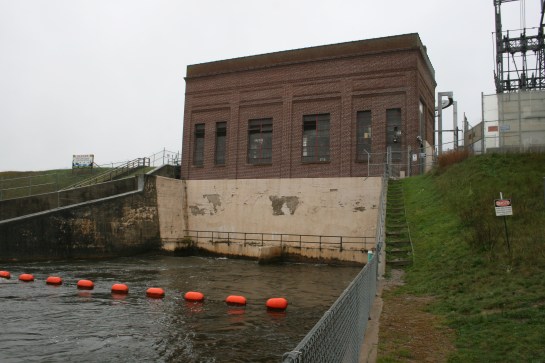
Mio Dam
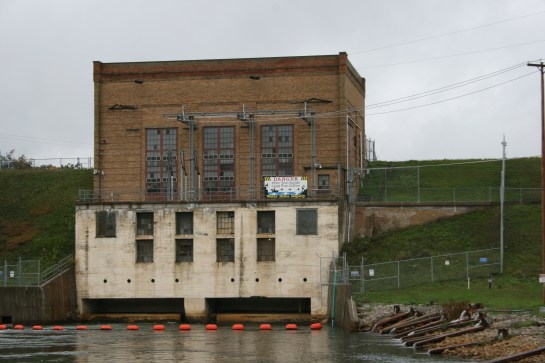
Alcona Dam
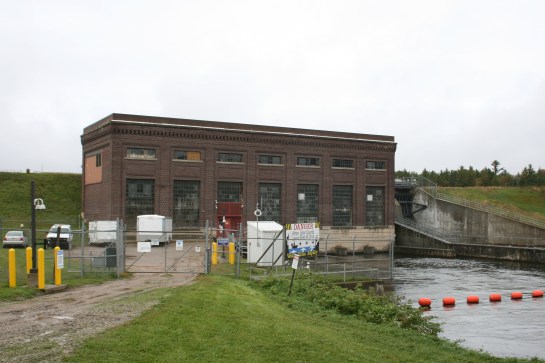
Loud Dam
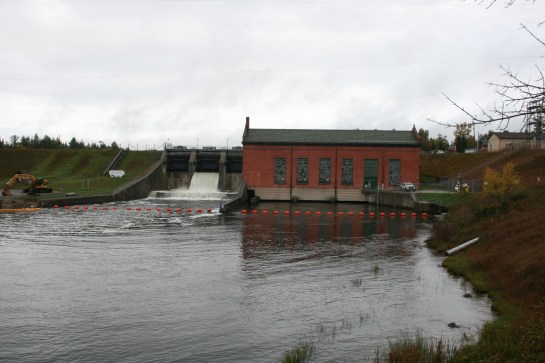
Five Channels Dam
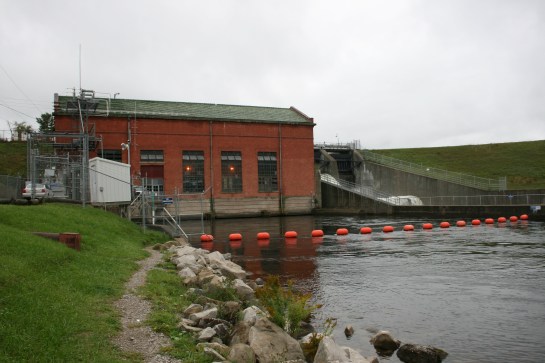
Cooke Dam
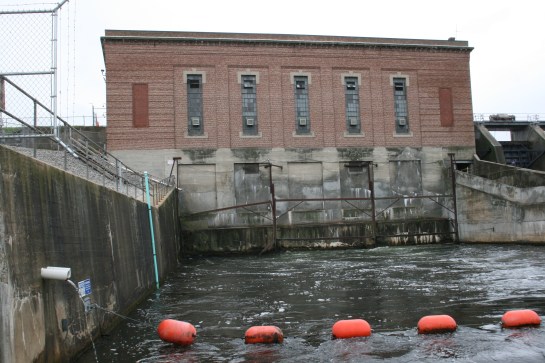
Foote Dam
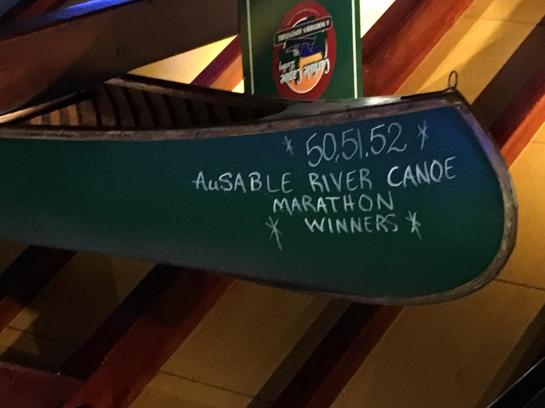
Jay and Ted’s canoe in Spike’s Bar in Grayling
 publicutilitymanagement