As South Park enters its 18th season, I can’t help but think back on all the laughable and teachable moments that it has provided us. While some may think that it is simply a show that tries to be fair by taking equal shots at everyone (there is some truth to that), the greater point…

via The Wit and Wisdom of the Best South Park Quotes — Inspirational Quotes | Motivational Blog | Images | Pictures


This is an interesting article from the Union of Concerned Scientists.  Should we be designing for climate change within our infrastructure systems?  The obvious answer, and the one that the ASCE code of ethics suggests for engineers, is yes.  If you live in a coastal area like me, and where sea level rise is your enemy, the solutions are somewhat clearer.  But what if you are in one of those areas where the future is far less certain?  How do you plan for uncertain, uncertainty?  A new area to study and maybe find a means to address things by thinking outside the proverbial box?


Designing Infrastructure with Climate Change in Mind: Assembly Bill 2800 Becomes Law


Southeast Florida was lucky – little damage, little impact.  Farther up the coast the little eastward wobble on Friday helped folks in Melbourne, but the path of destruction picked up going north.  People were still on the bridges and the beaches in St. Augustine after they were told to evacuate.  Not smart.  The death toll is 21 at the moment – we were lucky it was not worse like in Haiti where it will exceed 500.  Fortunately we have better infrastructure to respond and better warning systems.

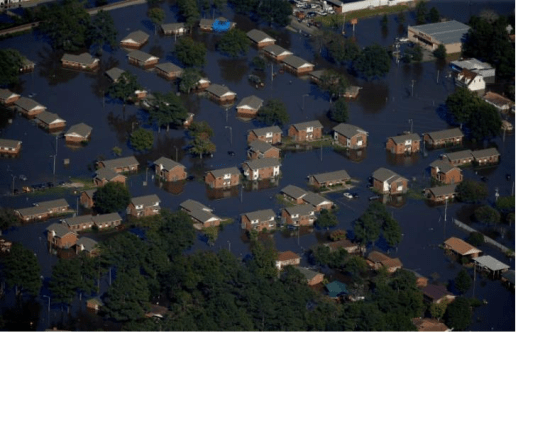
Homes on the beach in Palm Coast has sand inside, but the Carolinas got the brunt of it, much like in 1999 with Hurricane Floyd.  Then they had cows and pigs on roofs of barns to stay dry.  My friends in eastern North Carolina, living in the land of hard red clay and  limited topography, have a situation that will make drainage more difficult, and therefore more costly and disruptive.  Millions are without power.  Some without water.   The situation in Lumberton shows what can happen when vital services like water are not available even for short periods.   The news does not tell us when that system will be back up, but you can see the breakdown occurring in the community as people struggle with basic needs. Our thoughts for quick recovery and safety are with them.

And those of us who were not impacted by this storm despite being being in its path – be really really thankful!!  Talking about us, south Florida!!

From Reuters:

lumberton-2

lumberton


We are currently waiting on Hurricane Matthew, a category 4 hurricane that will be skirting the Florida coast for the next 2 days.  We could get some really big winds out of this.  And lots of power outages and possible water and sewer outages.  The good news, our Florida WARN system is a system where utilities work together to pool assets to help each other.  It is a model system modeled by many others. Tree create the biggest challenge to water viability since most of us have generators.  Sewer is much more dependent on localized power, which is why the FLAWarn system to share generators is a model.  It helps those who are stressed.  The hope is not too many people will be stressed.  Matthew is offshore, a slight eastward movement.  We will see how this affects us.    Meanwhile the models show a loop.  A second Florida hit.  That would be a first.  Let’s hope it doesn’t create more a problem.  Stay Safe out there!!


This is very cool.  Summer of 2015 I was laying in bed in Grand Lake Colorado after a day of hiking around with my wife.  I got an idea for  a short story about a coyote that was old and having trouble keeping up.  I have never written fiction before but typed out the story on the plane ride back.  The entire story is from they coyote’s view realizing he does not understand people, cars, dogs, etc.  So here is the really cool thing – I submitted it to the Rocky Mountain Fiction Writers 2016 anthology called “Found”  and it was accepted as one of the 15 short stories.  So cool!  Here is the link to amazon.

And  the cover:

found-ebook-cover

The signing is October 5 at Union Station in downtown Denver.  My challenge – seeing if I can figure a way around classes etc to get there….  But even if I don’t the anthology is great.  Here is the Denver post link….

Best Bet: Rocky Mountain Fiction Writers’ “Found” locates itself at Tattered Cover


Every water body will be different but in southeast Florida there are a couple options for Lake Okeechobee’s waters.  One option has been in discussion for years – buy back the EAA lands and restore the Everglades flow.  That has two benefits – improved water quality, and less potential for east-west releases.  The downside is cost.  But the sugar industry knows that the muck layer is decreasing and there are plans to develop the EAA into hundreds of thousands of housing units.  That was not the intention in the 1940s when the EAA was created, but trying to stop someone from developing land, especially when the lake communities are challenged economically, is difficult.  Buying the land would remove it from production, but decrease tax revenues.  And it would need to be managed with no guarantee that it would cleaned up quickly.

The alternative?  The South Florida Sun-Sentinel had a front page article that is a little scary.  The figure below is reproduced from that article.  The discussion was if there is no conservation/public purchase of land, Florida may look very different.  The impact of not buying the land is development.  More people.  More taxes.  More stormwater.  The fertilizer does not go away – it now fertilizes lawns and golf courses.  Add wastewater, and human activities.  We find that urban living and farming can have similar impacts from a nutrient perspective.  So development may exacerbate the problem and given that our modeling indicates that sea level rise imperils inland communities from groundwater, this is not a solution to coastal risk.  Given limitations with local governments inland, it may create a larger crisis.  All there things need discussion, but the question is – will the algal issues on the coast improve?

graphic-of-development

http://www.pressreader.com/usa/sun-sentinel-palm-beach-edition/20160916/281479275879132/textviewer worse?


The most important parameters regulating algal growth are nutrient quantity and quality, light, pH, turbulence, salinity and temperature. Light is the most limiting factor for algal growth, followed by nitrogen and phosphorus limitations, but other nutrients are required including carbon. Biomass is usually measured by the amount of chlorophyll a in the water column.  Water temperature influences the metabolic and reproductive rates of algae. Most species grow best at a salinity that is slightly lower than that of their native habitat,  The pH range for most cultured algal species is between 7 and 9, with the optimum range being 8.2-8.7. Through photosynthesis, algae produce oxygen in excess of respiratory requirements during daylight hours. Conversely, during low light or nighttime periods algae respire (consume) dissolved oxygen, sometimes depleting water column concentrations. Thus, high algae concentrations may lead to low dissolved oxygen concentrations.

A common solution for algae is copper sulfate.  Copper Sulfate works to kill the algae, but when it dies, it settles to the bottom of the water body where it becomes a carbon source for bacteria and future algae.  One will often see shallow ponds with rising algae.  But there is significant concern about copper in coastal water bodies.  Copper is toxic to marine organisms so USEPA and other regulatory bodies are considering the limits on copper use.  Such a limitation would severely limit options in dealing with algal blooms near coastal waters.

Mixing is necessary to prevent sedimentation of the algae, to ensure that all cells of the population are equally exposed to the light and nutrients.  So oxygenation can help (it also mixes the water.  The depth of south Florida water bodies is problematic (shallow and therefore warmer than normal).  But oxygen will help microorganisms on the bottom consume the carbon source on the bottom, which might slow algal growth.  Analysis is ongoing.

Two other conditions work against controlling blue-green algae outbreaks: climate change and political/regulatory decision-making.  Lake Okeechobee has routine algal blooms from the nutrients introduced from agriculture and runoff around the lake, which encouraged an artificial eutrophication of the lake years ago.  It continues today.  Warmer weather will encourage the algal blooms in the future.  The decisions to discharge the water without treatment is a political one.  From a regulatory perspective, algae is seen as a nuisance issue, not a public health or environmental issue.  But algal blooms consume oxygen and kill fish, so the ecosystem impact is considerable – it is not a nuisance .


The term algae encompass a variety of simple structures, from single-celled phytoplankton floating in the water, to large seaweeds.  Algae can be single-celled, filamentous or plant-like, anchored to the bottom.  Algae are aquatic, plant-like organisms – phytoplankton.  Phytoplankton provides the basis for the whole marine food chain. Phytoplankton need light to photosynthesize so will therefore float near the top of the water, where sunlight reaches it.  Light is the most limiting factor for algal growth, followed by nitrogen and phosphorus limitations), but other nutrients are required including carbon, silica, and other micronutrients. These microscopic organisms are common in coastal areas.  They proliferate through cell division.

A natural progression occurs in many water bodies, from diatoms, to green algae to yellow/brown to blue-green, with time and temperature.  The environment is important.  Southern waters are characterized as being slow moving, and warm.  This encourages cyanobacteria – or blue green algae.  The introduction of nutrients is particularly difficult as it accelerates the formation of the blue green algae. Blue-green algae creates the bright green color, but is actually an end-of-progression organism.

If cells are present in the water mass in large numbers an algal bloom occurs.  An algal bloom is simply a rapid increase in the population of algae in an aquatic system. Blooms may occur in freshwater as well as marine environments. Colors observed are green, bright green, brown, yellowish-brown, or red, although typically only one or a few phytoplankton species are involved and some blooms may be recognized by discoloration of the water resulting from the high density of pigmented cells.

So the desire for development created the idea to drain the swamp, which led to exposure of dark, productive soil that led to farming, which lead to fertilizers, which led to too much water, and water pollution leading to algae.  A nice, predictable progression created by people.  So what is the solution?


We have all seen the stories about land in the Everglades agricultural Area thissummer.  I was asked to give a presentation at a national conference in Orlando recently about water management in Florida.  It was a fun paper and most of the people there were not from Florida, so it was useful for them to understand the land of water.  Florida has always been a land shaped by water.  Initially it was too much, which frustrated federal soldiers trying to hunt down Native Americans in the 1830s.  In 1881, real estate developer Hamilton Disston first tried to drain the swamps with canals.  He was not successful, but Henry Flagler came through a decade later and constructed the east coast railroad in the 1890s.  It is still there, 2 miles off the coast, on the high ground.  However water limited development so in 1904, Napoleon Bonaparte Broward campaigned to drain the everglades.   Broward’s efforts initiated the first land boom in Florida, although it was interrupted in the 1920s by hurricanes (1926 and 1928) that sloshed water out of Lake Okeechobee killing people and severely damaging property in Miami and around Lake Okeechobee.  A dike was built (the Hover dike – it is still there). However, an extended drought occurred in the 1930s.  With the dike preventing water from leaving Lake Okeechobee, the Everglades became parched. Peat turned to dust, and saltwater entered Miami’s wells. When the city brought in an expert to investigate, he found that the water in the Everglades was the recharge area for the Biscayne aquifer, the City’s water supply.  Hence water from the lake needed to move south.

Resiliency has always been one of Florida’s best attributes.  So while the hurricanes created a lot of damage, it was only a decade or two later before the boom returned.  But in the late 1940s, additional hurricanes hit Florida, causing damage and flooding from Lake Okeechobee prompting Congress to direct the Army Corps of Engineers to build 1800 miles of canals, dozens of pump stations and other structures to drain the area south of Lake Okeechobee.  It is truly one of the great wonders of the world – they drained half a state by lowering the groundwater table by gravity canals. To improve resiliency, between 1952 and 1954, the Corps,  in cooperation with the state of Florida, built a levee 100 miles long between the eastern Everglades and the developing coastal area of southeast Florida to prevent the swamp from impacting the area primed for development.

As a part of the canal construction after 1940, 470,000 acres of the Everglades was set aside for farming on the south side of Lake Okeechobee and designated as the Everglades Agricultural Area (EAA).  However water is inconsistent, so there are ongoing flood/drought cycles in agriculture.   Irrigation in the EAA is fed by a series of canals that are connected to larger ones through which water is pumped in or out depending on the needs of the sugar cane and vegetables, the predominant crops.  Hence water is pumped out of the EAA, laden with nutrients.  Backpumping to Lake Okeechobee and pumping the water conservation areas was a practice used to address the flooding problem.

There was an initial benefit to Lake Okeechobee receiving nutrients.  Older folks will recall that in the 1980s , the lake was the prime place for catching lunker bass.  That was because the lake was traditionally nutrient poor.  That changed with the backpumping which stimulated the biosystem productivity.  More production led to more biota and more large fish.  This works as long as the system is in balance e- i.e. the nutrients need to be growth limiting at the lower end of the food chain.  Otherwise the runaway nutrients overwhelm the natural production and eutrophication results.  Lake Okeechobee is a runaway system – the algae now overwhelm the rest of the biota.  Lunker bass have been gone for 20 years.

The backpumped water is usually low in oxygen and high in phosphorus and nitrogen, which triggers algal progressions, leading to toxic blue-green algae blooms and threaten lake drinking water supplies.  Think Toledo. Prolonged back pumping can lead to dead zones in the lake, which currently exist.  The nutrient cycle and algal growth is predictable.

The Hoover Dike is nearly 100 years old and while it sit on top of the land (19 ft according to the Army Corps of Engineers), there is concern about it being breached by sloshing or washouts.  Undermining appears in places where the water moves out of the lake flooding nearby property.  So the Corps tries to keep the water level below 15.5 ft.  During the rainy season, or a rainy winter as in 2016, that can become difficult. If the lake is full, that nutrient laden water needs to go somewhere.  The only options are the Caloosahatchee, St. Lucie River or the everglades.  The Everglades is not the answer for untreated water – the upper Everglades has thousands of acres of cattails to testify to the problem with discharges to the Everglades.  So the water gets discharged east and west via the Caloosahatchee and St. Lucie River.

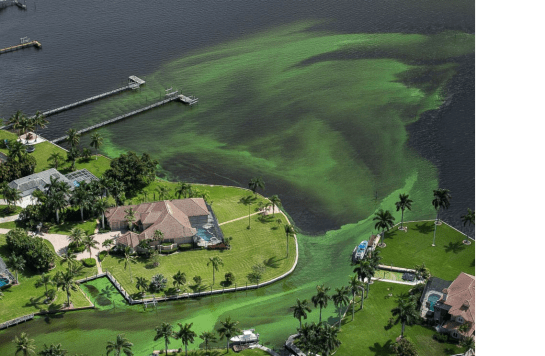
The nutrient and algae laden water manifests as a green slime that washed onto Florida beaches in the Treasure coast and southwest Florida this summer, algae is actually a regular visitor to the coasts.  Unfortunately memories often fail in temporal situations.  The summer 2016 occurrence is reportedly the eighth since 2004, and the most severe since 2013.  The green slime looks bad, can smell bad, kills fish and the 2016 bloom was so large it spread through estuaries on both coasts killing at least one manatee.  One can see if from the air – try this link:


https://www.google.com/search?q=algae+florida+aerial&rlz=1C1CAFA_enUS637US637&espv=2&biw=1194&bih=897&tbm=isch&imgil=-znOtKN1py0w1M%253A%253BR2WKOUpBlkwQUM%253Bhttp%25253A%25252F%25252Fabcnews.go.com%25252FUS%25252Ftoxic-algae-blooms-infesting-florida-beaches-putting-damper%25252Fstory%25253Fid%2525253D40326610&source=iu&pf=m&fir=-znOtKN1py0w1M%253A%252CR2WKOUpBlkwQUM%252C_&usg=__KgNR31PY5qxleBf1KST7DWY2mXo%3D&ved=0ahUKEwiqyKK6uJvPAhWr6oMKHdt7C5oQyjcIKg&ei=QNvfV6qoLavVjwTb963QCQ#imgrc=-znOtKN1py0w1M%3A
 

algae