Archive

Tag Archives: management


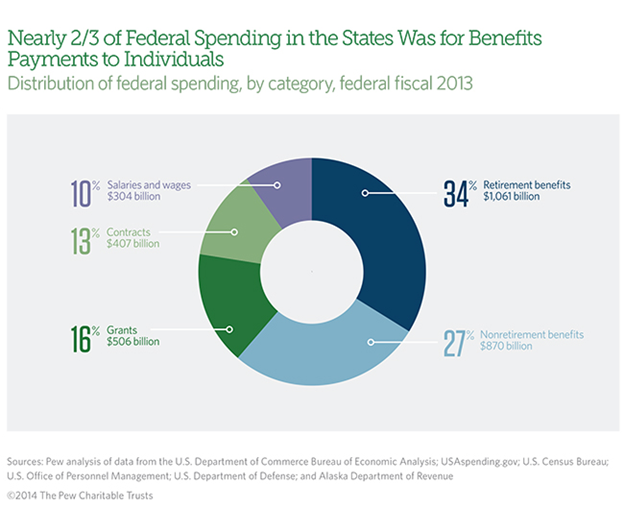
How much money goes to the states from the Federal government? Ever wonder about that? And how do we react? We talk about the need to tighten the federal spending so we keep cutting back on the Superfund cleanup monies ($1 billion/yr), the State Revolving Fund loan system ($2.35 billion/yr), and under $2 billion/yr for clean energy systems. We are concerned about the projected increase of $66 billion/yr for the Affordable Care Act. But these sums are just a tiny component for the federal budget, which is dwarfed by the $3.1 trillion sent to the states during its 2013 fiscal year. So what are these funds? Retirement benefits, including Social Security and disability payments, veteran’s benefits; and other federal retirement and disability payments account for over 34% of these payments. Medicare in another 18%. Food assistance, unemployment insurance payments, student financial aid, and other assistance payments account for another 9%. Another 16% is for grants to state and local governments for a variety of program areas such as health care (half the amount is Medicaid), transportation, education, and housing and research grants. All the SRF and grant monies are in this 16%. Those water programs are barely visible in this picture. Contracts for purchases of goods and services for military and medical equipment account for another 13%, while smallest amount – salaries and wages for federal employees is 10%.  Keep in mind that federal employees have dropped from nearly 7 million to 4.4 million since 1967. No federal employment expansion going on there.

growth in fed payments

fed payments

So how much does this affect the states? Federal funds account for about 19 of the total gross domestic product of the US, a number that has been relatively consistent (within a few percentage points) for years. That is below its all-time highs, and about typical over the past 30 years. Figure 1 from a PEW report shows that federal funds are greater than 22% of the GDP in most southern states (which interestingly enough have the people that complain the most about the federal government intrusion), while the Plains states, Midwest, northeast and the west coast are generally below average, and the two coasts, especially complain the least. Mississippi, Virginia and New Mexico all top 30%.
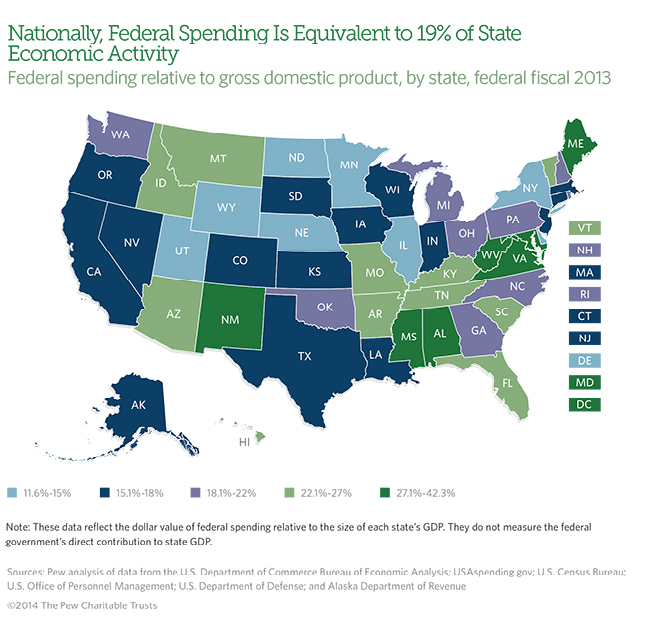
figure nat fed spending by state

So let me see if I have this right – those that pay the least, but get the most, complain the most about their benefactors, and those that pay the most, but collect less, complain less. That is the message! What is WRONG with that picture? And those people? The problem is I see it every day at the local level and it is truly baffling. It means that somehow our politics gotten so out of whack that those in need the most, seem to continue to vote against their best interests? Marketing clearly is a problem but are we fooled that easily. A message that distracts from the reality is obvious, but this continuing trend is just truly weird. No wonder it is so hard to accomplish things.

Most states were doing pretty well before the 2008 recession hit, but that ended in 2009. Most states had to make extremely difficult cuts or raise taxes, which was politically unacceptable. Of course invested pension systems received a lot of attention as their value dropped and long term sufficiency deteriorated, which was fodder for many changes in pensions, albeit not how they were invested. The good news is a lot of them came back in the ensuing 5 years, but 2015 may be different. A number of states have reported low earnings in 2015 and whether this may be the start of another recession. The U.S. economy has averaged a recession every six years since WWII and it has been almost seven years since the last contraction. With China devaluing their currency, this may upset the economic engine. At present there are analysts on Wall Street who suggest that some stocks may be overvalued, just like in 1999. If so, that does not bode well states like Illinois, Kansas, New Jersey, Louisiana, Alaska and Pennsylvania that are dealing with significant imbalances between their expenses and incomes. Alaska has most of its revenue tied to oil, so when oil prices go down (good for most of us), it is a huge problem for Alaska that gives $2200 to every citizen in the state. An economic downturn portends poorly for the no tax, pro-business experiment in Kansas that has been unsuccessful in attracting the large influx of new businesses, or even expansion of current ones. California and next door Missouri, often chided by Kansas lawmakers as how not to do business, outperform Kansas.

Ultimately the issue that lawmakers must face at the state and as a result the local level is that tax rates may not be high enough to generate the funds needed to operate government and protect the states against economic down turns. There is a “sweet spot” where funds are enough, to deal with short and long term needs, but starving government come back to haunt these same policy makers when the economy dips.   It would be a difficult day for a state to declare bankruptcy because lawmakers refuse to raise taxes and fees.


I have a friend in south Florida who is a lawyer who is starting the conversation about farmland for sale.  Ok, in south Florida is might be about 40 years too late, but he has a great argument to make, even here, now.  Developers have paid handsomely for agricultural land near urban areas, especially in areas with nice weather (see Florida).  The problem is that many of those lands have been productive and because they are close to urban areas, convenient for the movement or produce to feed those communities or export the food to other areas.  It would seem obvious that buying food locally would be preferred to buying food from far away, unless you are an Agribusiness or developer that is.  And most family farms have been handed down to generations that, well, just don’t want to work farms, given the amount of money that the land can be sold for.  So it is an easy economic argument to make – sell your farm to developers and live happily ever after.  Except that means farmland that is no longer producing.  And as my friend notes, there is a finite amount of farmland out there and we are decreasing that acreage in the US every year.

Now true, some will argue than development is less water intensive than farms, but much of that argument is due to the traditional practices used for farm watering, as opposed to newer, less wasteful means.  So they argue, development is preferable to farming, but that argument may be limited to areas that are a) water poor  b) bring water in from elsewhere, c) extensively use groundwater which may not recharge, or d) should probably have neither farming or development.  But is Florida, we see fewer oranges, fewer row crops and less ranching than 20 or 40 years ago.  All that land is condos and houses, and our food gets trucked or shipped in from many places, a lot of them not Florida and few local.  He suggests that might not be a good thing for the long term.

Of course Florida is going to be faced with another of these land dilemmas.  When Crist was governor, he negotiated a deal to buy land from US Sugar to help restore water from Lake Okeechobee to the Everglades.  Now the powers say they can’t afford to maintain the land, so US Sugar can keep it.  Of course US Sugar has plans for 100,000 houses in the Everglades Agricultural Area, or more, once farming stops.  I see my friend cringing.  That land, while not beneficial as farmland, surely would be less beneficial and farm more vulnerable as development.  Maybe we should rethink that land purchase?  Worth thinking about anyway.


As technology advances I have an observation, and a question that needs to be asked and answered.  And this could be a pretty interesting question.  Back in the day, say 100 or 150 years ago, there were not so many people.  Many activities occurred where there were few people and impacts on others were minimal.  In some cases ecological damage was significant, but we were not so worried about that because few people were impacted by that ecological damage.  In the 20th century, in urban locations, the impact of one’s activities on others became the basis for zoning laws – limiting what you could do with your property because certain activities negatively impacted others.  And we certainly had examples of this – Cuyahoga River burning for one.  Of course this phenomenon of zoning and similar restrictions was mostly an urban issue because there potential to impact others was more relevant in urban areas.  We also know that major advances in technology and human development tend to occur in population centers (think Detroit for cars, Pittsburgh and Cleveland for steel, Silicon Valley, etc.).  People with ideas tend to migrate to urban areas, increasing the number of people and the proximity to each other.  Universities, research institutions, and the like tend to grow up around these industries, further increasing the draw of talent to urban areas.  The observation is that urban areas tend to have more restrictions on what people do than rural areas.  So the question – do people consciously make the migration to urban areas realizing that the migration for the potential financial gain occur with the quid pro quo of curbing certain freedoms to do as you please?  Of does this artifact occur once they locate to the urban areas?  And is there a lack of understanding of the need to adjust certain activities understood by the rural community, or does it become yet another point of philosophical or political contention?  I have blogged previously about the difference between rural and urban populations and how that may affect the approach of utilities, but read a recent article that suggests that maybe urban citizens accept that financial gains potential of urban areas outweighs the need to limit certain abilities to do as you please to better the entire community.  They are motivated by potential financial opportunities that will increase their standing and options in the future.  So does that mean urban dwellers understand the financial tradeoff differently than rural users?  Or is it a preference issue.  And how does this translate to providing services like water to rural customers, who often appear to be more resistant to spending funds for improvements?  While in part their resistance may be that their incomes tend to be lower, but is their community benefit concern less – i.e. they value their ability to do as they please more than financial opportunities or the community good?  I have no answer, but suggest that this needs some further study since the implications may be significant as rural water systems start to approach their life cycle end.


I am working on a book on engineering ethics. My wife and I were talking about the ethical obligations of engineers and how that compares to the medical industry (which she is in).  Engineers by canon, creed, code and law, have an obligation to protect the public health, safety and welfare above all else, including their clients and their firms.  It is one of the reasons that engineering services provided to the public require a license and why codes exist to help guide design.  My wife recently raised an interesting question – if licensure means that you must protect the public health, safety and welfare, can you sign and seal a project for which the consequences are not perfectly known?  It harkens back to a lecture I do in my summer environmental science and engineering class – the infamous “What could possibly go wrong?” lecture.  In that lecture we look at logging, mining, oil and gas and agriculture.  I should note that we need each of these industries and will continue to need them for the foreseeable future, so abandoning any of them is not an acceptable answer.  But in each case there are large, historical consequences, as well as current ongoing consequences.  Let’s start with logging which fed the rapid development of many cities by providing accessible building materials.  And actually let’s just start in the upper half of the state of Michigan where loggers cut timber across the state for over 50 years, eliminating white pines form many areas.  The logs were sent down small streams and rivers, many of which had to be altered to take the logs.  Rivers like the AuSable and Manistee changed completely afterward (starting with the loss of sweepers, increased siltation, the loss of the grayling (fish), and the need to introduce trout.  Siltation is a difficult issue for water plants to deal with.  Today the AuSable is a “high quality fishing water” with open fishing season, but limits of zero trout kept in many places or only really large fish (rare in cold water), which means catch and release only, which sounds more like – “not enough fish, so put them back” as opposed to high quality fishing waters.    We needed the logs, but the impacts of logging were never considered and 150 years later, we still suffer the effects.  Few engineers were involved.

Next we look at mining.  Again we needed the gold, silver, lead, iron, etc. from the mines.  The gold rushes started in the 1840s and expanded across the west.  Material was dug out, metals processed and mines abandoned.  The tailings from these mines STILL leach metals into waterways.  The metals content remains toxic to ecology and to us in drinking water, and will continue be so for years.  Metals are often expensive to remove via treatment.  Sometimes the situation is serious enough that the federal government will construct treatment plants to protect downstream waters (drinking waters for people), as they have done in Leadville and Idaho Springs, Colorado.  The tailings issue will be with us for years, which is why the mining industry is subject to regulations today.  Maybe we learned something?  Engineers have become more involved with mining with time, but historically, not so much.

With agriculture (Ag) the big issue is runoff and siltation.  Siltation has increases as more property is farmed.  The runoff also contains pesticides herbicides, and fertilizers, which impact downstream ecological sites, as well as creating difficulty for water treatment.  Ag is largely unregulated with respect to runoff and best management practices are often lacking.  The results include dead zones in the Gulf of Mexico and the Pacific.  Engineers try to deal with water quality issues in rivers and streams, but the lack of ability to effect changes with Ag practices is limiting.  There are situations like Everglades where the engineers did exactly what was asked (drain it), but no one asked the consequences (lack of water supply), or the impact of farming north of the Everglades (nutrients).

The Everglades results, along with the unknowns associated with fracking (primarily surface and transport) brought the question to my wife — should an engineer sign off on a project for which the consequences are uncertain, unstudied or potentially damaging the public health safety and welfare, like fracking wells, or oil/gas pipelines across the arctic (or Keystone)?  Engineers design with the best codes and intentions and clearly the goal is to design to protect the public, but she has a great point – when you know there are uncertainties, and you know there are unknowns that could impact public health, safety and/or welfare, or which could create significant impacts, should we be signing off?  I am not so sure.  What are your thoughts?

photo 4IMG_6527 (2015_03_08 17_53_48 UTC)


I am in the initial stages of a project to look at economy of scale, utility bench-markings, asset management and impacts of economic disruption on utility systems. I should note that I am looking for volunteers, so let me know. But an initial question is whether economy of scale still applies. We think it should but given the disparities across the US, does it. As a quick survey, I enlisted several volunteer utilities to provide me with some basic information that I sued to create some ratios. And then we discussed them. The baselines were accounts and cost per millions of gallons produced.  The graphics are shown below. Economy –of-scale is alive and well. That means if you have a small utility, you cannot expect to have the same costs/gallon, or the same rates, as your larger neighbors. If you do, you are probably shoring your maintenance or capital programs. That leads to bigger costs later. Instead of comparing yourself to your larger neighbors, see what happens when you compare yourself to cable and cellphones in your area. You may be surprised.

economy of scale MGY economy of scale cost per MGY


The US EPA estimates that there is a $500 billion need for infrastructure investment by 2025.  The American Water Works Association estimate $1 trillion.  Congress recently passes the Water infrastructure Finance and Innovation Act (WIFIA) at $40 million/year, rising to $100 million in 5 years, which is a drop in the bucket.  Peanuts.  We have so many issues with infrastructure in the US and Congress tosses a few scheckles at the problem and thinks it is solved.  The reality is that the federal government wants to get out of the water infrastructure funding business and shift all water infrastructure to the local level.  This is a long-standing trend, going back to the conversion of the federal water and sewer grant programs to loan programs.

The reality is that local officials need to make their utility system self-sustaining and operating like a utility business whereby revenues are generated to cover needed maintenance and long-term system reliability.  The adage that “we can’t afford it” simply ignores the fact that most communities cannot afford NOT to maintain their utility system since the economic and social health of the community relies on safe potable water and wastewater systems operating 24/7.  Too often decision are made by elected officials who’s vision is limited by future elections as opposed to long-term viability and reliability of the utility system and community.  This is why boom communities fall precipitously, often never recovering – the boom is simply not sustainable.  Long-term planning is a minimum of 20 years, well beyond the next election and often beyond the reign of current managers.  Decisions today absolutely affect tomorrow’s operators.  Dependency on water rates may be a barrier, but this ignores the fact that power, telephone, cable television, gas, and internet access are generally more expensive hat either water or sewer in virtually all communities.  We need water. Not so sure about cable tv or he internet.  Great to have, but needed to survive?

The growth in costs can lead to mergers where a utility cannot afford to go it alone – as the economy of scale of larger operations continues to play out in communities.  Several small plants cannot operate at the same cost as one larger plant.  As a result larger projects will increase – from 87 to over 336 between 2005 and 2014.

But these costs are generally plant costs – treatment and storage, not piping.  Distribution pipelines remain the least recognized issue for water utilities (collection pipelines for sewer are similarly situated).  The initial Clean Water Act and Safe Drinking Water acts did not focus on piping systems – only treatment and supply.  The national Council on Public Works concluded their first assessment grade for infrastructure in the 1980s – but piping was not discussed.  ACSCE’s first report card in 1998 did not express concern about piping system.  Yet piping continues to age, and expose communities to risk.  In many communities greater than 50% of their assets are buried pipes.  Tools for assessing the condition of buried pipes especially water distribution pipes is limited to breaks and taps.  As a result the true risk to the community of pipe damage is underestimated and the potential for economic disruption increases.  The question is how do we lead our customers to investing in their/our future?  That is the question as the next 20 years play out.  Many risk issues will be exposed.  The fact that there are not more issues is completely related to the excellent work done by the utility employees.  More to come….


A past project I was involved  with involved a look at the feasibility of using wastewater to recharge the Biscayne aquifer In the vicinity of a utility’s potable water supply wells.  The utility was feeling the effects of restrictions on added water supplies, while their wastewater basically unused.  So they wanted a test to see if the wastewater could be cleaned up enough to pump it in the ground for recovery downstream, with the intent of getting added allocations of raw water.  Assuming the water quality issues could be resolved, the increased recovery would solve a number of water resource issues for them, and the cost was not nearly as high as some thought.

So we tested and using sand filters, microfiltration, reverse osmosis, peroxide and ultraviolet light, we were successful in meeting all regulatory criteria for water quality.  The water produced was basically pure water – not constituents in it, and therefore it exceeded all drinking water standards.  We demonstrated that technologically the water CAN be cleaned up.  The only issue is insurance that the treatment will always work – hence multiple barriers and the ground.  This was an indirect potable reuse project and ended because of the 2008 recession and the inability to of current water supply rules to deal with the in/out recovery issues.

The indirect reuse part was the pumping of the water into the ground for later withdrawal as raw water to feed a water treatment plant, as opposed to piping it directly to the head of their water plant.   But recovery of the water can be a challenge and there is a risk that a portion of the injected water is lost.  In severely water limited environments, loss of the supply may not be an acceptable outcome.  Places like Wichita Falls, Texas have instead pursued more aggressive projects that skip the pumping to the ground and go straight into the water plant as raw water.  Technologically the water CAN be treated so it is safe to drink.  The water plant is simply more treatment (added barriers).  So, with direct potable projects, monitoring water quality on a continuous basis maybe the greatest operational challenge, but technologically there is no problem as we demonstrated in our project.

The problem is the public.  You can hear it already – we are drinking “pee” or “poop water” or “drinking toilet water.”  The public relations tasks is a much bigger challenge because those opposed to indirect and direct potable projects can easily make scary public statements.   Overcoming the public relations issue is a problem, but what utilities often fail to convey is that many surface waters are a consolidations of a series of waste flows – agriculture, wastewater plants, etc. by the time they reach the downstream water intake.  Upstream wastewater plants discharge to downstream users.   But the public does not see the connection between upstream discharges and downstream intakes even where laws are in effect that actually require the return of wastewater to support streamflow.  So are rivers not also indirect reuse projects? In truth we have been doing indirect potable reuse for, well ever.

We have relied on conventional water plants for 100+ years to treat surface waters to make the water drinkable.  The problem is we have never educated the public on what the raw waters sources were, and how effective treatment is.  Rather we let the political pundits and others discuss concerns with chemicals like fluoride and chlorine being added to the water as opposed the change in water quality created by treatment plants and the benefits gained by disinfectants.  That message is lost today.  We also ignore the fact that the number one greatest health improvement practice in the 20th century was the introduction of chlorine to water.  Greater than all other medical and vaccine advances (although penicillin and polio vaccines might be a distant second and third above others).   Somehow that fact gets lost in the clutter.

Already the Water Reuse Association and Water Research Foundations have funded 26 projects on direct potable reuse.  Communicating risk is one of the projects.  The reason is to get in front of the issues.  You see, playing defense in football is great and you can sometimes win championships with a good defense (maybe a historically great one, but even they gamble).  Defense does not work that way in public relations.  Offense usually wins. Defenses often crumble or take years to grab hold.

The failure of utilities to play offense, and the failure of elected officials particularly support playing offense is part of the reason we struggle for funds to make upgrades in infrastructure, to perform enough maintenance or to gather sufficient reserves to protect the enterprise today.  And it remains a barrier to tomorrow.   Leadership is what is missing.  It struck me that when looking at leaders, what made them leaders was their ability to facilitate change.  Hence President Obama’s campaign slogan.  But talking about change and making real changes are a little more challenging (as he has seen).  You cannot lead without a good offense, one that conveys the message to the public and one that gets buy-in.  With direct and indirect potable reuse, the water industry has not changed the perception of “toilet water.”  That needs to change.  We need to be frank with our customers.  Their water IS SAFE to drink.  They do not need filters, RO systems, softeners, etc., or buy bottled water, when connected to potable water supplies (private wells, maybe).  We CAN treat wastewater to make it safe, and the technology tis available to make it potable.  . The value they pay for water is low.  Yet in all cases, others, have made in-roads to counter to the industry.  That happened because we play defense.


So what does ability to pay really mean?  We hear this discussed by political pundits and local officials but few really understand what this means.  Likewise the “I’m on a fixed” budget argument pops up a lot, and it is hard to understand what this really means.

The ability to pay concept was developed many years ago by political scientists and economists looking at the allocation of costs to consumers for government services.  Property taxes are a logical place to start – higher value homes have more potential for loss, so their taxes were more (the percent was the same but because of their value the amount was higher).  For income taxes, those with higher incomes we deemed to have more disposable income and again more to lose, so the rates increased as income rose (we forget that until 1963 the highest income tax rate was 90%, and the economy was growing quickly!).  People with lower incomes had little disposable income because all their money went to food and housing.  Today the issue of affordability arises with water, sewer, taxes and storm water fees, as well as federal and state taxes.  The SRF and bonding agencies often look at 3.5% or 4.5% and the maximum water or water/wastewater cost as a percent of income, but few  utilities charge this much.  Few water and sewer utilities (combined) approach the cost for power per household, let along the cost of cable or cell phone use for all but the cheapest carriers.  Certainly water, sewer and storm water are essential service, but not so much cable, although there are those who will argue the point.  So somehow the ability to pay issue does not apply to private sector services, but does to essential services, especially when we all know we do not collect enough money to cover significant infrastructure needs on those public works systems?  That just does not make logical sense except in the political world.

Likewise the “fixed income” argument is often applied in tandem.  Fixed income is generally applied to retirees, but let’s not forget that 10% of those in poverty are retirees, but 18% of millionaires are over 65.  But don’t most people have a fixed income – their income is fixed by their employer.  They can change jobs but the argument that younger folks should change jobs if they want to earn more is like telling retirees to go back to work.  There is only so much we can do and only so much income to be earned because few control their income.

So on both counts, the ability to pay argument seems like an argument created to keep public service costs down and prevent the full cost application to many.  The squeaky wheel gets coddled, at the expense of society.  Somehow that is not fairness, and subjects us all to unnecessary risks.  The question is who is going to be the person/group to stand up and say enough?