As technology advances I have an observation, and a question that needs to be asked and answered. And this could be a pretty interesting question. Back in the day, say 100 or 150 years ago, there were not so many people. Many activities occurred where there were few people and impacts on others were minimal. In some cases ecological damage was significant, but we were not so worried about that because few people were impacted by that ecological damage. In the 20th century, in urban locations, the impact of one’s activities on others became the basis for zoning laws – limiting what you could do with your property because certain activities negatively impacted others. And we certainly had examples of this – Cuyahoga River burning for one. Of course this phenomenon of zoning and similar restrictions was mostly an urban issue because there potential to impact others was more relevant in urban areas. We also know that major advances in technology and human development tend to occur in population centers (think Detroit for cars, Pittsburgh and Cleveland for steel, Silicon Valley, etc.). People with ideas tend to migrate to urban areas, increasing the number of people and the proximity to each other. Universities, research institutions, and the like tend to grow up around these industries, further increasing the draw of talent to urban areas. The observation is that urban areas tend to have more restrictions on what people do than rural areas. So the question – do people consciously make the migration to urban areas realizing that the migration for the potential financial gain occur with the quid pro quo of curbing certain freedoms to do as you please? Of does this artifact occur once they locate to the urban areas? And is there a lack of understanding of the need to adjust certain activities understood by the rural community, or does it become yet another point of philosophical or political contention? I have blogged previously about the difference between rural and urban populations and how that may affect the approach of utilities, but read a recent article that suggests that maybe urban citizens accept that financial gains potential of urban areas outweighs the need to limit certain abilities to do as you please to better the entire community. They are motivated by potential financial opportunities that will increase their standing and options in the future. So does that mean urban dwellers understand the financial tradeoff differently than rural users? Or is it a preference issue. And how does this translate to providing services like water to rural customers, who often appear to be more resistant to spending funds for improvements? While in part their resistance may be that their incomes tend to be lower, but is their community benefit concern less – i.e. they value their ability to do as they please more than financial opportunities or the community good? I have no answer, but suggest that this needs some further study since the implications may be significant as rural water systems start to approach their life cycle end.
management
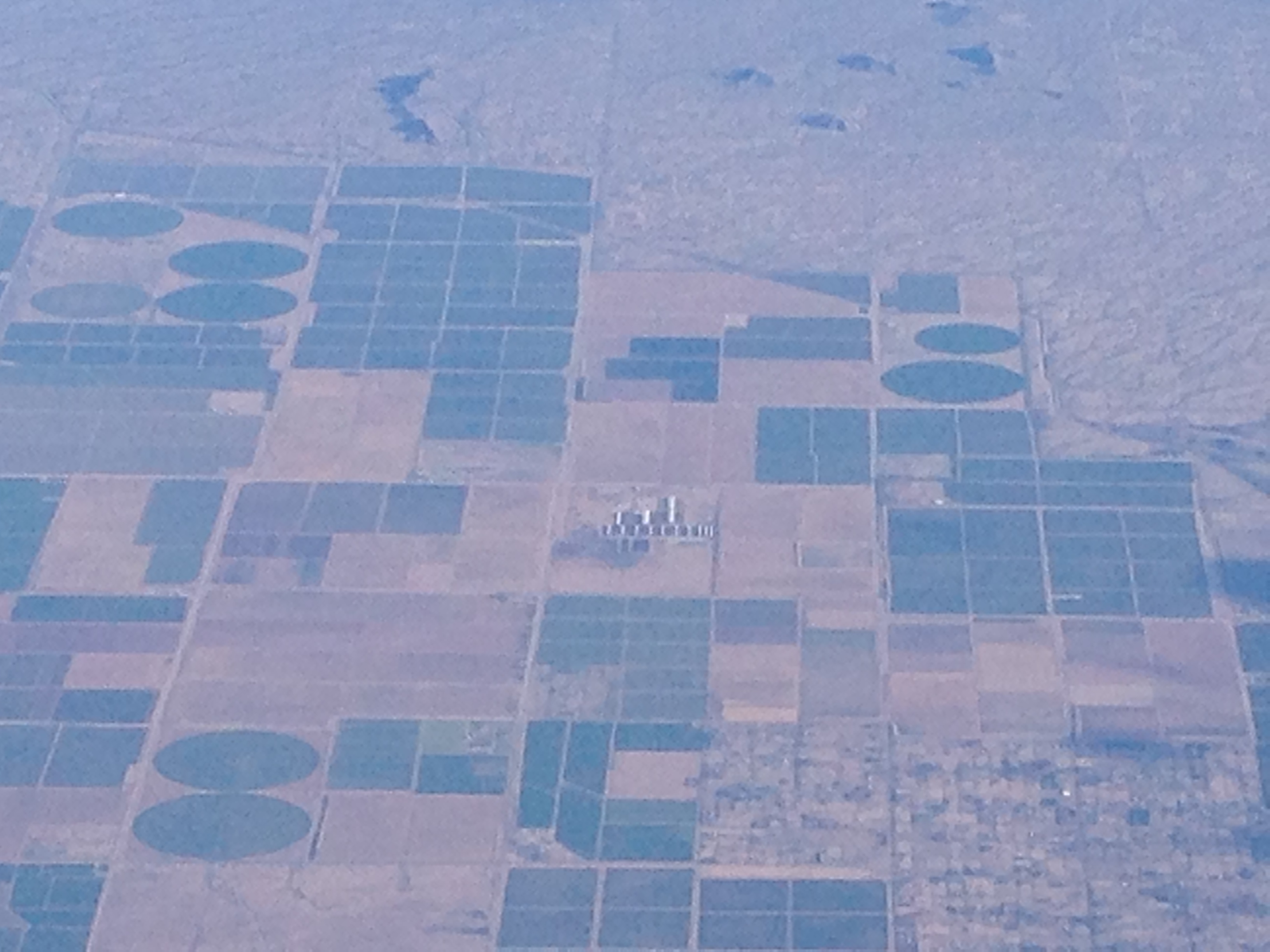
If you were wondering what Unsustainable Groundwater Use looks like
Economy of Scale?
I am in the initial stages of a project to look at economy of scale, utility bench-markings, asset management and impacts of economic disruption on utility systems. I should note that I am looking for volunteers, so let me know. But an initial question is whether economy of scale still applies. We think it should but given the disparities across the US, does it. As a quick survey, I enlisted several volunteer utilities to provide me with some basic information that I sued to create some ratios. And then we discussed them. The baselines were accounts and cost per millions of gallons produced. The graphics are shown below. Economy –of-scale is alive and well. That means if you have a small utility, you cannot expect to have the same costs/gallon, or the same rates, as your larger neighbors. If you do, you are probably shoring your maintenance or capital programs. That leads to bigger costs later. Instead of comparing yourself to your larger neighbors, see what happens when you compare yourself to cable and cellphones in your area. You may be surprised.
Ability to pay?
So what does ability to pay really mean? We hear this discussed by political pundits and local officials but few really understand what this means. Likewise the “I’m on a fixed” budget argument pops up a lot, and it is hard to understand what this really means.
The ability to pay concept was developed many years ago by political scientists and economists looking at the allocation of costs to consumers for government services. Property taxes are a logical place to start – higher value homes have more potential for loss, so their taxes were more (the percent was the same but because of their value the amount was higher). For income taxes, those with higher incomes we deemed to have more disposable income and again more to lose, so the rates increased as income rose (we forget that until 1963 the highest income tax rate was 90%, and the economy was growing quickly!). People with lower incomes had little disposable income because all their money went to food and housing. Today the issue of affordability arises with water, sewer, taxes and storm water fees, as well as federal and state taxes. The SRF and bonding agencies often look at 3.5% or 4.5% and the maximum water or water/wastewater cost as a percent of income, but few utilities charge this much. Few water and sewer utilities (combined) approach the cost for power per household, let along the cost of cable or cell phone use for all but the cheapest carriers. Certainly water, sewer and storm water are essential service, but not so much cable, although there are those who will argue the point. So somehow the ability to pay issue does not apply to private sector services, but does to essential services, especially when we all know we do not collect enough money to cover significant infrastructure needs on those public works systems? That just does not make logical sense except in the political world.
Likewise the “fixed income” argument is often applied in tandem. Fixed income is generally applied to retirees, but let’s not forget that 10% of those in poverty are retirees, but 18% of millionaires are over 65. But don’t most people have a fixed income – their income is fixed by their employer. They can change jobs but the argument that younger folks should change jobs if they want to earn more is like telling retirees to go back to work. There is only so much we can do and only so much income to be earned because few control their income.
So on both counts, the ability to pay argument seems like an argument created to keep public service costs down and prevent the full cost application to many. The squeaky wheel gets coddled, at the expense of society. Somehow that is not fairness, and subjects us all to unnecessary risks. The question is who is going to be the person/group to stand up and say enough?
Infrastructure is Broken
ASCE came out with more bad news about infrastructure. 60 Minutes did a piece about deterioration of bridges. The magazine American City and County has published a couple articles about the risks of aging infrastructure. Asset management is practiced by few governments, and even fewer small ones. The public doesn’t want to foot the bill and lobbyists want taxes cut further. Where does it end?
The infrastructure crisis is a political and business leadership crisis. Or vacuum. The economy of America and much of the developed world was built on advanced (for their time) infrastructure systems constructed by governments with a vision to the future. Some of this infrastructure was repurposed (federal interstate system for example), but much of it has addressed critical issues that hampered our development. For example, the lack of water severely inhibits many third world nations. Even when they have water, it is unsafe to drink or use. In America, at the turn of the 20th century 1:100,000 people DIED each summer from typhoid. Just typhoid, not all the other waterborne disease options. Many more were sick. And the population was much smaller. Talk about reduced productivity. Now we have advanced water systems, disinfection practices that protect people and pipes, and few event get sick from contaminated water. Those that do, become headlines. You don’t want to be a headline. Productivity is up. But we expect good water and can’t see the pipes.
Sewer is an even better example. People just don’t want to know. Flush and it’s gone. But the equipment, treatment and materials may be even more complex than the water system. But few people get sick from sewage because of the systems we have built. Now think about third world examples. Or conditions you have seen in documentaries, the news or movies. Being in sewage is not a great place to be. Even the manhole thriving cockroaches agree..
Stormwater is probably the laggard here, in part because changes in development patterns have overwhelmed the old systems. Miami Beach experienced this when redevelopment replaced small houses on permeable lots with large housed with mostly impermeable property. Oops. Meanwhile road and bridges have received a lot of funding – with much to do (see bridge that collapsed on I-75 in Cincinnati a few weeks back). Most states fund transportation at a magnitude more than water and sewer.
What is the problem? Local officials do not convey an understanding of these complex system to the public very well. In part this may be because understanding the maintenance needs is difficult and highly variable. And many do not fully comprehend the assets they have, their condition, life expectancy or technological needs. No one knows when things will fails, so maintenance or replacement of some equipment or pipeline is always the thing cut in the budget, with no real understanding of the consequences.
The public does not see the asset, assumes it will have a long life, so is unconcerned until they are affected. Then it is personal. The public does not understood the impact or value that these assets have to society – they tend to be personal focused, not societal. That is a leadership issue. That leadership starts with vision and communication from those that understand the issue to the elected officials that need to advocate for their infrastructure. Elected officials need to take ownership of infrastructure. It is like your house – you need to upgrade and protect it constantly. You do not let that roof leak keep leaking! Elected officials that do not invest in infrastructure, are letting the roof leak. Making is someone else’s problem for political expediency is not leadership.
Despite the infrastructure crisis, the good news is that construction of piping is increasing – both new and replacement. Every so many months, the magazine Utility Contractor will note current trends and pipe seems to be going up. That’s good but there is a long way to go. Better news – the construction of buildings is increasing. That could lead to more revenues. In Florida, all of a sudden finding experienced construction workers is a problem. Things are definitely better economically, but are we taking advantage to improve the local infrastructure, or is you economy simply an infrastructure disruption away from another fault?
Fires and Climate Change
The Union of Concerned Scientists reviewed recent wildfires in the west. One of the concerns they raised was that increased forest fires are both a climate change and a man-induced issue. Wildfires on federal land has increased 75% on federally owned land. Fire impacted areas are larger and impact more development which encroaches on those federal holdings. We spend over $1 billion in fire fighting on federal lands each year. But why?
Because many of the forest are in mountainous areas, fire season starts earlier in year with less mountain snowfall. And that is most years as snowfall accumulation decrease. Temperatures are warmer, earlier with shortens the snow season. Water runs off faster. Of course the fact that we altered management philosophies to prevent all forest fires didn’t help because some burning is natural each year. As a result there is a huge reserve of unburned land out west. The beetles did not help either as they left millions of acres of dead trees on mountain sides from Canada to New Mexico. Beetle infestation is clearly climate change driven.
The solutions are more difficult. Building up next to federal land needs to be restricted. Regulations in dealing with trees, bushes and underbrush in fire prone areas need to be enacted and enforced. Early spring fires set as control burns need to happen more frequently. But these are all local responses to a global climate problem. That response is currently lacking. These are leadership issues.
From a utility perspective, this issue may be significant. We like those high, clean mountain streams. But after a forest fire, those streams are often warmer and less clean. The soot, ash and runoff from now barren land can create significant impacts on water plant, create major treatment alterations, increase costs, and risk contamination. A friend some years ago suggested that utilities were instruments of social change. The fact that we have treated water and sewer creates social change. We need to protect water supplies and therefore we should be a part of the conversation on land use. That requires some leadership.
Misconcepted?
There is a recent iPos MORI study that evaluated the perception and reality of issues in 14 western, industrialized countries to determine how well the perception of the populace matched reality. The US was one of those surveyed. No surprise, most Americans’ perception is very different than reality because the news and politics get in the way of the facts. The study found for example that Americans perceived that teenage birth rates were 24 % of girls vs the real number of 3%, that 32% of the population is immigrants vs 13% actual, and that the majority of people perceiving welfare were black vs. the reality of 39% (38% are white and 15% Hispanic). The states with the largest number of welfare recipients are in the northeast, which are also the states that received the smallest amount of federal funding per capita. Talk about misperceptions.
While other countries have similar misperceptions, perpetuating misconceptions is part of the extreme discourse in Congress and among different constituencies. When we perceive the issues incorrectly and our elected officials do nothing to improve that perception? What does that say about them? No wonder we cannot get infrastructure to the top of our funding needs? They perceive if you get water, can drive on it or flush it away, things must be fine?
An Answer: If the assumption of all economists, government officials and investors is that the population must increase exponentially, what does that suggest for our future?
“If the assumption of all economists, government officials and investors is that the population must increase exponentially, what does that suggest for our future?” was a question asked a few days back. Did you ponder this at all? I suggest we should and here is why. An exponential growth rate assumes a certain percent increase every year. That means the increase in population is greater the farther out you go. That doesn’t really make sense except perhaps at one point in Las Vegas (but not anymore). The economy cannot really expand at a rate greater than the expansion of the population because there is no one to buy the goods or increase the demand, which is why increasing the US population is going to be viewed favorably by all politicians regardless what they say today. House values do not increase faster than population increase unless they are in a bubble, nor does the stock market really (inflation adjusted). Your water sales will not increase faster than your system’s population increase for any extended period of time either, so an assumption of ever increasing water sales is likely to be an overestimation sooner as opposed to later. And then what – you have to raise rates, and keep raising rates to keep up because your demands are too low?
And what if your growth stagnates, or goes backwards as many did in 2009/2010? That was a severe problem for most entities, causing layoffs and higher prices, pay cuts and deferral of needed improvements, mostly because no one had reserves because people thought the good times would roll on forever. Layoffs, price hikes, pay cuts and deferral of needed improvements do help society (of course if you had lots of reserves, you weathered the recession without a problem, but too many did not). Keep in mind the repair, replacement, and maintenance needs, along with ongoing deterioration, do not diminish with time or lack of new customers. We have relied on new people to add money to solve old as well as new problems for many years. What is the contingency if growth stops?
So a growth scenario makes us feel better and more confident when we borrow funds. But if growth does not stop, where is the water to come from? What are the resources that will be used faster? Where does the power come from to treat the water or cool the houses? And the cooling water to cool those power plants? Even renewable resources are limited – most metals and oil have likely passed their peaks as far as production and water does not always fall consistently. We have overstressed aquifers and over allocated surface waters, especially in the west. So while growth makes us feel good financially, we need answers to the growth scenario despite the fact that we may have more funding. Many resources are not limitless, but an exponential growth pattern ignores this. Locally growth maybe less of an issue, but society wise? Maybe a societal problem, or maybe we get into extreme completion with each other. Some how that doesn’t look like a solution either
QUESTION TO PONDER FOR THE DAY
If the assumption of all economists, government officials and investors is that the population must increase exponentially, what does that suggest for our future?
Financial Traps for local governments
Some recent reading led me to the following items that seem to crop up when municipalities have fiscal problems that are not otherwise created by the economy or federal or state government decisions:
Assuming high returns of retained earnings (Orange County, CA)
- Pension systems that are underfunded (Portland OR, and others)
- Lack of appropriate financial advisors (many)
- Assuming growth will be exponential
- Failure to address deterioration of infrastructure (many)
- Getting involved in complicated credit swaps and revenues tools involving borrowing (Detroit).
- Declining use by customers that are economically stressed (many)
Food for thought… or caution.